
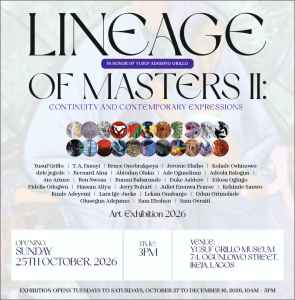
More than a tribute to a celebrated artist, Lineage of Masters II brings together generations of Nigerian artists whose creative journeys reflect the influence of Professor Yusuf Grillo and the traditions he helped establish. Lineage of Masters II: Continuity and Contemporary Expression opens on 24 October and runs until 16 December 2026 at the Yusuf Grillo Museum, Ikeja, Lagos. Dr Kunle Adeyemi, Prof. Dele Jegede and Art critic and historian, Rasheed Amodu, all reflected in their own words about a master of masters.
With reflections by Rasheed Amodu,PhD, Professor Emeritus Dele Jegedé, and curator Dr. Kunle Adeyemi.
Reflections edited by iBAND Magazine editorial team
Yusuf Adebayo Cameron Grillo born in 1934 and passed away in 2021, left more than paintings behind. His influence lives in the artists he taught, the cultural identity he championed and the generations still finding their own ways of expressing what Nigerian art can be.
The erudite scholar was born in the Brazilian quarters of Lagos, where he drew inspiration from Yoruba culture and his immediate environment. After graduating in Visual Arts from the Nigerian College of Arts, Science and Technology in 1960, he became part of the Zaria Art Society, that had his contemporaries such as Uche Okeke, Bruce Onobrakpeya, Demas Nwoko and others, whose members challenged colonial art education through Natural Synthesis, bringing indigenous Nigerian themes into conversation with European techniques.
Grillo, known to have developed a distinctive style, and recognised for its elongated figures, carefully balanced compositions and characteristic use of colour. His work extended beyond painting to sculpture, murals and stained glass, while Yoruba attire and cultural traditions remained central to his artistic expression.
Through his teaching at Yaba College of Technology and his leadership as pioneer president of the Society of Nigerian Artists, he helped shape Nigerian art and influence generations of practitioners.
Five years after his passing, Lineage of Masters II: Continuity and Contemporary Expressions brings these questions of artistic inheritance and cultural identity into focus.
In his foreword, Grillo’s Apotheosis, Professor Emeritus Dele Jegedé of Miami University, Ohio, describes Grillo’s continuing influence as the “Grillo Mystique”. His reflection considers how Grillo’s teaching reached beyond the classroom, encouraging artists to develop their own creative languages rooted in indigenous sensibilities. The aim was never to produce artists who would copy the master, but practitioners confident enough to explore their own directions.
Art critic and historian Rasheed Amodu similarly examines the ideas behind Grillo’s work, particularly his ability to connect modernism with Yoruba visual traditions. His reflection reminds us that Grillo’s importance lies not only in the works he created, but also in the artistic philosophy he helped establish and pass on.
Curator Kunle Adeyemi builds on this conversation in his curatorial note. He describes lineage as a connection between generations that allows inherited knowledge to be re-examined and transformed. The participating artists are not expected to repeat Grillo’s achievements. Rather, their work offers an opportunity to see how ideas associated with an earlier generation continue to find expression in contemporary practice.
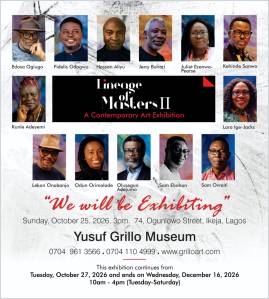
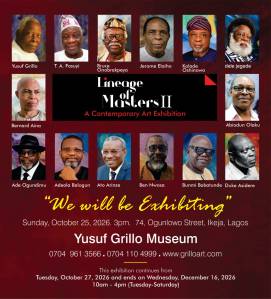
The exhibition features 24 artists who, in Dele Jegedé’s words, have come under the influence of the “Grillo Mystique”. They are Jerome Elaiho, Kolade Oshinowo, Dele Jegede, B. A. Aina, Abiodun Olaku, Ade Ogundimu, Adeola Balogun, Ato Arinze, Ben Nwosa, Bunmi Babatunde, Dotun Adegbite, Duke Asidere, Edosa Ogiugo, Fidelis Odogwu, Hassan Aliyu, Jerry Buhari, Juliet Ezenwa, Kehinde Sanwo, Kunle Adeyemi, Lara Ige-Jacks, Lekan Onabanjo, Odun Orimolade, Olusegun Adejumo, Sam Ebohon and Sam Ovraiti.
Separately, the exhibition also features three members of the Zaria Art Society: Yusuf Grillo and T. A. Fasuyi, both deceased, alongside Bruce Onobrakpeya. Their inclusion brings another dimension to the exhibition, linking the history of the Zaria generation with the artistic conversations continuing today.
The establishment of GRILLOArt Limited and the Yusuf Grillo Museum at the artist’s former residence on Ogunlowo Street, Ikeja, provides another dimension to this effort. Led by his family, the project seeks to preserve his artistic estate and keep his contribution accessible to artists, students, researchers and the wider public.
For Adeyemi, preserving an artist’s legacy is not simply an act of remembrance. It is a commitment to keeping the work, ideas and cultural knowledge available for future generations. In this sense, the museum and exhibition serve as meeting points between history and contemporary artistic practice.
Lineage of Masters II is more than a tribute to Yusuf Grillo. Through the reflections of Amodu, Dele Jegedé and Adeyemi, it invites audiences to consider what happens when a master’s ideas outlive him and are taken up by artists who bring their own experiences and perspectives to the conversation.
Grillo’s legacy is not secured by asking the next generation to become him. It lives on when artists draw from the cultural foundations he valued and use that knowledge to explore new creative territories.
Lineage of Masters II: Continuity and Contemporary Expressions opens on 25 October 2026 and runs until 16 December 2026 at the Yusuf Grillo Museum, Ikeja, Lagos.
With reflections by Rasheed Amodu, Professor Emeritus délé jẹ́gẹ́dẹ́, and curator Kunle Adeyemi.
iBAND Magazine, Celebrating Visual Art from the Original.
Africa | Visual Art | Lifestyle | Culture

