
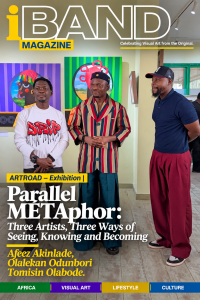
If the highly revered Chief Newton Jibunoh, the founder of Didi Museum, Lagos, had been in town and not in his ancestral home at Asaba in Delta State, he would have wanted to be physically present at Parallel METAphor exhibition. This exhibition by young, enterprising and ambitious three young men held between 12th to 21st September 2026, brought that nostalgic experiences personally shared by Chief Jibunoh in his expedition series and environmental campaigns. It is just simple that there is a connection between him and the three young artists at Didi. The line they share is how ambitious the young artists are in their muses the same way he was in 1964 when he embarked on his first expedition trip at just aged 28.
Words Ireho Aito | Don’t Keep Your Art in the Finger! Photographs credit Nasiru Ahmed of NA. Studios
What a presence to behold at the opening reception of the exhibition Parallel METAphor, a group exhibtion of paintings and drawings by Afeez Akinlade, Olalekan Odunbori and Tomisin Olabode.
The masters, lecturers and mentors, actually came out to support the emergence of three artists who have started reshaping the way we think as appreciate efforts on canvas through their specific mediums.
The roll call was huge and brilliant. Masters such as advertising guru and artist of international repute Wande George, Dr. Adeola Balogun, Yabatech lecturer, definitely one of their teachers. Adeola Balogun PhD, is a renowned sculptor known as a first class artist who has been able to redesign the city of Lagos with many of his public commissions. The Prince of the Niger Delta, Timi Kakandar, a prolific painter, sculptor and mixed media artist was on standby to support as well. Sola Olumuyiwa, the king of watercolour whose is currently having an exhibition at Mydrim Gallery titled Echoes of the Commute was present. One of Sola Olumuyiwa’s watercolour work “The King’s Arrival” holds the record of the largest watercolour work in Nigeria at the moment. His presence was impactful to the audience.
Renowned culture advocate and retired journalist Jahman Anikulapo was also in attendance at Didi Museum. Who else was not there? Lagos turned out for Parallel METAphor.
Even guests and collectors from conservative careers such as Medicine and global health consultants such as Dr. Sobamowo was present. The presence of young people, young minds were in large turn out to make the opening reception talk of the town.
The list was élan which definitely showed the road to mentorship has been rewarding for the three firebrand artists. The presence of established figures, art enthusiasts and collectors made the gathering more than an opportunity to view paintings. It created room for conversations between generations, artistic practices and different ways of understanding art.
The three artists dwelt with spirituality, childhood and education, destiny and the has a that wears it. They interpreted in colours life and language. The offered an opportunity to consider all three, bringing together Afeez Akinlade, Olalekan Odunbori and Tomisin Olabode, three young artists whose works approach the human experience from different directions. They all graduated from the prestigious Federal College of Technology Lagos.
Curated by another young and vibrant Patrick Odimnfe, who revealed that Parallel MÉTAphor takes its name from two ideas that meet without necessarily becoming the same. MÉTA draws from the Yoruba word mẹ́ta, meaning three, while metaphor describes how one thing can illuminate another. The title provides a fitting entry into the practices of the three artists. Their works do not tell one story, yet each offers something through which we may better understand the other.
For Afeez Akinlade, the starting point is childhood and the question of where learning truly begins. His paintings place children within two familiar environments: the classroom and the playground. One represents formal education, with its structure, curriculum and recognised methods of teaching. The other opens onto the everyday experiences through which children learn to communicate, negotiate, imagine, cooperate and understand their place among others.
Akinlade’s interest goes beyond the familiar image of children at play. He asks us to consider what happens outside the classroom and whether the lessons acquired through friendship, family, neighbourhoods and ordinary encounters receive the attention they deserve.
In his artist’s statement, he explains that play is not an interruption to learning but a formative space where children encounter the world through interaction, imagination and experimentation. It is an important distinction. A child may learn to read and write in school, but the experiences of growing up also teach patience, independence, cooperation and how to live with other people.
His paintings place these two forms of learning alongside each other rather than suggesting that one must replace the other. The muted tones and brighter colours also bring childhood memories into the conversation, reminding us that what we experience early in life can continue to shape us long after those moments have passed.
Afeez Akinlade creatively took us back to our favourite Children’s Workshop Television Series known as “Sesame Street,” where education and experiential knowledge are aired through human and cartoon characters to young audience.
At the exhibition, his works were interpreted in mixed media on canvas with works such as The Weight We Carry Together” that shows the typical street play among children, pushing their toy – vehicle all together, The Journey of A Thousand Miles, Echoes in the Olive, Education Under Constraints, Brotherhood in Progress, Little Mechanics, and Ferrari on Dust. These works are our reality as we all in one way or the order lived through them.
While Akinlade looks at how the individual begins to learn, debonair looking Olalekan Odunbori turns towards the idea of the self and the forces that shape an individual’s journey.
His body of work, Ori: The Sacred Crown, draws from the Yoruba understanding of Ori, the spiritual essence associated with character, destiny, personal choices and direction in life. The head, hair and adornment become central to his exploration of identity, beauty and cultural expression.
In the Pop – Culture cap wearing Odunbori’s paintings, hairstyles are not merely decorative details in his approach. Braids, coils and sculptural arrangements become extensions of the personalities they frame, taking on the appearance of crowns. His use of saturated colours, including purple, green, red, orange, yellow and blue, gives the figures a distinctive presence, while the surrounding landscapes and Yoruba-inspired textile patterns connect them to wider questions of memory, heritage and belonging.
Olalekan Odunbori explores his work through Acrylic, charcoal and gold leaf on canvas. And he experimented these mediums on notable works like Crown of Becoming, that shows a mother and her daughter, both sitting to accommodate one another in the picture but special focus was the gold leaf hairstyles on their heads.
Other works include In Her Own Time, The Crown Within, Ori To Ke- A Head Worth Cherishing, Ori Ade, The Head Destined To Wear The Crown, Crowned in Beauty, Her Golden Crown, She Carries Her Heritage, She Blooms, A Grace of Her Own, Beauty in Full Bloom, Ewatomi – Beauty is Enough For Me, and Afro Beauty. Many of his paintings revealed the power of tenacity in him as they are done between 2023 and 2026.
There is a relationship here between what we see and what remains unseen. A person’s appearance may attract attention, but it cannot tell the whole story of that person’s life, ambitions or destiny.
The Yoruba saying “A ń jọ̀ọ́rin, a ò mọ̀ orí ọlọ́wọ́” speaks to this difference. People may walk together, share experiences and appear to follow similar paths, yet their individual journeys and fortunes are not necessarily the same.
Odunbori’s portraits bring this thought into view. The adorned head becomes both a crown and a reminder that every individual carries a distinct identity and must find a way through life.
For Tomisin Olabode, the third person in the group, he approaches the human experience from another direction. For instance, in The Architecture of the Gaze, he explores the relationship between the face, recognition and perception. His portraits begin with real people, but he does not seek to reproduce their likenesses in the conventional sense. Instead, he breaks faces into forms, alters proportions and uses colour to create images that remain recognisable while moving away from photographic realism.
The eyes and nose often serve as the structural points around which his portraits develop. The eyes, in particular, command attention, creating an encounter between the person in the painting and the viewer standing before it.
This changes the question we bring to portraiture. Rather than asking only who the person is, Olabode invites us to consider how we see that person. What do we notice first? How much of our understanding comes from appearance, and how much is shaped by our own experiences, memories and expectations?
These are interpreted by using Acrylic on Canvas, Coffee, charcoal and acrylic as his mediums with works like In the Garden of Self, Blooming Reverie, Man On Dreads, GenZ on Purple Hair, Portrait of General Aminu, African Glamour, Chief Inspector, Red Elegance, and Mr. Lecturer to mention a few.
His use of bold colours, simplified planes and unexpected proportions makes the act of looking part of the experience of the work. The face becomes more than a representation of an individual; it becomes a meeting point for observation, memory and imagination.
Olabode’s engagement with other artists’ visual languages also raises questions about influence and originality. An artist learns by looking, experimenting and finding ways to translate what has been encountered into a personal language. In these portraits, that process becomes part of the journey towards discovering what a face can communicate beyond its physical features.
Placed alongside Akinlade’s exploration of childhood and Odunbori’s interpretation of Ori, Olabode’s portraits complete a conversation about how we learn, how we become ourselves and how we perceive others.
The three artists may not arrive at the same conclusions, but their differences are precisely what give the exhibition its character.
Just as we are wrapping up this journey of the three awesome firebrand, legendary painter and president of Guild of Fine Artists, ever presence Duke Asidere, captured the scene in his studio on a September when Tomisin, Afeez and Olalekan, visited him at his studio and they all had a lot to talk about. Asidere, an entertainer and teacher with humour recalled how the sat together, three talented artists on a quiet morning somewhere in Lagos in an artist studio.
He confessed they probed the art systems and practices. Three young men decided to speak with an older man. It happened to be fun, engaging with large and loud dreams from the three young men. He recounted it was an interview – type of questioning. Duke stated he wanted to hear the deep thoughts that went before their explorations on canvas. And he eventually did. He is proud of their movement right from their Yabatech days to mentoring period and standing tall to define their technique and channel their patterns to fruition.
iBAND Magazine, Celebrating Visual Art from the Original.
Africa | Visual Art | Lifestyle | Culture

