
Our feature on Don’t Keep Your Art in the Finger! continues with one of Nigeria’s most thoughtful sculptors, Olusegun Emmanuel Mokayi. This is a man whose career proves that artistic destiny sometimes arrives through disappointment rather than design.
Words: Ireho Aito | Don’t Keep Your Art in the Finger! Photographs and images courtesy Olusegun Mokayi archives
 Wood speaks long before Olusegun Emmanuel Mokayi touches it. In his hands, mahogany is more than timber. It becomes a memory and history that serve as a witness to communities whose traditions are quietly disappearing. The rhythms of women weaving cloth, the patience of village artisans, the wisdom preserved in old proverbs and the resilience of ordinary Nigerian life are the muses that continually shape his sculptures. Every incision into wood is an artistic decision, but it is also an act of cultural preservation.
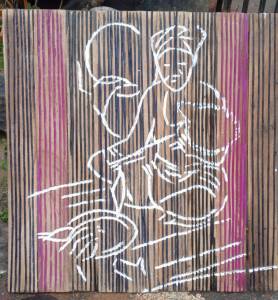
The remarkable thing about Mokayi is that he did not inherit sculpture. He is not from a family of sculptors. Neither was he born into a lineage of celebrated artists. His journey emerged from curiosity, observation and an openness to life’s unexpected turns. Rather than following a family tradition, he built one of his own, patiently carving a path that has earned him recognition as one of the distinctive voices in contemporary Nigerian sculpture.
 Today, Olusegun Emmanuel Mokayi is a respected sculptor, educator and scholar. Born in Ibadan in 1962 and hailing from Igarra in Akoko Edo Local Government Area of Edo State, he earned his Higher National Diploma in Sculpture at Yaba College of Technology before obtaining a Bachelor’s degree in Art Education (Sculpture) from the University of Nigeria, Nsukka, and a Master of Fine Art degree in Sculpture from the University of Benin. A doctoral candidate at the same university, he also heads the Art Education Department at the School of Technical Education, Yaba College of Technology, in affiliation with the University of Nigeria, Nsukka, Epe Campus. His academic accomplishments, however, reveal only one side of his story.
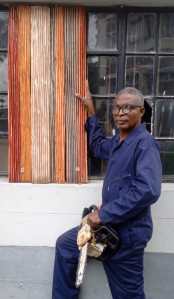
Who would have believed that long before galleries, exhibitions and university studios became part of his life, Mokayi imagined himself in a courtroom. He wanted to become a lawyer. The black suit and the traditional barrister’s wig represented the future he believed was meant for him.
He pursued that ambition relentlessly, writing matriculation examinations repeatedly. He passed the required subjects, yet admission remained elusive because of the quota system affecting him as an indigene of the former Midwest, later Bendel State. The greatest disappointment came in 1983. His name appeared on an admission list, filling him with hope. Two months later, when he returned to complete registration, it had disappeared.
“The straw that broke the camel’s back was in 1983 when my name appeared on the admission list, feeling fulfilled this time. Only for me to come back two months later for proper registration but to my dismay my name was no more on the list. I was lost and short of words, Mokayi recalls with an alarming look.”
The experience left him devastated. Like many young Nigerians confronted by closed doors, he began asking difficult questions. What could he naturally do? Agriculture appealed to him, but he lacked the science subjects. Zoology suffered the same fate. Theatre Arts briefly attracted his attention. Music followed, leading him to observe rehearsals by Nigerian Army military bands. Yet none of these possibilities truly settled in his heart.
“I thought of Agriculture, but I didn’t do science subjects. I also considered Zoology, but I still needed science subjects,” he says. Theatre Arts briefly appealed to him. Music followed, and for a while he spent time watching Nigerian Army military bands rehearse. “I just didn’t like the style of music anymore,” he says with a smile.
Then came the encounter that changed everything.

At a museum in Jos, Mokayi watched a traditional woodcarver pick up what seemed to be an ordinary piece of discarded timber. Before his eyes, the craftsman transformed scrap wood into a beautiful sculpture.
“I opened my mouth in awe and fell in love with the art,” Mokayi recalls.
It was a moment of revelation. The young man who had dreamed of courtrooms suddenly discovered another language through which ideas, emotions and history could be expressed.
The journey was still far from easy. During an apprenticeship, he met students from Ahmadu Bello University, Zaria, who explained what was required to study Fine Art formally. They were surprised to find someone with seven credits already learning in a studio.
“I was told I needed to have five credits. I told them I have seven.”
Surprised to find someone with such qualifications apprenticing in a workshop, they encouraged him to sit for the required art subjects and pursue formal training in Fine Art.
Building on that encouragement from the students, he sat for the necessary art subjects and pursued admission into an art programme. What had begun as fascination gradually became vocation.
Leaving secondary school, Olusegun Emmanuel Mokayi seemed destined for a conventional path. His father, eager to see his children become financially independent, was prepared to secure jobs for them, and the young Mokayi gladly accepted the opportunity. In 1983, he began working as a clerk in Niger State, earning a monthly salary of ₦100. Rather than spending his modest income, he carefully saved it, determined that one day it would finance his further education.
Looking back, it is tempting to see the quiet significance of his second name, Emmanuel that means “God is with us.” Mokayi’s life was unfolding in ways he could neither predict nor control. The dream of studying law had faded, yet every disappointment seemed to position him for another opportunity. His modest earnings, his unwavering discipline and his refusal to abandon the pursuit of education reflected an inner conviction that his story was still being written. Years later, those seemingly ordinary moments would become part of an extraordinary artistic odyssey, one in which providence often appeared disguised as chance.
Mokayi realises that the seeds had been planted much earlier. As a young boy, he had watched a traditional sculptor with no formal education work from his mother’s compound. The sculptor often trusted him to watch over the workshop while he stepped away. At the time, they were ordinary childhood moments. Years later, they became part of a larger story. Inspiration had been quietly waiting long before he recognised it.
That providence revealed itself in an unexpected encounter. Music was part of Mokayi’s first creative passion, and his fascination with musical instruments led him to seek the guidance of an American expatriate named Harold Patterson. Hoping to learn how instruments such as the accordion were made, Mokayi visited Patterson’s residence. Instead of finding only musical craftsmanship, he encountered a house transformed into a gallery, its walls alive with paintings, batik textiles and works by artists from the renowned Osogbo art movement. The experience left a profound impression on him.
“Sensing my young and ambitious Nigerian’s curiosity, Patterson offered simple but life-changing encouragement for me that if I was truly interested, I could create art myself.”
Those few words ignited a creative spark that would eventually redefine Mokayi’s future. What began as a search for knowledge about musical instruments became an encounter with visual art, setting him on the extraordinary artistic journey that would shape his life’s work.
 Over the years, Mokayi has developed a distinctive sculptural language rooted primarily in mahogany and reclaimed hardwoods, often enriched with acrylic colour and mixed-media elements. His practice is defined by bold, stylised figurative forms, rhythmic surface patterns and carefully orchestrated textures that echo the visual vocabulary of traditional African woodcarving while embracing contemporary expression. Recurring motifs in his work include indigenous cloth weaving, women at work, communal labour, folklore, proverbs, musicians, masks and symbols of cultural continuity. Rather than treating these subjects as nostalgic memories, Mokayi transforms them into visual archives that preserve Nigeria’s disappearing traditions and celebrate the resilience of everyday life.
That sensitivity to memory continues to define Mokayi’s artistic practice which also reignited at the recently concluded 12 – man exhibition at Quintessence Gallery titled Endless Possibilities.
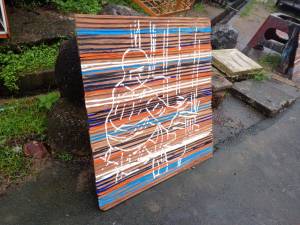
His contribution to Endless Possibilities demonstrated how biography, memory and philosophy converge in wood and painting. The five works he presented were not isolated creations but chapters from the same lifelong conversation about labour, identity, heritage and the enduring wisdom embedded in everyday Nigerian life. Each work translated a lived experience into wood, proving that for Mokayi, the material is only the beginning of the story.
Olusegun presented wood-inspired body of work that reflect his continuing fascination with indigenous knowledge systems and disappearing traditions.
One of the strongest examples is Health is Wealth, executed in Mahogany wood and acrylic. The work celebrates dignity in Labour and happiness among the women whose lives revolved around cotton spinning and cloth weaving. Mokayi remembers participating in aspects of the weaving process himself, observing how cotton was cleaned, spun into thread and transformed into cloth through knowledge passed from one generation to another. To him, weaving represented more than production. It embodied generational wealth, discipline and cultural continuity.
 The women immersed themselves in their craft before taking their woven fabrics to periodic markets held every fifth day. They dressed beautifully for the occasion, sold their products with pride and returned home with goods that improved their families’ lives. Their happiness became part of the story.
Another of his works, Endless Wealth (Proverbs 31:19), executed in mahogany wood and acrylic, pays tribute to the industrious African woman. Borrowing from the biblical portrait of diligence and virtue, Mokayi celebrates hands that create prosperity through honest labour. The work honours women whose strength has long sustained families and communities, suggesting that true wealth is measured not merely by possessions but by industry, wisdom and the ability to pass knowledge from one generation to another.
“When you are happy, it means you are healthy,” he explains.
That celebration of feminine dignity extends into Elegance – Gèlè ò dùn bí ká mọ̀ wé, another mahogany and acrylic sculpture inspired by a popular Yoruba saying. Mokayi reminds viewers that outward beauty achieves its fullest meaning only when accompanied by refinement, character and proper conduct. While the elaborate gèlè remains a symbol of grace and cultural pride, the proverb gently teaches that elegance is ultimately rooted in wisdom rather than appearance alone. Through the sculpture, Mokayi captures both the splendour of traditional adornment and the values that give it lasting significance.
Yet Mokayi also recognises the fragility of this heritage. Industrial production has steadily displaced traditional weaving, making it increasingly difficult for local artisans to sustain both production and income. Rather than merely lament the decline, he documents it through sculpture, ensuring that these stories survive beyond memory.
The story of weaving reaches another profound expression in Threads of Prosperity – Òwú tí Ìyá gbón l’ọmọ ò ràn. Drawing from a Yoruba proverb, Mokayi reflects on the enduring value of inherited knowledge. The artwork suggests that the skills patiently acquired through experience cannot simply be borrowed at the last moment; they must be nurtured across generations. It becomes both a celebration of maternal wisdom and a reminder that cultural prosperity depends on preserving the knowledge passed from parent to child.
Mokayi’s philosophical reflections find perhaps their clearest expression in Truth is Like an Indigo, executed in iroko wood and acrylic. Drawing inspiration from the enduring qualities of traditional indigo dye, the work suggests that truth, like natural colour, penetrates deeply and cannot easily be erased. Beneath its elegant composition lies a meditation on honesty, integrity and permanence, values that continue to resonate in contemporary society despite changing times.
His works are equally notable for their titles. Mokayi frequently draws from proverbs and traditional wisdom, creating names that deepen the spiritual and philosophical dimensions of his Mahogany inspired work. For him, the title is never an afterthought; it is another layer of storytelling that invites viewers to pause, reflect and discover meanings beyond the physical form.
Perhaps that is why his body of wood work possess a quiet authority. They are not simply objects carved from wood. They are conversations between the past and the present, between inherited knowledge and contemporary expression, between personal experience and collective memory.
It was a beautiful moment of reflection when Olusegun Mokayi recounted how some of the wood for his sculptures found its way into his studio. For him, inspiration is not limited to ideas; it is also embedded in the materials that many people overlook. Mokayi has developed a profound commitment to transforming discarded wood into enduring works of art, demonstrating that what society considers waste can be reborn with purpose and meaning.
His philosophy of recycling is rooted in everyday experience. “Working as a civil servant made me see opportunities to recycle abandoned or unused materials,” he explains. “There was a procurement for new furniture, and the old ones were removed and dumped to be discarded. That aroused my attention, and I decided to pack the discarded furniture and recycle them into works of art.”
What others regarded as obsolete office furniture became the raw material for artistic expression. In Mokayi’s hands, discarded wood acquires a second life, carrying fresh narratives while quietly reminding viewers that renewal is often hidden within what has been cast aside.
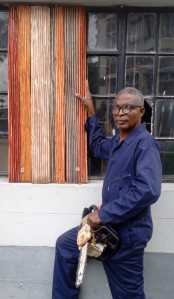
His body of work therefore celebrate not only craftsmanship but also sustainability, resourcefulness and the limitless possibilities that emerge when an artist learns to see value where others see waste.
The irony is impossible to ignore. The man who once dreamed of becoming a lawyer eventually found his true voice not in legal arguments but in wood. Every work he creates stands as evidence that life’s greatest disappointments can become the doorway to its most enduring purpose.
Olusegun Emmanuel Mokayi’s journey has been marked by resilience, providence and quiet perseverance. Whether standing before a block of mahogany or preserving the fading memories of Nigeria’s weaving traditions, Mokayi’s art reflects a belief that every setback can be transformed into purpose. In many ways, his sculptures, paintings and teachings, all embody the reassuring spirit of his name, remaining present, enduring and hopeful, while reminding collectors and patrons that even ordinary pieces of wood can reveal extraordinary stories when guided by patient hands.
Endless Possibilities, a group exhibition of 12 artists at Quintessence Gallery in Lagos ended on the 1st of August 2026.
iBAND Magazine, Celebrating Visual Arts from the Original.
Africa | Visual Art | Lifestyle | Culture


A
wesome. Keep it up Mr Mokayi. The sky is just your stepping stone.
LikeLiked by 1 person