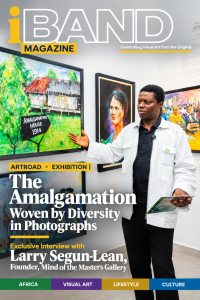
The amalgamation story of 1914 came alive again with a commemorative exhibition organised by The Mind of Masters Gallery titled The Amalgamation – Woven in Diversity, inside Art Hotel, on Victoria Island, Lagos. Another island that was part of the story of Lagos, where history, art and culture continue to meet in ways that invite us to look back at the events that shaped Nigeria to realised we are woven by diversity. The exhibition opened on the 1st of October and will run till 31st of October 2026
Words Ireho Aito | Don’t Keep Your Art in the Finger! Photographs courtesy Mind of the Masters Creative Gallery
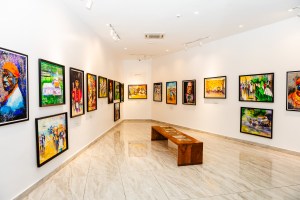
The exquisite Art Hotel was abuzz on Independence Day as Nigeria clocked 66 years old on October 1st 2026 after gaining independence on October 1st 1960. Before the nationalists movements engineered for independence, the path to nationhood was mired with divergent routes. Nigeria’s Juju music maestro King Sunny Ade and Various Artistes aptly titled song of unity – ‘Kajogbe’ which literally means, Lifting Together, that hums with sonorous voices beautifully in the gallery as visitors tried to enjoy the over 30 artworks, was actually the rich and right song for such an event on Independence Day celebration.
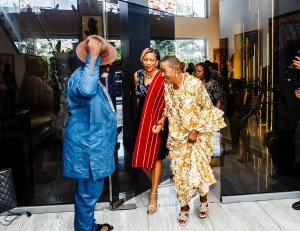
The song was done in the 1990s to bring Nigerians together as we have been woven by diversity from the lyrics that brought over 20 musicians, King Sunny Ade, Dan Maraya Jos, Orlando Owoh, Chales Oputa, known as Charly Boy, Funmi Adams and others illustrious musicians inside one studio to record a song of unity that has stood the test of time.
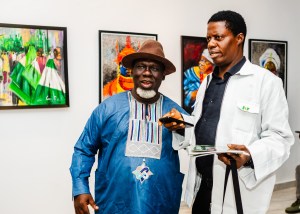
Mind of the Masters Creative Gallery organised this commemorative exhibition for Nigeria’s independence anniversary, to look back with the same burning national question of where are we 112 years after that amalgamation declaration.
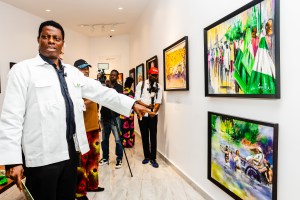
At the heart of the exhibition is Lenri Preks, whose artistic engagement with history gives these subjects a visual language. An alumnus of Auchi Polytechnic, where he graduated with a distinction in Painting, Preks brings an artistic perspective to a subject that can easily become confined to dates, documents and classroom accounts. His paintings invite viewers to spend time with the personalities and events, examining how the past has been represented and what its images continue to communicate.
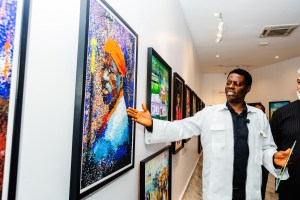
The story begins with the colonial encounter and the trading relationships through which European powers extended their influence across African territories. The works explore the history and tools used by the colonial masters, drawing attention to the systems through which trade, taxation and political authority were imposed on local communities. The transatlantic trade, orchestrated by imperial interests, forms part of this historical account, reminding viewers that the struggle over territory and resources preceded the formal creation of Nigeria.
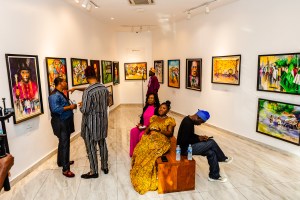
Lord Lugard’s portrait stands out as a significant part of the exhibition’s visual narrative. The artist’s treatment of the colonial administrator gives the portrait a stern appearance, suggesting the determination associated with his mission.
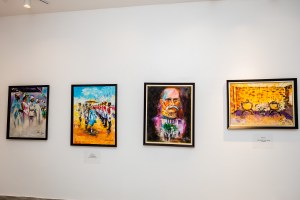
One interesting observation from guests and enthusiasts inside Art Hotel on Nigeria’s Independence Day was the art direction of the body of work on display. The curators, Larry Segun – Lean and Dr. Mudiare Onobrakpeya, arranged the artworks in such a way that observers get transfixed to history that they have read or even experienced without knowing what went behind the scenes until they entered the gallery for the exhibition. Immediately, they got stuck in awe.
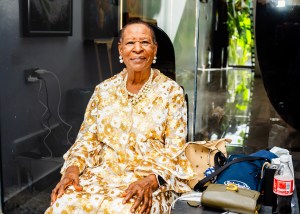
This could be felt from conversations around the room as soon as they saw Lord Lugard’s Amalgamation House 1914, where the amalgamation took place. It was not hurriedly discussed but debated on why it happened in the first place. Just behind the house is the woman that gave Nigeria the name. Flora Shaw became part of history by lending a name that reshaped the two protectorates forever. She suggested the name Nigeria, a name that stayed and built various ethnicities and nationalities in one country proudly called Nigeria today.
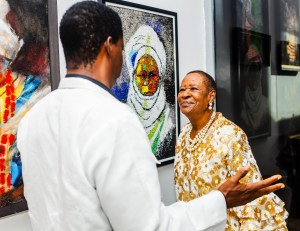
On this Independence Day exhibition, a commemorative exhibition that started from October 1st and will run till October 31st, the vision of Larry Segun – Lean and creative expression of renowned Lenri Preks should be celebrated with the way the Amalgamation Story was woven to diverse audience, old and young, different generations to connect without beating about the gallery. The works were done in 2026.
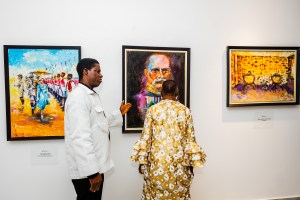
More importantly, Mind of the Masters Creative Gallery was able to take Nigerians down memory lane with the power of commerce and investment of that era. The trading system was displayed where goods and services were the order of the day.
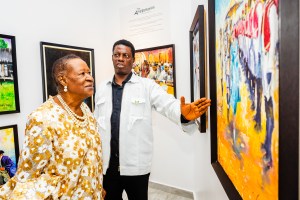
Before the amalgamation, some notable traditional rulers resistance and civil struggles against the white supremacy was important for proper records and Lenri Preks did justice to that from his paintings.
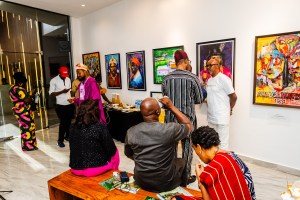
Among the historical figures represented from the illustrious knife of Lenri Preks is King Jaja of Opobo, whose resistance to British imperialism remains an important part of the story. His portrait in the exhibition recalls a period when African leaders challenged the growing power of foreign traders and colonial authorities. King Jaja of Opobo experience offers a perspective on the unequal relationships that developed between African kingdoms and European commercial interests.
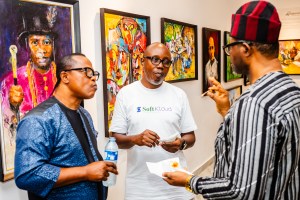
The Oba of Benin, Ovonramwen Nogbaisi, is another important historical presence. His story recalls the confrontation between the Benin Kingdom and British imperial power, including the 1897 British invasion and the eventual exile of the Oba. His inclusion broadens the exhibition’s examination of resistance, showing that the imposition of colonial rule encountered opposition from established African political institutions.
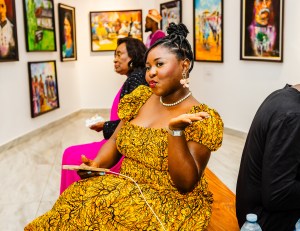
This exhibition does not present colonialism simply as a change of government. It also examines the imbalance of power that defined everyday encounters between the rulers and the ruled. One particularly striking subject is the depiction of colonial officers being carried by local people across forests and streams. The image recalls the physical demands placed on Africans to serve colonial officials and the hierarchy that allowed foreign administrators to move through the country with the labour of local people at their disposal.
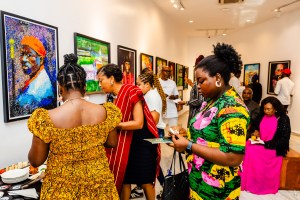
Tax collection also appears in the historical account, reflecting the economic controls through which colonial administration extended its reach into local communities. Together, these works encourage visitors to consider the human cost of a system that often placed the interests of the colonial government above those of the people it governed.
On view from October 1 to 31, 2026, the exhibition invites visitors to look beyond the familiar date of amalgamation and consider the people, interests and struggles that shaped Nigeria’s history.
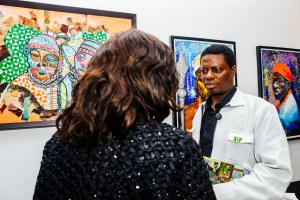
From the events surrounding amalgamation, the exhibition moves towards the growing demand for self-government. The nationalist movement and the contributions of those who challenged British rule form another chapter in the narrative. The works refer to the efforts of Nigerian political figures whose campaigns and public interventions helped shape the country’s journey towards independence.
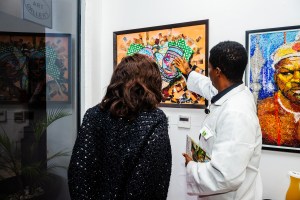
Chief Anthony Enahoro’s place in this history is particularly significant. In 1953, he moved a motion in the House of Representatives calling for self-government for Nigeria in 1956. Although the motion was defeated, it became a defining moment in the independence struggle and intensified the political debate over Nigeria’s future. The exhibition’s reference to the debate and the motion recalls the determination of nationalist leaders to move the country beyond colonial rule.
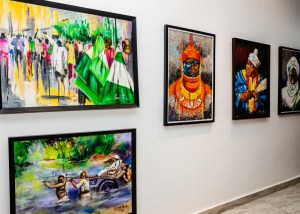
The movement towards independence is presented as a gradual process rather than a single event. The nationalists, their arguments and their political activities form part of a wider story of people seeking to determine their own future. The independence celebrations and the accompanying parade imagery provide a visual connection to the moment Nigeria became an independent nation on October 1, 1960.
The reference to Princess Anne and a ceremonial march parade introduces another dimension to the exhibition’s historical imagery, connecting official ceremonies with the longer relationship between Britain and Nigeria. These visual accounts encourage viewers to examine the symbols and rituals through which political transitions are remembered.
Yet, the central question remains, and that is, what did amalgamation mean for the different peoples brought together under one administration? The title, Amalgamation: Woven by Diversity, suggests a country formed from multiple histories, traditions and identities. The weaving is not necessarily seamless. It carries the memory of imposed boundaries, competing interests, resistance and the continuing search for a shared national identity.
Again, such exhibitions also reflects a long-standing relationship between art and collecting. Larry, who has collected Preks’ works for 30 years, represents the kind of sustained interest through which an artist’s practice can be followed over time. Such a relationship adds another layer to the exhibition, linking the creation of artworks with the people who recognise their value and preserve them.
At Mind of the Masters Creative Gallery, Amalgamation: Woven by Diversity offers visitors an opportunity to revisit a defining chapter of Nigerian history through art. Its account moves from trade and colonial authority to resistance, political debate and independence, placing familiar historical personalities within a broader visual narrative.
For today’s audience, the exhibition raises questions that extend beyond 1914. Nigeria’s diversity remains one of its defining characteristics, but the circumstances under which its different territories were brought together continue to inform conversations about nationhood, belonging and the meaning of independence.
Through the works on display, Lenri Preks encourages viewers to look again at the history behind the nation and reflect on how the experiences of the past continue to shape the country we know today.
Right inside Art Hotel, Ireho Aito for iBAND Magazine, had an interview with Larry Segun – Lean, the founder of Mind of the Masters Creative Gallery about the Amalgamation Story and how we are woven by diversity.
You have brought the history of Nigeria into a hotel on Victoria Island. How did you come about the concept or idea of doing this for Independence Day?
Larry: For me, I love history, and I am a storyteller. Art has to do with storytelling, and Mind of the Masters Creative Gallery, my company, has this vision: how do we enlighten Nigerians, educate our people, and inform our audience? So, we decided to enlighten the people on this auspicious occasion of our 66th Independence Day, to help them understand the journey.
Sometimes, we quarrel among ourselves. A lot of times, we do not even know where we are coming from, or have anyone to tell us the story of ourselves. The amalgamation is how we came together, and we realised that this is something we have to live with. But we can now form a better union with this diversity if we truly understand where we are coming from.
Before 1914, Nigeria had been in existence, but not as Nigeria; rather, as colonies. Lagos was already a colony. It was annexed in 1861 and was already a city-state, thriving in commerce and everything else. Lagos was functioning effectively, with the media, newspapers and a middle class. The city was vibrant.
Until 1900, when the Governor-General appointed by the British, Lord Frederick Lugard, felt that to administer these territories, known as Protectorates, the South and the North, they had to be brought together. They had different cultures. The North was mostly Islamic, while the South was Christian, with what I would call traditional religious beliefs.
To manage these places, the Governor-General felt they had to be brought together. They had to be amalgamated for administrative purposes. The idea of amalgamation was basically for administration: to administer them and ensure they could thrive as one.
There was no referendum and no particular discussion about it. It was done simply for convenience.
However, over time, we have had difficulties dealing with one another. Sometimes, we do not understand one another well as Nigerians.
Yet, here we are, fused together, as the theme of this exhibition says, Amalgamation: Woven by Diversity. We have been woven together, so let us make use of it. Do not forget that we fought a civil war. We do not need to go through that route again. Let it remain in the past.
We have been trying to understand ourselves. Nigeria is a work in progress. Yes, the North has a lot of discordant tunes, just like the South. As we continue to unravel, let us have the mindset that we are going to succeed. It is a project.
You mentioned discordant tunes, and here we have the art. Can art actually liberate everyone?
Larry: When we have information and understand why we do the things we do, it is the beginning of our healing. You begin to understand that the Hausa man does not hate me, or that the Igbo man does not hate me. It is just that we come from different cultures. So, we can understand ourselves by understanding our cultures.
So, this exhibition can serve as a healing process for every Nigerian who believes in the Nigerian project?
Larry: Yes. And we must understand ourselves.
Let us go to the artist. How did you discover Lenri Preks to do this body of work? Did you commission him to produce what we are seeing today, works that look so amazing and reveal our past?
Larry: At Mind of the Masters Creative Gallery, we have some artists, and we engage them with what we want to achieve by executing projects on Nigeria. How do we bring these stories into pictorial form through visual art?
The artists came up with different sketches. I had to let them know my views about the theme and the story of Lord Frederick Lugard. So, they have done the work. The works are still in progress. The exhibition is not exhaustive yet. There are still some landmark works coming out as well.
How many works do you have here?
Larry: Today, we have 33 works in this exhibition.
One can see diversified creative expressions from the artist’s point of view, covering commerce, transportation, tax enforcement, punishments and the instruments of Lord Lugard’s administration. When you look at everything in this exhibition, what can you say about Nigeria’s situation today?
Larry: In Nigeria today, honestly, I would want to give us credit for having done very well. Seriously, it is not easy for a marriage that was not discussed to be seamless. It is not possible to achieve that.
I can only celebrate Nigerians and Nigeria. We have done extremely well by managing ourselves and not being too hard on ourselves. We understand ourselves. That is why we have some works here that have to do with our cultural attires.
I actually believe that we are great people. More than 250 ethnic nationalities have been gathered together, and we have been able to manage ourselves. We must give everybody a sense of belonging and ensure fairness.
You are one of the prominent art collectors in Nigeria. What influences your choices when you are picking an artwork?
Larry: The work has to make sense. Art has to be felt. It is storytelling. Art, whether in cinema, visual art or some other form of creativity, must make sense at all levels.
My collections must have history. I make sure that the art I collect has some history. If it does not have history, I will not know how to relate to it. When the history is challenged, I have to create the history around it.
This series done by Lenri Preks is very special. The body of work is very close to my heart because it talks about our journey as a country. Diverse interests are being formed into unity, where more than 250 ethnic groups, with about 500 languages, are fused together to make a very progressive and dynamic nation.
Artists are said to be the mirror of society. Do you think Nigerian artists are actually projecting the image of society back to us in terms of social commentary and promoting our culture?
Larry: In my opinion, the artists are doing well. We need more education. We need to be taught about art collection, too. Art collection has to be taught. We need to know that art preserves who we are.
Look at what Lenri Preks has done. I know for sure that some people are conforming with these realities for the first time. Some have read about Lord Frederick Lugard’s story somewhere, but now they are seeing it here, coming back to life.
Art is meant to educate us, liberate us, broaden our minds and help us understand that we are one unique human race.
Let me take you to this portrait. Lord Lugard looks very mean. Was that the idea of the artist, or was that who he was during that period or era?
Larry: It was not an easy thing to govern such a system, and you would not look that way without reason. Managing diverse people was not easy. The 1914 amalgamation was a real kind of agenda by the colonialists that was well orchestrated.
Such mannerisms or a tough personality should be expected. It had to happen, or else you would not be able to continue.
So, that means Lenri Preks got it right?
Larry: Yes, excellently. He got it right.
All the works here are collectors’ items. One thing about me as a collector is that once I pick a work, I hardly want to give it out. I have been collecting for more than 30 years.
I believe all of us should collect the works in this room. They are beautiful works done by Lenri Preks. When you collect these works, you are collecting part of history.
iBAND Magazine, Celebrating Visual Art from the Original.
Africa | Visual Art | Lifestyle | Culture

