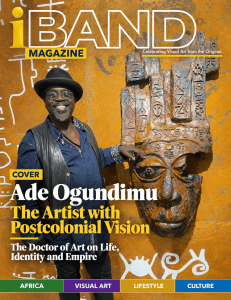
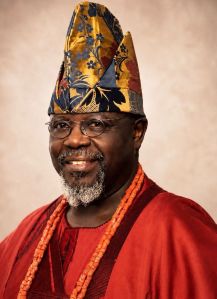
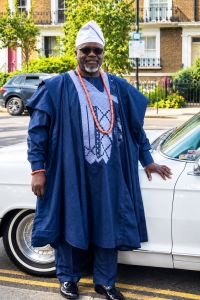
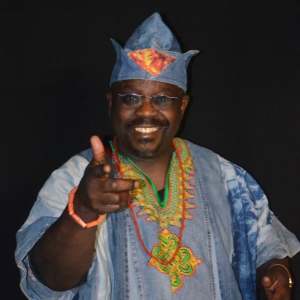
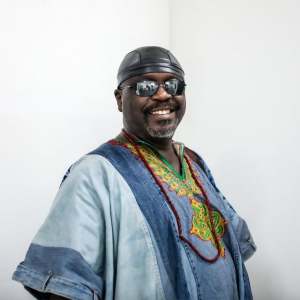
Dr. Ade Ogundimu graces our Cover this week as he is actually the crown whose presence smells royalty. His name is woven around such history of royals. He landed in Nigeria through Apapa port to know that he is a black child.
It was a journey of discovering not just his colour, but also the culture, identity and heritage that came with it. Little did anyone know that this discovery would find expression in an unusual childhood ambition, one that would later become a defining part of his artistic journey.
Yet, when his beloved mother once asked him about the future for him, the young Ade, who at that time had embraced his culture in Nigeria, especially, the masquerade macabre dance and behaviour, he confidently told his mother that a career in wearing such masquerade apparel with a mask would not be a bad idea. His cosmopolitan mother could not believe what she just heard and frowned at him in disdain, telling him, how unserious he was to have wanted to choose such path as a career route. Interesting to reveal that the same Ade Ogundimu is now a master of the art, celebrating his root and culture through creative expression.
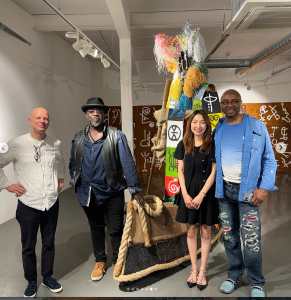
Ade Ogundimu explores various mediums and brings together personal history, migration and the complex relationship between Nigeria and Britain. His art installation, Abeokuta to Willesden, was among the works presented at Waves of Change: Artistic Journeys from Nigeria to Britain, an exhibition organised by the Nigeria Art Society UK (NASUK) at the 1-54 Contemporary African Art Fair at Somerset House in 2024. The work offered a compelling way to consider how individual lives, cultural memory and the experience of migration connect with a much wider history.
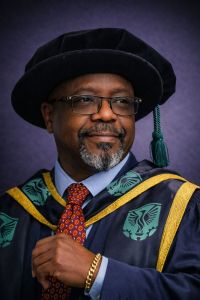
For Ogundimu, art extends beyond the act of making or exhibiting work. It is a means of examining identity, belonging and the legacies of empire, including the historical relationship between Nigeria and Britain. Born in London and trained at Yaba College of Technology in Lagos, he continued his studies in the United Kingdom, earning an MA and a Professional Doctorate in Fine Art through his academic journey at the University of the Arts London, Oxford and the University of East London. His practice brings these different experiences into conversation, addressing postcolonial identity, cultural fusion, anti-Blackness and human rights. Behind the artist is also a scholar whose work invites us to look more closely at the histories we inherit and the societies we continue to shape.
Beyond the works and the ideas they communicate, there is a personal story behind Ogundimu’s artistic journey. His experiences growing up between Nigeria and Britain, his education from Yaba to Oxford, and his life as an artist navigating different cultural spaces have all contributed to the way he sees and interprets the world. What of a day his father drove him to see Professor Yusuf Grillo. A story that changed everything.
In this conversation with Ireho Aito, he reflects on the experiences that shaped his identity, the development of his artistic practice, the realities of finding a place in the British art world, and the historical questions that continue to inform his work. He also speaks about the relationship between art, migration, belonging and empire, offering a closer look at the man behind the art and the ideas that have sustained his journey.
Interview Ireho Aito | Don’t Keep Your Art in the Finger! Photographs courtesy Dr. Ade Ogundimu.
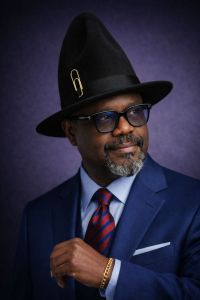
Let’s begin from the beginning, sir. You were born in London, but your story also has a strong Nigerian connection. Take us back to the circumstances surrounding your birth. What took your family to the UK, and what have you been told about that period of your parents’ lives?
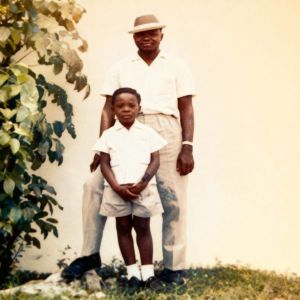
Ogundimu: My parents met in London in the 60s during their student days. They later got married, and I was born after they completed their education. My Dad studied Building and Quantity Surveying while my Mum started studying Nursing and, in her final year, decided it wasn’t what she wanted and switched to Journalism and Public Relations.
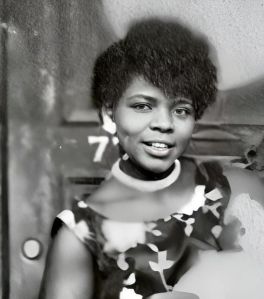
Mum was the Omo Iyawo, that is, the bride’s maid at the wedding of Chief Obafemi Awolowo and Mrs Hannah Dideolu, popularly called HID Awolowo.
Obafemi Awolowo, we would recall was the former Premier of the Western Region and the founder of Tribune newspapers, including a political party known as Unity Party of Nigeria in the second republic.
My mother was related to Mama, as we called her. My father was the second son of a Chief Superintendent of Health in Lagos State. My mother was sent to England by Chief Awolowo, while Dad was sent here by my Grandfather. They both had a swell time in the ‘Rocking sixties’, all expenses paid, so they didn’t need to disrupt their education to look for work. Both parents are now late.
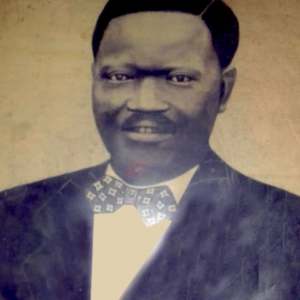
Every family has stories that children grow up hearing, sometimes without fully understanding their significance until they become adults. What stories did you hear about your family when you were growing up?
Ogundimu: Both parents were from royal background. The current Osile Oke-Ona is my uncle, and Mum was from the Moko Ruling house of Ikenne. The current Alakene is from this house. My parents both grew up in Lagos when it was still a friendly and rapidly developing place.
Were there particular experiences your parents spoke about that have stayed with you? Perhaps there were stories about their own upbringing, their journey to Britain, or the decisions they made for their children. When you look back today, do you understand any of those stories differently?
Ogundimu: Chief Awolowo was very disappointed at Mum’s decision to change her course of study without informing him of such decision. She was sanctioned for it. When they finished their education, work was waiting for my parents in Nigeria, which was the norm in those days. Mum became a Public Relations Officer at Agip Oil, and Dad worked at the Federal Ministry of Works and Housing, later working his way to the top. As with the stories parents of those days told their children, they were always top in class, very obedient, and the Dads’ were perfect gentlemen.
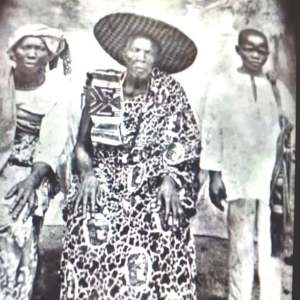
Growing up, I later heard about his exploits as a young man when he got together with his childhood friends in our home, and I eavesdropped; though they were very brilliant chaps, it was a very different story from what they all made us believe. I heard what they were doing with the damsels et al. Dad attended Baptist Academy in Lagos while Mum attended the Methodist Girls High School. I think she was the Senior Prefect of her set. Mum wanted me to become a lawyer, but Dad wanted me to become a Builder like himself.
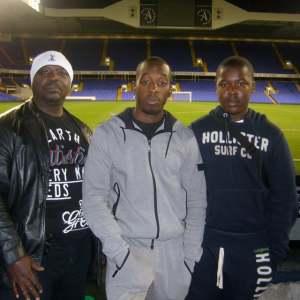
You were born in Britain, but Nigeria became an important part of your formative years. What do you remember most about your childhood?
Ogundimu: I remember my first time in Nigeria like yesterday. I spent some time with foster parents in Kent, England, whilst my parents were on Industrial training, so I was used to being among Caucasians. I always visited my parents on weekends.
In those days, the foster parents got really attached to their charges, and it was really difficult to let go. My parents came for my sister and me; as usual, we headed straight to Liverpool docks, onboard an Elder Dempster ship to Lagos through cities like Freetown, among others.
We got to Apapa Port in Lagos, and for the first time in my life, I saw so many black people in one place and voiced it out: “Why were there so many black people here?” It must have been very loud, as many people looked towards me and asked if I wasn’t black. That was the day I realised I was black.
Also, I was the face, the model character that people saw on an infant medication called ‘Junior Aspirin’ in the 60s, billboards, Newspaper adverts, and on the bottle itself.
What was young Ade like? Were you the quiet, observant child, or the one always looking for something to do? What was family life like, and what were the things that interested you before art became a serious part of your life?
Ogundimu: My young self was both: a quiet, observant child and someone always looking for something to do. I was very inquisitive. I wasn’t allowed to go and play with anyone downstairs; for some reason I can’t understand, my parents saw all the other kids as ‘free-range kids’. My father believed children that age shouldn’t be able to decide where they went or who they mixed with; hence, I was kept upstairs when I was six years old.
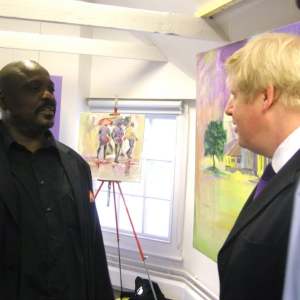
My form of escape was drawing and painting. I had so many drawing books and paints I got as birthday presents. You can’t keep a wanderer down for long, though, so when my parents went to work, I ran wild with the free-range kids. That’s when I discovered we had tribes in Nigeria.
The Yoruba children had been taught by their parents to be wary of the Igbo kids; I found this rather distressing, as many of my own friends were Igbos. I have kept this up to date. I went to discover swamps and mounds with them at the University of Lagos, which was near our home. On the way back, we used to sit on a particular mound and watch another tribe called the Calabar. The Igbo kids were taught to be wary of them. They told me we had to watch them from afar, as they are known to eat Igbos.
Wow! Imagine the picture in a seven-year-old’s head. I made my way home terrified of the Calabar. Incidentally, new tenants moved in downstairs; they were Ibibio, but were called Calabar. I was terrified of them at first; my parents wondered why. I couldn’t tell them any reason. I got used to them later, and was introduced to their many soups. I think Ofe Owerri is the Rolls Royce of soups; I have been on it since age seven. I was never caught for my exploits, as I always got back home well before my parents returned. It was after this that the unfortunate civil war started, and all my Igbo friends disappeared. I still wonder what happened to them.
I lost my Mum when I was nine years of age, and life became so different. I withdrew into myself. I solved all my problems myself, and it remains that way to this day.
Growing up between Britain and Nigeria must have given you different experiences of home, family and identity. When did you first become conscious of that difference?
Like I pointed out earlier, I first knew I was a black kid when we disembarked at Apapa Port. Life was easy in London, with no cares in the world. Like me, most of my family members were also returnees from abroad, so I wasn’t viewed in any different or strange light. The only thing was the song the free-range kids used to sing at me because of my accent.
‘Oyinbo pepper if e eaty pepper e go yellow momo’.
They couldn’t really understand what I was saying. I picked up pigeon English, as it was called then. I mistakenly twanged it at home and got in real trouble.
As with the colonial mindset of a newly independent country, all wanted to sound and behave like the colonial masters. We weren’t allowed to speak Yoruba at home or in school. They called it ‘vernacular’; this was unfortunate, as the Yoruba I learnt came from running with the free-range kids, and it wasn’t of a pleasant hue.
Did you feel British in Britain and Nigerian in Nigeria, or was it never that straightforward? Were there moments when people treated you differently because of where you were born or where you had lived? I am interested in the personal experiences that helped you understand who you were.
I was too young to feel any impact at that age, but after graduating from higher institution and three days after my National Youth Service Corps Scheme – NYSC, I returned to England. I had a Nigerian accent, as I had to lose the British accent fast because it got me into a lot of bother, especially from girls. I was always everyone’s boyfriend even when I didn’t know them, and the boys would always want a fight when they heard this, so I had to lose it. Fast. In Britain, I was seen as just another African before they discovered I was of Nigerian descent.
As a Nigerian, you get different treatment, as they know very well that you can hold your own under any condition. One can say I am not welcome in either country. ‘Oyinbo’ in Nigeria, ‘African’ in Britain. I see myself as a hybrid that can mutate to any condition. Asking: ‘How una want am?’
Let’s talk about schools from elementary to secondary.
My first school was the American International School in Victoria Island; next was Mainland Preparatory Primary School, Yaba. Then secondary school: Saint Finbarr’s College, Akoka, and Birch Freeman High School, Surulere. I was the youngest in every school I attended, and I attracted bullies, but I gave as good as I got. I wasn’t an easy person myself.
At higher level, your education took you through Yaba College of Technology in Lagos and later to the University of East London. How did that journey unfold?
Yes, Yaba College of Technology was different for me, as it was full of older men and women. You addressed them as sir, ma’am, or Aunty. It was a socially dead place when I started in 1978. A place for mature students only. About three or 4 of us were teenagers.
I read for my Ordinary National Diploma, OND, and decided to travel back to England. This was really frowned upon at home. I quarrelled with my sole surviving parent, my father when I even tried everything possible to get out but didn’t succeed.
Later, I had to spend three years out on I.T. instead of 1. I got admission into Ahmadu Bello University, which would have cost 4 years of my life instead of 2 more in Yabatech to get a Higher National Diploma, HND. I opted for the latter.
When I came back, it was a changed place; the social life was jumping, the crowd was young, and I felt at home. I passed through, but I still wasn’t allowed to travel out. I had to serve my NYSC.
Anyway, I finished that, and three days later I was on a trip back to England where I was on my own. I had to pay the bills.
Art from Africa wasn’t recognised. I enrolled to read Graphic Design and Photolithography at the London College of Printing, now University of the Arts.
After finishing the course, I worked as a designer. Went back to the same University and read printing. I decided to set up my own ‘one-stop shop,’ where I worked from concept to finish before Bill Gates and Steve Jobs now decided to flood every home and office with computers, and it ate into the business. I moved home to reduce costs, sold the printing machine and worked on design only.
After that, I traced my way back to fine art. I decided to go back to art school to understand the way of thinking and ended up at the University of East London.
What kind of student were you? Was art something you had always wanted to pursue, or did you arrive at that decision after considering other possibilities? Take us back to those early days at Yabatech. What did you discover about yourself there, and was there a lecturer, friend or particular experience that changed how you saw art? Mention the role of teachers in your journey as well
Ogundimu: I was a regular student; nothing strange or special. My work was just as important as my playing. I gave as much as I got in everything. I was supposed to read building or law and was looking into it. I came across a friend who was working in the graphics department at the Ministry of Information and was later admitted to Yaba College of Technology. I got home and voiced to my Father that I wanted to become an artist.
Surprisingly, my father eyed me up and down and said to me, “You think Art is a child’s play? You think it’s just about messing around with colours?” He then rattled off names of British artists and Yusuf Grillo and dismissed me from his presence.
Later, he called me to get some decent clothes on, saying we were going out. He drove down to Yabatech. headed for Grillo’s office. I had no clue as to where we were going.
When we got in, he told Grillo, “This is my son; he says he wants to become an artist” They both burst out with laughter. Grillo called on an assistant to take me round the Art department. This guy took me everywhere. All the works I saw were unbelievable and intimidating.
I found myself in a dilemma, as I didn’t think I was up to the task of being an artist, but I dared not say so, not with the trouble Dad went through to bring me here, also thinking he would see it as me embarrassing him.
Well, we got back to the office, and the question came out simultaneously: “Do you still want to become an artist”? I answered with a very quiet ‘yes’.
Then I was told the entry form submission date had closed. The next day I was taken to the National Council for Arts and Culture in Surulere to another of my father’s friends, Mr Frank Aig Imoukhuede, the boss. I was employed in the Graphics department. That was my first job.
That is where I met Mr Kolade Oshinowo. I helped design his exhibition invitations and flyers, among others. I started modelling myself on him. The next year, I got admitted to the Yaba College of Technology. It was a great achievement. My work experience served me well.
Before we get too far into your career, I want to understand the person behind the qualifications. What was happening in your life when you decided that art was worth pursuing seriously?
Ogundimu: To be honest, I think I got into art because it gave me somewhere to escape. I had my own private world, and when I drew or made things, I could get lost in it. It was mine. I could do what I wanted in that world, without having to explain myself to anybody.
I didn’t start out thinking I would become a professional artist, or that I would eventually earn degrees and a doctorate in Fine Art. It started with that personal connection with art. I enjoyed creating something from my own imagination.
As I got older, that private world began to open up. I started using art to explore things I was seeing and experiencing around me, including questions about identity, culture, history and the relationship between Britain and Nigeria.
In a way, the irony is that I started using art to escape the world, but I eventually found myself using it to make sense of it. I suppose the escape never really went away. It simply became a way of looking at things differently.
Choosing to become an artist is one thing; deciding to build a life around it is another. What were the conversations at home like? Did your family understand your decision immediately, or did you have to convince anyone that this was more than a passing interest? And when you began to take your work seriously, what sacrifices did that require?
Ogundimu: My family encouraged me to study art, which was unusual among many Nigerian parents at the time. Professions such as medicine, law and engineering were generally preferred because they appeared to offer a more secure future. Yet my family allowed me to follow my interests, and with my dad’s encouragement, I went on to study at Yaba College of Technology.
The real challenge came later, when I had to turn that interest into a life and career. Art has been central to my life for decades, but earning a living from it has not always been straightforward. Like most artists, I have had to balance life’s practical demands with the time and energy required to develop my work.
I did not begin with a grand plan. I simply followed my interests, continued learning and kept making work. That journey led to exhibitions in several countries and, eventually, to completing my Professional Doctorate in Fine Art.
For me, the greatest sacrifice has been the persistence required to keep going, especially when the effort involved in making the work has not always been matched by recognition or financial reward. Yet I have persevered because making art is something I have always felt compelled to do.
Your first recorded solo exhibition was in 1992 at House of Hope Gallery at the Scala in King’s Cross, London. Do you remember the young artist who put that exhibition together?
Ogundimu: Yes, I remember him. He was daring, perhaps a little rebellious, and not particularly concerned about how people might react to his work.
The exhibition was based on Christianity, but I wasn’t interested in simply illustrating Bible stories or producing paintings to decorate church walls. I took ideas from sermons I listened to and interpreted them in my own way, through my own eyes and imagination. I wanted people to look at familiar teachings differently, rather than simply present them with images they already recognised.
Looking back, I think I cared more about expressing what I saw and understood than about pleasing an audience. I wasn’t trying to offend anyone, but I wasn’t going to dilute my ideas out of fear of how they might be received. That young artist was determined to do things his own way, and I can still recognise that part of myself in the work I make today.
Did you pick any Nigerian languages at anytime, especially Yoruba?
Ogundimu: Yes, I picked up Yoruba outside the home. In those days, Yoruba was often dismissed as vernacular and, in some settings, speaking it was forbidden.
Many parents of that generation had been so influenced by colonial education that English was seen as the proper language, while indigenous languages and traditions were often treated as backward, or even evil.
I also picked up a little Ibibio and Igbo. But the language I enjoy most is Nigerian Pidgin, or what we call Broken English. I learnt it from mixing with my Warri, or Waffi, guys. When I speak it, there is hardly any Yoruba flavour in it. E sweet die!
For me, language is more than a means of communication. It carries identity, history and attitudes towards culture. Growing up around these different languages gave me a feel for how people express themselves and how language can bring people together, but also how it can distance people from their own roots.
Share your experiences about food and religion. Where do you belong and how was it for you to adapt back home?
Ogundimu: I grew up eating English food, so I was familiar with it, but the moment I started tasting the variety of Nigerian dishes, my palate changed. English food began to seem rather bland by comparison. I was comfortable with the food at home, but as with everything else, I was adventurous and wanted to explore.
For me, food is tied to identity, memory and belonging. It takes you back to places, people and experiences. Nigerian food connects me to home in a way that goes beyond simply satisfying hunger. And when you have tasted a properly prepared Ofe Owerri or Ekpang Nkukwo, you understand why I say what I say!
As for religion, I see it as another part of growing up between cultures. My early Christian paintings show that I was engaging with religion from quite a young age, but I was always inclined to interpret things for myself rather than accept them without question. That independent streak has remained part of who I am.
I imagine you have a different perspective on that experience now, after more than three decades of making art. What did you hope people would see in those early works? Were you confident about the direction you were taking, or were you still searching for your voice? And what happened after that first exhibition that encouraged you to keep going?
Ogundimu: Looking back, I think I wanted people to see that Christian teachings could be interpreted beyond the familiar images and stories we had grown accustomed to. I was not interested in simply reproducing what people already knew. I wanted to express my own understanding of what I heard and experienced, and I was prepared to take risks.
Was I confident? I was confident enough to put the work out there, but I would not say I had everything figured out. I was still learning about myself and what art could do. I had ideas, curiosity, and a willingness to experiment, but finding your voice doesn’t happen overnight. It develops as you work, make mistakes and discover new ways of seeing things.
That first exhibition gave me the opportunity to put my ideas before an audience. It was a starting point, rather than a moment when everything suddenly fell into place. I continued to make work, explore different subjects and exhibit whenever opportunities arose.
Over time, my interests expanded beyond religion into questions of identity, culture, migration, history and the legacies of Empire.
Looking back, I can see a connection between the early work and what I do today. Even then, I wanted to interpret things for myself rather than follow an established formula. That instinct has stayed with me, though the questions I ask and how I express them have changed over the years.
From your educational background, you are a multimedium artist: a painter, sculptor and mixed media artist. Can you share those days of humble beginnings or was it very easy to work with the mediums from the word go?
Ogundimu: It certainly wasn’t easy from the word go. I learnt by doing, experimenting and sometimes getting things wrong. My training gave me a foundation, but working across different mediums requires more than knowing the theory. Each material has its own behaviour, limitations and possibilities, and you have to learn how to work with it.
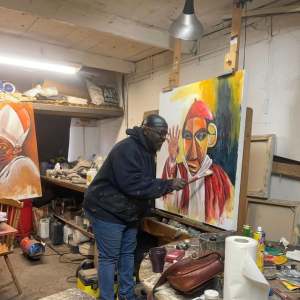
I studied painting at Yaba College of Technology, but my curiosity was never confined to paint and canvas.
Over time, I became increasingly interested in sculpture, found objects and mixed media. I wanted to see what could happen when materials and ideas that didn’t traditionally belong together came together in the same work.
I have used materials such as charred wood, terracotta, jute, resin, fibre, bitumen and discarded objects. Some of these materials come with their own histories and associations, which can become part of what the work communicates. I have also learnt to make use of what is available. I sometimes describe myself as a skip diver because I can see possibilities in things other people have thrown away.
For me, working across different medium is not about collecting skills or trying to be everything at once. It is about finding the right material for the idea. Sometimes a painting says what I need it to say; at other times, I need to build something, combine materials or create an installation.
I am still learning. After decades of making art, I do not believe you ever reach a point where you know everything a material can do. That continuing process of discovery is part of what keeps the work interesting for me.
Your work has dealt with Black identity, Christianity, migration, the African diaspora, Biafra and the continuing effects of Empire. These are subjects that carry considerable personal and historical weight. How did they find their way into your practice?
Ogundimu: I think these subjects came naturally from my life experiences. I was born in Britain, taken to Nigeria as a child, and grew up experiencing both cultures. That gave me a lot to think about: who I was, where I belonged, and how people from different backgrounds saw one another.
My early work focused on Black identity and Christianity because those were the things I was thinking about at the time. I never accepted everything at face value. I wanted to question things and interpret them for myself. That attitude has followed me throughout my career.
As I grew older, my interests widened. I became more conscious of the history between Britain and Nigeria, the experience of migration, and the way colonialism continues to affect how we see ourselves and how others see us. These were not abstract subjects to me. They were connected to my own background and the world I had experienced.
My work on Biafra came from wanting to engage with a painful part of Nigerian history that has had lasting consequences for its people. My interest in Empire grew from similar questions about history, identity and power. I began to look at how these things survive in language, objects, cultural beliefs and everyday attitudes, even when people are no longer conscious of their origins.
These concerns eventually led to my doctoral research on myth, language and objects. But I had been exploring them through my art long before I began the doctorate.
I suppose I make art because I want to examine things that trouble me, interest me or simply do not make sense to me. I use whatever materials help me express those ideas. I am not trying to preach or tell people what to think. I want to put the questions out there, and let people engage with them in their own way.
Was there a particular experience that brought you closer to these subjects, or did they emerge gradually as you became more aware of the world around you? I am especially interested in the relationship between your own life, your Nigerian connections and your decision to examine these histories through art.
Ogundimu: No single experience led me to these subjects. They developed over time. Taken to Nigeria as a child, I grew up with a personal connection to both countries. That experience shaped how I saw the world, although I didn’t fully understand its significance when I was younger.
As I grew older, I became more aware of how colonial history shaped attitudes toward African people, beliefs, and traditions. I began asking why certain cultures were treated as superior to others, and how those attitudes continued to shape how we understood ourselves.
These questions gradually entered my art. I started with subjects closer to my immediate experience, including Black identity and Christianity, before moving into migration, Biafra and the legacies of Empire. Each subject opened up further questions for me.
Art lets me investigate these issues in ways writing or conversation alone cannot. I can work with materials, images and objects to express ideas that may not have straightforward answers. My doctoral research later gave me the opportunity to examine some of these concerns in greater depth.
Ultimately, I draw on what I have lived, observed and questioned. I am not looking at these histories as a detached observer. I am connected to them, and making art is one way I try to understand what they mean for me and for others.
You have worked with materials such as charred wood, terracotta, jute, resin, fibre, bitumen and reclaimed objects. Some of these materials seem to carry their own histories. How do you arrive at the decision to use a particular material?
Ogundimu: Sometimes I choose a material, and sometimes the material finds me. The charred wood is a good example.
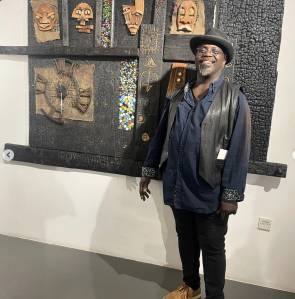
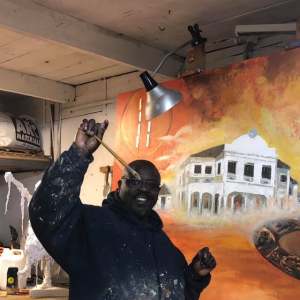
A record shop near my studio had burnt down. I walked past while the workmen were stripping out the damaged interior in preparation for repairs. I noticed the patterns, textures and colours in the burnt wood. Something about them stayed with me. I knew I had to do something with it.
I waited until the workmen finished and left, put on my protective gloves, grabbed a wheelbarrow, and collected the pieces that interested me. I took them back to my studio, not as rubbish, but as material with possibilities.
I wanted to give the wood a second life. Fire had destroyed something, but the damage had created new patterns and textures I could work with. For me, that process held an idea of regeneration: taking what had been damaged or discarded and making something new from it.
That experience says a lot about how I work. I pay attention to materials and what they might offer, rather than deciding in advance to use a particular medium. With terracotta, jute, bitumen or reclaimed objects, the material has to contribute something to the work. I want to know what I can do with it, but also what it brings to the idea.
I suppose that is part of being a skip diver. I see possibilities in things that other people may have finished with.
When you encounter an object, do you first see what it can become visually, or are you drawn to the memory, cultural meaning or history it carries? Can you take us through one work in which the material itself became as important as the idea you wanted to communicate?
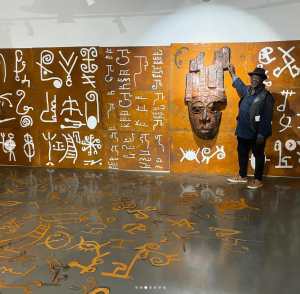
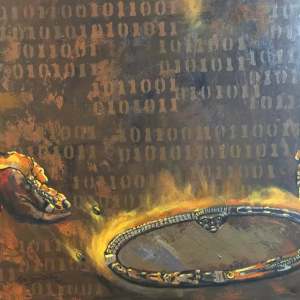
Ogundimu: In Orishas and Binaries, I bring together my understanding of Ifa aesthetics, Yoruba deities and the relationship between traditional systems of knowledge and computer language. As Dr Tunde Adegbola explains, Ifa is an all-encompassing system of knowledge that contains elements of religion, philosophy, science, mathematics and literature.
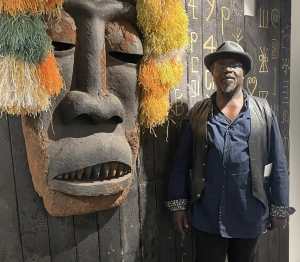
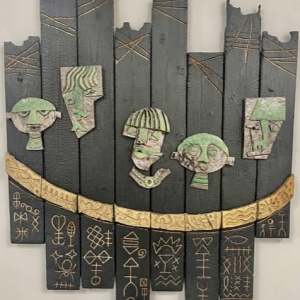
I represent Yoruba deities, including Ogun, Shango, Obatala, Orunmila, Oya, Oshun and Esu, through faces and masks mounted on charred wood. The wood represents regeneration and the perpetual cycle of life. I reclaimed discarded floorboards, charred them with a roofer’s torch to create distinctive textures, and engraved binary-like marks inspired by Ifa divination codes and my research into African graphic systems such as Nsibidi, Adinkra and Ulli.
I sculpted the masks from clay, fired them in a kiln and applied thin washes of acrylic colour to bring out their contours. I then assembled the components using battens, screws, resin, and fibre.
The work grew from my discovery of connections between Ifa divination and computer language. By combining reclaimed, fire-marked wood, coded symbols and sculpted deities, I explore how different systems of knowledge may relate to one another, while giving discarded materials a new life.
Your Professional Doctorate in Fine Art, completed in 2024, examined the relationship between myth, language and objects within the legacies of Empire. What did the research reveal to you that you had not fully understood before?
The research helped me understand more clearly how myth, language, and objects work together to shape how we see ourselves and other people. I had been exploring these things through my art for years, but the doctorate gave me the opportunity to examine their connections more systematically.
One thing that became clearer to me was how the effects of Empire can survive long after formal colonial rule has ended. They can remain in the names we use, the stories we tell, the objects we value and the assumptions we make about different cultures. Sometimes we inherit these ideas without questioning their origins.
I also became more conscious of the importance of African systems of knowledge, symbols and communication, and how easily they can be misunderstood or dismissed when viewed only through Western frameworks.
The research did not suddenly change my practice. It helped me put words and structure around questions I had already been exploring. It also made me more aware of the relationship between my practical work as an artist and the ideas informing it.
For me, completing the doctorate was not about finding all the answers. It was about learning to ask better questions and understanding more clearly why I make the work I do.
You had already spent many years working as an artist before undertaking the doctorate. Did the research change the way you approached your studio practice, or did it give language to ideas that had been developing in your work for years? What was the most challenging part of bringing your artistic experience and academic research together?
Ogundimu: would say it did more to give language and structure to ideas I had been exploring for years than to change my studio practice completely. I had been working with objects, symbols, materials and questions of identity long before the doctorate. The research helped me understand how these things connected and gave me a framework for examining them more closely.
The biggest challenge was bringing the practical side of making art together with the demands of academic research. In the studio, I can respond instinctively to a material, an image or an idea. Academic work requires me to explain my thinking, examine sources, build an argument and support my conclusions. Something that feels clear when I am making a piece can be much harder to put into words.
I had to learn to move between these two ways of working without allowing the academic side to take over the art. I did not want my work to become an illustration of my thesis, or my research to become a justification for everything I made.
In the end, the two informed each other. My practice gave me questions to investigate, while the research helped me see those questions from different perspectives. Completing the doctorate in 2024 gave me a clearer understanding of the ideas behind my work, but I still rely on experimentation, observation and instinct in the studio.
Let’s talk about exhibitions and how to organise them. You have spent many years exhibiting in the UK, from galleries in London to institutions such as the Brunei Gallery at SOAS. For many artists of African origin who relocate to Britain or other parts of Europe, finding their feet in the art world can be quite challenging. How has the journey been for you? How did you begin to find exhibition opportunities, build relationships with galleries and get your work in front of the right people? What have you learnt along the way that you think other artists coming from Nigeria should know?
Ogundimu: It has been a long journey, and it has not always been straightforward. I have been exhibiting since 1992, and over the years I have learnt that making good work is only one part of being an artist. You also have to find opportunities, build relationships and make sure people know what you are doing.
I began by taking opportunities where I could find them, exhibiting in galleries and group shows, meeting other artists and staying involved in the art community. Some opportunities came through personal contacts, others through organisations and curators. You learn to keep looking, keep showing your work and not wait for somebody to discover you.
Exhibiting at the Brunei Gallery at SOAS in Legacies of Biafra, which later travelled to Gallery Oldham and Iwalewahaus in Germany, was important because it brought the work into a wider institutional and international context. But these opportunities do not happen overnight. They are built through years of working, participating and maintaining relationships.
One thing I have learnt is that the art world can be difficult to navigate, particularly when you are working across cultures. You cannot assume that the quality of your work alone will open every door. You have to understand how exhibitions are organised, how to approach galleries and curators, how to present your work professionally, and how to keep a clear record of your exhibitions and achievements.
My advice to artists coming from Nigeria is to build relationships without making every encounter about getting an exhibition. Be interested in what other people are doing, attend events, talk about your work clearly and follow up when appropriate. Keep good photographs, maintain an up-to-date CV and document your work properly. These things matter.
I would also say, do not rely entirely on galleries to build your career. Take the initiative, work with other artists and look for opportunities beyond the commercial gallery system, including museums, universities, artist-led spaces and cultural organisations.
I am still working on building my own place within the art world. I have had opportunities to exhibit in different countries, but I know there is a difference between exhibiting and achieving sustained recognition. One thing I have learnt is that you have to keep making work, but you must also take responsibility for how it is documented, presented, and brought to the attention of the people who need to see it.
You have exhibited in Nigeria, Britain, the United States, India and Germany. Yet an international career is not always a straightforward journey. What have these different places taught you about how people see your work?
Ogundimu: journey has been a long one, with its share of opportunities and frustrations. I have been exhibiting since 1992, and I have learnt that being a good artist is not enough on its own. You must also understand how the art world works, make connections and take responsibility for getting your work seen.
Coming from a Nigerian background and working in Britain, I have had to navigate different cultural expectations. We come with our own experiences, histories and ways of seeing the world, but we also have to understand the environment in which we are presenting our work. I do not believe we should abandon our identity to fit in. We need to learn how to communicate what we do without compromising who we are.
I began by taking the opportunities available to me, exhibiting in London and elsewhere, meeting other artists and becoming involved in art organisations. Over time, this led to wider opportunities, including Legacies of Biafra, which began at the Brunei Gallery at SOAS and later travelled to Gallery Oldham and Iwalewahaus in Germany. It has taken years of work to reach this point, and I am still building.
My advice to Nigerian artists coming to Britain or Europe is to arrive with an open mind, but not assuming talent alone will carry you. Learn how the system works. Find out who the curators, galleries and cultural organisations are. Attend exhibitions, speak to people, build genuine relationships and follow up professionally. Keep a good record of your work, your exhibitions and your achievements.
I would also encourage Nigerian artists to look beyond the idea that success means getting into a commercial gallery. Universities, museums, artist-led spaces, cultural organisations and collaborative projects can all provide opportunities to develop an audience. Do not sit back and wait to be discovered. Create opportunities with other artists where you can.
Another point I feel strongly about. Nigerian artists should not feel obliged to produce work that confirms somebody else’s idea of what African art ought to look like. Our experiences are diverse, and our work should reflect that. We should be able to address our own histories and traditions, but also politics, technology, migration, religion, everyday life or anything else that concerns us. We are not a single artistic category.
I have exhibited internationally, but I know that exhibitions are not the same as sustained recognition, representation, or sales. That distinction matters. We need to document our careers, support one another and build stronger networks, both at home and abroad. We should not depend entirely on external institutions to tell us that our work has value.
For me, the lesson has been to keep making the work, keep learning and take an active role in building a career. We must understand the system without letting it dictate who we are or what our art should become.
For instance, do you find that audiences in Britain read a work differently from audiences in Nigeria? Has there been a moment when somebody’s response to your work surprised you or made you reconsider what you thought the work was communicating? And after all these years, where do you feel most understood as an artist?
Ogundimu: I do find that audiences in Britain and Nigeria can approach my work differently, although I would not want to generalise too much. A Nigerian audience may recognise certain cultural references, symbols, languages or experiences that a British audience might not immediately understand. On the other hand, someone in Britain may respond to a work through the history of Empire, migration or questions of identity. Neither response is necessarily more valid than the other. We simply bring different experiences to what we see.
My work often draws on Yoruba culture, Nigerian experiences and the history of Empire, but I do not make it only for Nigerians or only for people who understand those references. I want the work to communicate beyond its immediate cultural setting. Sometimes the viewer may not know the background, but something in the material, form or arrangement catches their attention and leads them to ask questions. That is important to me.
I have learnt that I cannot completely control how people interpret my work, and I do not necessarily want to. Once a work leaves the studio and meets an audience, people bring their own experiences to it. They may see something I had not consciously considered. That does not mean my original intention was wrong; it means the work can have a life beyond what I first imagined.
As for where I feel most understood, I would not say there is one particular place. Being Nigerian or British does not automatically mean someone will understand my work. What matters more is whether the person is willing to engage with it, look beyond the surface and consider the questions it raises. I live and work between these cultural experiences, and both are part of who I am. I want my work to speak from that position without choosing one side over the other.
Take us through your exhibitions. How many have you done as a solo exhibition and how did they turn out with curators, galleries, audience and collectors?
Ogundimu: My exhibition history goes back to 1992, when I held my first solo exhibition, Blackman in Christianity, at the House of Hope Gallery, Scala, King’s Cross, London. The paintings explored Christian ideas through my own interpretation of sermons, rather than illustrating Bible stories. In 1993, I returned to the same venue exploring atheism. These early exhibitions reflected my willingness to question belief, identity, and how we interpret the world.
Over the years, I have exhibited in Britain and internationally, including in the United States, Nigeria, India and Germany. My exhibitions have explored African music, migration, diaspora, cultural identity, slavery, markets and the effects of Empire. Some have been independent or joint exhibitions, while others have involved galleries, cultural organisations and institutions.
One important milestone was Legacies of Biafra, which was presented at the Brunei Gallery at SOAS before travelling to Gallery Oldham and Iwalewahaus in Bayreuth, Germany. Having the exhibition travel beyond its original venue allowed the work to reach audiences in different settings. More recently, I exhibited in Joy at SMO Contemporary Art in Lagos in 2024, and Reflections with the Guild of Fine Artists of Nigeria in Ikoyi, Lagos, in 2025. In 2026, I will participate in Lineage of Masters II at the Yusuf Grillo Museum alongside other artists.
My experience with curators and galleries has varied from one exhibition to another. Institutional exhibitions can provide valuable context and bring work to audiences who might not otherwise encounter it. Group exhibitions also let my work be seen alongside other artists’ and open conversations about different approaches and experiences. However, exhibiting does not automatically lead to representation by a commercial gallery or to sales and collecting opportunities.
That is one reality of my career. I have spent decades making and exhibiting work, but sustained recognition and a reliable market are different challenges from securing an exhibition. I would like to see more of my work acquired by private collectors and public collections, and to develop lasting relationships with galleries that understand the direction of my practice.
I would not measure every exhibition by the same standard. An exhibition may bring critical discussion, introduce the work to a new audience, lead to another opportunity or result in a sale. Each outcome has its own value. I am proud of the range of opportunities I have pursued, but I remain conscious of the distance between having an exhibition history and achieving sustained recognition and financial support as an artist.
My aim now is to build on that history, strengthen relationships with curators and collectors, and ensure that the work continues to reach audiences in Britain, Nigeria and beyond.
Moreso, are you a full time studio artist or a mercurial business man?
Ogundimu: I would say I am first and foremost a full-time studio artist, but I have a mercurial side! I have never been comfortable putting myself in one box. I trained in art, design and print, ran businesses, and eventually returned to making art full-time when the business side slowed down.
I have always had to be resourceful. Being an artist isn’t just about sitting in the studio and making work; you also have to find opportunities, manage projects, make connections, and sometimes create your own openings. So, perhaps I am a bit of both: an artist at heart, with a businessman’s survival instincts. But the studio is where I belong.
In the UK, Can someone survive independently as a professional artist – full time studio artist?
Ogundimu: Can you make a living from art in Britain, or do you have to keep one eye on the studio and the other on how to pay the bills? After just over 40 years of making art and exhibiting since 1992, I can tell you the answer isn’t as straightforward as people might imagine.
I have trained in Nigeria and Britain, studied Fine Art to professional doctorate level, and exhibited in Britain and internationally, including in Nigeria, the United States, India and Germany. My work has been shown in settings ranging from independent galleries to the Brunei Gallery at SOAS, with Legacies of Biafra subsequently travelling to Gallery Oldham and Iwalewahaus in Germany.
I have also experienced life on the business side. I helped run Falco Design and Print Ltd and served as a director of DigitalBait Dot Net Ltd. That background taught me how to run a business, manage clients, and make things work financially. When the client base dried up, I returned to concentrating on my art full-time. So, I am not approaching this question purely as an artist who wants to make work; I understand the commercial realities as well.
Despite my training, experience and exhibition history, establishing a dependable income from selling my art remains a challenge. An exhibition can bring visibility and critical attention, but it does not guarantee sales, gallery representation, or collectors who will keep buying your work. That is one of the profession’s uncomfortable realities.
In Britain, many artists have to combine sales with commissions, teaching, workshops, grants, residencies or other work. There is no shame in that, but it can take time away from the studio. I want to reach a point where the work itself provides a sustainable living, without spending so much time looking for the next opportunity or income source.
My experience has taught me that artistic ability, academic qualifications and years of commitment do not automatically translate into financial security. You also need access to the right networks, people who are prepared to buy your work, and institutions and galleries willing to support your practice over time.
So, can someone survive independently as a full-time studio artist in the UK? Yes, but it depends on their circumstances, costs, market and sources of income. In my case, after decades of work and international exhibitions, I am still working towards that level of financial sustainability. I keep making the work because it is what I do, but I also believe artists should be able to earn a living from their practice. The challenge is to build a sustainable career without allowing the market to dictate what you make.
Let’s come to Legacies of Biafra and your forthcoming exhibition, In the Shadow of Empire. These projects bring difficult histories into the gallery. How did you approach such subjects without reducing them to historical illustrations?
Ogundimu: For me, the starting point is that I am not trying to illustrate history or produce a history lesson. I am interested in how history continues to live with us, often in ways we do not recognise. The past is not simply behind us. It shapes our identities, our language, our beliefs and the way we see ourselves and others.
With Legacies of Biafra, I was concerned with the Nigerian Civil War and its human consequences, but also with memory, identity, and how a traumatic past is carried across generations. I did not want to reduce the subject to images of suffering or recreate events as a documentary record. I wanted to explore what remains after the fighting stops: the memories, the silences, the wounds and the questions that are not easily resolved.
My forthcoming exhibition at Gallery Oldham, Restless Objects: Migration, Memory and Survival in the Afterlives of Empire, curated by Professor Paul Goodwin, takes these concerns into a wider conversation about Empire and its continuing effects. Empire is not simply something that happened and ended. Its legacies remain in institutions, cultural attitudes, language, migration and the ways African histories and knowledge have been interpreted. I am interested in how these histories continue to shape lives and identities today.
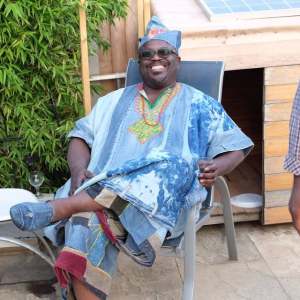
My approach is to let the materials, forms, symbols and relationships within the work carry meaning. Objects are not merely things to be looked at; they can hold memories, histories and traces of displacement. Materials such as reclaimed and charred wood also interest me because they carry evidence of what has happened to them, while suggesting the possibility of another life. I use these qualities to create work that engages with history without simply illustrating it.
I am not interested in telling people what to think or offering easy answers to difficult histories. I want the work to raise questions and encourage people to look again at what they may have taken for granted. For me, the challenge is to make work that is historically grounded but speaks to the present, because these histories are not finished business.
What responsibility does an artist have when dealing with histories that remain painful or politically sensitive? With Legacies of Biafra travelling from Britain to Germany, and In the Shadow of Empire scheduled for Gallery Oldham, what conversations do you hope these exhibitions will open up?
Ogundimu: I believe an artist has a responsibility to approach painful histories with honesty, sensitivity and a willingness to ask difficult questions. That does not mean avoiding controversy or trying to please everyone. It means recognising that behind historical events are real people, their lives, their losses and the memories carried by those who survived. I do not see my role as telling people what to think, but as creating work that encourages them to look, question and reflect.
The origins of Legacies of Biafra are important here. In 2014, as Britain marked the centenary of the outbreak of the First World War, I became aware of the public attention given to remembrance. The BBC broadcast commemorative programmes, the Royal Mint issued a £2 coin featuring Lord Kitchener, museums staged exhibitions, and the Tower of London hosted the installation Blood Swept Lands and Seas of Red, with 888,246 ceramic poppies representing British and colonial military deaths during the war.
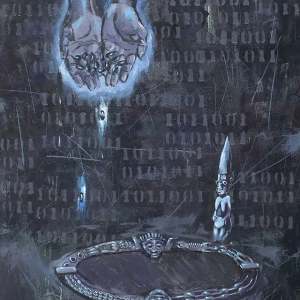
Seeing the scale of this commemoration made me think about the approaching fiftieth anniversary of the Nigeria-Biafra War in 2017. I began asking myself why there appeared to be so little comparable public remembrance of this devastating conflict, which had cost so many lives and left deep scars on families and communities. That absence stayed with me. It led me towards an exhibition that would acknowledge this watershed in Nigerian history, commemorate those who died, and explore the war’s consequences both locally and globally.
I did not want Legacies of Biafra to become a simple illustration of the war or a collection of images of suffering. I wanted to consider how conflict lives on through memory, identity, displacement and silence, and how its effects can pass from one generation to another. The exhibition’s journey from Britain to Germany has also created opportunities for the work to encounter audiences in different historical and cultural settings. I hope it encourages people to consider not only the Nigerian experience, but also the wider questions of war, remembrance, whose suffering is publicly acknowledged, and whose histories are allowed to fade from view.
My forthcoming exhibition at Gallery Oldham, Restless Objects: Migration, Memory and Survival in the Afterlives of Empire, curated by Professor Paul Goodwin, extends these concerns. It considers how the legacies of Empire continue to shape migration, identity, cultural memory and the objects through which histories are carried. I want visitors to think about the relationship between the past and the present, and to question the assumption that Empire is merely a closed chapter of history.
Ultimately, I hope these exhibitions open up conversations that might not otherwise take place. Commemoration should not be reserved for one nation’s history or one group’s losses. We need to be willing to acknowledge difficult histories, including those that have received less public recognition. For me, art offers a way of bringing those histories into view, not to reopen wounds for their own sake, but to encourage understanding, reflection and a more inclusive account of the past.
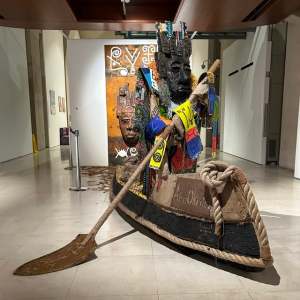
Let’s discuss the massive installation From Abeokuta to Willesden – The prestigious Waves of Change – Artistic Journeys exhibition organised by Nigeria Art Society UK (NASUK) at the prestigious 1.54 Contemporary African Art Fair, held at Somerset House.
What was running through your mind when you designed such an iconic piece? What was the duration from idea generation to conceptualisation of the piece?
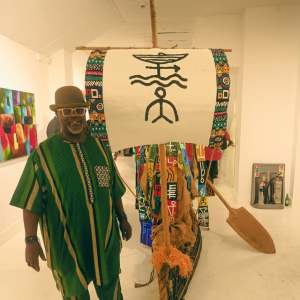
Ogundimu: When I conceived Abeokuta to Willesden, I was thinking about migration, identity and what we carry with us when we leave one place to make a life somewhere else. Having been born in Britain, taken to Nigeria as a child, and later returned to Britain, I understand something of what it’s like to live between cultures. For me, migration is not simply about moving from one geographical location to another. It is also about memory, belonging and the ways our origins continue to shape us.
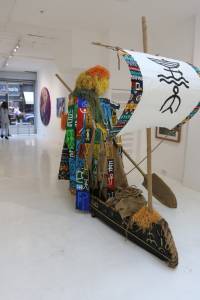
The boat became a central image because it represents a journey, but also the risks, uncertainties, and hopes of leaving home. I made it from charred wood, a material that already carries a history of damage and transformation. I wanted to give that discarded material another life, just as people who migrate must often rebuild their lives in unfamiliar surroundings.
The masquerade rowing the boat was equally important. It represents cultural knowledge and ancestral memory throughout the journey. The masquerade is not simply travelling from Abeokuta to Willesden; it carries something of home. The African scripts on the boat reinforce this idea. I wanted to challenge the assumption that African knowledge is exclusively oral by highlighting the richness of African systems of writing, symbols, and communication. Our intellectual and cultural histories are much deeper and more varied than such assumptions allow.
The title brings together two places that mean different things to me. Abeokuta evokes Yoruba history, ancestry and cultural roots, while Willesden represents the London environment in which I have lived and worked. The distance between them is geographical, but their relationship is also personal and cultural. In a sense, the journey connects two parts of my own experience, while speaking to the wider experiences of African migration and the diaspora.
The work also made me think about the longer history of movement from this part of Nigeria. Journeys connected with ancestry, pilgrimage, trade and settlement existed long before contemporary international migration.
Today, people leave for many reasons, carrying their languages, beliefs, memories and traditions with them. They contribute to their new societies while continuing to negotiate their relationship with home. I wanted the installation to hold these different dimensions of migration together, rather than present it as either a story of hardship or one of success.
As for the time it took, the idea developed through my ongoing research and reflection on migration, Yoruba cultural knowledge and my own experience between Nigeria and Britain. I would not want to give a precise duration from the first thought to the finished installation without checking my records. The physical construction was only one part of the process; the thinking behind the work had been developing over a much longer period.
Presenting Abeokuta to Willesden in Waves of Change – Artistic Journeys, organised by Nigeria Art Society UK at the 1-54 Contemporary African Art Fair at Somerset House, gave the work an opportunity to enter a wider conversation about African art and diaspora. I wanted viewers to consider what migration means beyond moving bodies across borders. We also carry knowledge, culture, history and ways of seeing the world. Those things travel with us, change through contact with new environments, and continue to shape who we become.
Back home in Nigeria, you are participating in a group exhibition titled Lineage of Masters II in honour of Prof. Yusuf Grillo. Did you meet him and what do you know about him and philosophy of life in visual art?
The exhibition Lineage of Masters II is gathering many of Prof. Yusuf Grillo’s proteges. What does mentoring mean to you?
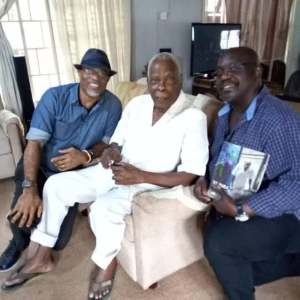
Professor Yusuf Grillo taught me about pictorial composition and the use of planes, particularly in constructing the human face. His teaching helped me understand how shapes, colours and forms could work together to create an image without relying solely on realistic representation. Those lessons have stayed with me, and I still reflect on them in my own practice.
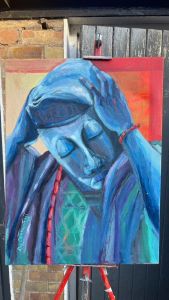
2. The space between us. Showing at the Linage of Masters. Artworks credit. Dr. Ade Ogundimu
Grillo was a major figure in Nigerian modern art. He brought modernist principles into conversation with Yoruba culture and African visual traditions, developing a distinctive approach through geometric forms, carefully structured compositions and bold use of colour. What I find particularly important is how he engaged with modern art without losing sight of his cultural roots.
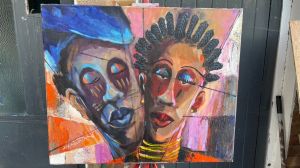
2. The space between us. Showing at the Linage of Masters. Artwork credit Dr. Ade Ogundimu
For me, Lineage of Masters II is an opportunity to recognise his contribution and consider how his influence continues through the artists he taught and inspired. Being part of a lineage does not mean imitating the master. It means learning from that experience and taking it somewhere new.
Mentoring is valuable because an artist’s development is rarely a solitary process. A teacher can offer knowledge, challenge assumptions and help a student recognise possibilities in their work. But mentoring should also encourage independence. The aim is not to produce replicas of the teacher, but artists confident enough to develop their own ideas and visual language.
In my case, Grillo’s lessons in composition remain part of my artistic thinking, even though my practice has since expanded into different materials and subjects. That, to me, is the real value of teaching: its influence can endure without restricting what comes next.
What are the titles of your submission for the commemorative event on October 25th
In the first painting titled ‘Bless My Head I use simplified forms, angular structures and strong colour relationships inspired by his teaching, but I soften the geometry so the planes merge more fluidly. The closed eyes and hands against the head add emotional tension, shifting the work from formal study towards introspection. In Bless My Head, the hands suggest comfort, blessing and a plea for relief, giving the work a distinctly Nigerian spiritual and conversational quality.
2. The space between us. Showing at the Linage of Masters. Artwork credit Dr. Ade Ogundimu
The second painting, ‘The Space Between Us’, extends Grillo’s influence through overlapping planes, contrasting colours, and cultural markings, exploring intimacy and identity. Although the two faces are physically close, the painting suggests emotional boundaries, connection and separation. The title raises the question of what exists between two intimate people: desire, memory, trust, distance, vulnerability, or even things that cannot be spoken. The markings across the faces, the patterned hair and the intersecting lines all contribute to questions of identity, connection and perception.
UK based Lara Ige – Jacks and US based Prof. Dele Jegede are also participating. What do you have to say with this Diaspora relationship?
Ogundimu: As someone who lives and works in Britain but has deep Nigerian roots, I know that being part of the diaspora can offer a different perspective on both places. Distance can change how we see things, sometimes making us question assumptions we might otherwise take for granted.
For me, the value of Lineage of Masters II is that it brings artists together without requiring us to work in the same way or see everything through the same lens. We can acknowledge the influence of Professor Yusuf Grillo and the traditions that shaped us while expressing our own individual experiences.
I would like to see more sustained exchange between artists in Nigeria and those in the diaspora, through exhibitions, mentoring, research and collaboration. These relationships should be more than occasional reunions; they can help us share knowledge, challenge one another and build stronger connections across generations and borders.
After years of exhibitions, research and travel, what does home mean to you now?
Is home a particular place, the people around you, your studio, or something that has changed as you have moved between Britain and Nigeria? When you need to step away from the demands of being an artist, where do you go, and what do you enjoy doing?
Home has become more than a particular place for me. Having lived between Britain and Nigeria, I carry experiences of both with me. Nigeria is deeply rooted in my cultural identity, while Britain is where I was born, where I have spent much of my life, and where I have developed my artistic practice. Each has shaped how I see the world, although in different ways. Home is also about familiarity, belonging and the people with whom you share your life.
My studio is an important part of my world, but it is also where I work, think and sometimes wrestle with ideas. When I need to step away from the demands of being an artist, I turn to music. I particularly enjoy Reggae and Jazz, and I like going to live music venues. I also enjoy angling. There is something satisfying about being outdoors, waiting patiently and allowing your mind to wander. The frustrating part, of course, is having to put the fish back in the water! These activities give me a break from the constant thinking that comes with making art and allow me to enjoy life beyond the studio.
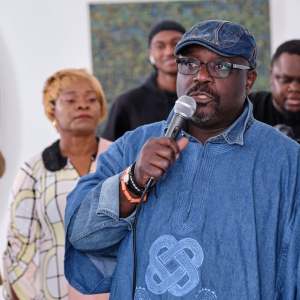
We have spoken about your professional journey, but I would like to return to your family. How much of the man you have become can be traced to the values you grew up with?
Ogundimu: Hard work was drummed into me from childhood. My parents were both highly accomplished in their professions, and they taught me, by example, that you had to work hard to make your way in life. That lesson has stayed with me.
But my childhood had another side. I remember being about seven when my mother asked me what I wanted to become when I grew up. We were surrounded by different Nigerian cultures, and I was fascinated by the sounds around me, especially the pounding rhythms of the drums at Christmas, when the masquerades came out. I loved the whole atmosphere. I watched the Egungun and thought, that is what I want to be when I grow up. I wanted to become a masquerade!
What appealed to me was the freedom. The Egungun could roam about, moving from place to place, and I wanted that freedom for myself. I wasn’t thinking about a profession or how I would earn a living. I was a little boy captivated by the drums, the masquerade and the world around it.
My mother was not impressed. She was so disappointed that I still remember how it felt. She made it clear she expected me to aspire to something more serious, and after that, she steered me toward other pursuits.
Looking back, I can smile at the memory. My mother wanted me to have a secure future, while I was dreaming of being an Egungun, free to roam. Yet that childhood fascination never quite left me. The sounds, the movement, the symbolism and the cultural life surrounding the masquerades are all part of the world that shaped my imagination. I cannot say that this one moment determined the artist I became, but I can recognise something of that little boy in the work I make today.
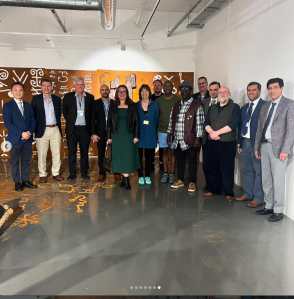
Are there lessons from your parents or other family members that you still carry with you? Looking back, is there anything about your upbringing that you appreciate more today than you did when you were younger?
Ogundimu: The values my parents instilled in me were family, discipline, firmness and a strong sense of right and wrong. They expected me to take everything seriously, even when I was having fun. Their attitude was very much: work hard and play hard. At times, I saw their strictness as a restriction, but as I have grown older, I have come to appreciate what lay behind it. They wanted me to be responsible, stand on my own feet, and understand that my actions had consequences.
Another lesson I carry with me is not to bite off more than I can chew. It means knowing my limits, being realistic about what I take on, and seeing things through rather than making promises I cannot keep. That is particularly relevant to my life as an artist, where ideas can be endless but time, money and physical energy are not.
I appreciate these lessons more now because life has given me the opportunity to understand their value for myself. My parents are no longer here, but the principles they taught me remain part of how I live, work and relate to people. I may not always get everything right, but I have a foundation to return to.
Every artist has moments when things do not go according to plan. Can you remember a period when you questioned your direction or wondered whether you were making the right decisions. What was happening at the time, and how did you find your way through it?
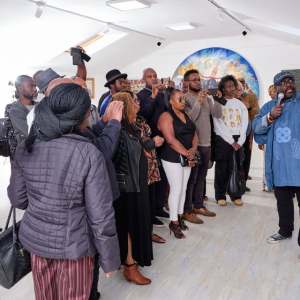
Ogundimu: Sometimes the experiences that never appear in an exhibition catalogue tell us the most about a person’s character.
When I returned to England, I expected to get straight into the art scene and build on the experience I already had. I soon discovered that contemporary art from Africa had very little recognition at the time. I had bills to pay, like everybody else, and I began to wonder whether I had made a mistake coming back. It was a difficult realisation because I had come with expectations, only to find that the opportunities were not quite what I had imagined.
I had to be practical. I recognised that I could make a living from graphic design and printing, so I put my skills to work in that area. It was not a case of abandoning art, but of finding a way to support myself while keeping it alive. Looking back, that decision helped me continue, even if my artistic career didn’t develop the way I had originally expected.
Another thing that changed my thinking was going to university in England. I had not fully appreciated the skill involved in practical trades until I had to do welding and carpentry as part of my studies. I developed a new respect for people who work with their hands, understand materials and make things happen through practical knowledge. I often think about how useful those skills would have been if I had learned them earlier.
That period taught me that being an artist requires more than creative ambition. You also have to adapt, find ways to sustain yourself and remain open to learning from unexpected places. I questioned my decision to return, but I kept going. I did not know then how the journey would unfold.
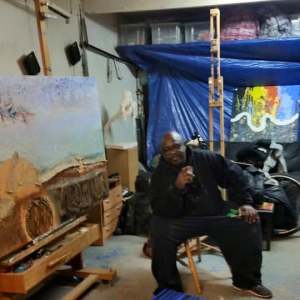
Is there a particular memory, encounter or achievement that you look back on with a sense of gratitude? And is there anything you wish you had understood earlier in your career?
Ogundimu: One achievement I look back on with gratitude is completing my Professional Doctorate in Fine Art. It was a demanding journey, and completing a 221-page thesis alongside my artistic practice let me examine questions that had stayed with me for many years. Before this, I was a hands-on person. It helped me understand more clearly how my work connects with the legacies of Empire, and how myth, language and objects shape our understanding of identity and history.
I am also grateful for the opportunities to exhibit my work in different places, particularly Legacies of Biafra, which travelled from SOAS in London to Gallery Oldham and Iwalewahaus in Germany. Seeing work that began with my own questions reach different audiences has been important to me.
If there is one thing I wish I had understood earlier, it is that making good work and getting that work recognised are two different challenges. I spent a great deal of time making art, developing ideas, and improving my practice. I could have given more attention to building relationships with galleries, collectors and people who might help my work reach a wider audience. Talent and hard work matter, but they do not automatically lead to recognition or sales.
I have learnt that an artist needs to think about both the work and the life that sustains it. I would not change the experiences that brought me here, but I might have approached the business side of my career differently if I had understood its importance sooner.
Finally, when people encounter your work years from now, what would you like them to understand about Ade beyond the paintings, sculptures and installations?
Ogundimu: I would like people to understand that, beyond the paintings, sculptures and installations, I am a man who has spent much of his life asking questions about who we are, where we come from and how history continues to shape our lives. My work comes from living between Britain and Nigeria, observing different cultures, and questioning things that are often accepted without much thought.
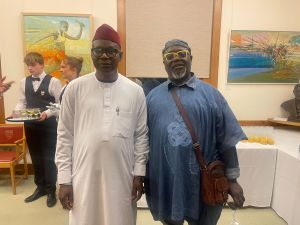
I would also like people to see that I have never wanted to be confined to one way of working or thinking. I paint, sculpt, make installations and experiment with materials because different ideas demand different forms of expression. I am still learning, still curious and still willing to try things I have not done before.
Above all, I hope people understand that I am not simply trying to make objects for people to look at. I want to open up conversations, challenge assumptions and encourage people to look again at histories, traditions and identities they may think they already understand. I do not expect everyone to agree with me or arrive at the same conclusions.
When I am no longer here, I hope the work will keep asking questions. Beyond the work itself, I would like to be remembered as someone who remained curious, worked hard, questioned what he was told, and tried to make sense of the world through art.
iBAND Magazine, Celebrating Visual Art from the Original.
Africa | Visual Art | Lifestyle | Culture

