
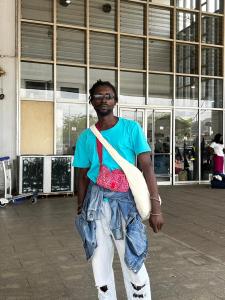
On a road trip from Lagos to Abuja, an artist began asking a deceptively simple question: what if the colours we paint with are already telling us where we come from?
Words Ireho Aito | Don’t Keep Your Art in the Finger! Photographs courtesy Josiah. C. Josiah archives
There is a moment when an artist stops looking at colour merely as colour. Red is no longer simply red. Blue begins to carry the weight of a particular sky. Ochre starts to resemble the earth beneath one’s feet. Green becomes inseparable from the vegetation that surrounded childhood. Even the intensity of a colour can begin to suggest something about the weather, soil, people, culture and landscape that produced it.
This is where Josiah C. Josiah found himself. For an artist whose first love was drawing and colour, the discovery did not come from sitting quietly in a studio. It came from leaving it.
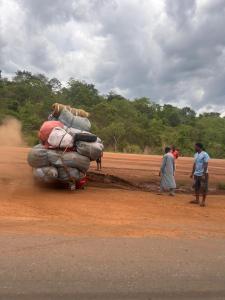
Between May 13 and 29, 2026, Josiah embarked on what he called The Drawing Tour, a road trip through locations between Lagos and Abuja, including Ibadan and Osogbo. He travelled with drawings, charcoal, pigments and questions, meeting artists, craftsmen, curators and gallery practitioners along the way. Beneath the movement was a serious investigation: how does environment influence the colours artists see, choose, produce and eventually put on canvas?
It sounds simple until one begins to look closely. Why does an artist in Benin repeatedly arrive at certain earth tones? Why might fabrics from Iseyin carry a visual character different from those produced elsewhere? Why does Abuja seem to possess its own particular light? Why is the soil in other parts of the country different from that of other parts too, and can such differences enter an artist’s consciousness?
Josiah was not looking for a formula that says every artist must paint the colour of the soil beneath their feet. He was interested in something subtler, that is, the unconscious ways in which environment enters artistic practice.
“In Lagos, the earth colour is different from the earth colour in Ogbomoso,” he explains. “If you look at Benin, for instance, the colour looks reddish. That colour is supposed to influence the Benin artists.”
The word ‘supposed’ is important. Josiah is not prescribing an artistic language. He is asking why certain visual tendencies appear in particular places and whether artists recognise the forces behind them.
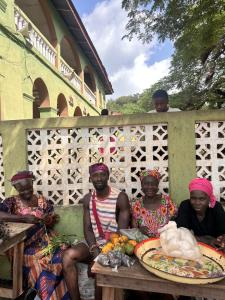
His journey became a kind of moving laboratory. Some artists he encountered admitted that they had never consciously considered how their environments might have influenced their colour schemes. They had simply been painting.

Until someone asked them to look again.
For Josiah, that question began much earlier. “Sincerely, the first thing that attracted me to becoming an artist is drawing and colour,” he says. But over the years, his understanding of art expanded beyond technique.
“Environment plays a big role in our subconscious. And for us artists, there are unconscious things that we see around that we do not pay attention to.”
At one point, he became bored with the colours he was seeing and using. His response was to retreat into charcoal and limited pigments.
“I wanted to experiment more because what they taught us in school was different from what the environment is saying.”
Charcoal became a way of grounding his thoughts. “For years now, I have been experimenting with charcoal. This was because I was really bored with colours, especially after my graduation from art school. Charcoal was for grounding my thoughts; I wanted something more obscure.”
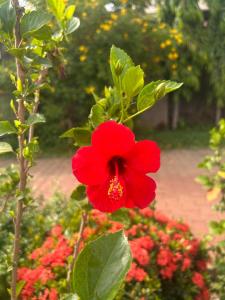
Yet his withdrawal from colour eventually brought him back to it with a different pair of eyes. Plants became important. Flowers became important. The natural world became a palette.
“I am beginning to see colours more in their natural appearance, light through these plants and flower colours,” he says.
This is where his research moves beyond painting technique. Josiah is no longer asking merely how to use colour. He is asking where colour comes from, what shapes our perception of it and what happens when artists stop paying attention to their environments.
Nigeria offered him an unusually rich field of study because the country itself is a collection of different visual worlds. The sunlight in Kaduna is not necessarily experienced like the light in Ondo. For example, Lagos has its humidity, rain, dust, concrete and coastal atmosphere. Abuja has its own light and landscape.
“In Abuja, their sky, I discovered, is very different from what I am used to and I actually termed it ‘Abuja Yellow,” he says.
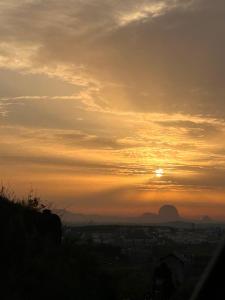
“If you go to Abuja, Kano or Kaduna, you understand that the sunshine is different from the way it is in Ondo State, just like how the colours and soils are different.”
For Josiah, these are not just poetic observations. They are environmental factors capable of influencing colour production and artistic consciousness.
His investigation also took him into traditions where colour is inseparable from material and culture. At Nike Art Gallery in Osogbo, the dye pit became another point of inquiry. Here, colour is not simply squeezed from a commercial tube. It is connected to plants, processes, knowledge and generations of practice.
Katurag Chinyio, curator at Nike Art Gallery in Abuja, points to indigo. “Mama Nike always preaches about the colour indigo; it is her favourite colour. She takes out time to make people understand its importance. Indigo is a traditional colour. It is here around us; it is growing in our environment.”
The observation is significant because it shifts colour from being merely an aesthetic decision to becoming cultural evidence where a pigment can carry history and a process can carry memory.
The conversations Josiah had with other artists further complicated the picture. Kolapo Olorunyemi, known as Kingdiah, reflected on how experience shapes an artist’s relationship with colour. “Every painting comes with a different experience. I can’t transfer that experience to someone else.”
He also discovered that his refined method of painting had been influenced by his background in graphic design. “Experience has a great influence when working with colours,” he says, adding that certain colours can become distinct to particular places and regions.
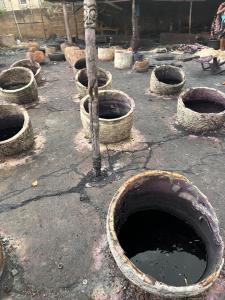
At Nike Art Gallery in Osogbo, senior instructor Owolabi Afeez Adekunle offered another perspective: “Demand is what, in most cases, dictates our choice of colour, especially in the contemporary era.”
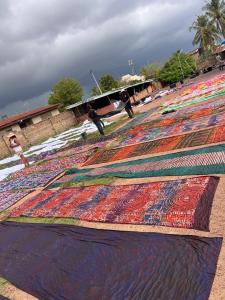
It is an important counterpoint. Artists do not work in nature alone. They work within markets. Collectors have preferences the same way Galleries have identities. It is important to know that clients make demands and the same time, trends travel. Commercial considerations can influence colour just as much as soil, sunlight or memory.
Perhaps, then, an artist’s palette is a negotiation between place, training, culture, commerce, memory and personal experience.
Curator Adebimpe Ajarat believes artists need to become more curious about this relationship. “The environment is an essential source of inspiration for artists. A place where we find colours, forms and functional materials. I think artists are not curious enough about how and what the environment can provide. Creatives should all go back to the environment they claim inspires them and study it.”
That may be one of the most important ideas to emerge from Josiah’s project. Artists often say the environment inspires them. But how many actually study it?
Josiah’s own childhood perhaps explains why this question has become so personal. His mother was a farmer, and growing up around agriculture gave him an early relationship with plants and the changing landscape.
“Plants have the way of describing colour and emotions due to environmental factors,” he says.
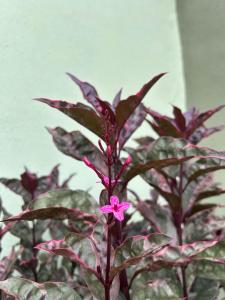
A farmer does not encounter a plant simply as green. It changes with weather, soil and seasons. It flowers, dries, produces and dies. Its colours tell stories. Josiah began to recognise that the artist can learn from this constant transformation.
His artistic journey itself has been shaped by movement and adaptation. He grew up in Taraba, Adamawa and mostly Abuja, although he is originally from Imo State. His parents wanted him to become a priest. Instead, he moved through music and photography before finding his way more firmly into visual art.
He earned money as a drummer in a musical band before moving into event photography. But drawing remained the persistent attraction.
“Every child loves drawing,” he says.
Then came an encounter that changed the meaning of drawing for him. “The first time I saw a painting, it was an emotional experience for me. I started crying.” It was a portrait of a woman in Abuja.
That emotional response would eventually become a career. Josiah has had two solo exhibitions, beginning with The Room, presented from his studio in collaboration with Signature Gallery Lagos. Yet his current investigation suggests an artist still more interested in questions than conclusions.
The Drawing Tour also turned his attention towards the materials artists use and where those materials come from. For years, he says, his palette had been influenced by what he describes as “unnatural professionalism” the expectation that certain colours and materials were necessary for an artist to appear professional.
“We were taught to appreciate foreign colour schemes which also affected our perception of colours,” he wrote before the tour.
This is one of the more provocative aspects of his research. He is not arguing that foreign-produced colours have no place in African art. He is questioning what happens when imported materials and colour systems become so dominant that artists stop investigating what their own environments offer.
“Every colour has its influence; a foreign-produced colour reflects its environment,” he argues.
That thought has encouraged Josiah to experiment with earthy materials. Sometimes, he adds soil or sands to his colours, thereby, just experimenting Nigerian and foreign made colours by mixing them. This has helped him to understand not just the materials but the cultures behind them.
“Culture influences everything,” he says. “It relates to every material a culture has used or is using.”
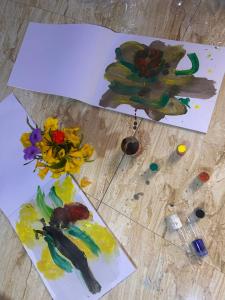
The implications extend beyond the artist’s palette. Josiah believes a deeper understanding of materials and their environmental origins could help artists, collectors and audiences think differently about how artworks are made, interpreted and conserved.
This is where colour research becomes an ecological conversation.
“Our immediate environment needs our attention and care,” he says. “That way the environment can flourish more and when it flourishes, it blesses us.”
What humans put into the earth affects plants. When plants change, the colours available within the environment can change too. If indigenous plants disappear, traditional pigments and processes can disappear with them. The loss of a plant can therefore become the loss of a colour, and the loss of a colour can become the loss of cultural knowledge.
Artist and curator Rufus Unochukwu Nwoko also connects colour to nature. “Colour for me always comes from nature,” he says, noting that natural and colourful aesthetics can intuitively align with African visual identity.
Ugwu Paschal Obinna found something similarly personal in his own palette. “The inspiration behind this new series of works which are more in earthy colours can be related to my Igbo origin. I also had some colour scheme-related series from my experience in Maraba, unconsciously.”
Again, that word “unconsciously.”
It may be the most revealing word in Josiah’s entire investigation.
The colours artists absorb before they have the language to explain them. It may be the light of childhood or the soil of a hometown. Sometimes, it may be the fabrics of a community or the plants beside a house. The visual memories that enter the mind long before an artist learns to call them inspiration.
Special Projects Curator and Gallery Manager at Orisun Gallery in Abuja, Rowland Yohanna Goyit, observes that visual composition is more than form. “Colours express emotions; it is a lived experience.”
He points to indigenous cultures where colours can describe auras and energies, and where colour may not always be named in isolation but through its relationship to something in nature.
Perhaps that is another question Josiah’s research leaves us with and that is; what happens when we stop asking only, “What colour is this?” and begin asking, “What does this colour mean here?”
The Drawing Tour ended on May 29 but the research did not.
Josiah says he is still trying to understand what he started. “For me, colours are endless. For instance, with two colours you could have two million colours.”
There is a delightful contradiction in that statement. An artist who once became bored with colour now sees an almost infinite field before him.
He was asked whether, at any point during the long road journey, he wanted to give up.
His answer was simple.
“I only wanted to continue.”
Each drawing led to another, just as each encounter produced another thought. The journey gradually became a body of work.
“The thing about this series is mostly about the study of colours and environment,” he says.
There is now an exhibition in the pipeline to present the experience and research. There will also be a book.
That next stage may be more important than the tour itself. A road trip can remain a personal adventure, but documentation can turn experience into an archive. Josiah’s drawings, conversations and observations have the possibility of becoming part of a larger conversation about African art education, materials, ecology, culture and conservation.
Literature has already played a major role in his own development. “I fell in love with Art from literature,” he says. “The power of literature in my work is not an exaggeration.”
Perhaps this explains the way he approaches the world not simply as an artist looking for subjects, but as someone looking for stories inside things.
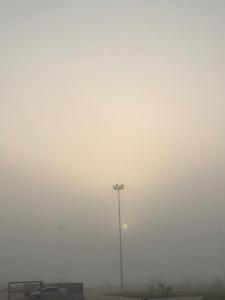
The soil carries a story, just as the plant, the pigment and the artist do. Colour becomes the meeting point where these stories converge, connecting nature, memory, material and human expression in ways we may not always realise.
Josiah C. Josiah’s Drawing Tour does not ask African artists to abandon the colours they know; it asks them to look again before reaching for them and to examine the environments they claim inspire them, question the materials they inherit, also investigate what their communities have always known. Colour, after all, carries more than visual beauty, as it holds geography, memory, culture, ecology and lived experience. Perhaps the palette was never simply a collection of tubes arranged on a studio table. We need to know that every colour carries a place, a climate, a memory and a culture.
And just as Josiah. C. Josiah discovered on the road from Lagos to Abuja, to understand African art more deeply, we may first have to learn to look again at the ground beneath it.
iBAND Magazine, Celebrating Visual Art from the Original.
Africa | Visual Art | Lifestyle | Culture
 iBAND Magazine