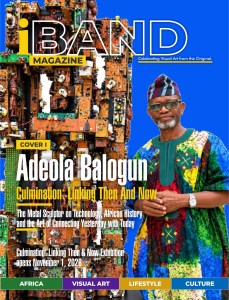
Who else could have emerged to honour the Saints as they keep marching on? None other than Dr. Adeola Balogun, the sculptor whose mastery of metal has earned him a place among Nigeria’s distinguished contemporary artists. As the world marks All Saints’ Day on November 1, 2026, the artist presents Culmination: Linking Then and Now, a solo exhibition of recent works drawn from years of experimentation, research and artistic inquiry.
The exhibition, organised in partnership with Adeline Gallery, opens at the Metropolitan Club, Victoria Island, Lagos, bringing together a body of work that explores the relationship between history, technology, culture and contemporary life.
Words Ireho Aito | Don’t Keep Your Art in the Finger! Images and photographs courtesy of Dr. Adeola Balogun. Graphics: Adewale Oseni
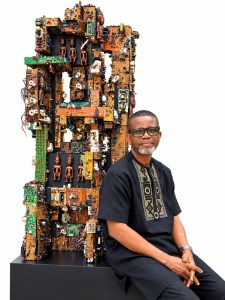
There is something striking about Adeola Balogun. His slim frame, gentle disposition and measured manner hardly suggest the towering presence he commands in the world of contemporary sculpture. Yet, behind that quiet exterior is an artist whose imagination continues to push the boundaries of materials, methods and meaning.
Dr. Adeola Balogun is a scholar and practising artist whose journey has been shaped by determination, curiosity and a willingness to experiment. His artistic destiny began to take shape at Yaba College of Technology, Lagos, where he specialised in sculpture and graduated with distinction in the 1993/94 set. The institution would later become his professional home, where he rose through the academic ranks while building an impressive studio practice.
Even as a student, Balogun attracted the attention of established figures in the art world. Among them was the late David Dale, the respected printmaker whose admiration for the young artist suggested that there was something special to watch. What began as a promising student journey would eventually develop into a career spanning teaching, research, sculpture, painting, installation and public commissions.
After completing his studies, Balogun returned to Yaba College of Technology as a lecturer in 1995, following his National Youth Service. He subsequently earned a Master of Fine Art in Sculpture from the University of Benin and a PhD in Studio Sculpture from Delta State University, Abraka.
Iron, as the saying goes, sharpens iron. Balogun’s story is also one of a young artist who continued to learn, experiment and develop his voice while working within the very institution that had nurtured his talent.
His studio practice moves with an energy that seems to allow little room for stagnation. He is constantly exploring, testing materials and searching for fresh ways to communicate ideas. From metal and discarded tyres to electronic circuit boards and mixed-media painting, his work reflects a restless imagination and an enduring interest in the world around him.
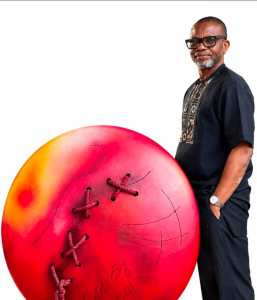
Drive through Lagos and other parts of Nigeria, and you will encounter public sculptures that bear his creative signature. His commissions include the monumental statue of Chief Obafemi Awolowo at Allen Roundabout, Ikeja; the bronze statue of the late Funso Williams; the statue of the late Ayangburen of Ikorodu; and the bronze busts of Sir John Glover and Madam Tinubu at Union Bank’s Marina building.
His public works extend beyond Nigeria. His sculpture History and installation Outflow are held in the Galleri Astley collection in Sweden, reflecting the international reach of his practice.
There is power in a name, indeed. Adeola is commonly associated with the crown of wealth, while Balogun refers to a war general. In his own way, the artist seems to carry something of both meanings: the dignity of a crown and the determination of a general who keeps advancing.
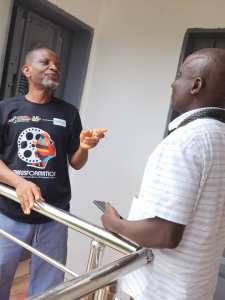
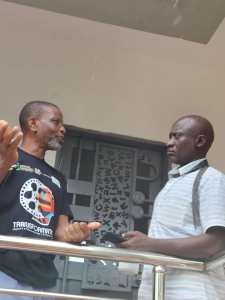
My relationship with Balogun’s work has brought me to his studio on more than one occasion. This latest visit to his base in the Aladura Community, Alagbado, Lagos, offered another opportunity to encounter the artist away from the public monuments and exhibition spaces with which his name is associated.
This time, the conversation was about Culmination: Linking Then and Now opening at the Metropolitan Club on Victoria Island on Sunday and the continuing evolution of an artist who never seems content to remain in one creative territory. This conversation is a complete Soundspiration.
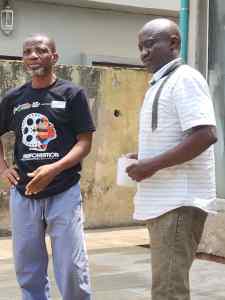
As I made my way to Alagbado, Balogun called to guide me. He is clearly at home in his community, just as he is well established within the art world, both locally and internationally.
Slim, bespectacled and blessed with a deep baritone, he is a quintessential gentleman. In conversation, he is relaxed and engaging, but when discussing his work, his thoughts move quickly from the immediate object before him to the larger questions it raises.
Balogun once imagined a future in law. Destiny, however, had a different route in mind. Today, he is a sculptor and art educator whose work has earned recognition among collectors, institutions and fellow practitioners.
What a man for iBAND Magazine to visit again on a glorious Sunday!
Adeola Balogun keeps moving, inventing and creating. His studio has become a meeting point for ideas, materials and possibilities, with each new experiment opening another direction for his practice.
“We are trying to clear our space for the new space we just set up. Additional studio, more apartments within and we need to start having our art residencies. It is very important we move as the world is moving,” says the originator of Transmogrification.
We walk through an expansive compound filled with metal structures, sculptural figures and works at different stages of development. The atmosphere is almost cinematic. The sheer variety of objects and constructions makes the space resemble the setting of an epic film.
I ask whether he has ever considered becoming a set designer for television and film.
“I actually created some of the props used for Saworoide and Agogo Ewo by Mainframe Productions. Both films were directed by renowned filmmaker Tunde Kelani. It was a beautiful experience and I have been invited again on so many occasions which I have declined. I would not want to be boxed into such corner when I can rove better this way,” the sculptor explains.
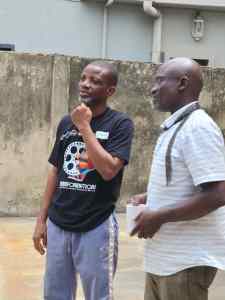
His answer reveals something important about his creative temperament. Balogun appreciates the possibilities of collaboration, but he is equally determined to protect the freedom to explore. His practice is not confined to one material, one subject or one mode of expression. He prefers to move between ideas, allowing each experiment to take him somewhere new.
The studio itself tells this story.
Balogun points out the new building, a multi-storey addition designed to accommodate studio apartments, working spaces and future engagements with artists from Nigeria and abroad. The plan includes facilities for residencies, opportunities for collaboration and a dedicated space where members of the board can discuss projects, review briefs and curate exhibitions.
“The ground floor would be ideal for a sculptor and those who experiment with installations,” he says.
I remember my previous visit and how the place looked more like a shed. The transformation is remarkable. What was once a modest working environment is developing into a broader creative space, reflecting the artist’s ambition to extend his practice beyond his own production.
For Balogun, movement is essential. The world is changing, and he wants his studio to respond to that change.
Several works destined for Culmination: Linking Then and Now are already present. Sculptures, installations and mixed-media pieces occupy different parts of the compound, offering a glimpse into the ideas that will come together at the Metropolitan Club on November 1.
One particular work immediately commands my attention: a large sculptural figure of a woman posing for a selfie.
It is a familiar scene. We see it on the streets, at social gatherings, in restaurants and at public events. The raised arm, the carefully arranged pose and the desire to capture the moment have become part of everyday life.
Balogun takes this ordinary gesture and turns it into a subject for deeper reflection.
“Ladies are emotionally attached to their phones and you see them taking pictures always. There is going to be a dummy phone on the stretched hand of the model sculpture, on exhibiting day,” he explains.
The work, titled Entangled, moves beyond the familiar image of someone taking a photograph. Balogun is interested in what our attachment to technology has done to the way we live, interact and understand ourselves.
“The lady with the selfie talks about our struggles with modernity and innovations and how obsessions have taken over our lives. It seems we have been programmed by the innovators and we can’t resist,” he says.
The figure is therefore not simply a commentary on the selfie culture. It becomes a representation of a society increasingly caught between the convenience of technological innovation and the demands it places on human attention.
What makes Entangled particularly compelling is the incorporation of electronic circuit-board tracks into the sculptural composition. The lines, originally designed to carry electrical signals and data, become visual elements that wind around the figure.
Balogun has been exploring these lines as motifs, translating the patterns found on electronic panels into forms that communicate human experiences.
The result is a conversation between two-dimensional and three-dimensional expression. The lines belong to the technology that surrounds us, yet they also become a metaphor for the invisible systems through which modern life is organised.
As Balogun continues to explain the work, he returns to the experience shared by many people.
“You and I struggle to escape from the labyrinths of daily struggle,” he says. “The reasons the track lines are wired around the figure. There is no escape despite our efforts to run away from our daily struggles. We are just wired around it.”
The statement brings the work into sharper focus. We may believe that technology gives us freedom, but our constant dependence on it can create another form of confinement. The very devices designed to connect us may also influence our attention, habits and choices.
Balogun’s observations are particularly relevant in a society where mobile phones and social media have become inseparable from everyday life. His concern is not simply that people use technology, but that the relationship can become so consuming that it begins to determine how they experience the world.
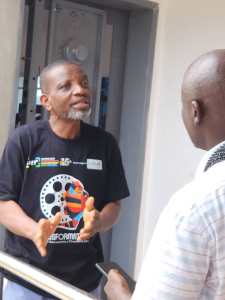
“In today’s world, the Gen Z are distracted. They have short attention span. Check their mannerisms, they are fixated on their phones always. This is a trap already. So, these track lines extracted from electronic boards carry current and data which are interpreted in three-dimensional lines on the figures. These become the connecting lines to explain the struggles and challenges we are battling with every day globally,” he explains.
Here lies one of the defining qualities of Balogun’s practice: the ability to take an everyday object or material and transform it into a vehicle for social commentary. Electronic waste, which might ordinarily be discarded without a second thought, becomes a language through which he examines the human condition.
His approach is rooted in research and sustained experimentation. He studies the materials, considers their original purpose and explores how their physical properties can contribute to a new visual statement. The finished work is not merely an arrangement of found objects; it is an attempt to give those objects another life and another meaning.
This method connects Entangled to a broader history of his practice, particularly his earlier explorations of discarded tyres, metal and other materials that society often regards as useless. Balogun has consistently demonstrated that what has been abandoned can become a source of creative possibility.
His current exploration of electronic circuit boards extends that principle into a world increasingly shaped by digital technology.
Yet technology is only one side of the story. Balogun is equally concerned with history and the need to recover African narratives that have not received the attention they deserve.
One of the most intriguing aspects of his studio is the collection of historical figures he has been developing through painting, sculpture and mixed media. Among them is Mansa Musa, the celebrated ruler of the Mali Empire whose wealth and influence have secured him a lasting place in world history.
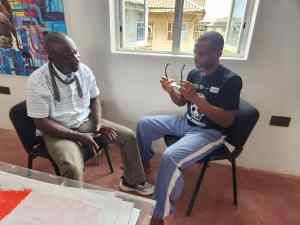
Balogun has approached the subject through a series of works, including a realistic bust that reflects his own interpretation of the historical figure.
“I actually generated this Mansa Musa myself. This is a realistic bust,” he says.
His process began with research. He searched publicly available images and representations of Mansa Musa, examining the different ways artists have imagined the ruler. Since there is no authenticated photographic portrait of him, Balogun had to work from existing artistic impressions and historical references.
“I went on public search looking at different images of Mansa Musa. There was no real photographs about him rather what we see are artists impression of him. What came out of my own research was a lean and bearded figure in real life. Toga that belongs to the royals was also evident in my discovery concerning his fashion sense,” he explains.
The resulting figure carries a turban and carefully considered details that communicate royal identity. A lion and a rising sun form part of the visual language surrounding the turban, reinforcing the artist’s interpretation of a ruler whose historical reputation continues to inspire fascination.
Balogun’s interest in Mansa Musa is part of a wider project he calls Heroes of the Past. The series brings together figures whose lives and achievements deserve continued attention, including Queen Nefertiti Re-imagined.
These works demonstrate the research dimension of his practice. Balogun is not simply reproducing familiar historical images. He is examining how such figures might be represented today and how contemporary visual art can renew interest in the past.
There is something particularly valuable about this approach. History can become distant when it remains confined to books and dates. Through sculpture and painting, however, historical personalities acquire a physical presence that invites viewers to look again, ask questions and consider the societies that produced them.
For Balogun, African history offers an abundance of material for such exploration.
“One thing we keep missing it, Africa and Africans are royals. We had a great past but we refused to research and celebrate such periods and eras in our historical firmament,” he says.
He continues: “There is nothing new being brought to us as Africans apart from the fact that Europeans colonised us, took away all those things, rebranded them to us.”
His words reflect a concern with the ways African knowledge, cultural practices and historical achievements have been represented, displaced or overlooked. Through his work, he seeks to reopen these conversations and encourage audiences to consider the depth of African civilisation beyond the familiar narratives of colonial history.
This interest in indigenous knowledge also informs his exploration of traditional technologies. He offers an example from the history of textile care.
“In Africa, we have our own indigenous knowledge and that is for sure. Take a look at the way Africans were ironing their clothes in mediaeval period. It had nothing to do with electricity nor even charcoal at that time. There was a manual way of stretching clothes to look for such as Aso Oke. Such act is still being practised here,” he explains.
His point is clear that innovation did not begin with the arrival of modern Western technology. African societies developed their own systems, methods and knowledge, many of which continue to inform contemporary life.
Balogun’s art invites us to look at these practices with renewed respect and curiosity.
The Mansa Musa bust is also an example of the patience his work demands. He tells me it took him three months to complete the sculpture. Such an undertaking requires more than technical ability. It calls for sustained research, the interpretation of historical references and the discipline to translate an idea into a convincing physical form.
That same commitment to research has brought Balogun into contact with some of the most influential figures in Nigerian art and collecting.
He recalls his first group exhibition at Yaba College of Technology, an event sponsored by the Russian Consulate. Prince Yemisi Shyllon, who attended as a special guest, was impressed by the young artist’s work and purchased all five pieces he presented.
Shyllon subsequently asked to meet the artist behind the works. Their meeting led to words of encouragement and further collaborations over the years.
For a young assistant lecturer at the time, the encounter was an important moment of recognition. It also illustrates how a single exhibition can open doors, create relationships and encourage an artist to continue developing a distinctive practice.
Balogun’s academic career had its own unexpected beginning. He did not initially intend to become a lecturer at the institution where he had studied. But his former lecturer, Dr. Tola Filani, had other ideas.
Today, his relationship with the institution extends beyond teaching. As an artist and mentor, he continues to contribute to the development of younger practitioners, sharing the experience and discipline acquired through decades of studio work.
His public commissions provide another record of that journey. Among the figures he has been commissioned to represent is Chief Obafemi Awolowo, one of Nigeria’s most prominent political leaders. Balogun also acknowledges those who helped him along the way, including Dr. Kukoyi, whose role in his professional life remains important to him.
His studio contains a number of busts of distinguished personalities, including past presidents of the Metropolitan Club, the very institution that will host his forthcoming exhibition.
The connection gives the November presentation another layer of significance. The venue is not unfamiliar territory for the artist. His work already forms part of the club’s visual history, and Culmination offers an opportunity to introduce audiences to another dimension of his practice.
There is also a monumental figure that immediately draws attention within the compound. The imposing statue of Igan-Omode, a warrior associated with Balogun’s hometown of Ota. It is very difficult to ignore the statue and not ask one or two questions about its creation. It is just close to the entrance, commanding its own aura as you walk by the compound’s walkway.
According to the history that inspires the work, Igan-Omode was known for going to war with extraordinary confidence and for conjuring animals, including lions, to accompany him into battle.
Balogun conceived the sculpture in the late 1980s, but a lack of sponsorship prevented its completion for many years. Now, with the work brought closer to fruition, he intends to donate it to Ota as a contribution to the preservation of the town’s cultural heritage.
The proposed donation reflects another aspect of his practice: the desire to return something meaningful to the community from which he emerged. The sculpture is not simply a representation of a historical warrior. It is also an attempt to preserve a story and give it a lasting physical presence.
From Igan-Omode to Mansa Musa, from the rulers of African empires to contemporary public figures, Balogun continues to explore the relationship between identity, memory and representation.
These concerns find a different expression in Culmination: Linking Then and Now. While sculpture remains central to his artistic identity, the exhibition places particular emphasis on mixed-media paintings derived from his earlier sculptural works.
“I culled some of the images of my sculptures and infuse them into mixed media,” he explains.
The process allows Balogun to revisit forms he has already developed and introduce them into a new visual setting. Images from his sculptures become elements within mixed-media compositions, while electronic circuit-board patterns provide another layer of meaning.
The resulting works bring different periods of his practice into conversation. His sculptures supply the historical and figurative references while the electronic tracks introduce the visual language of contemporary technology. Together, they form a body of work concerned with how ideas, materials and systems change across time.
The exhibition is expected to present about 25 works, offering audiences an opportunity to experience the range of his current explorations.
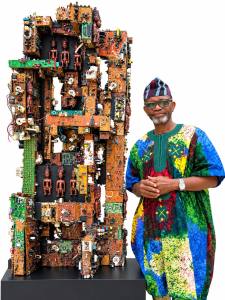
Balogun’s use of discarded materials remains central to this development. Electronic panels, waste materials and other found objects provide the physical resources for his experiments. Through careful selection and transformation, these materials acquire new aesthetic and conceptual possibilities.
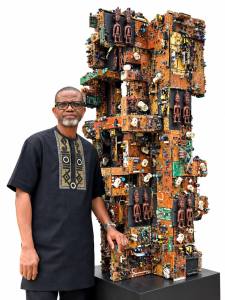
“My exploration and interaction with electronic panels actually culminated in me extracting those lines and culminating in what the audience will experience on November 1st,” he says.
The word culmination is significant. It suggests the coming together of ideas that have been developing over time, rather than a sudden departure from the artist’s earlier concerns. The exhibition brings together strands of his practice that might initially appear unrelated, traditional African knowledge, historical personalities, sculptural forms, electronic waste and the social consequences of technological advancement.
For Balogun, however, these subjects belong in the same conversation.
He draws a parallel between the traditional Gelede masquerade, which communicates messages to society, and the information systems of the contemporary world.
“Gelede masquerade is a message bearer. It is an old traditional way of passing information to the society. In today’s world, technology, social media are now being used to pass information to the society. There is nothing new but the only difference is information now comes in real time,” he emphasises.
The comparison is revealing. Across different periods, societies have developed ways of communicating values, preserving knowledge and responding to change. The methods may differ, but the underlying need to convey information remains.
Balogun’s interest lies in that continuity. He examines how traditional forms of communication can be understood alongside the technologies that now shape our daily lives.
Another mixed-media work brings the subject of royalty into focus. The composition depicts a queen, the wife of the Oba of Benin, within a visual framework that considers the structures of power and authority in precolonial African society.
“This is the royal. The work depicts the wife, a queen of the king. The Oba of Benin. They are part of the control system we have back then before the advent of colonialism,” he says.
Once again, the artist looks to history to examine the structures that organised society before colonial rule. His representations of royalty are not merely exercises in historical imagery, rather, they form part of a larger inquiry into African systems of governance, identity and cultural authority.
The electronic track lines that run through these works connect the different subjects. They are deliberate visual elements, referring to the circulation of information across different eras and the ways in which people remain connected to the systems around them.
In this sense, Culmination: Linking Then and Now is more than an exhibition of mixed-media paintings and sculptural references. It is a meeting point between historical memory and contemporary experience, between the physical materials of the artist’s studio and the questions he wants society to consider.
Balogun understands that exhibitions must do more than bring works together for display. They provide opportunities for artists to communicate ideas, challenge assumptions and encourage audiences to see familiar things differently.
Sales, of course, remain an important part of an artist’s professional life. But for him, the exhibition must also leave something with the viewer.
His practice is sustained by reading, reflection and physical discipline. He tells me that mornings are often devoted to books, meditations and research, while exercise helps him maintain the energy required for demanding studio work.
“I read a lot in the mornings. Very convenient for me. Keeping fit is key to creativity and I do a lot exercise to be in shape. I meditate a lot,” he says.
It is a simple routine, but one that speaks to the discipline behind his output. The works that appear effortless in an exhibition space often emerge from long periods of observation, research, physical labour and reconsideration.
Before I leave his studio, Balogun surprises me with a biographical publication about him produced by Position Magazine, the respected art and culture quarterly founded by veteran journalist, author and filmmaker Dapo Adeniyi. He also presents me with one of his mixed-media paintings, a gesture I receive with genuine delight.
It is a fitting end to a visit spent discussing art, history, technology and the many directions in which an artist’s imagination can travel.
Adeola Balogun’s journey has never been confined to metal. Metal may have established his reputation, but his continuing explorations of sculpture, painting, installation and repurposed materials reveal an artist who is always prepared to question his own methods and venture into new territory.
His works remind us that discarded objects can still carry meaning, that history deserves to be revisited, and that technological progress must be examined alongside its consequences for human life.
At the Metropolitan Club, Victoria Island, Lagos, Culmination: Linking Then and Now promises to bring these concerns together in a new presentation of his artistic journey.
Adeline Gallery’s partnership with Balogun makes the November 1 exhibition an opportunity to encounter the artist’s mixed-media practice through works that connect his earlier sculptures with his present explorations.
The title says it all. The past is never entirely past, and the present does not emerge from nowhere. Between the two lie the materials, memories, knowledge and experiences that continue to shape who we are.
For Adeola Balogun, the task of the artist is to make those connections visible.
And so, as the Saints keep marching on, the sculptor continues his own journey through researching, experimenting, remembering and creating. His materials may change, but his commitment to asking questions through art remains.
At Culmination: Linking Then and Now, yesterday meets today, and Adeola Balogun invites us to look again.
Culmination : Linking Then and Now opens on November 1, 2026 at The Metropolitan Club, Victoria Island.
iBAND Magazine, Celebrating Visual Art from the Original.
Africa | Visual Art | Lifestyle | Culture

