
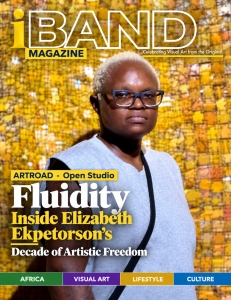
From Different Shades of Being to an open studio invitation, the Lagos-based artist peels off labels and invites us into her workroom.
Words: Ireho Aito | Don’t Keep Your Art in the Finger! Photograph courtesy of Elizabeth Ekpetorson
Elizabeth Ekpetorson lives and works on the island of Lagos, on the top floor of a high-rise along the Lekki–Epe Expressway. Her apartment is home, studio and a place of retreat where she can remain indoors for weeks, absorbed in the demands of her creative practice. Open the door, and the first impression is of an artist whose life has become inseparable from the things she makes. Her surroundings carry traces of charcoal drawings, models and artistic experiments, while the arrangement of her working space offers a glimpse into a mind that is constantly observing, questioning and searching for another way to express an idea. For Elizabeth, who prefers to be called Eleez, the studio is not simply where art is produced. It is where she continues to discover herself.
Her short, platinum-gold hair, distinctive glasses and collection of tattoos give her a striking presence. There are approximately 24 tattoos on her body, including the names of her parents, each contributing to a personal visual language through which she expresses herself. Yet the appearance is only one part of a larger conversation about identity, freedom and the courage to live beyond conventional expectations. Eleez identifies as a non-binary artist, and her relationship with identity is closely connected to her understanding of art. She does not see herself as a person who must fit neatly into a predetermined category before she can be understood.
“I believe in discovering myself and not to be boxed up in one conventional atmosphere,” she says.
It is a thought that runs through her life and creative practice. Her work explores the human form, emotions and the experiences that shape how people see themselves and are seen by others. She is interested in what lies beneath appearances, in the parts of a person that remain hidden behind social expectations, shame or the labels imposed by others. Her interest in women whose voices have been silenced or whose identities have been judged adds another dimension to this exploration. The body, in her hands, can become a place where questions of freedom, vulnerability and self-acceptance are brought into view.
Her understanding of identity is not limited to a single aspect of who she is. It begins with the person before the labels.
“Before being a woman, Nigerian, African or artist, I consider myself a human being,” she says.
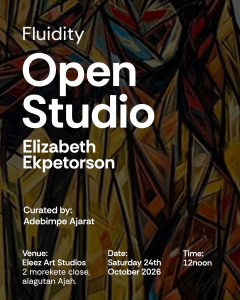
That statement offers a way into Fluidity, the open studio experience through which Eleez marks ten years of full-time artistic practice. She began working full-time in October 2016, making October 2026 a significant point in her professional journey. The milestone provides an opportunity to look back at the decisions, experiences and bodies of work that have shaped her, while considering the possibilities that remain ahead.
For Eleez, the relationship between the artist and the art cannot easily be separated.
“What I do isn’t an integral aspect, or a percentage, rather it is me in entirety,” she says.
The thought is revealing. Art is not an occasional activity that she steps into and out of at will. It is part of how she experiences the world, interprets her surroundings and gives expression to what she might otherwise struggle to communicate. Her practice is bound to her search for identity, but it also extends into her observations of other people and the environments they inhabit.
To understand how that relationship developed, it is worth returning to Port Harcourt, where Elizabeth Chioma Ekpetorson was born in 1991 and raised as the youngest of six children. Her father, Ekpetorson Felix, worked in the oil industry, while her mother, Ego-Oyinbo Betty Ekpetorson, was a fashion designer from Imo State. Her father was from the Kwale area of Delta State, and her parents met in Rivers State, where the family made its home.
Creativity was not an unfamiliar presence in the household. Her mother’s fashion practice involved working with magazine cuttings and collage, assembling materials to create something new. As a little girl, Elizabeth was fascinated by what happened in that space. She would wander into her mother’s studio, eager to participate, sometimes becoming a distraction to a woman trying to concentrate on her work.
“I used to disturb her a lot in her studio back then at the age of four,” Eleez recalls with laughter. “One day, she decided to carry me because of my disturbance and placed me on top of the cupboard and asked me that I am free to jump from the cupboard if I want.”
The story brings a smile, but it also captures the early relationship between mother and daughter: a young child determined to be part of the creative activity taking place around her. Her mother’s studio was a place of discovery, and Elizabeth’s curiosity kept drawing her back.
Drawing soon became one of her favourite activities. She would scribble on whatever was available, experimenting with lines and colours and making use of scraps she could lay her hands on. Her mother noticed the interest and encouraged her to draw. Sometimes she would request a portrait of Jesus, offering the young Elizabeth an opportunity to demonstrate what she could do.
“Come, Elizabeth, please kindly draw this Jesus’ portrait for me,” her mother would say.
The encouragement, however, came with a standard that the child did not always meet. Her mother could be supportive one moment and critical the next, a combination that Elizabeth remembers with affectionate humour.
“I prayed never to have clients like my mum at any time,” she says.
That early experience may have given her a first taste of the expectations artists encounter when they put their work before an audience. Encouragement does not always mean unqualified approval, and the person who appreciates one’s talent may also be the person who demands more. Her mother recognised the creative spark in her daughter, but she did not treat every drawing as a finished achievement.
The family placed considerable importance on education and practical skills. Her mother believed that attending school should be accompanied by learning something useful, an ability that could help a person navigate the uncertainties of life. In a society where qualifications alone do not always guarantee employment, acquiring a skill was seen as a way of creating opportunities.
“She doesn’t believe in just going to school for school’s sake. There was this ideology from her that Nigeria is growing into that kind of a society where skills will determine how far you can go,” Eleez explains.
The family’s decisions reflected that belief. Her eldest sibling attended the DOF Institute to study catering, while the other five children attended Government Technical College in Port Harcourt, specialising in different fields. For Elizabeth, painting and decorating provided a natural direction. Her childhood fascination with drawing was beginning to take on a more practical shape, and she was moving towards an education that could help her develop those interests.
She attended Emmanuel Comprehensive Primary School before proceeding to Government Technical College. Later, she gained admission to the University of Port Harcourt to study Fine Art and Design. The journey appeared to be following the direction she had always wanted, although getting there required her to trust her own judgement.
When she went to register for the Joint Admissions and Matriculation Board examination, technical difficulties disrupted the process. Finding Fine Art as a course option proved challenging, and the people assisting her suggested that she choose another course and try to change it after a year.
For a moment, the advice created uncertainty. Foreign Languages and Literature became a possible alternative, with the prospect of eventually becoming a career diplomat. It was a respectable ambition, but it was not the one that had brought her to that point.
Then she remembered her mother’s words.
“I remember my mother’s strong words, which I can never forget. She said, ‘So you want to go and do what you don’t love and regret later in life to see people excelling in what you always wanted to do?’”
The question forced her to look beyond the immediate difficulty and consider the consequences of abandoning an ambition she had carried since childhood. Her mother’s advice was not simply an instruction to pursue art. It was a reminder that the decision belonged to her, and that she would have to live with whatever direction she chose.
For Eleez, that moment reinforced the importance of listening to herself. Other people’s opinions can be useful, but they cannot substitute for the understanding a person must develop of their own desires and abilities. She continued towards Fine Art and Design, choosing to give her creative interests the opportunity to grow.
Her love of literature has also contributed to the way she thinks about people. Books offer her another means of exploring identity, upbringing and the consequences of personal choices. Her reading includes Lord of the Flies, which she first encountered in a pirated edition, and Purple Hibiscus by Chimamanda Ngozi Adichie.
Her experience with Purple Hibiscus was memorable for an unexpected reason. Some pages of the copy had been printed in such a way that she found herself turning the book upside down to follow the text.
“This copy of Purple Hibiscus was so funny reading it. I had to be turned upside down at a point. That is how my copy was printed,” she says, laughing. “If you had seen me then with the copy, you would think something was going wrong with me.”
The incident is amusing, but her interest in reading is serious. She sees literature as a way of examining the forces that shape people and influence their behaviour.
“Literature helps me think and understand. I use it to think,” she says.
She particularly remembers Chinua Achebe’s Things Fall Apart, which encouraged her to consider how upbringing can shape a person’s choices. Her attention is drawn to Okonkwo, the central character, and the fear that drives him to avoid becoming like his father.
“It makes me to see how upbringing can shape your path and life decisions. Everything that the character Okonkwo did was done not to be like his father,” she observes. “Despite having another father figure that he could have learned from or looked up to for guidance, that fear of not wanting to be like his father did not allow him to see beyond the edge.”
It is a reflection that resonates with her own journey. The influences that shape a person can provide direction, but they can also become limitations if they prevent the individual from seeing other possibilities. Eleez has drawn encouragement from her family, especially her mother, while learning to make decisions that reflect her own ambitions and sense of self.
Her professional journey began to take clearer shape when she travelled to Lagos for her industrial training at Universal Art Studio in Iganmu. She was about 22 when she arrived, entering an environment that would change her understanding of what it meant to work as a visual artist.
Until then, her experience of the art world in Port Harcourt had been limited. She had seen artisans working by the roadside, but she had not fully encountered the professional structures, work ethic and networks that could sustain an artistic career. At Universal Art Studio, she found artists who had spent years developing their practices and earning a living from their work.
“At Universal Art Studio, I saw artists whom I got to know they have been doing what they do professionally for over 10, 15, 20 and more years without looking back,” she says.
“I was amazed with the work ethics and output every day that I could not but go deep to know more about this business. This group of artists at the studio were making good living from what they love. It was very impressive and encouraging compared to where I was coming from.”
The experience was an eye-opener. It showed her that an artistic career could be built through consistency, professional relationships and an understanding of the business behind the work. She was no longer looking at art only as a passion or a course of study. She was beginning to understand the practical decisions involved in making it a lifelong occupation.
The period was also marked by personal loss. Her father died while she was away in Lagos for her industrial training, having been ill at the time. She lost her mother during her final year at university. The deaths of both parents meant that the people who had encouraged and shaped her childhood would not be present throughout the next stage of her journey.
Her older brother became an important source of support, helping her navigate the transition into professional life. He encouraged her to take Lagos, as a base seriously, believing that the city offered better opportunities for her chosen career.
“My older brother also agreed that Lagos will provide better opportunities for my career path than Port Harcourt and he was very supportive,” she says. “We never really had that kind of flamboyant art culture in Port Harcourt. What we could see were the average artisans on the streets, working by the roadsides, and we couldn’t really build our careers toward those scenes we saw.”
After graduating in 2015, she also encountered an unexpected obstacle when she tried to join art-oriented organisations in Port Harcourt. She was told that they could only accept artists who were indigenes of Rivers State, despite her having been born and raised there.
“I was short of words,” she recalls.
The encounter was discouraging, but her experience at Universal Art Studio had already given her a clearer idea of the professional possibilities available elsewhere. She had seen artists sustain their careers, and she was convinced that she could do the same.
She continued developing her skills under Joshua Emezuronye at Universal Art Studio before he left to undertake the National Youth Service Corps programme in Zamfara State. Her own service year took her into teaching, an experience that helped her understand what she did not want to pursue.
“It was during the scheme that I realised teaching was awful for me as I was posted to serve in school,” she remembers with humour.
When her service year ended on 10 October 2016, Eleez did not wait long to make her next move. On 12 October, she went to the railway station in Kaduna and took a three- day train journey to Lagos.
The decision marked the beginning of a new phase. After staying with friends for a while, she received further help from her older brother, who paid the bills for a new home and gave her the support she needed to settle down. She returned to Universal Art Studio, where she undertook a full year of internship through 2017.
By 2018, she was practising full-time from her own home, building her career through a combination of personal discipline, exhibition opportunities and relationships within the art community. Her full-time practice had begun in October 2016, however, and that date remains central to the ten-year milestone she now celebrates.
The early years required persistence. Eleez participated in numerous group exhibitions, some of which she paid to join, while others came through invitations. Her first invitation was to Next of Kin at Thought Pyramid Art Centre in Ikoyi, followed by Faces and Phases at Terra Kulture and other exhibitions.
Each appearance offered a chance to meet audiences, build relationships and become more familiar to the people who followed contemporary art in Lagos. She understood that a career could not develop in isolation, and she remained open to opportunities that might bring her work into new spaces.
Yet there was also a point when she recognised the need to slow down and reflect on the direction of her practice.
“It got to a point I had to ask myself to calm down. I was just moving on without looking back,” she says with a smile.
The experience taught her that being present everywhere was not necessarily the same as making progress. Exhibitions offered visibility, but she also needed time to develop her work and understand what she wanted to communicate. Her practice would have to grow through both participation and reflection.
In 2019, she presented her first solo exhibition, Live and Let Soar, featuring approximately 35 works, including eight to ten drawings alongside paintings. The title drew inspiration from the expression “Live and Let Live”, transforming it into an encouragement for people to support one another’s progress.
The exhibition marked an important step in her journey. It brought together a body of work under her own name and offered audiences a more concentrated encounter with her ideas. Although sales were not as strong as she might have hoped, the exhibition helped establish her visibility and gave her work a wider audience.
For an emerging artist, the relationship between making art and earning a living can be difficult to navigate. Materials cost money, opportunities require investment, and recognition does not always translate immediately into patronage. Eleez nevertheless understood that people needed to encounter her work before they could develop an interest in collecting it.
“Over time I started getting interest from different patrons,” she says.
Collaboration and networking became important parts of her development. She continued participating in exhibitions, meeting other practitioners and establishing relationships that could help her work reach new audiences. Following the COVID-19 lockdown, she moved from Ikorodu to the island of Lagos, placing herself closer to the galleries, collectors and art activities that formed an important part of her professional environment.
The lockdown itself was a period of adjustment, but Eleez found opportunities to experiment.
“Lockdown for me was cool. I was still living at Ikorodu. I used that period to expand my practice by being more innovative,” she says.
With many activities moving online, she found room to explore different possibilities. Yet the period also brought emotional challenges. There were times when she became depressed, but she continued painting.
The experience found expression in her second solo exhibition, Different Shades of Being, presented in 2021 at the National Museum in Onikan, Lagos. The exhibition brought together ideas about identity, emotional experience and the different states through which people move.
“That period inspired my second exhibition title, Different Shades of Being,” she says. “If you had stumbled on my body of work exhibited for Different Shades of Being, you would have agreed that it was a personal relationship I had with the body of work.”
One of the ideas she explored was the duality that exists within human experience. People can be happy and troubled, confident and vulnerable, strong and uncertain. Such experiences do not necessarily belong to separate individuals. They can exist within the same person, sometimes at different points in life and sometimes in ways that are difficult to explain.
“There were works I called ‘Duality of Nature’,” Eleez recalls.
“In some of the works you could see some part of the models dark while another part lighter. Sometimes one could be in joyful moments and another time the same person is going through a lot of low moments.”
The contrast between darkness and light becomes a way of thinking about the different parts of human experience. The outward appearance of a person does not always reveal what is happening within. A portrait may show the face, but the emotional life behind that face is far more complicated.
This interest in what lies beneath appearances connects her exploration of duality to her broader engagement with identity. Her use of the human form, including nudes and portraits, allows her to consider the relationship between the visible body and the individual whose experiences it carries. The body can be presented as something to be judged by others, but it can also become a means through which people reclaim their presence and express themselves without apology.
Her interest in women who have been silenced or shamed adds a social dimension to this concern. The expectations placed on women can influence how they present themselves, what they reveal and what they feel compelled to conceal. In such a context, the human figure becomes more than an object of observation. It can prompt questions about dignity, vulnerability, self-acceptance and the freedom to be seen on one’s own terms.
For Eleez, these concerns belong within a larger exploration of what it means to be human. Her work does not need to offer a single answer to every question it raises. Instead, it allows different experiences and interpretations to coexist, inviting viewers to consider what they recognise in the figures before them and what remains beyond their immediate understanding.
Her preferred drawing medium is charcoal, which offers a direct and responsive way to work with the human figure. She appreciates its capacity for variation, from delicate marks to strong contrasts, and the way it allows an image to develop through a process of discovery.
“I enjoy working with charcoal a lot. The way it flows and comes to me naturally,” she says.
She also enjoys acrylic, a water-based medium that offers different possibilities for building colour and working across surfaces. Her practice includes work on damask, cotton and paper, while her stylistic interests encompass cubism and impressionism. These references provide ways of considering her approach to form, composition and visual expression, although the meaning of each work ultimately depends on the ideas she chooses to pursue.
Charcoal and acrylic offer different ways of responding to a subject. One may emphasise the force of a line or the movement of a shadow; the other can introduce colour, texture and changes in atmosphere. In either case, the medium becomes part of the conversation between the artist and the image.
This commitment to her own direction also informed her decision to exhibit Different Shades of Being at the National Museum.
“It is better to be precise about what you are doing,” she advises.
She had set herself a clear goal for herself which is to hold her solo exhibition at a venue whose name would carry weight when she spoke about her work beyond Nigeria.
“I told myself that I wanted my solo exhibition to be held at a place if I told anyone outside Nigeria that I have exhibited at my National Museum, such people would surely take me seriously,” she says.
The decision was an expression of ambition, but it also demonstrated the importance of making deliberate choices. She was learning to identify the opportunities that aligned with her aspirations rather than simply accepting whatever became available.
Her practice would also take her beyond the studio and into the natural environment. During a residency at Tarkwa Bay, Eleez found herself drawn to the water and the opportunity to observe the surroundings closely. She began her mornings by walking before returning to her work, allowing the environment to shape her thoughts and artistic responses.
“During that residency, it was fun to be around where there is water. First thing in the morning for me was to wake up and walk, then come back and create,” she recalls.
But the beauty of the location was accompanied by a growing awareness of its neglect. She observed the condition of the lighthouse, the state of the surroundings and what she considered a troubling absence of proper maintenance.
“Overall, I felt sad at Tarkwa Bay because I was exposed to high level negligence around the place,” she says.
The lighthouse became a particular focus of her attention. What might have been viewed simply as a ruined structure became, for the artist, a subject through which she could reflect on the relationship between beauty, deterioration and responsibility.
“Apart from the lighthouse which I concentrated on, a lot of mismanagement was going on. One could see oil filtering away. This is a place that should have been a tourist site but one could only see the downward spiralling of things around the place. The artist in me had to react to this with my illustrations.”
Her response took shape in the A Beauty Forlorn series, associated with the ruined lighthouse and a striking palette that includes acid greens and hot pinks. The colours offer a way of interpreting the place rather than merely reproducing its physical appearance. They bring an expressive dimension to a landscape marked by neglect, allowing the artist’s response to become part of the visual experience.
Her observations also led to a wider reflection on the responsibility to maintain places that hold environmental, cultural or tourism value.
“The average Nigerian has a maintenance problem,” she says.
The remark is direct, but its implications extend beyond Tarkwa Bay. The preservation of public spaces requires continued attention, and places with considerable potential can lose their value when care is neglected. Through her illustrations, Eleez responds to what she sees, turning an encounter with a damaged environment into an artistic statement.
The experience also demonstrates that her interests are not confined to the human figure. Although the body and personal identity remain important to her practice, she is equally capable of allowing a place to become the subject of observation and interpretation. Her work can move from intimate questions about the individual to wider concerns about the environment in which people live.
That willingness to move between subjects and experiences brings us back to Fluidity.
The title is deliberate, drawing on the idea of water as a symbol of movement, adaptability and the ability to continue without becoming trapped in one form.
“This is coming from that idea of water. Being versatile and not being stuck,” Eleez explains.
The experience of the pandemic demonstrated how quickly familiar routines could change. Artists, like many others, had to adapt to new ways of working, communicating and presenting their work. For Eleez, adaptability has become part of how she understands her practice and her relationship with the world.
“As we go into post-COVID, many things have changed, we became adaptable. For me, that is the whole idea. My art and me are both wrap in one,” she says.
There is an important distinction between changing direction and losing one’s sense of purpose. Fluidity suggests that a person can evolve, respond to new circumstances and explore unfamiliar territory without abandoning the experiences and values that have shaped them. For an artist, this can mean allowing a practice to develop rather than insisting that every new work must resemble the last.
It is also an invitation to look at the past without becoming confined by it. Ten years of full-time practice offer Eleez an opportunity to consider how far she has travelled since returning to Lagos in October 2016. She has moved from training and internships to independent practice, from group exhibitions to solo presentations, and from the early exploration of her identity to bodies of work that examine emotional complexity and environmental neglect.
Her journey has not been free of difficulty. There have been periods of uncertainty, disappointing experiences and moments when patronage did not match her expectations. Yet she has continued to work, learning from each stage and allowing the experience to inform what comes next.
That persistence is one of the qualities curator Adebimpe Ajarat appreciates in her practice. Ajarat began becoming familiar with Eleez’s work in 2019 and has since developed a closer relationship with the artist, including through their time together at the Mind Calories Residency.
“I just love her work. Her composition and working with charcoal makes her unique and could be defined,” Ajarat says.
Her appreciation extends beyond the visual qualities of the work to the consistency behind it. Ajarat believes that an artist’s practice requires a commitment that goes beyond periods of recognition or favourable circumstances.
“She is a real artist. Real artists don’t work based on circumstances,” she says. “You can see a lot of artists practising right now and you know that you may never see them again on that journey in the next five years.”
It is a reminder that a creative career is sustained through time. Exhibitions can introduce an artist to new audiences, but a lasting practice requires the willingness to continue working after the immediate excitement has passed. The ability to keep producing work, even when circumstances become difficult, is part of what gives a decade of practice its significance.
Eleez understands this distinction. She knows that patronage is not always predictable, and that there are periods when the financial rewards of an artistic career may fall short of expectations. Yet she does not regard those fluctuations as the final measure of her progress.
“Sometimes, you need to look back and appreciate how far you have gone in the creative space,” she reflects. “There are times when patronage is down, but you are not down. It has always been art or nothing.”
Her words return the conversation to the relationship between the artist and the work. There is a practical side to sustaining a career, but there is also a personal commitment that cannot be measured entirely in sales or exhibition invitations. The work continues because the artist remains engaged with the questions that brought her to it in the first place.
For Ajarat, the tenth anniversary is an opportunity to honour that commitment while opening another conversation between Eleez and her audience. A book accompanying the project is planned for release in 2027, extending the celebration beyond the immediate event.
“Celebrating a decade of art practice is to launch into something bigger. Like the word fluidity, you keep flowing. So celebrating a decade is to honour her and also bridging the gap between her and her audience,” Ajarat explains.
That connection is central to the open studio. An exhibition presents finished works to an audience, often within a limited period in which the artist may have little time for extended conversations with visitors. The studio offers a different kind of encounter. It allows people to come closer to the environment in which the work is produced and to ask questions about the process, the ideas and the experiences behind it.
Ajarat wants visitors to engage with both the work and the person who makes it.
“It is easier and conducive to have such conversations in the studio than at exhibitions where the time would not be available for the artist to do such,” she says.
The invitation gives audiences an opportunity to encounter works that Eleez has not previously brought out, while allowing her to discuss the process through which her ideas take shape. It offers a view of artistic practice that is not limited to the polished moment when a work appears on an exhibition wall.
Eleez is enthusiastic about sharing that experience.
“I am enthusiastic about this experience. People should come and see the birth process of how things are done before they go for exhibition,” she says.
“It also gives the audience to see some of my works that I have not brought out before and we can talk about them.”
The open studio, taking place on Saturday, 24 October 2026, is therefore more than an occasion to celebrate a professional anniversary. It is an invitation to enter the space where the artist’s thoughts, observations and experiments come together. Visitors can encounter the work before it reaches the formal setting of an exhibition, and they can engage with the person whose experiences continue to inform it.
iBAND Magazine, Celebrating Visual Art from the Original.
Africa | Visual Art | Lifestyle | Culture

