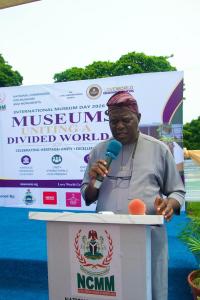
Veteran Nigerian artist, scholar and former Dean of the School of Art, Design and Printing, Yaba College of Technology, Dr. Kunle Adeyemi, has described museums as powerful institutions capable of fostering unity in an increasingly divided world.
Words Ireho Aito | Don’t Keep Your Art in the Finger! Photographs credit: Uzezy Arure Adejoh

Delivering a paper titled “Museums Uniting a Divided World” during the 2026 International Museum Day celebration at the National Museum, Onikan, Lagos, Dr. Kunle Adeyemi argued that museums have evolved beyond their traditional role as repositories of artefacts to become active centres of dialogue, education, reconciliation and peaceful coexistence.
Addressing museum professionals, researchers, artists, students and invited guests, he observed that contemporary society is confronted by numerous challenges.

“Today’s world space, you will agree with me, has been characterised by strife, unnecessary wars, conflicts, religious intolerance, banditry, kidnapping and other forms of social disorder,” he said.
“In the face of these global disorders, the museum as an institution stands to promote genuine dialogue, lasting cooperation and peaceful co-existence.”

Reflecting on his own artistic journey, Adeyemi paid tribute to the National Museum, Onikan, for its role in nurturing young artists during the 1980s.
“The National Museum was one of the organisations that made us who we are as veteran artists today,” he recalled.

“It is gratifying to note that the management believed in us so much that I had my first solo exhibition in September 1989.”
He recounted how that exhibition opened international opportunities, including an invitation to an artist residency in Brooklyn, New York.
“A lady curator at a gallery in Manhattan saw my profile as having shown my works at the National Museum of my country and concluded that I was famous in my country. She advised that I should stay with my roots, Nigeria.”

Returning decades later to deliver a keynote presentation at the same institution, Adeyemi expressed appreciation to the museum’s leadership.
“Here we are today again under the auspices of another curator, Mrs. Nkechi Adedeji, inviting me as an art scholar to deliver a paper titled ‘Museums Uniting a Divided World’. I cannot thank you enough for the value placed on me as a Nigerian artist.”
Throughout the lecture, Adeyemi emphasised the significance of museums in preserving humanity’s collective heritage.
“Museums are invaluable institutions that preserve the memory, creativity, achievements and heritage of humanity,” he stated.

“They function not only as storehouses of artefacts but also as educational and cultural centres that promote research, creativity, tourism, national pride and intercultural dialogue.”
According to him, museums help communities appreciate diversity while recognising common human aspirations.
“Whether displaying African bronze works, Asian ceramics, European paintings or Indigenous cultural materials, museums demonstrate that every culture contributes to the global human story.”

He further argued that museums are uniquely positioned to address social divisions through education.
“Education remains one of the strongest tools against division and ignorance,” he said.
“Many social conflicts arise from misinformation, historical distortions or lack of exposure to other cultures. Museums counter these problems by presenting evidence-based narratives and encouraging critical thinking.”
Adeyemi also described museums as neutral spaces where people from different backgrounds can encounter one another peacefully.
“When individuals understand the customs and histories of others, they are more likely to develop empathy and tolerance,” he noted.

“Museums therefore function as cultural diplomats, promoting understanding through artistic and historical engagement rather than conflict.”
On the question of historical trauma, he stressed that museums have an important role to play in healing societies.
“Rather than concealing difficult histories, museums provide opportunities for communities to confront past injustices and collectively seek healing.”
He cited institutions dedicated to preserving memories of slavery, colonialism, apartheid, genocide and civil rights struggles as examples of how museums can encourage reflection and reconciliation.
As museums continue to evolve, Adeyemi advocated for greater inclusivity and representation.
“When people see their stories and identities respected in museum spaces, social alienation decreases,” he said.
“Community-curated exhibitions also empower people to participate directly in cultural interpretation, thereby democratising knowledge production.”
The scholar also highlighted the universal language of art.
“Art possesses a unique ability to transcend language, religion, race and political ideology,” he said.
“A painting depicting suffering, joy, migration, motherhood, celebration or resistance can resonate universally regardless of cultural background.”
Concluding his presentation, Adeyemi described museums as vital institutions for the future of humanity.

“In a world increasingly threatened by division, intolerance and conflict, museums remain vital cultural institutions capable of reminding humanity of its interconnectedness and shared destiny.”

“Far beyond being storehouses of objects, museums are transformative spaces where history, memory, creativity and dialogue converge to build bridges across social, cultural, religious and political divides.”
Ultimately, he said, “museums are not merely guardians of the past; they are architects of a more united future.”
iBAND Magazine, Celebrating Visual Arts from the Original.
Africa | Visual Art | Lifestyle | Culture
 iBAND Magazine
The Museums researched paper by Dr Kunle Adeyemi is beautifully captured.
LikeLike
Thank you so much
LikeLike