Print on Archival Paper
53.34 x 38.1cm
Edition 1/15
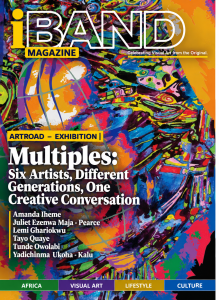
Lagos Island has always been a meeting point for people, ideas, trade and history. Walk through its streets and you find traces of different generations living side by side, sometimes in the same building, sometimes in the everyday objects we have learnt to overlook. It is an interesting place to consider an exhibition like Multiples, now showing at No Parking Lagos, where June Creative Art Advisory brings together six artists working across printmaking, photography, illustration and graphic design. Their works raise a simple but important question: must an artwork exist as a single piece to be valued, collected and enjoyed? Multiples invites us to look again at how art is made, shared and experienced.
Words Ireho Aito | Don’t Keep Your Art in the Finger! Photographs and images courtesy June Creative Art Advisory
There is something interesting about Multiples, the ongoing exhibition at No Parking Lagos, Onikan. Six artists, different generations and a variety of artistic practices have come together in an exhibition that asks us to look at art beyond the familiar idea of a single, original work.
Curated by June Creative Art Advisory, Multiples brings together Yadichinma Ukoha-Kalu, Juliet Ezenwa Maja-Pearce, Amanda Iheme, Tayo Quaye, Tunde Owolabi and Lemi Ghariokwu. Their works move across printmaking, photography, illustration and graphic design, bringing different experiences and approaches into the same space.
For me, the gathering is one of the interesting things about this exhibition. Tayo Quaye’s relationship with master printmaker Bruce Onobrakpeya goes back to his school days at St. Gregory’s College, Lagos. Maja-Pearce and Ukoha-Kalu share a connection through the Harmattan Workshop organised by the Bruce Onobrakpeya Foundation. Ghariokwu’s career takes us back to the album covers that helped define the visual identity of Fela Anikulapo-Kuti’s music. Iheme looks at the architecture of everyday Nigeria, while Owolabi moves between photography, sculpture, print and design.
These are not artists telling the same story. Their coming together gives us an opportunity to see how different generations have approached the making, reproduction and circulation of images.
June Creative Art Advisory is becoming the missing link in Nigeria’s and Africa’s art advisory space. Its exhibitions have shown an interest in bringing art closer to people, encouraging conversations and making room for stories that might otherwise remain outside the usual gallery experience. The team at No Parking Lagos has also created a setting where the exhibition itself becomes a starting point for wider engagement with artists, collectors and the public.
iBAND Magazine has followed some of this work. In October 2025, we visited Afrobeat Rebellion: Fela Anikulapo-Kuti, curated by Seun Alli at Ecobank’s Pan African Centre on Victoria Island. The exhibition brought together archival material, photographs, installations and stories around Fela’s life, music and political legacy. In February 2026, our ARTROAD coverage turned to Murtala Ramat Muhammed: Life, Leadership and Legacy, presented by the Murtala Muhammed Foundation and curated by Alli at the Nigerian Institute of International Affairs, Lagos. We also covered Without Rest: The Crown We Gain, Tunde Owolabi’s solo exhibition at No Parking Lagos, and joined the artist for a walkthrough and conversation that offered a closer look at his practice.
These exhibitions have approached different subjects, but they share an interest in how art can tell stories, preserve memory and help audiences see familiar things differently.
For Multiples, Alli’s curatorial statement places the idea of access at the centre of the exhibition.
“Print has historically offered a democratic and accessible alternative to the singular artwork. Through editions, an image can travel between homes, collections, publications and public spaces, reaching wider audiences and creating more approachable pathways into collecting.”
She further explains that the exhibition does not treat reproduction as something secondary to an original work. Instead, Multiples examines “repetition, variation and circulation as integral parts of artistic production.”
That thought is worth considering in a country where many people admire art but may still see collecting as something reserved for a small circle. An edition can offer another way to begin a collection. A photograph can preserve a part of a city’s history. A print can carry an artist’s ideas into different homes and communities. The process of making multiples opens up possibilities without taking away the individual character of the work.
The story of Tayo Quaye, a grandmaster, brings this conversation into the history of Nigerian printmaking. As a student at St. Gregory’s College in Obalende, Lagos, Quaye met Bruce Onobrakpeya, one of Nigeria’s modernists through the renowned natural synthesis and who would become an important figure in his artistic development. From 1974 to 1976, Quaye trained as an apprentice and worked as a studio assistant at Onobrakpeya’s Ovuomaroro studio.
He later studied Painting at Yaba College of Technology, where Yusuf Grillo helped strengthen his approach to line, stylisation and economy of form. Over more than five decades, Quaye has developed a distinctive visual language, particularly through his large-scale plastocast prints. His works draw on metaphor and symbolism to explore everyday experiences and Nigeria’s social and political realities.
His place in Multiples also brings attention to the people and spaces that sustain artistic traditions. The knowledge passed from a master to an apprentice does not end when the training is over. It continues to develop in the work of the artist, who may eventually introduce those techniques and ideas to another generation.
Juliet Ezenwa Maja-Pearce’s story offers another connection between artistic practice and the sharing of knowledge. A painter, printmaker, writer and cultural advocate, she has spent more than three decades working across different media. Born in Benin City in 1968, she studied Visual Arts at Bendel State University, now Delta State University, Abraka, and later worked as an apprentice and artist-assistant to renowned painter and one of Auchi school of colours, Sam Ovraiti.
Since 2007, she has participated regularly in the Harmattan Workshop organised by the Bruce Onobrakpeya Foundation, becoming a facilitator in its printmaking section in 2012. Yadichinma Ukoha-Kalu also participated in the workshop, providing a link between two artists whose practices have developed in different directions.
Ukoha-Kalu is a multidisciplinary artist and illustrator whose work spans painting, drawing, printmaking, sculpture, metalwork, film and technology. Her interest in material culture comes from an understanding that objects carry their own histories and systems of meaning. She combines forms, textures and materials to explore space, boundaries and the relationships between individual elements.
Her series First, I Dreamed considers the dream as a beginning, whether it comes through thought, aspiration or sleep. The work reflects on how ideas and desires gradually find expression, with colour becoming a way of locating hope in personal experience.
The connection between Maja-Pearce and Ukoha-Kalu is more than a shared exhibition space. Their involvement in the Harmattan Workshop points to the movement of artistic knowledge across generations. Each artist develops her own language, but the opportunity to learn, experiment and exchange ideas remains an important part of the journey.
Amanda Iheme comes to the exhibition through photography. Based in Ibadan, the historical fortress know for his deep Yoruba culture, profound tribal marks, myriads of highway roundabout, many hills and bums. Not forgetting the power of the popular Micra taxis all over the cities being handled by loquacious Ibadan drivers. Amanda Iheme is an architectural photographer, researcher and art educator whose work documents buildings, spaces and landscapes. She pays attention to the design and history of the built environment, including structures that people encounter every day but rarely stop to examine.
Her photographs of filling stations in Ibadan are particularly interesting in this context. Filling stations have become familiar features of Nigerian cities, yet their architectural forms often receive little attention. By photographing them as a series, Iheme creates a record that allows viewers to compare their forms and consider their place in the city’s development.
Her wider work includes Gates, an archive of disappearing gate designs, and projects documenting Ibadan’s architectural history. These projects show how photography can preserve details of a changing environment. What appears ordinary today may become an important record of how a city once looked and lived.
In Multiples, the repetition of images allows differences to become visible. The photographs are not simply records of buildings; together, they invite a closer look at the spaces that shape everyday life.
Tunde Owolabi is another artist whose work iBAND Magazine has followed closely. In April 2026, we covered his solo exhibition Without Rest: The Crown We Gain, a presentation of sculpture, photography and prints curated by Seun Alli at No Parking Lagos. We returned in May for his artist talk and exhibition walkthrough, where the conversation moved from art and materials to family expectations, childhood drawing and the experiences that eventually led him towards an artistic career.
Owolabi’s journey was not a straight line. During the artist talk, he recalled his mother’s hope that he would become a medical doctor. As a schoolboy, however, he was more interested in drawing cartoon characters in his notebooks and textbooks than in meeting her expectations. He eventually gained admission to study Creative Arts at the University of Lagos before continuing his education at Yaba College of Technology.
That early interest in drawing has since developed into a multidisciplinary practice spanning sculpture, photography, print and graphic design. He also co-founded Ethnik Afrika, a design brand exploring Yoruba and wider African visual cultures through contemporary textile design.
In Without Rest: The Crown We Gain, Owolabi turned his attention to women whose daily work keeps neighbourhoods and local economies moving. Market women, hawkers, food sellers and traders became the subjects of sculptures, photographs and prints. The works were rooted in observation, including the artist’s encounters with people whose labour is so familiar that it can easily be overlooked.
Speaking about the women at the heart of the exhibition, Owolabi described the value of their work in direct terms: “Philosophically and literally, her work is her crown.” The statement captures the central thought behind the exhibition: labour can carry dignity and meaning even when it receives little public recognition.
During our earlier coverage, I was struck by the way the exhibition connected the gallery to life outside it. Looking down from the gallery, I saw two women working with reclaimed bottles. Their labour continued below as the exhibition explored the lives of women working across Lagos. It was one of those moments when the subject of an exhibition seemed to be taking place right before one’s eyes.
Owolabi’s inclusion in Multiples brings his interest in image -making and material experimentation into another setting. His work moves between different media, and the exhibition gives audiences another opportunity to consider how images and forms can be repeated, adapted and encountered in different ways.
Then there is the living legend Lemi Ghariokwu, whose work brings a major chapter of Nigerian music and visual culture into the exhibition.
iBAND Magazine featured Ghariokwu in a cover story marking his 70th birthday. He clocked 70 on December 26, 2025, after a career shaped by drawing, design, music and social commentary. His collaboration with Fela Anikulapo-Kuti produced some of the most recognisable album covers in African music, including Zombie and Sorrow, Tears and Blood.
The story of how the young Ghariokwu met Fela remains one of those moments when a chance connection can change the course of a life. In an earlier interview with iBAND Magazine, Ghariokwu recalled how music journalist Babatunde Harrison, then with Punch newspapers, introduced him to Fela. Harrison knew the young, self-taught artist through a liquor-selling establishment owned by an Ijaw family, where Ghariokwu often sat drawing.
Fela needed an album cover, and Harrison believed the young artist could do the job after seeing what he did with the famed Bruce Lee portrait. Harrison returned, looked through Ghariokwu’s catalogue and took him across the railway line at Idi-Oro, Mushin, towards Kalakuta.
Ghariokwu was barely 19. He had grown up in a religious household, and the visit to Fela’s commune was an unfamiliar experience. As he recalled in our earlier feature, “My mother was a religious person,” and she blessed his visit to the musician’s abode.
He also admitted, “I was a bit afraid. The house was full of community to behold.”
The encounter soon became a defining moment. Fela looked at the artwork Ghariokwu had brought and approved it. When a cheque was offered, the young artist declined it, explaining his decision simply: “I just wanted to do it for him.”
Fela instead gave him access to his world, including a handwritten note that allowed him to visit his home and shows. The meeting marked the beginning of a close creative relationship and a career that would see Ghariokwu help translate Afrobeat’s music and politics into a visual language recognised around the world.
His album covers were never just images placed on record sleeves. They carried messages, personalities and arguments. Through colour, lettering, portraiture and satire, they became part of the way audiences understood Fela’s music. Reproduced and circulated with the records, they travelled into homes and collections, helping to preserve the visual memory of an era.
That history makes Ghariokwu’s presence in Multiples especially fitting. His work demonstrates how an image can move far beyond its original setting and become part of a much wider cultural story.
The six artists in the exhibition have taken different routes, but their works return to a shared question about what happens when an image is allowed to travel?
For Quaye, printmaking is a practice shaped by decades of experimentation. For Maja-Pearce and Ukoha-Kalu, the exchange of knowledge forms part of the story. Iheme uses photography to document the built environment, Owolabi moves between art and design, and Ghariokwu’s graphic work shows how reproduced images can enter popular memory.
Seun Alli’s curatorial statement gives this gathering its wider context. By considering repetition, variation and circulation, Multiples makes room for a conversation about how art is produced, shared and collected. It also reminds us that the value of an artwork is not determined only by whether it exists as a single object. An edition can have its own history, reach a new audience and become meaningful in a different home.
The exhibition is currently on view at No Parking Lagos, 15 Military Street, Onikan, and runs until November 8, 2026.
Maybe, anyone who has wondered how to begin collecting art, or simply wants to spend time with works that offer different ways of looking at familiar things, Multiples is worth a visit. It brings six distinct practices together without asking them to become the same, leaving visitors to discover the connections for themselves.
The exhibition is currently on view at No Parking Lagos, 15 Military Street, Onikan, and runs until November 8, 2026.

