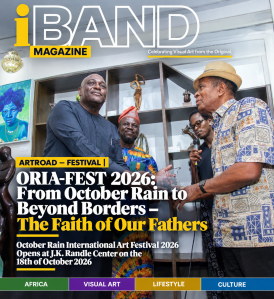
When the Society of Nigerian Artists, Lagos State Chapter, began its October Rain initiative, it was rooted in the familiar format of an annual visual art exhibition. Over the years, however, October Rain has grown into something larger, a platform for celebrating artists, preserving artistic legacies, recognising contributions to the Nigerian art ecosystem and creating opportunities for artists and the public to engage and see beyond borders. ORIA – FEST 2026 by Society of Nigerian Artists opens at J.K. Randle Center on the 18th of October and ends 24th of October 2026.
Words and Interview Ireho Aito | Don’t Keep Your Art in the Finger! Photographs courtesy Prince Kolawole Olojo – Kosoko
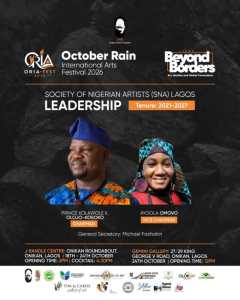
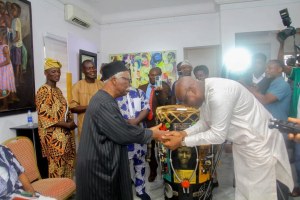
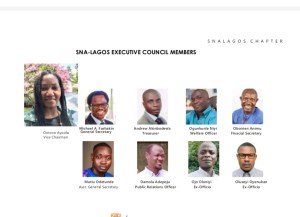
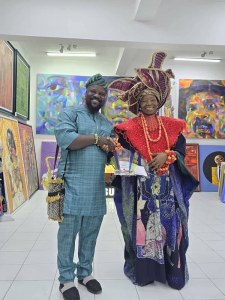
It was an emotional scene still to behold when the executive members of Society of Nigerian Artists, Lagos State Chapter, led by the current Chairman of the association, Prince Kolawole Olojo – Kosoko paid a courtesy visit and tribute to one of the founding members, fathers and the first Chairman of SNA Lagos Chapter. The group of artists wisdom of paying homage to the ones that paved the way and nurture the path for others who came behind them to grow will remain a legacy to pass down from generation to generation.
If anyone had ever visited the SNA Lagos Chapter social media platform such as their official Facebook, one would appreciate the essence of documentation and what Prince Kolawole Olojo – Kosoko led team has done with their stewardship, to steer the association of creative minds to masterpiece podium that they belong.
There are uploaded visuals in videos and literature of living legends interviews such as Dr. Kolade Osinowo, a renowned scholar, painter of Inter national repute who introduced the power of fashion for artists as brand style for prosperous appreciation by clients, Pa. Jerome Elaiho, a patron of the art, also has a documentary feature on the social network and not even forgetting Nathaniel Hodonu, another distinguished painter who gave account of how he joined SNA officially, and participating in his first October Rain and what the exhibition fetched him afterwards. Nathaniel Hodonu, actually confessed in the short but incisive interview that he made surprising amount of money from the work he exhibited at his first October Rain. It was unbelievable as he couldn’t believe his eyes. That was when it was known as October Rain.
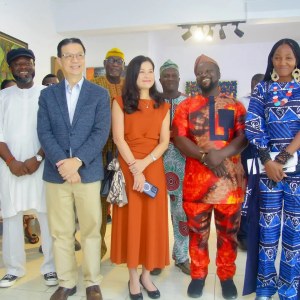
In 2026, that journey takes another step with its rebranding as October Rain International Arts Festival, ORIA-FEST 2026, under the theme “Beyond Borders.”
This year’s edition will be hosted at the JK Randle Centre in Lagos, at the historical Onikan where Lagos culture melts into one. On this edition this year, the festival looks beyond the conventional boundaries of an exhibition, bringing together visual art, sculpture, photography, performance, music, literary and other creative expressions.
And for SNA Lagos, the idea is not simply to introduce another festival to the Nigerian cultural calendar. It is about continuity, connecting the work of those who built the foundation of the profession with the artists working today and the generation coming after them.
In this exclusive conversation, the Chairman of SNA Lagos, Prince Kolawole Olojo – Kosoko, speaks about the thinking behind the rebranding, what “Beyond Borders” means, the place of Nigerian artists in the global creative conversation, the importance of documentation and artistic memory, and what he hopes artists, collectors, students and the general public will take away from ORIA-FEST 2026.
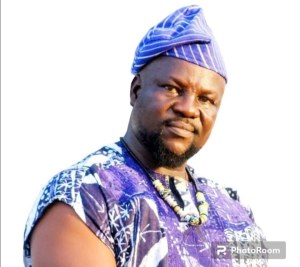
What is ORIA-FEST 2026, and what inspired the rebranding of October Rain International Arts Festival?
ORIA-FEST 2026 – the October Rain International Arts Festival is the expanded and reimagined continuation of the October Rain exhibition initiative of the Society of Nigerian Artists, Lagos State Chapter.
October Rain has grown beyond being simply an annual visual art exhibition. Over the years, it has become a platform for celebrating artists, documenting artistic legacies, recognising significant contributions to the Nigerian art ecosystem, and creating opportunities for engagement between artists and the public.
The decision to rebrand it as an International Arts Festival is, therefore, a natural progression. We want to move from an exhibition-centred programme to a broader cultural platform that accommodates visual art, sculpture, photography, performance, music, literary and creative expressions, while also creating room for conversations and international exchange.
ORIA-FEST is also an institutional bridge between the past, the present and the future. We are building on the pioneering efforts of our forebears in SNA Lagos, particularly the vision and contributions of past leaders who helped establish a strong foundation for the visual arts in Nigeria.
The rebranding is ultimately about expansion, continuity and relevance, also preserving the history of October Rain while giving it a broader identity capable of engaging contemporary Nigeria and the international creative community.
The theme this year is “Beyond Borders.” What does this theme mean to you and to Nigerian artists?
“Beyond Borders” speaks to the fact that art has never really respected geographical, cultural or institutional boundaries.
For me, the theme represents the movement of Nigerian creativity beyond physical borders, beyond traditional artistic categories and beyond the limitations that sometimes define how African art is perceived.
Nigerian artists are creating work that speaks simultaneously to our local realities and to universal human experiences. Our artists are dealing with identity, migration, urbanisation, environmental concerns, technology, history, spirituality, politics, memory and everyday life. These are Nigerian experiences, but they are also global conversations.
So, “Beyond Borders” is an invitation for Nigerian artists to see themselves not merely as participants in a Nigerian art scene, but as contributors to a global artistic conversation.
It is also about breaking down the barriers between generations, disciplines, institutions, cultures and artistic communities. We want the young artist to engage with the established artist, the academic to engage with the studio practitioner, and Nigerian artists to engage meaningfully with the wider world.
Why is it important for Nigerian artists to connect with artists and creative communities from other parts of the world?
Art develops through dialogue. No artistic community exists in isolation.
International engagement gives Nigerian artists opportunities to exchange ideas, understand different creative practices, discover new technologies and approaches, and develop relationships that can lead to exhibitions, residencies, collaborations, research and other professional opportunities.
But the exchange must not be one-directional. We are not looking outward simply to learn from others. Nigerian artists have enormous knowledge and cultural resources to share with the world.
Our history, visual traditions, indigenous knowledge systems, contemporary experiences and diverse cultural expressions are valuable contributions to global conversations about art and society.
Internationalisation should, therefore, be based on mutual exchange rather than cultural dependency. We want the world to encounter Nigeria through the voices of Nigerian artists themselves.
What should visitors expect to see and experience at ORIA-FEST 2026 at the JK Randle Centre?
Visitors should expect an experience that goes beyond simply walking into a gallery and looking at paintings.
At the JK Randle Centre, ORIA-FEST 2026 will bring together different dimensions of artistic and cultural expression. A major component will be visual art, including works by established, emerging and younger artists. We are also paying particular attention to documentation and the history of the Society of Nigerian Artists and its artists.
One of the things I am particularly passionate about is artistic memory. We want visitors, especially young people and students, to encounter the artists who came before them and understand that the Nigerian art ecosystem they see today has a history.
There will also be opportunities for artistic demonstrations, conversations, photography, interactions with artists and other cultural activities.
The intention is to create an environment where a visitor does not merely see art, but begins to understand the people, histories, ideas and experiences behind the art.
How will the festival create opportunities for Nigerian artists to showcase their work to an international audience?
The first step is to create a platform that presents Nigerian artists professionally and gives their work the visibility it deserves.
ORIA-FEST provides a common meeting point where artists, collectors, galleries, cultural institutions, researchers, students, art enthusiasts and members of the public can interact.
We are also intentionally opening the festival towards the Nigerian diaspora and the international creative community. Nigerian artists living outside the country remain part of our broader cultural ecosystem, and their experiences can strengthen the connections between Nigeria and the rest of the world.
Beyond physical exhibition, documentation is very important. Artists need proper records of their works, profiles and professional histories. When an artist’s work is properly documented and presented, it becomes easier for curators, researchers, collectors and institutions anywhere in the world to engage with that artist.
So, ORIA-FEST is not simply about putting artworks on a wall for a few days. It is about creating visibility, building relationships and strengthening the professional ecosystem around Nigerian artists.
What role does art play in telling the Nigerian story and shaping how the world sees Nigeria?
Art is one of the most powerful ways a society documents itself.
A painting, photograph, sculpture or performance can preserve something about a particular period that may otherwise disappear from collective memory. Artists record our streets, architecture, festivals, people, conflicts, celebrations, environmental changes, social conditions and aspirations.
Nigeria is often discussed internationally through statistics, politics, economics or social challenges. Art provides another dimension. It allows the world to encounter Nigeria through the imagination, experiences and perspectives of Nigerians themselves.
That is why I believe Nigerian artists have a responsibility not merely to produce beautiful objects, but also to observe, question, interpret and document their society.
The artist is, in many ways, a witness to his or her time.
When future generations look back at Nigeria today, the works being created by our artists will form part of the visual evidence through which they understand who we were.
How does SNA Lagos hope to use ORIA-FEST to support young and emerging artists?
Young and emerging artists are central to the future of the Society of Nigerian Artists and the Nigerian art ecosystem generally.
Our responsibility is not only to celebrate established names. We must also create pathways for the next generation.
Through ORIA-FEST, we want younger artists to have opportunities for exhibition, visibility, mentorship, interaction with established practitioners and exposure to collectors, curators, educators and members of the public.
We also want young people to understand the history of the profession they are entering. You cannot build a sustainable future if you do not understand the foundation upon which that future rests.
My vision is for ORIA-FEST to become a space where a young artist can come in with an idea, encounter people who have travelled that road before, establish relationships and leave with a clearer understanding of where his or her practice can go.
Beyond the exhibitions and artistic activities, what kind of conversations or connections do you hope the festival will create?
I hope ORIA-FEST generates conversations that continue long after the festival closes.
We need to talk about the sustainability of the Nigerian art profession, artist welfare, intellectual property, cultural preservation, collecting, patronage, art education, technology, international mobility and the relationship between artists and cultural institutions.
We also need conversations across generations.
There is a lot that the younger generation can learn from established artists, but the older generation can equally learn from the energy, technology and new perspectives of younger artists.
I would, therefore, like ORIA-FEST to become a meeting point not just for artworks, but for ideas, relationships and possibilities.
If two artists meet at the festival and eventually collaborate; if a student meets a mentor; if a collector discovers an artist; if a researcher discovers a forgotten part of our artistic history; or if an institution begins a meaningful partnership, then the festival has already achieved something significant.
What makes Lagos an important city for an international arts festival of this nature?
Lagos is naturally positioned for this kind of festival because of its history, energy, diversity and longstanding relationship with the development of modern Nigerian art.
Lagos has historically attracted artists, writers, musicians, intellectuals, entrepreneurs and cultural practitioners from different parts of Nigeria and beyond. It has also been an important centre for the development of Nigeria’s modern and contemporary art movements.
The city itself is a living artistic subject. Its architecture, markets, waterways, people, transportation systems, festivals, neighbourhoods, history and rapid urban transformation provide an almost endless source of inspiration.
And Lagos is constantly changing. That makes it an appropriate setting for a festival that is interested in both heritage and contemporary expression.
Hosting ORIA-FEST in Lagos also places the festival within a city that already has strong cultural networks and an international outlook. We want to use that advantage to connect Nigerian artists more effectively with the wider world.
As Chairman of SNA Lagos, what would you like artists, collectors, art lovers and the general public to take away from ORIA-FEST 2026?
I would like everyone to leave ORIA-FEST with a renewed appreciation of the value of Nigerian art and the people who have dedicated their lives to building the profession.
For artists, I want it to be a reminder that your work matters and that there is a larger community within which your practice can grow.
For young artists, I want them to see possibilities.
For collectors and patrons, I want them to recognise that supporting Nigerian artists is not merely a commercial transaction; it is also an investment in culture, history and the future.
For students and researchers, I want them to discover stories and artistic legacies that deserve further investigation.
And for the general public, I want ORIA-FEST to demonstrate that art is not something distant or reserved for a particular class of people. Art belongs to society.
Ultimately, I want ORIA-FEST 2026 to strengthen the connection between the artist, the artwork, our history and the society we live in.
The festival is bigger than any individual chairman, executive or generation. It is part of a continuum. We inherited a foundation from those who came before us, and our responsibility is to strengthen it and hand it over to those coming after us.
That, for me, is the deeper meaning of “Beyond Borders.” We are looking beyond geographical borders, but also beyond generations, disciplines and limitations towards a Nigerian art ecosystem that is more connected, more visible, more inclusive and more confident in its contribution to the world.
ORIA – FEST 2026 by Society of Nigerian Artists opens at J.K. Randle Center on the 18th of October and ends 24th of October 2026.
iBAND Magazine, Celebrating Visual Art from the Original.
Africa | Visual Art | Lifestyle | Culture

