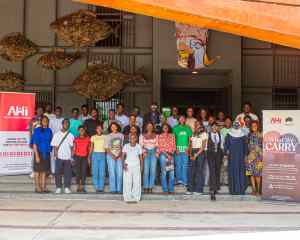
Lagos, Nigeria – The Yemisi Shyllon Museum of Art (YSMA), Pan-Atlantic University, in collaboration with the Art for Health Initiative (AHI), has concluded a two-day workshop that brought together art, public health, mental health and storytelling in an innovative exploration of “What We Carry: Stories of Mental Health and Resilience.” Held on October 2 and 3, 2026, the Health Story Lab was designed to explore how art can become a language for engaging difficult conversations around mental health, emotional well-being and resilience.
The workshop, which took place at the Yemisi Shyllon Museum of Art, ultimately brought together 25 Art students of the Yaba College of Technology (Yabatech) Epe Annex, providing the participants with a rare opportunity to examine their creative practice through the lens of health and human experience.
The programme was conceived by AHI as a participatory approach to health communication, recognising that young people often carry experiences of stress, uncertainty, social pressure, family expectations, grief, fear, hope and other emotional realities that may not always be easily expressed through conventional forms of communication.
The initiative sought to demonstrate how art can provide another avenue for reflection, dialogue, empathy and public engagement.
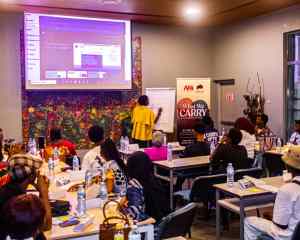
Across the two days, the students engaged with specialists and practitioners from different fields in different sessions on: Public Health and the Role of Art in Health Communication, by public health strategist Dr. Olayinka Badmus; Mental Health and Resilience, by psychiatrist and psychotherapist Dr. Emmanuel Abayomi; Expressing What We Carry through Art, by Art Project Lead Temitope Oladeji; and a curated museum tour of the YSMA focused on Art for Social Change, by Art Historian and Museum Educator Charles Udeh.
The mental health session proved particularly significant for the participants, creating an open space for reflection and conversation about emotions, experiences and the pressures that young people navigate. For many of the students, the conversation presented new possibilities for thinking about their artistic practice – not only as a means of personal expression, but also as a potential tool for communicating ideas around mental health and encouraging others to engage with their own emotional well-being. They subsequently developed creative concepts and presented their ideas for peer and facilitator feedback.
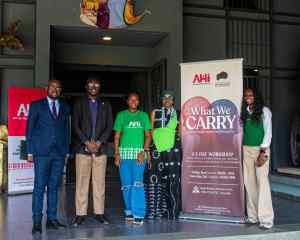
The experience was particularly significant for YSMA as it represents the museum’s first initiative specifically using art as a platform for exploring public health and mental health. According to the Museum, the programme reflects its broader commitment of serving as a space where people can learn, question, reflect and engage with issues that shape their lives and communities.
“What made this experience particularly powerful was watching the students realise that their art could do more than communicate an aesthetic idea,” said Solomon Nkwagu, Head of Corporate Communication and Visitors’ Services at YSMA. “They began to see the possibility of using their creative voices to start conversations around public and mental health, to tell stories that people can recognise themselves in, and perhaps even to create moments of reflection and healing for others. That shift in perspective was one of the most rewarding parts of the programme.”
He added:
“For YSMA, this is an important direction. Museums can create the conditions for people to encounter ideas differently. In this case, we brought art into conversation with public health and mental health, and gave young artists the opportunity to imagine what that intersection could look like through their own work.”
For AHI, the workshop represents an approach to health communication that places creativity and human experience at the centre of the conversation.
Chidera Rosecamille Aneke, Founder of the Art for Health Initiative, said the programme was developed from the conviction that health communication can benefit from approaches that are more participatory, culturally relevant and emotionally resonant.
“We wanted to create a space where young artists could understand that health is not only communicated through statistics, campaigns or clinical information. It can also be communicated through stories, images, symbols, emotions and lived experiences,” she said. “Working with the students showed us the possibilities that emerge when artists are given the knowledge, language and space to think about health through their own creative practice.”
The workshop also enabled participants to consider the responsibilities that come with communicating sensitive experiences. The Health Story Lab framework emphasises responsible and ethical storytelling, including avoiding stigma and harmful stereotypes and ensuring that participants are not required to publicly disclose personal trauma.
Following the workshop, the participating students will develop original artworks inspired by the ideas, conversations and creative exercises explored during the two-day programme. The resulting works will form the basis of a micro-exhibition in Lagos later in November 2026, with the exact date to be announced. The exhibition is expected to offer audiences an opportunity to encounter mental health and resilience through the perspectives of young emerging artists – moving the conversation from the classroom and workshop space into a public cultural setting.
Rather than presenting mental health only as a clinical subject, the resulting exhibition will invite audiences to consider the emotions, experiences, pressures, hopes and possibilities that people carry, and the different ways these can be expressed through art. The Health Story Lab is therefore not simply the conclusion of a two-day workshop. It marks the beginning of a longer creative process in which the participating students will translate learning and reflection into artworks capable of prompting conversations with audiences beyond the workshop.
For YSMA and AHI, the collaboration demonstrates the potential of partnerships across museums, creative practice and public health to create new forms of engagement with issues that affect individuals and communities. The artworks are now being developed, and the stories are only beginning to emerge.
The micro-exhibition will be presented in Lagos in November 2026. Details will be announced in due course.
iBAND Magazine, Celebrating Visual Art from the Original.
Africa | Visual Art | Lifestyle | Culture

