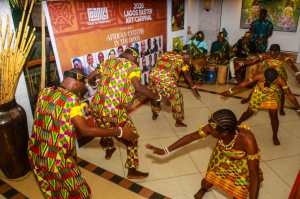
There are exhibitions one attends, and there are exhibitions one enters. The 2026 Lagos Easter Art Carnival curated by Folasade Abiola and presented by Fobally Art World Africa belonged firmly in the latter category. The exhibition was held from 3rd to 11th of April 2026 and It was not merely staged, it unfolded as a living archive of memory, textured with intention and alive with cultural recall.
Words Ireho Aito | Don’t Keep Your Art in the Finger! Photographs courtesy of Dr. Adeola Balogun PhD. Photographs taken on the opening day of the exhibition.
Proudly supported by MTN Nigeria, a major force within Nigeria’s communications landscape, the exhibition carried both artistic depth and institutional confidence, an alignment that amplified its reach and resonance.
The exhibition was set within the historic walls of Federal Palace Hotel & Casino, one of Lagos’ most storied hospitality landmarks, the exhibition curated inside the exquisite lounge, found not just a venue, but a collaborator. The building itself, steeped in political memory, cultural transitions, and decades of human gathering, also became a silent co-curator. Its corridors did not merely host art; they extended it.
There is a certain gravitas in entering such a space. A subtle awareness that moments of consequence have passed through these halls. Conversations that shaped eras. Decisions that altered trajectories. And it is precisely within this atmosphere that Echoes of the 1800s found its resonance.
Positioned on Good Friday 3rd of April, the exhibition aligns itself with a deeper rhythm of reflection and renewal. Just as Easter speaks of resurrection, Echoes of the 1800s resurrected histories that risk fading into abstraction.
On Easter Monday, 6th of April, a day already steeped in symbolic renewal, I found myself walking into time like other visitors who just visited Galilee to receive the Risen Christ.
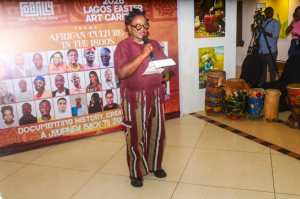
Entering to be welcomed by the curatorial intelligence of the invisible hand of Folasade Abiola and her curatorial team, what could easily distinguished why this exhibition was miles ahead in curatorial movement was simply the refusal for it not to behave like a conventional one. The art direction was spectacular!
Rather than confining artworks to a single gallery room, the curatorial approach dissolves boundaries. Art spills into the lobby, stretches into the lounge, punctuates corridors, and inhabits waiting spaces. The effect is both disarming and deliberate.
Admirably seated were some of the exhibiting artists like Edna Ekenimoh in her adorable elements. Also in the lounge was the elegant writer, artist and curator Adebimpe Adebambo. Mere having them in the lounge, I knew I haven’t arrived to see an exhibition but to have an encounter that will change history. Another exhibiting artist Joereal Emeh joined later in the evening with his handsome son.
At the centre of this cultural awakening stood Mrs. Folasade Abiola, a figure whose influence now extends far beyond the traditional expectations of a curator.
Since the establishment of Fobally Art World Africa and the Fobally Art Gallery, she has steadily positioned herself and Fobally mission, as an enduring icon of cultural advancement, one whose vision is as expansive as it is intentional.
For Abiola, art is not an isolated practice. It is not confined to exhibitions, nor reduced to the cyclical rhythm of art fairs. Instead, she frames it as infrastructure which is something foundational. Something that builds, shapes, and repositions identity.
In her own reflections, she has made this clear over the time that Fobally is not merely a platform for showcasing works; it is a driving force behind a wave of innovations aimed at repositioning Nigeria and by extension, Africa within a global cultural context. It is a bold claim, but one that finds grounding in execution.
Within diplomatic and cultural conversations, there has been a recurring sentiment: that Africa has come of age. Yet, Abiola does not treat this as a declaration to be admired from afar. For her, it is a responsibility. A call to action.
And so, the philosophy behind Fobally becomes clear and the reason it must live up to its promise.
Through initiatives like Echoes of the 1800s, Abiola translates vision into movement. She bridges past and present, tradition and innovation, scholarship and accessibility. Each exhibition becomes more than an event, it becomes a statement of intent.
There is a quiet determination in this approach. A refusal to allow African narratives to remain fragmented or externally defined. Instead, through carefully curated experiences, Abiola insists on authorship, on telling stories from within, with depth, dignity, and clarity.
In this light, Fobally Art World Africa emerges not just as an institution, but as a cultural engine that is steadily, deliberately, and unapologetically moving the narrative forward.
Before the landmark presentation of Echoes of the 1800s last Easter, Fobally Art World Africa had already been quietly, yet powerfully, shaping the future of art across generations. It will be on record that over the past four seasons, Fobally has remained at the forefront of promoting structured art competitions within both secondary and tertiary school categories with inspiring themes for the two categories; Paint Your Aspired Lagos at the Secondary Schools category and Paint Your Aspired Nigeria at the Tertiary institution category respectively. This action is positive, that speaks not only to visibility, but to investment. Investment in process and discovery. Investment in the next wave of creative voices emerging from Nigeria and beyond.
Young artists, many encountering formal recognition for the first time, have found in Fobally a platform that does more than applaud talent but also refines it. These competitions have evolved into incubators of possibility, where raw expression is guided, challenged, and elevated. What emerges is not just skill, but confidence and clarity of purpose.
In this way, Fobally’s role extends beyond exhibition-making. It becomes mentorship in motion and a cultural bridge between generations.
Yet, its calendar does not rest on developmental initiatives alone. It is equally marked by ambitious, high-level programming that reinforces its authority within the art ecosystem. One such defining moment came with the Grandmasters in Printmaking exhibition.
This was a showcase that brought together technical mastery, historical depth, and curatorial precision.
Through a carefully balanced rhythm of youth engagement and master-level exhibitions, Fobally has positioned itself as a true pillar of the arts.
While processing the curatorial effort from Fobally Art World Africa for Echoes of the 1800s exhibition, I quickly took note of many inquisitive hotel guests and patrons, some reaching out for a quiet coffee, some too, trying to figure their work – out routine and the lovely romantic couples within, in a pretty ensemble of expatriates, Nigerians and Africans, all found themselves confronted with royal narrative. I could feel and see from hindsight different conversations pauses mid-sentence as eyes drift toward textured sculptures or paintings, looking curious and asking questions as they read the power of literature attached to each work.
A couple speaking in Yoruba appreciated the curatorial intelligence which was at its most effective. They confirmed that art was not imposed upon the viewers but art was allowed to intersect organically with lived experience. Every placement felt intentional.
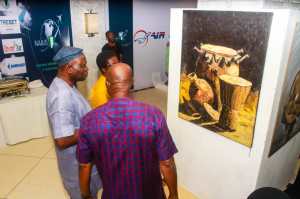
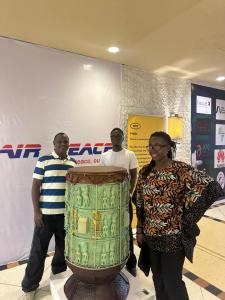
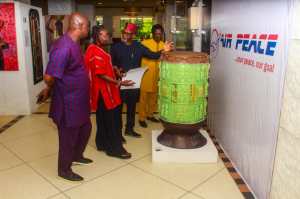
Large, commanding works anchored central spaces, asserting presence and authority. Smaller, intricate pieces rewarded those willing to look closer. Sculptural works engaged light and shadow, transforming static forms into dynamic presences as the day shifts. And the drum, imposing and welcoming a touch of hand for guests to create different rhythms. The exhibition activated the lounge so perfectly.
History was reimagined and as students of history, we all agree that the 19th century in Africa was not a quiet era. It was marked by upheaval and conflicts like the Kiriji War, colonial incursions such as the Benin Expedition of 1897, the forced exile of Oba Ovonramwen Nogbaisi, and the enduring trauma of the transatlantic slave trade. Yet, amid these disruptions, something persisted and that is the Community. And it is this persistence that forms the philosophical backbone of the exhibition.
The artists will always remain the custodians of our narratives. To have walked through this exhibition was to have encountered a chorus of voices that are distinct yet interconnected. Each artist contributed not just an artwork, but a perspective. A lens through which the 1800s is reimagined, reinterpreted, and reclaimed. Folasade Abiola revealed that 40 artists participated with over 80 works in display.
Moses Unokwa, a renowned disciple of Professor Bruce Onobrakpeya gave us metal, prints, memory, and moral dialogue in his “Pillars of the House II,” that was perfectly displayed on one forefront pillar of the lounge, artistically welcoming everyone. Moses Unokwa transforms metal foil into narrative. He was inspired by Ba Woyo potlids, the traditional Congolese objects used in matrimonial dispute resolution. The work becomes a meditation on conflict and reconciliation.
There is something profoundly symbolic here and that is, art is not merely seen as decoration, but as a form of arbitration. I stood smiling when I saw an hotel guest, may be going for some sort of swimming got enthralled at the work in a reflective mood with hands crossed.
The textured surface invites both visual and conceptual engagement. It is layered, much like the relationships it references. And beneath its aesthetic appeal lies a question, how did societies resolve tensions before modern institutions?
Not leaving so fast, Unokwa’s “Ancestral Mother and Child” deepened this inquiry, shifting focus to continuity. The relief work evokes fertility, lineage, and the unbroken thread of ancestry. It is both intimate and expansive, personal and communal.
Moving away eventually from Unokwa, I stopped by to pay homage to royalty by admiring Olanipekun Tunde, illustrating the weight of the crown in “Paraphernalia of Royalty and Power.” Olanipekun Tunde did not merely depict kingship, he interrogated it here.
Through mixed media, the work assembled symbols of authority such as crowns, regalia, and ceremonial objects into a layered composition that spoke to the sacred and political dimensions of leadership. I could see reverence here, but also complexity. Power, the work suggests, is never singular. It is ritual, and demand responsibility, full of burden, and spectacle, all at once.
Ojo Olaniyi and Dr. Kunle Adeyemi, PhD, made us realise that the body is an archive. That means If architecture holds memory, the body holds history. Ojo Olaniyi’s “Body Adornment” and Kunle Adeyemi’s “Tattoo Culture in Female Form” explored this idea with striking sensitivity.
Through epoxy etching and layered visual language, these works examined how markings, scarification, tattoos, adornments, all functioned as identity markers in pre-colonial Africa. These were not merely aesthetic choices but declarations of belonging to an ethnic group, status or transition.
Adeyemi’s focus on the female form added another dimension, by highlighting how women’s bodies became sites of cultural inscription, bearing both beauty and expectation. His work was big, bold and inviting to collectors and guests who glued to the work, to admire the eclectic finger that did such a commanding work.
Each time I turned my head within Federal Palace Hotel lounge, my head got lifted high. So, I sighted Abiodun Okema with his sound and sovereignty exhibiting “Royalty” and “Melody Makers,” Abiodun Okema bridged governance and sound. Traditional rulers are not isolated figures, rather, they exist within cultural ecosystems where music plays a vital role. Drums announce their presence, rhythms structure their ceremonies, and melodies carry messages.
Okema captured this interplay with a fluidity that felt almost auditory. One did not just see these works, one could hear them.
The old hand of a grandmaster will always be felt from the hands of his protege. This is what reflected in Bode Olaniran, a protege of Prof. Bruce Onobrakpeya working through war and unity at the exhibition. Bode Olaniran defined the 1800s as sharply as conflict and cohesion in “Are Ona Kakanfo,” Olaniran invoked the Yoruba war general, a figure synonymous with strength, strategy, and sacrifice. The composition was bold, assertive, unyielding.
Yet, in “Ifesowapo,” the tone shifted. Unity and togetherness are one. This was a reminder that survival is not achieved through strength alone, but through collective will. Placed in dialogue, these works revealed a truth, that societies endure not just through warriors, but through unity.
Oyetakin Success and Oluwole Olurinde both promoted rhythm as Language. History told us that before written records, there were drums for documentation. Oyetakin Success’s “Iya Ilu” paid homage to the talking drum and not merely as an instrument, but as a communicator. In many African societies, drums spoke. They conveyed messages, announced events, preserved history.
While Oluwole Olurinde extends this narrative through textile-based works like “African Solo Drummer” and “African Womanhood.” His use of fabric introduced softness, movement, and tactility, transforming rhythm into texture.
Adegbongbe Aderinsoye and Abiodun Okemakinde reignited the power of dance as rite. Dance, within this exhibition, was not performance but a passage.
Adegbongbe Aderinsoye a man of culture and lecturer at Yaba College of Technology Lagos, in his “Elerege – Maidens Dance” captured a moment of transition, where young women move from one stage of life to another. The work is both celebratory and ceremonial.
Similarly, Abiodun Okemakinde’s “Igbo Cultural Dance” reflects communal pride and identity. The figures are not isolated, they move as one, embodying collective expression.
Kelvin Ijiko introduced us to the sacred geometry of motherhood when I stumbled on “Three Mother Embrace,” Kelvin Ijiko presented motherhood not as sentiment, but as structure.
Three figures interlocked in a composition that suggests protection, continuity, and interdependence. It is a visual metaphor for generational transfer of the passing down of knowledge, care, and identity.
Adeola Balogun and Obayan Olusola are both maestros in spiritual and social movement.
Master sculptor and teacher, Adeola Balogun’s “Drum of Honour to the Spirits of Twins” draw from the Yoruba tradition of Ere Ibeji, where twins are revered and spiritually significant. The work pulsed with symbolic energy.
Adeola Balogun is one of Nigeria’s highly commissioned artists with a body of work spanning decades. He is a Senior Lecturer at Yaba College of Technology Lagos with numerous group and solo exhibitions as well as extensive global travels.
In “Transition,” Obayan Olusola turned the viewer’s gaze towards migration as both history and human condition. Drawing from the era of the Mfecane, that was time marked by widespread displacement and social reconfiguration in Southern Africa. The work unfolded through figures caught in motion, layered within a composition that feels restless and urgent. There is no stillness here. Bodies stretch forward, forms overlap, and space itself seems unsettled, mirroring the instability of the time. Yet beyond its historical reference, the piece spoke to something more enduring.
Movement, in this context, became both physical and existential that is a passage not only across land, but through identity, survival, and transformation.
If not her flamboyant hairstyles, then certainly her commanding fashion sense would arrest your gaze, such is the presence of Edna Ekenimoh. Yet beyond the visual charisma lies an artist of remarkable depth, one who continues to redefine textile as more than material but as archive, as memory, as living record.
In this exhibition, Ekenimoh once again asserts her mastery, weaving narratives that feel both ancestral and immediate. Her fabrics do not merely decorate space, they hold it. They speak of lineage, and belonging, of histories carried not in books but in textures, patterns, and handworked detail.
It is a language she has been steadily refining, and one that left an unforgettable impression during her debut solo exhibition at the National Museum Onikan in Lagos, in December 2025. This was one moment that announced her as a formidable voice within the contemporary art scene.
Here again, she did not disappoint. Edna Ekenimoh gathered memory in threads and releases it in form, thereby sweeping her audience off their feet, not just with beauty, but with meaning that lingers long after the encounter.
In “Akwanshi – Keeper of Earth and Lineage,” Edna Ekenimoh turned to textile as a storytelling medium. Inspired by the Ikom monoliths, the work became a tactile archive one that invited touch as much as sight.
From the gentle rhythm of moving in and out of splendid creativity, amidst works created by some of the finest artists Nigeria has produced, there was a quiet moment for me to pause in the lounge. A moment where the atmosphere softened, and a knowing smile emerged, drawn by the interplay of myth and metaphysics in the works of Lenrie Preks and Kehinde Akanni.
Lenrie Preks’ “Moremi” reached deep into pre-1800 mythology, anchoring 19th-century identity in the enduring story of a woman whose sacrifice reshaped her people’s destiny. The figure of Moremi here is not a distant legend but a living memory. She was the symbol of courage, and selflessness. Of the kind of strength that transcends time and continues to define cultural consciousness.
In close dialogue, Kehinde Akanni’s works “Orisa Aje” and “Ori” shift the experience inward, into the realm of metaphysics. His forms are contemplative, almost meditative, inviting viewers to consider forces that cannot be seen but are deeply felt by wealth not just as material possession, but as spiritual alignment.
Together, their works created a quiet yet profound encounter that moved beyond the visual into the philosophical. In that lounge space, myth was not distant, and metaphysics was not abstract. Both became present, immediate, and deeply human.
Within the unfolding narrative of the exhibition, the works of Abiodun Kabiru and Adebola Aderounmu created compelling contrast. One rooted in the familiar, the other in the unexpected.
In “The Rhythm of Calabash Market” and “Amala Ojuelegba,” Kabiru drew the viewer into the cadence of everyday life. His compositions are rich with movement and sensory recall of markets alive with exchange, the cultural intimacy of food, the unspoken rhythm that defines communal spaces.
These are grand historical moments, that are deeply significant. They remind us that culture is not only preserved in monuments or memory, but in daily rituals and the ordinary acts that quietly sustain identity.
Then comes a shift.
Adebola Aderounmu’s “Osun Mermaid with a Camera in 1985” interrupted this grounded familiarity with a striking surrealism. Here, mythology collided with modernity in a way that feels both playful and profound. The Osun figure, rooted in spiritual tradition, appeared reimagined within a contemporary frame, holding a camera, observing as much as being observed. It is a reversal of gaze.
In the closing arc of the lounge, the works of Adedotun Ojubanire and Joereal Emeh brought a reflective stillness where material becomes memory and meaning deepens into silence.
In “Echoes of the Ancient Throne,” Ojubanire worked with layered textures that feel almost archaeological in their intent. Each surface appears built like a record of time, where material is not merely used but remembered. The piece evoked authority without shouting it, allowing fragments of history, power, and tradition to emerge through subtle construction and tactile depth. It becomes less about depicting a throne, and more about feeling its lingering presence.
Then, in “Boundless Sacrifice,” Joereal Emeh whom I met with his son at the lounge shifted the emotional register into quiet contemplation. Rendered in acrylic casts, the work reflected Emeh’s ongoing interest in the human condition, particularly themes of endurance, offering, and emotional weight carried through form. Across his practice, Emeh who schooled in Ghana, often works within abstract figurative expression, using layered surfaces and textured finishes to suggest internal states rather than literal narratives.
“Boundless Sacrifice” can be read as a meditation on what is willingly given and what is silently endured. The acrylic casting technique itself becomes part of the message, solid yet fluid in perception, it suggested memory fixed in matter are fragile emotions preserved in hardened form.
In the broader context of Emeh’s 2023 output, this piece sat within a period where his work leaned into psychological depth and symbolic storytelling, often exploring how the body and spirit negotiated survival, identity, and devotion.
Ultimately, the work invited viewers into a reflective space where sacrifice is not seen as loss alone, but as a continuous act of becoming.
Together, these works bring the story to a close, not with an ending, but with thought. They ask the viewer to pause and reflect. Even after leaving the exhibition, the images, materials, and ideas remain in the mind, quietly speaking about memory and meaning.
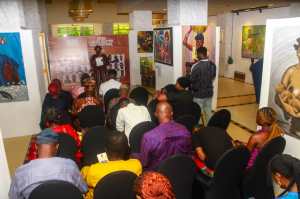
Perhaps the most striking thing about the exhibition was not one artwork, but the way everything came together. People who did not know each other found themselves looking and thinking side by side. Small conversations started naturally, and at times, there was a shared quietness as everyone available at the lounge took in the works.
The exhibition moved with a gentle openness, without forcing a fixed route on anyone. Instead, each visitor followed their own interest, shaping a personal experience through what they saw and felt.
In doing so, the exhibition mirrored the very essence of the 1800s it sought to evoke which is the community.
At the 2026 Fobally Lagos Easter Art Carnival, history did not stay still or locked away in books. It moved through the exhibition space, through conversations, and into the minds of visitors. The Federal Palace Hotel & Casino added depth to this experience, as its own long history blended with the stories on display. As people left the space, they carried something with them as new awareness. A quiet understanding that the past is never truly gone. Rather, It lives on in objects, in stories, in people, and in places.
On that Easter Monday in Lagos, history was not just remembered, it was shared and experienced together.
iBAND Magazine, Celebrating Visual Arts from the Original.
Africa | Visual Art | Lifestyle | Culture

