
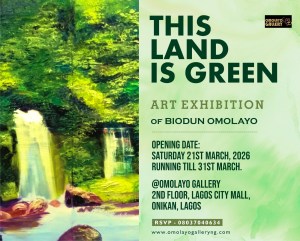
Biodun Omolayo lives like theatre and approaches his art with the intensity of a priest at the altar. In a world where creativity constantly reinvents itself amid the rush of commerce and culture, art becomes a language of resilience. Few artists embody this spirit as vividly as Omolayo, whose forthcoming exhibition, This Land Is Green, unfolds as both a landscape of colour and a testament to perseverance.
Words Ireho Aito | Don’t Keep Your Art in the Finger! Photographs iBAND Magazine archives

At first glance, the exhibition’s imagery with lush green landscapes, cascading waterfalls, and vibrant foliage, suggests serenity. Yet beneath the calm lies a deeper message about ecological consciousness and the emotional healing power of nature. Omolayo’s brushwork captures the rhythm of the earth itself, echoing the movement of rivers and forests that continue to sustain life across Africa. The title alone, This Land Is Green, reads like both a celebration and a reminder that the continent’s beauty must be cherished and protected.
For Lagos audiences, the exhibition also marks another milestone in the career of a man who has spent decades building platforms for African creativity. Omolayo is not just a painter but also the founder of Omolayo Art Gallery, a cultural hub that has grown into one of the city’s spaces for contemporary African art and creative mentorship. The gallery itself sits inside Lagos City Mall, opposite the MUSON Centre in Onikan, and has hosted numerous exhibitions, workshops, and training programmes aimed at nurturing the next generation of artists.
“This Land is Green,” opening on March 21, 2026, and running through March 31 at the Omolayo Gallery, the exhibition invites viewers into a world of cascading waterfalls, luminous forests and tranquil green landscapes. The imagery celebrates the vitality of nature, yet it also speaks quietly about endurance, also the possibility of growth even when the soil appears uncertain.
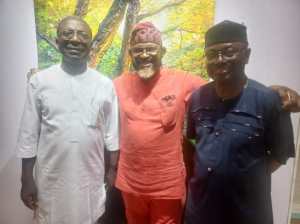
For Omolayo, that metaphor is deeply personal. Before the painter’s palette, before the gallery lights and exhibitions, he was a banker navigating the predictable corridors of finance. He was young, brilliant, stylish and result driven. So fast, he was already on the flight, rising to top position of a bank manager at two different banking institutions. Yet, the decision to abandon that world for the unpredictable terrain of visual art was driven by conviction but tested by reality.
Early in his journey, he believed the transition would be seamless. First thing was to return to school and start again to have a safe landing.
Instead, it brought an awakening. One defining moment came when his works were rejected by a gallery owner in the affluent district of Ikoyi because he lacked a recognised name. The rejection could easily have closed the door on a fragile artistic ambition. Instead, it opened another.
Rather than retreat, Omolayo created his own space. From a modest flat in Ikeja, he established what would become the Omolayo Gallery, a creative hub that has gradually grown into a respected platform for exhibitions, artistic mentorship and cultural dialogue in Lagos.
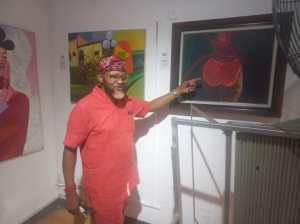
Over the years, Omolayo’s artistic philosophy has been deeply rooted in transformation. His works often emerge from everyday observations such as markets, landscapes, city life, and cultural traditions, all translated into expressive visual narratives. In previous exhibitions and writings, he has described art as a metaphor for renewal and reinvention, showing how discarded or overlooked elements of life can become sources of beauty and meaning.
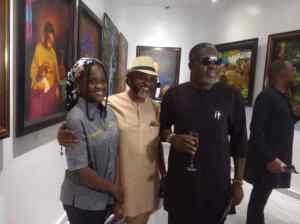
Ojogbogbobiodun Omolayo eventful journey did not remain confined to the canvas. And in a rare move among contemporary African artists, Omolayo documented his life’s odyssey in a self-titled autobiographical work, “Everyday Is a Milestone.” The memoir chronicles the winding path from banking halls to art studios, recounting the daily struggles, the moments of doubt and the unexpected triumphs that shaped his career.
The fashion-conscious artist writes with candour. Rather than conceal his vulnerabilities, he transforms them into reflections on discipline, entrepreneurship and personal mastery. The book reads like a motivational address rendered in literary form, something akin to a TED-style conversation about persistence, creativity and the art of survival in a demanding world.
Yet Omolayo’s contribution to art extends beyond his personal success. For more than two decades, he has also been the convener of the Young at Art Children’s Workshop, a creative programme that has introduced hundreds of children to the world of drawing, painting and artistic imagination. Through this long-running initiative, he has nurtured young talents and encouraged children to see art not merely as recreation but as a tool for self-expression and confidence.
In that sense, Omolayo’s life mirrors the evolution of the Nigerian art scene itself. Lagos has emerged as one of Africa’s most dynamic cultural capitals, yet the journey to recognition for many artists is still marked by rejection, uncertainty and relentless experimentation. Success often demands not just talent, but the courage to build one’s own platforms.
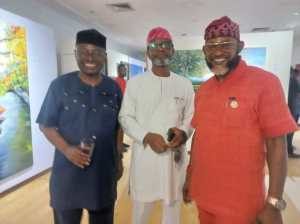
That spirit echoes powerfully in “This Land Is Green.” The landscapes glow with layered greens and fluid blues, evoking forests refreshed by rainfall and waterfalls carving their paths through ancient rock. The works offer moments of calm within the kinetic rhythm of life, reminding viewers that nature’s serenity still exists beyond the our restless energy.
The title of the exhibition carries an even deeper resonance. For Omolayo, “This Land is Green” is not merely a description of landscape; it is an affirmation. It suggests that despite the odds, despite the challenges confronting individuals and the nation alike, hope remains fertile ground.
Standing inside the gallery, enveloped by the quiet poetry of these landscapes, visitors may begin to sense that the exhibition is not merely about nature but equally a meditation on belief. It is a belief that reinvention is possible, that rejection can become the beginning of something new, and that perseverance has the power to transform barren ground into fertile soil.
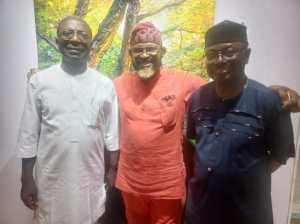
His last exhibition, titled “Path to Peace and Restoration,” was held at the same venue and curated by renowned curator and culture advocate Moses Ohiomokhare, reflected his ongoing exploration of healing and renewal. This edition, then, feels like a continuation, seamlessly building on these themes while inviting visitors to discover fresh perspectives and deeper meanings.
And in the life and art of Biodun Omolayo, the message becomes unmistakably clear, that is, sometimes the greatest landscapes are not those we see on canvas, but those we cultivate within ourselves.
Because for those who persist, the land is always green.
iBAND Magazine, Celebrating Visual Arts from the Original.
Africa | Visual Art | Lifestyle | Culture


Ato Ireo, thank you for your consistent and robust reporting of the activities in the Nigerian creative industry, especially the visual creative landscape. In your coverage of art activities and exhibitions, you have a unique style of linking past events to current activities and giving your readers a preview of what could be expected thereafter! Thank you!
LikeLike
Thank you so much sir. We appreciate your kind words. Thank you once again for turning up.
LikeLike
Thank you so much for your kind words and following
LikeLike
We really appreciate your constant following of what we do on iBAND Magazine. Gracias!
LikeLike