
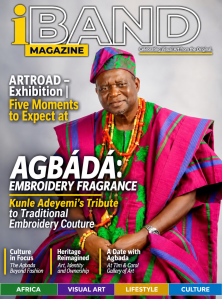
Dr Kunle Adeyemi’s remarkable portrait in a big, flowing Agbada, which has become a familiar sight across his social media platforms and the internet, offers a glimpse of what awaits visitors at his forthcoming exhibition. This time, the iconic Jakan apparel is moving beyond the artist’s portrait into the gallery space. Opening at Tim & Carol Gallery of Art in the exquisite and opulent Government Reservation Area of Ikeja, popularly known as Ikeja GRA, the exhibition brings a distinctive expression of Yoruba traditional dressing into the heart of Lagos, a city that understands the language, elegance and cultural significance of the Agbada. It is a research project from the stable of the renowned Kunle Adeyemi Studio, bringing the garment, its embroidery and its cultural heritage into a fresh visual arts conversation. Simply put, it is Agbada!
Words Ireho Aito | Don’t Keep Your Art in the Finger! Photographs courtesy Kunle Adeyemi Studios
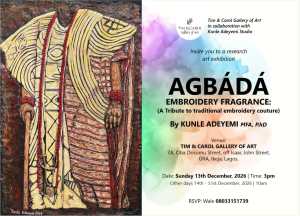
When iBAND Magazine visited KAS Studios in Mushin, Lagos, recently, a large and remarkably detailed artwork depicting the traditional Agbada caught our attention even before our conversation with the artist began. Standing against the studio wall, it offered a glimpse into a new creative direction that Adeyemi had previously discussed during our April cover interview.
Now, that idea is becoming an exhibition entitled Agbada: Embroidery Fragrance. This is a tribute to traditional embroidery. The research exhibition is presented by Tim & Carol Gallery of Art in collaboration with Kunle Adeyemi Studio.
Kunle Adeyemi PhD , an artist whose practice spans printmaking, painting, sculpture and his experimental Paintographs and Paintocasts, this new body of work promises an interesting encounter with traditional Nigerian fashion through visual art. He is a grandmaster!
In iBAND Magazine typical fashion, here are five moments to look forward to.
Discovering the Agbada Jakan Beyond Fashion
For many Nigerians, the Agbada represents elegance, prestige and cultural identity. It is an outfit associated with important occasions, our ever graceful ‘Owambe’ traditional celebrations, royalty and distinguished personalities.
But Adeyemi wants us to look beyond the familiar. During our April Cover interview, he disclosed his intention to explore traditional embroidery through a new series.
“This year I am coming out with embroidery series. A lot of work has been done in our culture and I am bringing the fabric out in different medium this year. I am talking about the Agbada ‘Jakan’ that is big and flowing,” he told iBAND Magazine.
The reference to Jakan is particularly interesting. Its expansive, flowing and flamboyant character offers a distinctive visual expression associated with Yoruba cultural traditions, especially Ondo.
What should visitors expect? An opportunity to appreciate the Agbada not simply as an outfit but as a cultural statement. Its silhouette, embroidery, patterns and elaborate construction communicate a history that goes beyond the occasion for which it is worn.
Adeyemi wants that history to find another home within contemporary visual art.
The Beauty of Traditional Embroidery and the Question of Cultural Ownership
One of the most interesting conversations surrounding this exhibition is the preservation of indigenous craftsmanship.
Traditional embroidery is not simply about decorating fabric. It involves skill, patience, creativity and knowledge passed through generations. The elaborate patterns and details of the Agbada represent a valuable aspect of our cultural heritage.
However, Adeyemi is concerned about what happens when communities fail to promote and document their own cultural expressions.
During our conversation, he made a passionate observation about the growing international appropriation of African cultural products.
“I don’t want to wait until a foreigner like a Chinese coming in and start promoting what is entirely ours. Once foreigners hijacked our culture, people subscribe to it because that is what is available.”
He went further by saying, “If I am living here and frown at my own culture, then there is a problem. We need to let the world know that the originality of such fabric and fashion is here.”
These are strong words from an artist who believes that cultural preservation requires active participation.
Visitors coming for the exhibition, need to know that, this moment offers an opportunity to consider the relationship between traditional craftsmanship, indigenous knowledge and the responsibility of contemporary artists to document their heritage.
When Printmaking Meets Sculpture and Painting
This is indeed one of the most exciting aspects of the forthcoming exhibition that you would find in Tim & Carol Gallery on November 13.
Dr Kunle Adeyemi is a printmaking grandmaster whose artistic journey has never been restricted to one medium. His experiments with Paintographs and Paintocasts which are now his acclaimed motifs, demonstrate an interest in exploring the possibilities of materials, techniques and processes. His Agbada project offers another opportunity to extend this creative exploration.
Explaining his approach during our studio conversation which has also been published earlier, he said, “I sketch the Agbada first. And the way it is, I can collaborate with fashion designers, collaborate with people who sells this culture. It is an Ondo culture to wear big flowing, flamboyant Agbada embroidery. It occurred to me that I need to start documenting the fashion through visual arts.”
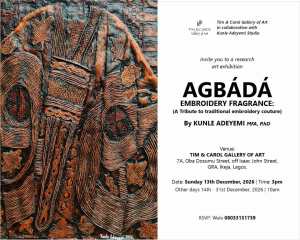
He also explained the artistic direction of the series, “It also has to do with royalty. The series will come in prints, sculpture, painting and other mediums.”
There is a lot to anticipate here. How does an embroidered garment translate into a sculptural expression? How can its flowing structure become an interesting subject for printmaking? What happens when the patterns and visual language of traditional embroidery are interpreted through painting? These are some of the creative possibilities visitors will encounter.
The Royal Connection – Celebrating Identity and Cultural Heritage
The Agbada has always carried associations with dignity, prestige, royalty and social identity. Its elaborate embroidery and flowing form make it particularly distinctive within traditional Yoruba dressing.
In Adeyemi’s creative position, the relationship between the garment and royalty is an important part of the exhibition’s story. He disclosed that the forthcoming exhibition would be dedicated to the Asiwaju of Ijesaland, whom he recognises as a prominent wearer of embroidered traditional attire. “If art is of the royalty, and I need to take it down there,” he reminded us in his office cum studio.
This dedication provides another cultural dimension to the exhibition. It connects the artistic interpretation of the Agbada with personalities who continue to wear and celebrate traditional embroidery. It also invites visitors to reflect on the importance of cultural figures in sustaining indigenous fashion and its associated traditions.
There is a bigger message here. Cultural identity should not be something we remember only during festivals and special occasions. It should be documented, celebrated and passed on.
Meeting the Artist, The Grandmaster, His Philosophy and a Lifetime of Creativity
An exhibition by Kunle Adeyemi is also an opportunity to encounter the thinking of an artist whose contributions extend beyond his personal studio practice. Retired from Yaba College of Technology, where he spent years teaching and nurturing young artists, Adeyemi remains actively engaged in creating, experimenting and mentoring.
His KAS Studios, established in 1986, has become a meeting point for generations of young creatives, interns and emerging artists. In our April Cover interview, he spoke about the importance of artistic identity and integrity. His position was uncompromising. “Integrity is the most important factor for any artist to have and not compromised with it. It makes you eschew from copying other people’s work,” he stated.
He was particularly emphatic about originality when he said, “If you don’t have integrity, you can’t be original.” He advised artist to run away from plagiarism.
These words provide an interesting context for the Agbada exhibition. Adeyemi is not simply reproducing a familiar cultural object. He is bringing his own artistic vocabulary, research and creative experience to a subject that deserves fresh interpretation.
There is also his philosophy about the role of the artist in society. During our conversation, he offered a memorable observation about the artist, “the artist is a prophet. The artist work must address the consciousness of collectors.”
It is a philosophy that connects his artistic practice with his interest in documenting culture, communicating history and creating works that speak beyond the studio.
iBAND Magazine, Celebrating Visual Art from the Original.
Africa | Visual Art | Lifestyle | Culture

