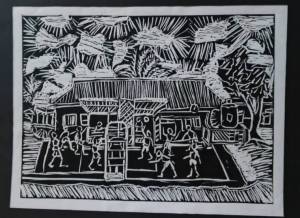
Medium: Lino block relief print
Artist: Lawrence Ahigbe
Year: 2026
Beyond the prison walls, nine inmates discover the possibilities of art, a renewed sense of purpose and the hope of a different future. It is the beginning of a journey towards becoming better men, ready to find their way back home when the prison gates finally open.
Words Ireho Aito | Don’t Keep Your Art in the Finger! Photo credit: PRO Unit, Nigeria Correctional Custodial Service, Lagos State Command.
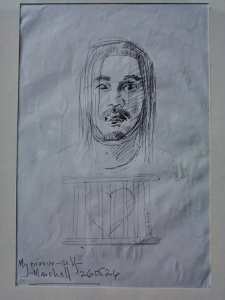
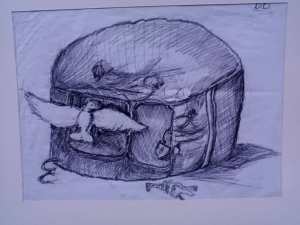
Medium: Graphite
Year: 2026.
Imagine the abundance of creative talents that could be lying dormant behind prison walls, waiting for someone to recognise them. Imagine minds that have been confined by circumstances, yet still possess the imagination, creativity and capacity to make something beautiful. For many incarcerated people, rehabilitation is often discussed in terms of punishment, confinement and eventual reintegration. But what happens when art becomes part of that journey?
This is where renowned printmaking grandmaster, scholar and art educator Dr Kunle Adeyemi and Muse Foundation are making a difference. Through an intervention that takes visual arts education beyond the conventional classroom, they are giving incarcerated people an opportunity to rediscover themselves, express their experiences and begin to imagine life beyond the walls of a correctional facility.
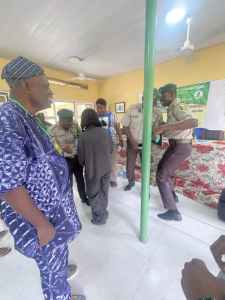
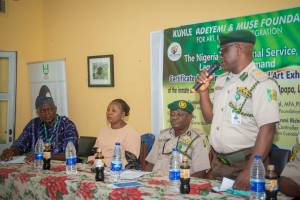
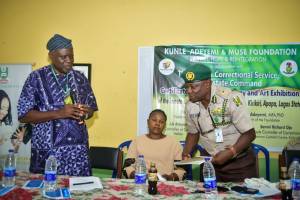
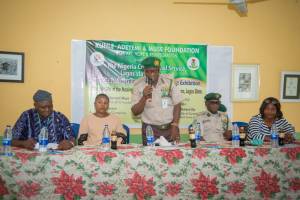
It was an emotional moment at the Kirikiri Correctional Centre in Lagos on November 3, 2026. One of the invited Deputy Controllers of Corrections opened his remarks with a Yoruba song, its message of gratitude to God setting the tone for an occasion that was as much about humanity as it was about art. For the nine inmates who had completed a six-month visual arts training programme, the day represented something they might never have imagined: an opportunity to have their creative efforts recognised and celebrated by the very institution in which they were serving their sentences.
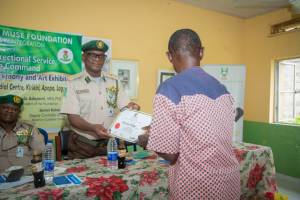
Their officers were present to honour them, their artworks were exhibited, and certificates of participation were presented. It was a meeting of hearts, creative expression and renewed possibilities, made possible through the collaboration by Kunle Adeyemi and Muse Foundation.
There is a long-standing perception that artists are unusual characters. The purists, as some would call them, have often attached different monikers and sobriquets to artists, sometimes describing them as eccentric, mystical or even strange. Yet, beyond these descriptions, society has come to recognise artists as its mirrors, reflecting its aspirations, contradictions, struggles and everyday experiences.
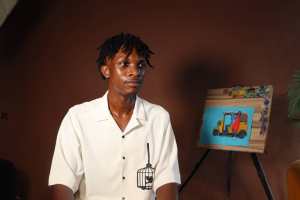
At the recent Voice in Pigment exhibition, organised by Aderinsoye.A. Aladegbongbe at the National Museum, Onikan, Lagos, the special guest, Prince Yemi Sodimu, offered an amusing recollection during his remarks. Recalling his days as a student of Dramatic Arts at the prestigious Obafemi Awolowo University, Ile-Ife, he said that his department was close to the Visual Arts students. However, he admitted that he had often regarded the latter as unusual personalities, even wondering whether they were normal human beings.
It was a light-hearted observation, but one that brought attention to the different ways artists are perceived and the unique world of creative expression they inhabit.
Beyond the humour, however, lies a more important responsibility. Artists have historically contributed to society through social engagement, cultural preservation, education and humanitarian interventions. Their creative enterprise often extends beyond the production of objects for galleries and exhibitions. Art can also become a tool for communication, healing, confidence-building and social restoration.
One artist who has consistently demonstrated this commitment to developing people and extending the reach of visual arts education is Dr Kunle Adeyemi.
A renowned printmaking grandmaster, scholar and speaker, Adeyemi is the founder of Kunle Adeyemi Studios, popularly known as KAS Studios, in Mushin, Lagos. Established in 1986, the studio has grown beyond its original identity into an institution for nurturing artistic talents, developing creative minds and building confidence among artists and mentees.
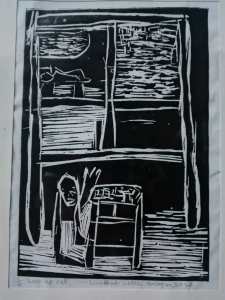
Medium: Lino block (relief print)
Year: 2026.
“At KAS Studios, we have been known for developing minds and building confidence in our artists and mentees since 1986,” Adeyemi explained, bringing out a catalogue documenting members of the studio over the years.
“Last year, we had a commemorative exhibition and this year, we bought two booths at the SNA October Rain International Art Festival. We have been building confidence in people since we started KAS Studios,” he added.
It was in this familiar, ever-active and welcoming environment at KAS Studios that we sat down with Dr Adeyemi to understand the thinking behind his decision to leave the conventional academic environment and take visual arts education into a correctional facility.
Why would an accomplished academic, after years of teaching and professional engagement, choose to spend six months teaching inmates behind prison walls? What could art possibly achieve among people whose lives had taken difficult turns? And how could creative expression contribute to their eventual reintegration into society?
Adeyemi was eager to share the story. “After my retirement from Yabatech, I kept getting offers from different academics and schools, such as Lagos State University of Science and Technology, which I took at a time as a contract staff for the post of senior lecturer in my area of specialisation, which is printmaking. More offers came from two other universities, and it dawned on me that I was still running this kind of race, coupled with my age. Do I still need to be running after such gratification?” he recalled.
For him, the question was no longer about another academic appointment or professional recognition. It was about what he could give back to society with the knowledge and experience he had accumulated over the years.
He began to look towards people whose opportunities had been interrupted by difficult circumstances, particularly young people and those in correctional facilities whose stories were often reduced to their mistakes.
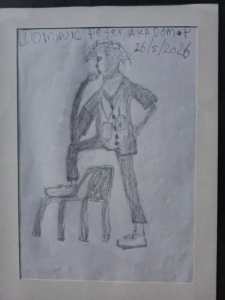
Medium: Graphite on paper.
Artist: Algoni Muhammad
Year: 2026
“I started with the younger ones by going to Oregun Rehabilitation Centre for younger ones below 18 years of age. From there, I got the inkling on how to go about my idea of giving back to society the knowledge one has garnered over the years,” he said.
With the approval of the relevant youth authorities in Lagos, he began vocational training for the young people. The programme started positively, but Adeyemi soon realised that he wanted to reach a different category of people. He wanted to work with individuals who could tell their own stories, explain their experiences and engage with the difficult realities that had brought them into confinement.
He subsequently extended his intervention to the girls’ centre at Idi-Araba, in the Mushin area of Lagos. Although the engagement was well received, his desire to make a deeper impact continued to grow.
“We needed people who can actually tell their stories. Why they are in that situation and incarcerated. Those ones with deeper stories,” he explained.
Interestingly, someone else was thinking along similar lines, although from a different creative direction. Samuel Muse, a film advocate, was exploring the possibilities of using film and related creative interventions to engage people in correctional facilities. During a visit to the National Museum, Onikan, he encountered the curator, who was already familiar with Adeyemi’s work and his interest in using art for social intervention.
The curator suggested that a meeting between the two men could be worthwhile. Muse subsequently made efforts to locate Adeyemi, and their paths eventually crossed at KAS Studios.
“He was so elated to hear about my objectives and he was anxious about the project,” Adeyemi recalled.
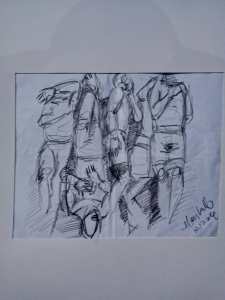
Medium: Graphite on paper
Artist: Chukwu Ndubuisi
Year: 2026
Their conversations soon developed into a shared vision, bringing together two creative disciplines with a common humanitarian purpose. Adeyemi brought his experience in visual arts, while Muse contributed his interest and experience in film. Together, they established the Kunle Adeyemi and Muse Foundation for Art, Hope and Reintegration.
The idea was simple but ambitious: to take creative education to people behind prison walls and give them an opportunity to rediscover their abilities.
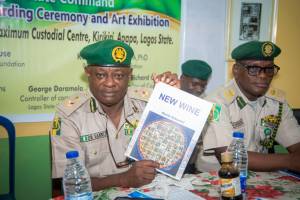
Adeyemi, believes the decision to work with inmates at Kirikiri was particularly important because these were individuals with lived experiences that could be translated into artistic expressions. “Their lived experiences can be interpreted in art,” he stated.
He believed that through creative practice, inmates could communicate their stories, share difficult experiences and express emotions that might otherwise remain unspoken.
The Foundation wrote to the correctional authorities at Alagbon and the relevant ministry, seeking the necessary permission to commence the programme. Once approval was secured, the next challenge was how to begin.
Interestingly, Adeyemi was not prepared to make sponsorship the condition for starting the intervention. “To also seek for sponsorship within these objectives will be counterproductive,” he explained. Instead, he decided to begin with the resources available to him, providing the basic materials required for the training.
At the first visit, 20 inmates expressed interest in participating. The number was subsequently reduced to 18 after registration. However, the Deputy Chief Controller of Corrections, DCC, offered an important observation: the participants needed encouragement and incentives to sustain their interest in the programme. Adeyemi took the advice seriously.
“The DCC advised that it would actually augur well to motivate the inmates with incentives to put their minds to the project and be active. Otherwise, they might all run away. We decided to start sharing biscuits and snacks for them to become attentive,” he revealed.
It was a simple approach, but one that helped establish a connection between the facilitators and the participants. Adeyemi also introduced philosophical discussions about life as a way of attracting their attention and encouraging them to think beyond their immediate circumstances.
Gradually, the inmates began to respond to the lessons, and the initial hesitation gave way to cooperation and enthusiasm.
Although the number eventually reduced, nine participants completed the six-month programme. Their works became the centrepiece of the exhibition organised within the correctional facility on November 3.
For Adeyemi, the achievement was not simply about the number of certificates presented or artworks displayed. It was about what had begun to change in the minds of the participants.
Asked what art could achieve among people who are often viewed primarily through the circumstances of their incarceration, he was emphatic. “Art can actually give them hope for a better future. Art can make them begin to believe in themselves. It can give them that life of rethinking that they can do things which, hitherto, were not in their sight. It can start making them imagine that success abounds if they can change and also become the change agents,” he said.
His conviction is informed by years of experience in art education and mentorship as a teacher at all levels of education. He recalled attending the Bruce Onobrakpeya Workshop at Agbarha-Otor, Delta State, on several occasions, where he observed the legendary artist’s willingness to encourage participants regardless of their initial abilities. “I have attended Bruce Onobrakpeya Workshop at Agbarha-Otor in Delta severally, and I know the Professor is known for encouraging everyone, whether you are good at it or not. He keeps encouraging you, knowing full well that you can improve on what you are doing,” Adeyemi recalled.
That philosophy of encouragement became particularly relevant during the Kirikiri programme. He shared the experience of an inmate from Borno State, whose identity he preferred to withhold. At the beginning of the training, the participant struggled to produce even a simple drawing. However, Adeyemi’s encouragement gradually opened his mind to the possibilities of creative expression.
Before long, the inmate began looking forward to the sessions and took pleasure in having his drawings recognised. It was a small but significant transformation.
“Hope opens the door to hopefulness. Art reintegrates you back into the system. Each time people appreciate your efforts, it motivates you and brings life into a dead horse. Before you know it, you see yourself becoming hopeful that there is light at the other end of the tunnel,” he maintained.
But there is another dimension to the programme that Adeyemi considers equally important: the possibility of earning a living through creative skills. For someone who has spent years behind bars, the thought of producing something that another person appreciates and is willing to purchase can be a powerful experience. It introduces a new understanding of personal value and the possibility of economic independence.
“Particularly when they come and discover that their works have been sold for certain amounts of money. What they have done can actually provide food for them to eat. This is reintegration,” he explained.
He went further to describe art as an opportunity for reformation, insisting that sustained creative engagement can help redirect attention and energy away from destructive behaviour.
“It gives daily bread. It is a natural talent, and the more you expose such talent, the more the host of heavens invest in your craft,” he said, allowing his spiritual convictions to find expression in the conversation. Again, for Adeyemi, the underlying message is that no human being should be regarded as completely useless or beyond redemption. Even within the difficult environment of a correctional facility, there is the possibility of discovering a talent, developing a skill and rebuilding a sense of purpose. “There is a beautiful life for them,” he affirmed.
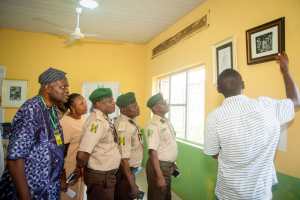
The exhibition at Kirikiri provided a practical demonstration of this belief. The inmates’ artworks were framed and presented, while the participants themselves took responsibility for introducing their works to the audience.
“The inmates did the presentations themselves,” Adeyemi proudly explained.
It was an important moment. Beyond having their works displayed, the participants were given the opportunity to stand behind their creative efforts, communicate their ideas and experience the confidence that comes with being recognised for something they had produced.
Their officers were visibly appreciative of the Foundation’s intervention, recognising the value of bringing a different kind of engagement into the correctional environment.
For the Foundation, however, this is only the beginning. Adeyemi disclosed that the second cohort, planned for the following year, would expand the programme to include more areas of creative practice, such as textile design, ceramics, sculpture and painting. “Creating good art goes beyond the four walls of our conventional schools,” he stated.
He also believes that government and relevant institutions need to pay greater attention to the role of creative education in rehabilitation. “The government needs to know that miscreants can be curbed through art. Taking art to them can tame them seriously,” he said.
To strengthen his argument, Adeyemi drew attention to the historical development of the Osogbo Art School, recalling the contribution of the German scholar and writer Ulli Beier to the growth of artistic practice in Osogbo and other parts of Nigeria.
The Osogbo art movement demonstrated how people from different backgrounds could discover and develop their creative abilities outside conventional academic structures. Some of the individuals associated with that movement had backgrounds in trades and other occupations rather than formal art education. Through exposure, encouragement and sustained creative practice, several went on to achieve international recognition.
In his opinion, this history reinforces an important point: artistic ability is not necessarily restricted to those who have passed through conventional art institutions. With the right environment, encouragement and opportunity, creative talents can emerge in unexpected places.
That is precisely the opportunity he wants to extend to incarcerated people.
One of the Foundation’s objectives is to build confidence that will remain with participants even after they leave the correctional facility. For those who eventually regain their freedom, the skills acquired during the programme could become a means of earning a living and finding their place in society.
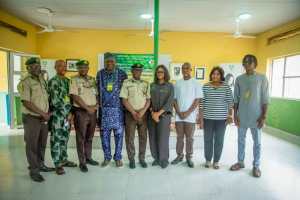
“Going out of here, for those who might get their freedom, is to know that whatever talent or skill they have in their hands can give them the confidence to look for their daily bread. The Foundation would also be waiting in the wings to back them up,” he assured.
He was particularly emphatic about the different forms of confidence the Foundation hopes to establish. “There is always financial, professional and spiritual confidence we build in our people.”
One of the historical examples Adeyemi cited was Arthur Judah Angel, the late Nigerian artist whose life story demonstrated the possibilities of creative discovery during incarceration. Having spent 16 years in prison, including nine years on death row, Angel eventually became recognised for his self-taught artistic practice. His early works, some produced with prison-kitchen charcoal on paper, emerged from his experiences behind bars and eventually attracted attention through local and international exhibitions.
Angel’s journey offers an important reminder that incarceration does not necessarily have to define the rest of a person’s life. “Art practice removes and dissolves stigma if you are an ex-convict. That is what happened to Arthur Judah Angel of blessed memory,” Adeyemi said.
The Kirikiri programme has already produced its own deeply personal testimonies, as the renowned printmaker recalled the confession of one participant who disclosed that he had belonged to a notorious armed robbery gang. According to the inmate, several members of the gang had been killed, leaving only two survivors. Yet, through the art training, he had begun to see possibilities beyond the life he previously knew. “He confessed that the art training has opened his eyes to new ways of life. This is a huge testimony for us,” Adeyemi revealed.
Another participant, who had previously been on death row before his sentence was commuted to life imprisonment, was among those who spoke during the programme’s closing ceremony. He delivered the vote of thanks and could hardly conceal his appreciation for the intervention.
His personal journey made the moment particularly moving. Before his incarceration, he had been involved in artistic practice and had worked with notable creative agencies. The experience of imprisonment, however, had taken a heavy toll on his confidence and sense of identity.
For someone who had lived with the frightening reality of a death sentence, the opportunity to reconnect with his creative abilities represented more than a training programme. It was a chance to rediscover a part of himself that had been overshadowed by his circumstances.
The six-month intervention had begun to restore his confidence and renew his hope for the future. This is where the real value of the Kirikiri initiative lies. The exhibition was not simply an occasion for displaying artworks produced during a vocational training programme. It was an opportunity to recognise people beyond the labels attached to their circumstances.
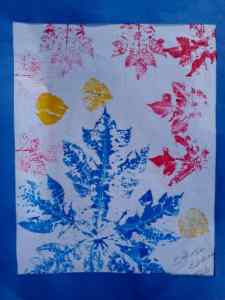
Medium: relief print
Artist: Ehosa Ebonhon.
Year: 2026
The works told stories, but the people behind them were equally important. Their participation demonstrated that even within an environment defined by restrictions, the human imagination remains capable of reaching beyond physical boundaries.
Looking ahead, Adeyemi is optimistic about the programme’s prospects. He believes the Foundation has laid a strong foundation for what could become a sustainable model of creative rehabilitation, estimating a potential success rate of between 80 and 90 per cent.
The next phase will broaden the range of artistic disciplines and provide more opportunities for participants to acquire practical skills that could support them after their release.
However, he has one important appeal to the wider society. “I expect the society to embrace their skills when they come out and not attach stigma because of where they are coming from,” he appealed.
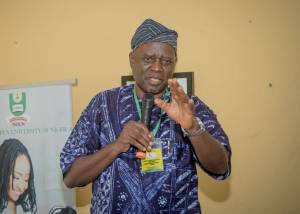
It is a request worth considering. Rehabilitation cannot end at the gates of a correctional facility. The willingness of society to accept, encourage and provide opportunities for people who have served their sentences is equally important to their reintegration.
As we reflected on our conversation at KAS Studios, one message remained clear: the value of art extends far beyond galleries, museums, collectors and exhibition openings. It can travel into places where people least expect to encounter it, opening doors to imagination, self-discovery and renewed purpose.
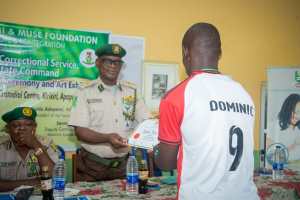
At Kirikiri, nine inmates have taken their first steps in that direction. Their artworks may have been produced within the walls of a correctional facility, but the possibilities they represent are not confined to those walls.
The most important lesson from this initiative is that people should not be defined entirely by their past. Given the opportunity to learn, create and contribute, they can begin to write a different chapter of their lives. For Kunle Adeyemi and Muse Foundation, the journey is continuing. The next cohort will bring new disciplines, new participants and, hopefully, more stories of transformation.
iBAND Magazine, Celebrating Visual Art from the Original.
Africa | Visual Art | Lifestyle | Culture

