
What happens when an iconic symbol of African elegance becomes the canvas for artistic reinvention? In Agbada Embroidery Fragrance, Dr Kunle Adeyemi transforms the intricate beauty, cultural symbolism and royal heritage of traditional Nigerian embroidery into a compelling visual art narrative. Presented by Tim & Carol Gallery of Art in collaboration with Kunle Adeyemi Studio, this research exhibition invites audiences to rediscover the Agbada beyond fashion as an enduring expression of identity, craftsmanship and cultural memory.
Words by Ireho Aito | Don’t Keep Your Art in the Finger! Photographs courtesy Kunle Adeyemi Studios
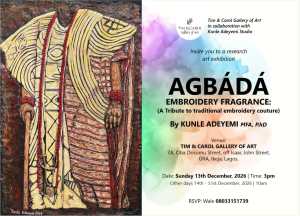
Interesting days sometimes lead to unexpected discoveries. My visit to Kunle Adeyemi Studios, popularly known as KAS Studios, in Mushin, Lagos, was one such experience. I had gone to see Dr Kunle Adeyemi, the gentle giant of Nigerian printmaking, following the recent accomplishment of his Kunle Adeyemi and Muse Foundation at the Nigerian Correctional Service facility in Kirikiri. I wanted to hear more about the programme and how the experience had unfolded.
While waiting for him to come downstairs, something caught my attention. Standing almost like a cultural monument against the studio wall was a massive, bold and remarkably detailed artwork depicting the traditional Agbada attire. I became momentarily stuck at the entrance, captivated by its imposing presence, the intricate embroidery patterns and the confident treatment of the flowing garment.
It was an encounter that revealed another dimension of an artist whose creative curiosity continues to find new territories.
For anyone familiar with Dr Adeyemi, KAS Studios is much more than a workplace. Established in 1986, it has become an enduring part of the Mushin community, where the artist has lived and worked for four decades. Having acquired his property, he has built a space that serves as a meeting point for artists, apprentices, young creatives and people who share his passion for visual art.
There is something almost communal about the environment. It is a studio, a learning centre, a meeting place and a home for artistic conversations. Over the years, generations of young people have passed through its doors, learning, experimenting and discovering their creative abilities under his guidance.
Adeyemi is, without doubt, a man of the people. His investment in the community is reflected not only in the physical space he has established but also in the opportunities he continues to create for others.
But that morning, my attention was firmly on the Agbada. What I saw is a cultural statement beyond fashion. Kunle Adeyemi is exhibiting. The forthcoming exhibition, Agbada Embroidery Fragrance: A Tribute to Traditional Embroidery Couture, represents a significant development in Adeyemi’s continuing exploration of Nigerian cultural identity.
The opening reception is scheduled for Sunday, December 13, 2026, at 3pm, the research art exhibition is presented by Tim & Carol Gallery of Art in collaboration with Kunle Adeyemi Studio. It will take place at 7A, Oba Dosumu Street, off Isaac John Street, GRA, Ikeja, Lagos, with the exhibition continuing from December 14 to 31, 2026.
However, this is not simply an exhibition about a fashionable traditional outfit. It is an opportunity to document a cultural heritage that deserves greater attention, appreciation and preservation.
During our April cover interview with iBAND Magazine in Lagos, Kunle Adeyemi had already revealed his intentions to explore the traditional embroidered Agbada through different artistic mediums.
He explained, “this year I am coming out with embroidery series. A lot of work has been done in our culture and I am bringing the fabric out in different medium this year. I am talking about the Agbada ‘Jakan’ that is big and flowing.”
The reference to Jakan is particularly important. It points towards the expansive, flamboyant and richly embroidered Agbada tradition associated with Yoruba cultural expression, especially its connections with Ondo.
Adeyemi sees the garment as something that carries more than fabric and embroidery. It communicates identity, social standing, cultural memory and royalty. Its flowing form and elaborate designs provide an artistic vocabulary that he believes deserves proper documentation.
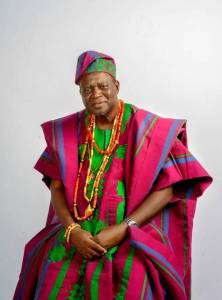
He is particularly concerned about the gradual loss of ownership and recognition of African cultural products. “I don’t want to wait until a foreigner like a Chinese coming in and start promoting what is entirely ours. Once foreigners hijacked our culture, people subscribe to it because that is what is available. If I am living here and frown at my own culture, then there is a problem. We need to let the world know that the originality of such fabric and fashion is here,” he had made this clarion call in our earlier meeting.
This is perhaps one of the strongest motivations behind the exhibition. African fashion, textiles, traditional embroidery and indigenous designs have become increasingly visible internationally. Yet the question of who documents, preserves, promotes and ultimately benefits from these cultural resources remains important. Adeyemi wants to take that conversation beyond the fashion industry and into the visual arts.
What makes this project particularly interesting is the artist’s decision to interpret the Agbada through different mediums. He once disclosed during our conversation, “I sketch the Agbada first. And the way it is, I can collaborate with fashion designers, collaborate with people who sells this culture. It is an Ondo culture to wear big flowing, flamboyant Agbada embroidery. It occurred to me that I need to start documenting the fashion through visual arts,” Kunle stated this while taking me through what to expect from the Agbada series.
This statement offers an insight into his creative thinking. The artist is not merely interested in reproducing the appearance of the garment. Rather, he is concerned with documenting its cultural significance and translating its visual characteristics into contemporary artistic expressions.
As he further explained in his studio, “it also has to do with royalty. The series will come in prints, sculpture, painting and other medium,” he affirmed.
Here lies the interesting connection with Adeyemi’s established practice as a printmaking grandmaster. The people’s artistic journey has involved continuous experimentation with materials and processes. Through his self-developed Paintographs and Paintocasts, he has explored the possibilities of moving between painting, printmaking and casting.
While his understanding of printmaking is not restricted to conventional approaches. Dr. Adeyemi has consistently demonstrated an ability to combine processes, introduce new visual possibilities and establish his own artistic vocabulary.
The Agbada series therefore becomes another opportunity to extend this experimentation, using the flowing garment, embroidered patterns and cultural symbolism as the foundation for new works.
There is a reason Adeyemi’s Agbada project deserves attention beyond the gallery walls. In September, iBAND Magazine featured his Yoruba Woman (Ode to Yusuf Grillo), a monumental 2026 Paintocast relief measuring 6 feet 6 inches by 3 feet and finished in gold plating. It was a tribute to his former teacher and mentor, Professor Yusuf Grillo.
That work demonstrated how Adeyemi approaches cultural identity, memory and artistic inheritance. Thoughtfully, he was not interested in simply reproducing another master’s visual language. Instead, he used his own artistic vocabulary to honour a legacy while establishing a contemporary interpretation.
The Agbada project continues this interest in cultural documentation, although its focus moves towards traditional embroidery, fashion, royalty and the preservation of indigenous knowledge.
He also disclosed that the forthcoming exhibition would be dedicated to the Asiwaju of Ijesaland, whom he described as a prominent wearer of embroidered traditional attire. As he put it, “the culture must be sustained and documented.”
Those words capture the central message of this exhibition. For an artist who has spent decades teaching, mentoring and experimenting, the decision to revisit traditional cultural expressions is not a departure from his practice. It is another way of extending it.
And this is where the research dimension of the exhibition becomes relevant. Visitors are invited to look beyond the familiar appearance of the Agbada and consider the history, craftsmanship, symbolism and cultural knowledge embedded in its embroidery.
One of the remarkable things about visiting KAS Studios is the opportunity to encounter an artist who remains actively engaged with his environment. Even after retiring from Yaba College of Technology, Adeyemi has continued to create, teach, mentor and participate in exhibitions.
His recent intervention at Kirikiri through the Kunle Adeyemi and Muse Foundation further demonstrates that his understanding of art extends beyond personal achievement. He believes in creating opportunities for people and allowing visual art to contribute meaningfully to society.
Now, with Agbada Embroidery Fragrance, he invites the public into another conversation, one that places traditional Nigerian embroidery within the wider possibilities of contemporary visual art.
The large artwork that caught my attention at the entrance of KAS Studios was more than an impressive representation of traditional clothing. It was an introduction to a project that had been developing in the mind and hands of an artist determined to give cultural heritage another life through art.
On Sunday, December 13, 2026, Tim & Carol Gallery of Art will provide the meeting point for this artistic conversation, in collaboration with Kunle Adeyemi Studio.
For collectors, researchers, artists, fashion enthusiasts and lovers of African cultural heritage, this is an opportunity to encounter the Agbada beyond its familiar place in our wardrobes.
iBAND Magazine, Celebrating Visual Art from the Original.
Africa | Visual Art | Lifestyle | Culture

