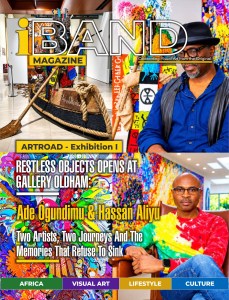
From an Elder Dempster ship that brought a young Ade Ogundimu from Liverpool to Lagos to Hassan Aliyu’s artistic interrogation of the ships that carried Africans across the Atlantic, two British-Nigerian artists bring their personal histories, cultural memories and three decades of collaboration to Gallery Oldham, United Kingdom.
Words Ireho Aito | Don’t Keep Your Art in the Finger! Photographs, images courtesy of the exhibiting artists. iBAND Magazine Cover Graphic Design Credit: Adewale Oseni
There was a time when a young Ade Ogundimu, travelling with his sister and parents, boarded an Elder Dempster ship at Liverpool docks for a journey to Lagos. He had spent part of his childhood in Kent, England, with foster parents while his own parents were away on industrial training. Britain was familiar to him, and the people around him were predominantly Caucasian. Nigeria, however, was about to introduce him to another part of himself.
When the ship eventually arrived at Apapa Port, the young Ade was fascinated by the number of black people he saw. His innocent question, “Why were there so many black people here?” attracted attention from those around him, who wondered whether he did not realise that he was black himself.
It was an extraordinary childhood encounter, but also the beginning of a journey into colour, identity, culture and heritage. Today, the same artist has turned that experience of movement between two countries into one of the most interesting visual expressions of migration in contemporary African art.
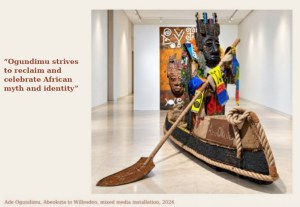
His installation, Abeokuta to Willesden, presented at the Nigeria Art Society UK (NASUK) exhibition Waves of Change: Artistic Journeys from Nigeria to Britain at Somerset House during the 1-54 Contemporary African Art Fair in 2024, brings this personal history into a much larger conversation.
Now, as Dr Ade Ogundimu and Dr Hassan Aliyu prepare to present their collaborative artistic histories in Restless Objects: Migration, Memory and Survival in the Afterlives of Empire, at Gallery Oldham from 5 December 2026 to 27 February 2027, that journey takes on another dimension.
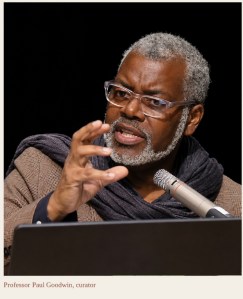
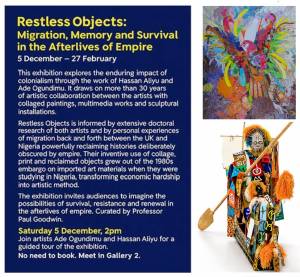
The exhibition, curated by Professor Paul Goodwin, brings together more than 30 years of artistic collaboration between the two British-Nigerian artists. Through collaged paintings, sculpture, installation, multimedia works and moving images, they examine the continuing influence of colonialism, migration, economic exploitation and cultural survival.
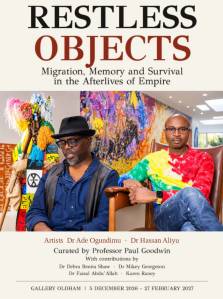
But there is more to this exhibition than two artists bringing their works into a gallery. Their individual histories are already intertwined with some of the questions the exhibition seeks to raise. Both have experienced the movement between Nigeria and Britain, both have encountered the complexities of belonging, and both have developed artistic languages that challenge the assumption that history should remain buried in the past.
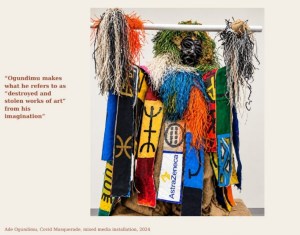
Ade Ogundimu, for instance, his installation titled Abeokuta to Willesden is not simply an installation about migration. It is an intensely personal work that brings together childhood memories, Yoruba cultural heritage, African knowledge systems and the experience of living between Britain and Nigeria.
The boat, constructed from charred wood, is central to the installation. It carries a masquerade figure, surrounded by colourful African textiles and symbolic inscriptions. Its paddles and physical structure suggest movement, while the masquerade represents the cultural knowledge and ancestral memory that accompany the journey.
When iBAND asked him about the thinking behind the installation, Ogundimu explained, “When I conceived Abeokuta to Willesden, I was thinking about migration, identity and what we carry with us when we leave one place to make a life somewhere else.”
That statement brings the work close to the experience of the artist himself. Abeokuta represents Yoruba history, ancestry and cultural roots, while Willesden represents the London environment in which he has lived and worked. Between these two locations lies a journey that is both geographical and personal.
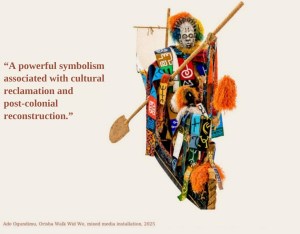
The masquerade rowing the boat is particularly significant. It is not merely a decorative figure added to an installation. It represents the cultural knowledge that travels with people, even when they find themselves in unfamiliar surroundings.
The African scripts on the boat also challenge the familiar suggestion that African cultures are exclusively oral. Through the use of Adinkra, Uli and Nsibidi-inspired visual languages, Ogundimu draws attention to the continent’s rich traditions of writing, symbols and communication.
The artist has consistently explored these ideas through painting, sculpture, installation and mixed media. His interest in postcolonial identity, cultural fusion, anti-Blackness and human rights has given his practice a distinctive direction.
His academic journey, which began with painting at Yaba College of Technology and continued through further studies in Britain, including his Professional Doctorate in Fine Art, has also provided another dimension to his exploration of history, myth, language and objects.
Yet, it is interesting that the artist who now examines masquerades and indigenous knowledge through sophisticated artistic installations once wanted to make a career out of wearing masquerade costumes.
As he previously shared with iBAND, his childhood fascination with masquerades was so strong that he told his mother he would not mind making a career of wearing the costume and mask. His mother was less than impressed with the suggestion. Today, that childhood fascination has become an important part of his artistic vocabulary.
There is something wonderfully circular about that story. The boy who wanted to become a masquerade performer has grown into an artist using the masquerade to carry conversations about heritage, identity and the movement of people across continents. What a journey of life to behold.
If Ogundimu’s artistic journey begins with a childhood voyage from Liverpool to Lagos, Hassan Aliyu’s story offers another perspective on the relationship between Britain, Nigeria and the movement of people.
He was born in Barnet, England, in 1964 to Nigerian parents, Aliyu was the first of a set of twins. The difficulties his parents faced as immigrants, with limited financial resources and the responsibilities of raising young children, led to the twins being sent to Nigeria to live with their grandparents in Auchi.
It was in Nigeria that his relationship with art began to take shape. He recalls his childhood in Auchi, drawing aeroplanes and making toys for himself. His natural interest in drawing and visual expression was already evident before he received formal artistic training.
Hassan’s journey eventually took him to Ahmadu Bello University, Zaria, where he studied Fine Art and graduated in 1986. He became a full-time professional artist, exhibiting in Nigeria and establishing a reputation among the generation of artists who shaped the country’s professional contemporary art scene during the 1980s.
In 1990, he travelled to Britain for an exhibition which led to a new wave. Although the visit eventually became a longer stay, Aliyu has explained that relocation was not initially his intention. He maintained his Lagos studio in Anthony Village between 1990 and 1995 while circumstances gradually changed his prospects.
His experiences in Britain also altered how he understood his identity. In an earlier conversation with iBAND, he made an observation that deserves attention: “I never saw myself as a black artist back home in Nigeria.”
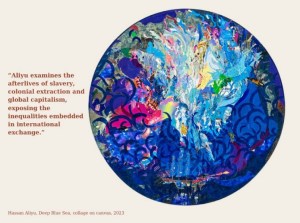
It was only after returning to Britain that he became acutely conscious of the racial categorisation attached to being a black African artist. His encounters with cultural misunderstanding, discrimination and the experiences of other migrants increasingly found expression in his work.
Aliyu’s interest in migration, however, goes beyond contemporary movement between countries. He has repeatedly examined the historical significance of shipping technology, the Atlantic Ocean, slavery and colonialism.
In his reflections on the subject, he draws attention to how vessels that once carried Africans into slavery later became part of the machinery of colonial expansion, transporting resources and produce while reinforcing the economic interests of imperial powers.
It is an important perspective when considering his artistic contribution to Restless Objects. His work The Apple Crumbles Like an Odyssey on the Bibby Stockholm offers another example of his interest in the relationship between migration and historical memory. Using the image of the apple crumble as a metaphor, Aliyu reflects on the experiences of African migrants who arrived in Britain after the Second World War with expectations of opportunity, only to encounter discrimination and the erosion of cultural identities.
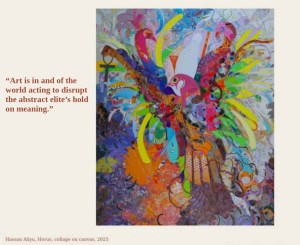
Reflecting on his parents’ experiences, he wrote: “My parents’ experiences mirror the struggles of many who faced systemic hostility in their pursuit of a new life in Britain.”
It is a personal observation that reaches beyond his own family history. Aliyu’s artistic practice has developed into an expansive engagement with collage, painting, multimedia and installation. His large-scale work, To the Lands Beyond the Seas, a ten-metre pentaptych, is another example of his sustained interest in the movement of people and the historical relationships between Africa and the wider world. While his work titled A Dance of Wealth and Strife similarly explores the structures of economic power and the contradictions of global exchange.
An artist, curator and academic, Aliyu has also played a significant role in promoting Nigerian visual art in Britain through his leadership of the Nigerian Arts Society UK (NASUK).
For him, he believes art is not separated from the responsibilities of cultural representation and artistic leadership. His career has consistently brought these interests together.
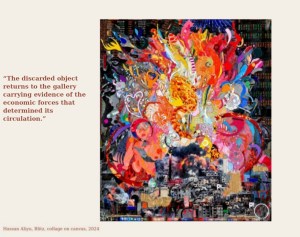
The most interesting meeting point between Ogundimu and Aliyu is their relationship with materials. Their experimentation with collage, print and reclaimed objects has a history that goes back to their experiences as young artists in Nigeria during the 1980s. The embargo on imported art materials created practical difficulties for artists who needed materials to sustain their creative production.
Rather than surrendering to those limitations, they explored alternative ways of making art. Discarded packaging, fabrics, wood, paper and other available materials became part of their artistic vocabulary. What might have been regarded as an inconvenience eventually developed into a distinctive approach to artistic production.
In Restless Objects, this history becomes particularly relevant. Materials are not simply chosen for their colours, textures or physical properties. They carry associations with labour, consumption, economic exchange, displacement and survival. When they enter the gallery, they bring traces of their former lives with them.
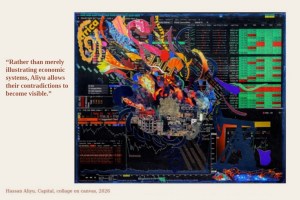
Dr Faisal Abdu’Allah explores this relationship in his essay, Memory, Matter and the Afterlives of Empire. His observation about Aliyu’s practice is particularly revealing: “Rather than merely illustrating economic systems, Aliyu allows their contradictions to become visible.”
It is an important distinction. The artist does not merely reproduce images of economic activity. He brings the contradictions of wealth, exchange and exploitation into the physical language of his work. The same attention to material and cultural history is evident in Ogundimu’s installations. His use of charred wood, terracotta, jute, resin, fibre and reclaimed objects allows materials to participate in the meaning of the work.
In Abeokuta to Willesden, for instance, the charred wood is not an arbitrary construction material. It carries the history of transformation, destruction and renewal. The boat itself becomes a vessel of memory, carrying the masquerade and its cultural references across an imagined geographical and historical passage.
This is where the two artists’ practices meet most convincingly. Their objects are not silent. They are witnesses to histories that continue to influence the present.
This duo exhibition is curated by Professor Paul Goodwin, Restless Objects brings the artists’ practices into conversation through six interconnected ideas: Arte Povera, collage, masking, regeneration, national identity and the gallery as a space of encounter. These themes provide different entry points into the exhibition.
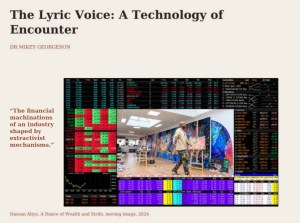
Arte Povera and collage draw attention to the possibilities of ordinary and reclaimed materials. Masking introduces questions of cultural identity, representation and indigenous knowledge. Regeneration considers how objects, traditions and memories can acquire new lives. National identity examines the complicated relationships between belonging, history and cultural inheritance. The gallery itself becomes another important consideration. It is a place where different histories can meet, where familiar objects can be reconsidered and where audiences are invited to question what they have previously taken for granted.
Dr Mikey Georgeson, in his contribution, The Lyric Voice: A Technology of Encounter, considers how the materials in the artists’ work generate meaning through their histories and relationships with the world around them. His observations draw attention to the unexpected life of objects when they are removed from their familiar surroundings and brought into an artistic context.
Also, Dr Debra Benita Shaw and Karen Raney also contribute to the wider intellectual and critical perspectives surrounding the exhibition. Together, these contributions extend the conversation beyond the individual works, encouraging audiences to consider how colonial histories, economic relationships and cultural identities continue to shape contemporary life.
There is a certain significance in seeing these two artists bring their experiences together at this stage of their careers. Ogundimu’s journey from Liverpool to Apapa, his childhood fascination with masquerades and his later artistic exploration of Abeokuta and Willesden provide one understanding of migration. Aliyu’s experiences of family displacement, childhood in Auchi, professional beginnings in Nigeria and eventual return to Britain offer another.
Their histories are different, but they share an understanding that migration does not end when a person reaches a destination. People carry memories, languages, traditions and experiences into their new environments. These things continue to influence how they see themselves and how they are seen by others. That is why the title Restless Objects works so well. The objects in this exhibition are not simply remnants of another time. They are reminders that the past is never entirely settled.
For audiences at Gallery Oldham, the exhibition offers an opportunity to encounter these questions through the visual language of two artists who have spent decades examining them. Opening on Saturday, 5 December 2026, the exhibition runs until 27 February 2027. Visitors can also join Ade Ogundimu and Hassan Aliyu for a guided tour at 2pm on the opening day. There is no need to book; visitors are asked to meet in Gallery 2.
iBAND Magazine, Celebrating Visual Art from the Original.
Africa | Visual Art | Lifestyle | Culture

