Arthur Judah Angel | A Walk through the Gallows
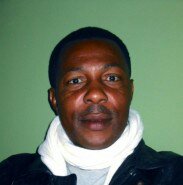
On the 7th of February 1986, Arthur Angel was found guilty of murder and sentenced to death. He ended up spending nine years and six months in Nigerian Prisons Service, Enugu as a death row inmate, an experience of a life and time.
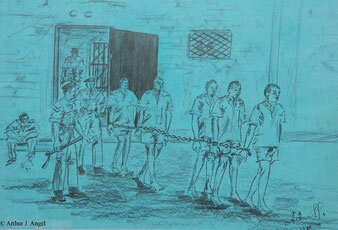
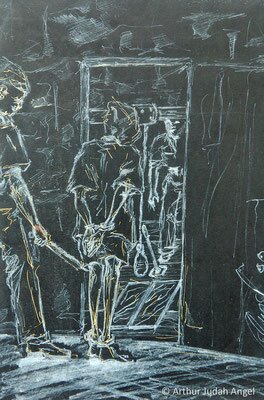
“Hallelujah, Amen, is one of such popular chants and threnodies among death row inmates and prisoners in Nigeria prisons as they drag chained hands and legs to the death chambers on a date with the hangman, known as a point of no return” explained Arthur Judah Angel, a Nigerian visual artist. The atmosphere and culture in death row chambers and gallows are horrific and sorrowful. No sign of happiness. Rather, fumes of blood, anger, darkness, depression and death. The boots of the warders and chains of the condemned, sing melancholic tunes of the death songs, while the odour is hell spit. You may never know this, unless you take a walk through the gallows.
He was born Arthur Ihaza on November 21st, 1962, in the ancient town of Onitsha, the eastern part Nigeria to Leonard Godgift Abumere Ihaza of Ugboha, Ishan tribe of Edo state and Amodo Elizabeth from Onitsha, Anambra state. The family later relocated to Port Harcourt. But at a very tender age, Arthur’s mother got separated from his father, due to irreconcilable differences. Then, mother and son left Port Harcourt, and relocated to Onitsha, in the south eastern part of the country, Arthur’s mother home town. He started his formal education properly in Onitsha, and was a gifted child. His love for creative art gave him away easily and to the delight of his friends, class teacher and head of school, he was always ahead of his class. One day, Arthur had a strange dream where he saw himself in the midst of world’s most influential personalities which he narrated to his mother. This dream and his talent for drawing put him in collision with his mother often who never appreciated his creative talent.
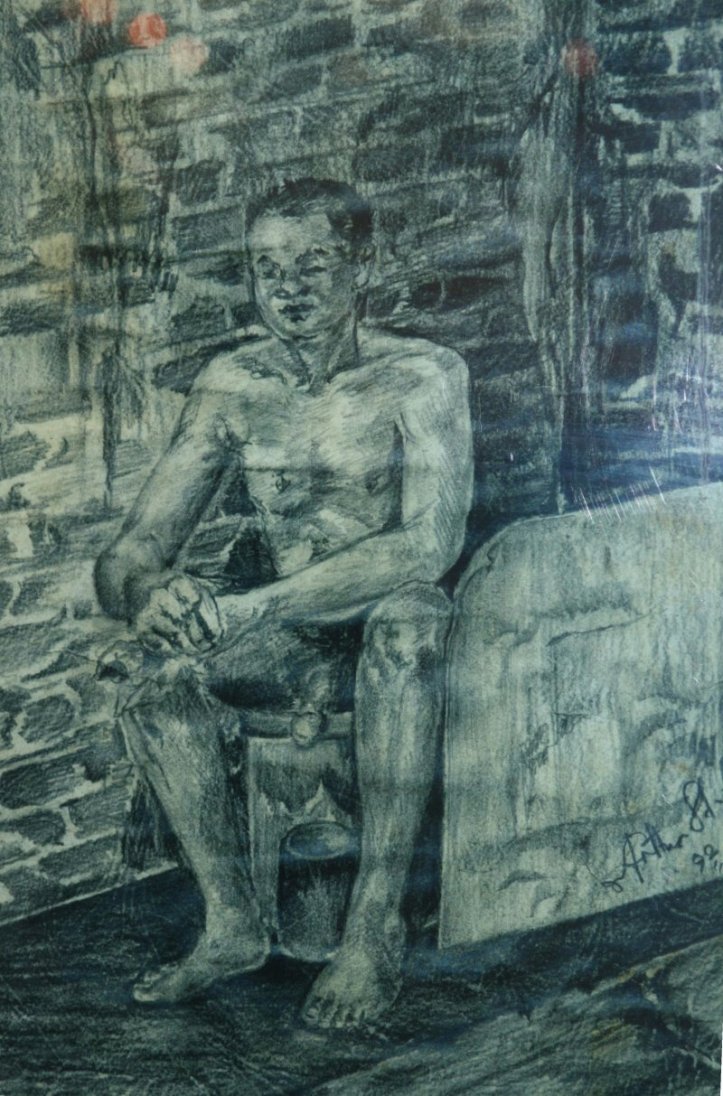
In 1979, during the transition to civil rule in Nigeria led by the then Head of State, General Olusegun Obasanjo, to usher in the new democratic regime, the pictures of the newly elected 19 states governors of Nigeria were displayed in the dailies across the country. Arthur was in secondary school, and bought a copy of the state newspaper. “The photos of Abubakar Rimi and Jim Nwobodo, the two governors of Kano and Anambra states respectively caught my attention instantly as they were so good looking” remarked Arthur Angel. He decided to do a painting on them. The two portraits of the governors he did caught the attention of his teacher who was elated about his innate talent and encouraged him. After the state inauguration, the governor of Anambra state, Jim Nwobodo, eventually embark on an official state tour. Arthur school made the official touring list. The work was later presented to the governor by young Arthur and he received the governor’s handshake to the envy of his other school mates. The photograph of Arthur and the governor dominated the front pages of major newspapers in the eastern part of Nigeria. “I received my mother’s blessings for the first time and became the toast of my community, making money as a self-taught artist and the youthful exuberance soon took over me.” He narrated further, “My father got wind of my escapades and came to Onitsha to take me back to Port Harcourt and remained under his watchful eyes.” After his secondary education, Arthur Angel went on a holiday to see his mother in Onitsha and at aged 22, he got a twist to his destiny.
I
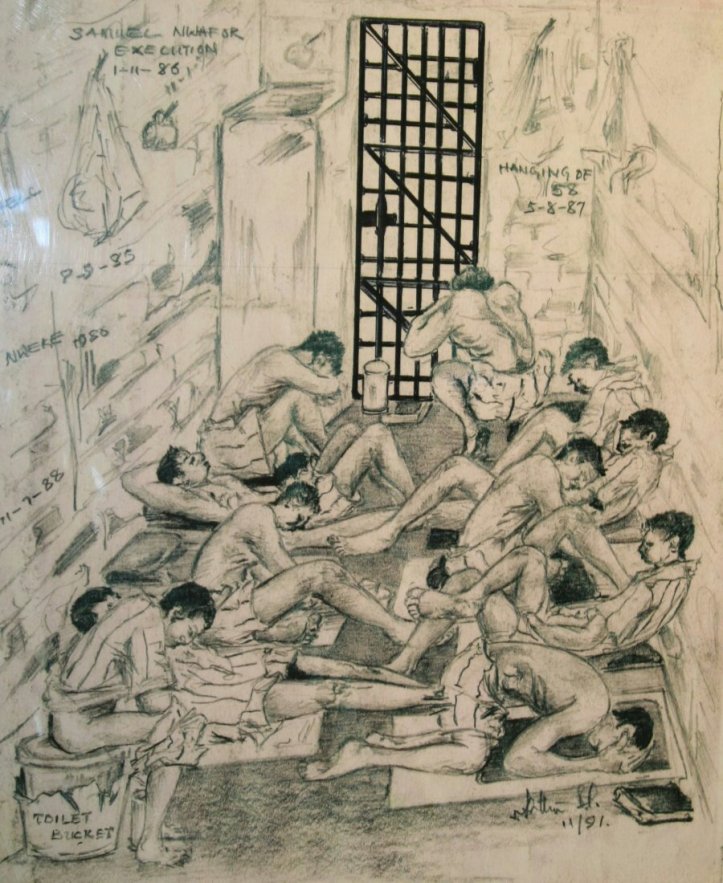
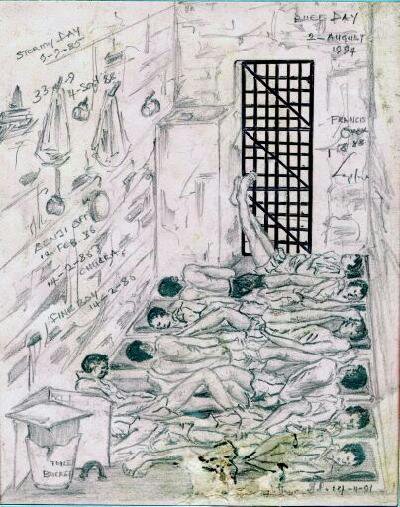
It\nIt started like a fairy tale for Arthur Angel in the ancient town of Onitsha on January 21 1984. Then the Nigerian military had just upstaged the democratic regime of President Shehu Shagari in a military coup on December 31, 1983. The military claimed corruption and gross indiscipline as the biggest problems of the country and why they struck. Many laws were enacted as decrees under the command of General Muhammadu Buhari, the then Head of State. Punitive measures such as forceful arrest and capital punishments like death penalty emblazoned the society. Arthur Angel learnt his name was mentioned in a murder case of a police corporal by his friend Victor, a senior back in school. He decided to visit the police station at Otuocha in Otuocha local government in Anambra state. Unfortunately, there was a standing order at the police command to arrest anyone that might come looking for the accused persons. Arthur on his arrival was immediately arrested. An arrival that marked the beginning of a journey. Arthur Angel ended up spending 16 calendar years in four Nigerian prisons. “After being tortured to the point of death. I was made to sign a statement written by one of the police officers, for an offence I never committed, I was arraigned in court some weeks later.” Arthur spent the next two years on Awaiting Trial Male with 71 inmates in a windowless six feet by seven square rooms. Hope rises for him as books and art kept him going. “I started drawing and painting the realities of prison on my cell walls and cardboards to knock off boredom, using the remnants of the prison kitchen charcoal as artistic tool.” This action would later become the hallmark of his sojourn, as he walked through the gallows.
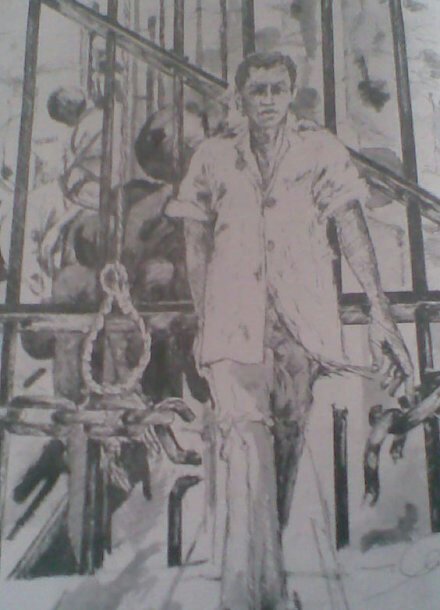
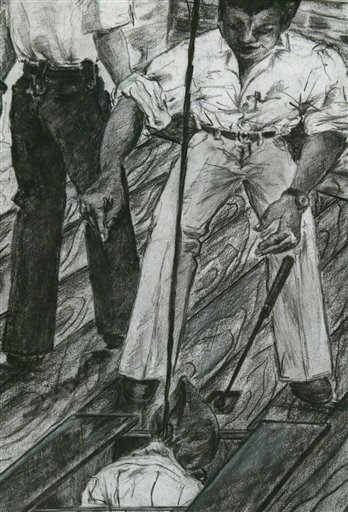
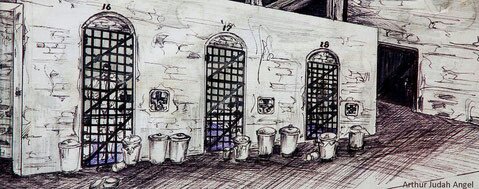
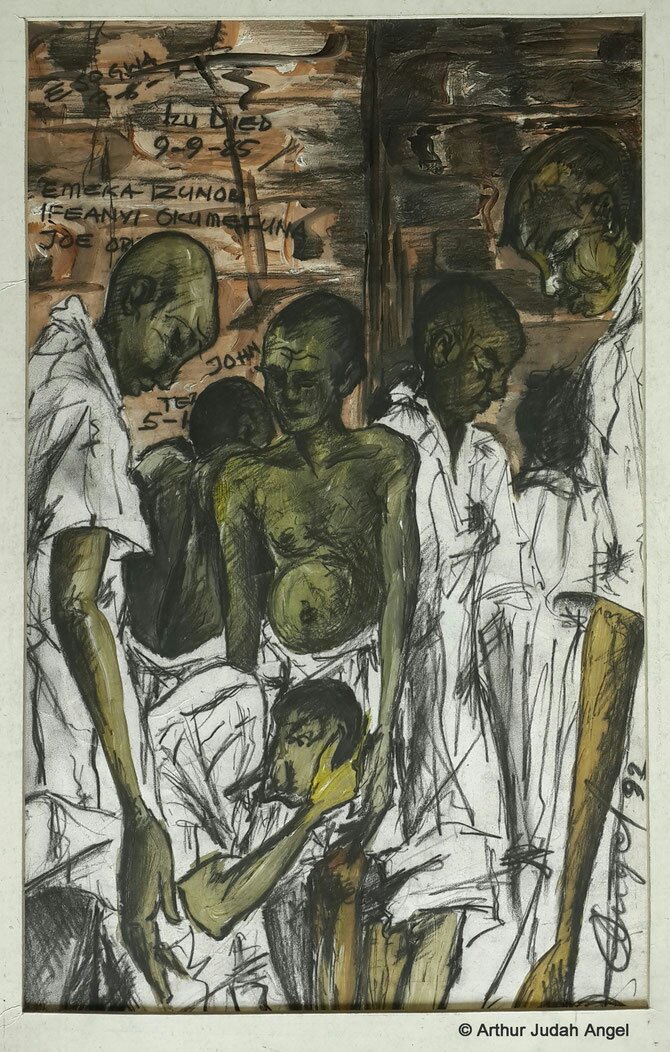
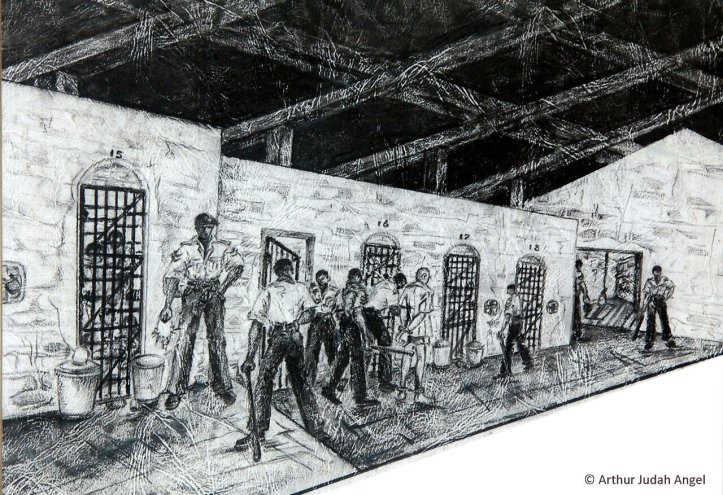
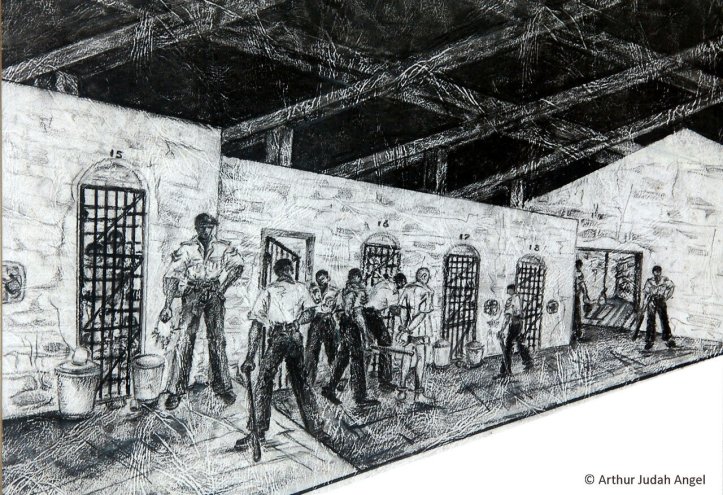
On the 7th of February 1986, Arthur Angel was found guilty of murder and sentenced to death. He ended up spending nine years and six months in Nigerian Prisons Service, Enugu as a death row inmate, an experience of a life and time. On arrival in death row, “I met on ground 202 condemned criminals and became condemned criminal 203. On death row, the chains are too cold to bear. Gory tales pervade everywhere in the death chambers, on death row, death means nothing. Threnodies of death are sung every day. The death row has 18 cells measuring six by seven feet. 15 of the cells are windowless in a row with the gallows at the end, cells are congested and dirty. Every condemned criminal only awaits the hangman or firing squad while the only corridor in front of the cells doors is the road to the gallows. There is always a slogan on death row, ‘wait for your turn’.” In prison, Arthur Angel witnessed the death of over 380 inmates on death row and at a period of time, Arthur Angel was in cell 17 for two years awaiting the hangman. On the 2nd of August 1994, he was served his last meal. 38 condemned criminals were executed. Some by hanging, while others by firing squad. Arthur Angel was number 29 on the list’ but at the end of the gory exercise, the name and the number 29 was found missing from the list, then, Arthur felt there was indeed a miracle. He refused to die.
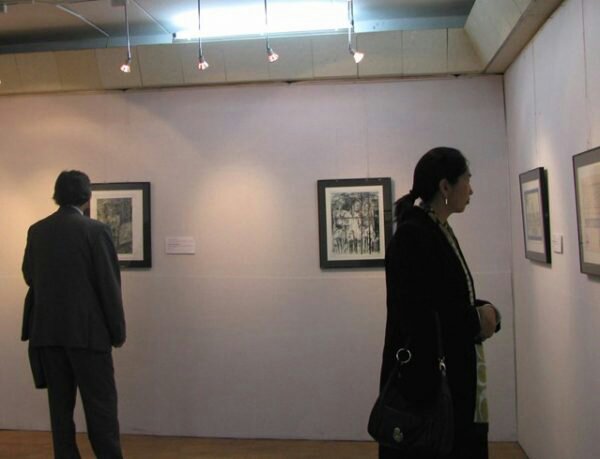
In Nigerian prisons, the welfare conditions are breath gasping. Inmates die before their time. The authorities in charge of Nigerian prisons continue to play an act of calumny as sorrowful experiences abound from the prisoners and their loved ones. Prisoners’ revolts are quashed by prison authorities. Punitive measures such as incessant clubbing of prisoners, death threat, diabolic transfer of prisoners and delay in release dates and petitions are meted on the prisoners. On death row, letters of clemency are always abandoned in welfare offices till the day of execution. Arthur Angel’s innate talent saved him while on death row. His sheer artistry and appreciation of literary works gave him better opportunities and which later paved way for his freedom. “I was making good money as an artist while on death row. Regularly, I would share my proceeds to other inmates who needed financial assistance and medical support.” Arthur became the bridge in their lives. The inmates saw in him a life wire. Prison missionaries, human right organization and prison welfare groups started having interest in prison situations in Nigeria through several letters written and sneaked out of prison walls by Arthur and his group. His artistic option made him the most important prisoner on death row in Enugu prison. Arthur’s engaging works served as souvenirs and gifts to prison special guests and dignitaries that paid courtesy visits to the prisons. One of such guests was Rev.Fr Obiora Ikeh, a Catholic Priest who got enthralled by Arthur Angel’s myriad of works. He organized exhibitions for Arthur while on death row in 1993 and 1994 respectively at the British Council and Catholic Institute for Development, Justice and Peace. These exhibitions brought Human Right interest groups and spearheaded the “Save Arthur Campaign” afterwards. Several letters of commendation and pardon for him were written and sent to the state government.
On August 8, 1995, Arthur Angel death sentence was commune to 20 years in prison after 10 years in prison. On the 22nd December 1995, there was a plot to kill Arthur Angel. “Four warders loyal to one DSP Orakwe, stormed the Nnamdi Azikiwe Medical Complex while I was on admission. Since then, I and my family had a torrid time with prison officials. I was later transferred to Onitsha and Uyo prisons on the 25th of June 1998 and 2nd of February 1999 respectively, just to delay my release date.” But on the 15th of February, 2000, Arthur Judah Angel, now 38years of age, was set free after sixteen calendar years in prison and nine years and six months on death row for an offence he didn’t commit. He was able to reconcile with his family again.
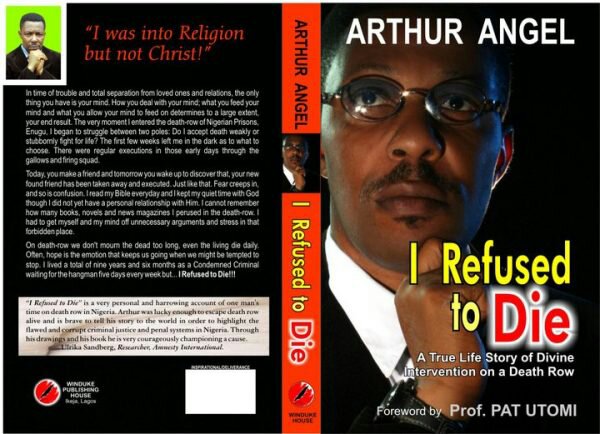
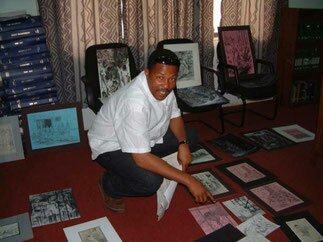
Arthur Angel knew he has a mission to fulfill. Surviving the odds was paramount. In 2004, Arthur Angel held his first solo exhibition at Quintessence gallery. An exhibition that became a defining moment in his life, as countless solo, group exhibitions and several speaking engagements as a motivational speaker followed. Arthur also became engaged to Amnesty International as one of their ambassadors as a global campaigner on human rights issues. Today, Arthur Angel is happily married to Sophia Faith Angel and they have five children namely Amanda, Arthur Judah II, Elizabeth II, Precious and Gold. He is the Executive Director of Life Wire International Foundation, since 2012 in Lagos, Nigeria, established to promote human right causes, rehabilitation of ex-convicts, fighting for prisoners’ and underprivileged rights and the abolition of capital punishment.
Story/Aito Ireho
Images/Arthur Judah Angel

