
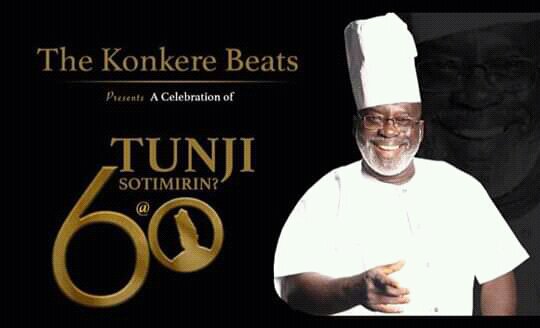
DR. ‘TUNJI SOTIMINRIN@60
Celebrating a…
Broda,
Friend-of-Ages
Comrade-of-all-Seasons…
MY LIFE, MY ART
(Interview originally titled, “Gov. Amosun copied my long cap style –Dr. Tunji Sotimirin,” published in New Telegraph, May 7, 2017)
Brief background
I am a performing artist, a play director, actor, dancer, storyteller, broadcaster and industry lecturer. I work with the Department of Creative Arts, the University of Lagos in the Theatre Unit because the department of Creative Arts consists of three different units; Music, Visual Art and Theatre Arts. So, I teach acting, play directing and sometimes the act of comedy.
Q: You’ve been in the industry for how long now?
A: Let’s say from the early ’80s till now. One can’t say specifically or calculate, let’s say for over thirty years.
Q: What inspires this creativity in you to do all you spoke about earlier?
A: I had the opportunity to be exposed early to community theatre. I mean, I use to follow masquerades in my area when I was much younger. I would watch them play drums, dance, sing; I’ll watch musicians perform at different social gatherings and it captivated me a lot. I liked to recreate things that I see, and I go to show my neighbours and family members in a way it will capture closely to how they did it. It’s an act that I found myself doing effortlessly; acting, drawing things, singing, and dancing. Some of these things you really cannot explain; it’s in you and you just find yourself expressing it. So that was the way I was motivated to do these kinds of things. When I was in primary school, I use to represent the school in cultural society and in school; I’ll do a lot of solo shows. For instance, I’ve dialogue with live chicken and goats on stage. So when some people say they started comedy, I wonder. I think we need to put things in a proper perspective especially in the act of comedy because a lot of them don’t know the history; they don’t know the early people who actually created the platform, those who started it out, it’s important we let them know.
Q: Where are you from?
A: I am from Ijebu Ayepe, Ogun State but I was born in Warri, Delta State. My mum is from Ikeriji, Ondo State. The irony is I couldn’t speak a word of Yoruba until I came to Lagos but of course, growing up within a community where people speak Yoruba, so I picked.
Q: You talked about your music career quite a lot, did you ever think of taking it up professionally?
A: For music, I’ve been doing it professionally but most of the time, what I did with the music is to work with institutions perhaps not commercially like that. For instance, I’ve worked in the German-French cultural centre. I had to feature in a lot of programs organized by them like World Music Day; I had to feature almost every year before I had to travel for some years out of the country. I had to perform in Germany under the platform of the institute. I had to perform in the UK at the MUSON Centre Festival; they usually have it every year. Aside from that, I have other social engagements for instance, I just came back from Ogun State 2nd Edition of Drums Festival. My band, Konkere Beat, also featured as one of the participants, so we perform at wedding parties, engagements, and birthday ceremonies. We not only do Yoruba music, we do jazz, gospel and English; we can do any type of cultural performance that you want. We can entertain in Igbo, Hausa, German whatever, I mean the exposure and experience one has, prepares you to express yourself in many languages. So, the meaning of ‘Konkere’ is a fusion of all the artistic ingredients in terms of the language, expression, musical instruments, in terms of even acting, poetry and storytelling, drums, all these are the ingredients that you put in ‘Konkere’. ‘Konkere’ also in Yoruba means concrete, a mixture of so many components; at the end of the day what you find is a solid performance and I’m the founder of this group.
Q: When you started your acting career, what was it like in the early days?
A: I would say that nowadays there is so much attention and interest now by people, particularly non-artists; people who usually are not practitioners of art showing deep interest in the art. In the good old days, you wanted to do art because you knew that you had the talent to express and that you have passion for it and that nothing, even when your mother or your father told you that you cannot engage in, you still wanted to do it. So, it was something of a passion and you were inspired by masters of the art. The economy was not this bad even though there was no much money in it. In fact, there was little or no money in it, but you were happy doing it and it was something like pride that you were part of the family of professional people. So, for someone like me, I met professionals and I was happy working with them, and they embraced me, and I came into what they called the elite group, the community of elite in the university system and I was proud, and my parents were too. I learned a lot, that’s one advantage that people like us had which is missing nowadays because people just go into it for the fun of it just to show their face on TV or for the fame. Yeah, it’s good to be famous but just have some knowledge so that you can explain what you know, and you can teach others and so you can fall back on it, because all the fame would fade away.
Q: You mentioned something about the misconception of the history of comedy in Nigeria. Can you throw more light on this?
A: The truth of the matter is it all started in the early 80’s. I started something on NTA channel 7 as a solo act, and nobody has ever done that before. You can go and check and that was the beginning of solo performances or stand-up comedy as far as I know and I was doing that every week, nobody has ever done that, and they were calling it ‘one-man show.’ I equally called in Richard Mofe Damijo, he’s alive, you can go and talk to him, and the late Yinka Greg. We are also talking about who started taking rap into music, into Fuji music; I did that as early as 1984 in University of Ibadan. I was doing all of these in my solo performances and the hall would be full at the German cultural centre and they sponsored it all over the country. So, these are things we need to correct so that the next generation after us will know the history, because most of these comedians in it now, calling themselves king of comedy won’t tell you how it all started. They all learned from me. It is in the records. So, I think this should be highlighted and corrected especially from the early ’80s of NTA channel 7, I was singing with teddy bears, having a dialogue with fowls, so all these comedians came in much later.
Q: What advice do you have for artists entering into the entertainment industry without some form of formal training?
A: I think it’s because of what they see out there so they just invite them for auditions and once they see they have light skin; they can speak phonetics and they have studs on their ear. They are selling glamour but then glamour would fade away at some point and I know a few of them that have thought deeply about not limiting their act to just the glamorous aspect. I know OC Ukeje for instance, he didn’t study drama, but he went abroad to study drama because he knew the significance of that in his life. Yes, you have talent but go and see how you can brush up your talent so that people would not be able to push you around. So, the advice is that they should combine their talent with knowledge and update yourself with information that will help you intellectually.
Q: Let’s talk about your marriage, when did you get married?
A: That was in 1993, my first son would be 22years old now. I have three children; the second is the writer in the house. Her first book is titled, ‘Not too far to reach’ and the other one is ‘Perfect together’. Her name is Yetunde Sotimirin, she is in her final year Mass Communication, the University of Lagos and the last one is preparing to go to SS1, her name is Eniola Sotimirin, the first one is Seun Sotimirin, he has graduated from Sociology, he is more or less putting his eye in Advertising now, he just wants to have a little experience before he goes for his masters.
Q: What has kept your marriage strong these past years?
A: It’s all about trust; if you hide anything, it’s going to complicate issues because your wife would be suspicious, and your children would be suspicious as well. So I don’t hide; they know what I have in my account, they know where I keep money, both the money they can use to run the home and their affairs and they have the ATM card, so they know what I have and what I don’t have.
Q: Who exactly is Tunji Sotimirin outside the ‘bad guy’ character we see him portray in movies?
A: All those things that you watch on TV are just roles being played by individuals who claim they have ability to entertain folks. Because of the training one has had, we try to pick pieces of information, personality, and age and deploy it into roles that we want to play, so that’s what brings about some of the characters that one plays. I’ve played a wicked person, a good person, kind, humble and meek. I’ve played roles that would annoy people. That is the joy of the actors training and it’s for you to apply it at a relevant point and appropriate time in the course of creating a role.
Q: What is your fashion style like? I like to wear anything that would present me as an African.
A: I am a Yoruba person but the bottom line is that I’m not a European, so I want to project my culture. I’m hardly on suit. I may go for a role that require I wear suit but personally, I don’t feel comfortable wearing them; so I wear traditional outfit that is peculiar to African people.
Q: I see you on mostly on this long cap, what exactly does it mean or signify?
A: This is the unique aspect of me, which is a mark of my identity, the long cap. I always have it in my bag, and I have so many of them. I try to stand out because I’m not in competition with anyone. The Governor of Ogun State, Ibukunle Amosun, got the style from me and he acknowledges it too; I’ve been wearing it way before he started wearing his own.
FURTHER READING…
https://guardian.ng/art/for-sotimirin-its-wedlock-of-song-drama/
Words and pictures courtesy of Jahman Anikulapo

