
THE YORUBA BARBIE DOLL: ỌMỌLÁŃGIDI–Tales from Iya Oyo
EPISODE TWO:
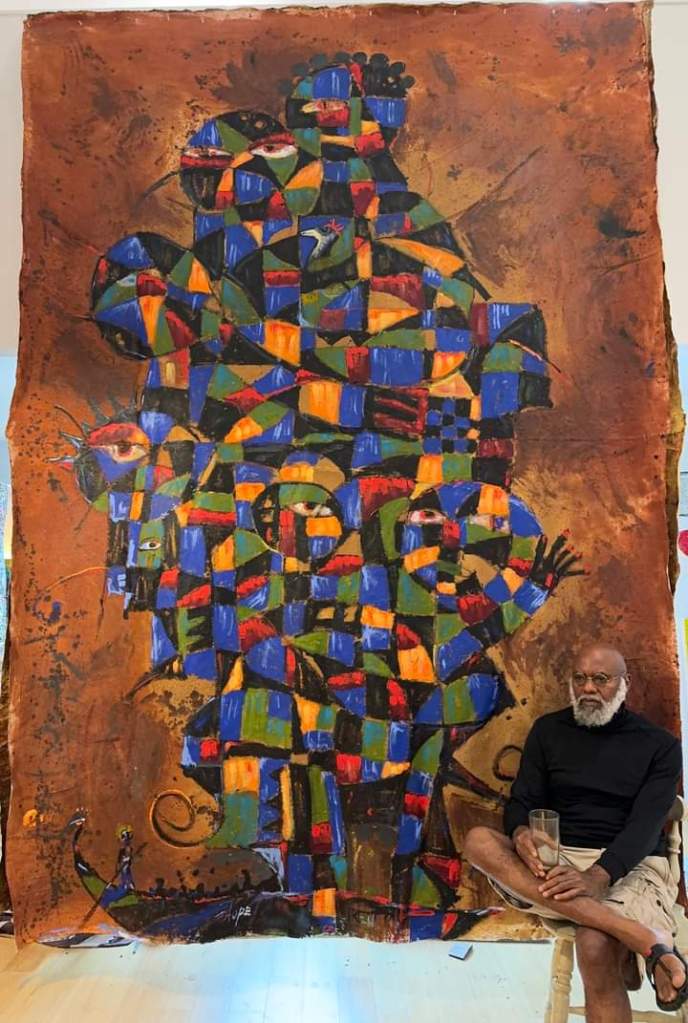
She was led, in leg chains, into the King’s Court. The heavy metal of the chains dragged on the polished floor, trailing behind her, as eight palace warders accompanied her into the large hall.
Two warders slowly marched in measured steps in front of her, carrying the insignia of the executioners. Two marched toward her right, two toward her left and two kept the rear. They all carried ritual swords, raised high above their heads.
The high chiefs were all seated, together with the heads of all the adugbo in the city of Ikire.
She wore only a white wrapper that covered her breasts, reaching barely down to her knees. Her hair had been shaved. Her eyes looked dead in the hollow of their sockets. She looked like she was a walking dead, a zombie. Hundreds of people were outside the King’s Court. But you could still hear a pin drop. It was so quiet that when a woman coughed among the crowd, all heads turned in her direction.
Early in the morning, the sun had come out blazing with heat and luminosity, and it promised to be another humid day that the yam tubers loved, buried under heaps of humus soil in the gardens near the houses within the city. Farmers did not venture from the Ikire metropolis that day. Even the markets were empty. Nobody was buying or selling. The men, women, children, dogs, goats and chicken of the town trooped only in one direction – towards the King’s Court, to listen to the verdict of the disgraced princess indicted for killing the little prince of their beloved royal family, with her wicked witchcraft.
Adewuyi stood on the platform inside the prisoners’ cage in the King’s Court. Her gaze was cast on the ground. All eyes in the courtroom were set on her.
For the past one moon, the people of Ikire were scratching their heads: how did such a wonderful woman turn into a baby-killing witch?
“No woman is to be trusted when it comes to witchcraft,” said Owolabi, an influential farmer. “Even my mother, my sisters. Any of my daughters,” he announced with authority. “The only remedy is to keep them happy.”
“I’m not a witch,” retorted a young woman who heard the statement. “My mother is not a witch, nor is any of my sisters!”
“That’s what they all claim until they are caught,” Owolabi countered. “Could anyone have believed that the beautiful princess would use witchcraft to kill the same baby she had been caring for so tenderly?”
“I wanted to warn them,” said Eweje, a local herbalist. “I have been noticing strange birds perching on top of her roof the very day she arrived Ikire!”
“What a heartless witch,” opined Ayelabowo, a wealthy gold trader. “Not all witches are bad. Some use their witchcraft to protect and raise the children in the community. Some of them bring wealth and prosperity.”
“There is no good witch,” Oseni snapped back. “The only protection comes from Allah. You must all burn your idols and pray five times daily at the mosque. We just cut down that huge Odan tree at the center of the town to begin the construction of the second mosque. Before we could cut down the tree, our Imam had to command 256 black birds out from the inside of the tree. A powerful man, or they would have killed him.”
“Since we cut down that evil tree,” Suberu said, “there has been peace in our neighbourhood.”
“Shhhhh,” warned Oyewole, “Kabiyesi is entering the court.”
The king’s entourage files in, with Kabiyesi attired in intricately embroidered indigo gown. He wore a crown of glowing rubies and red beads. It was the special crown that he wore when sitting in judgment over the rare case of murder. It had occurred only twice before in his fifty-eight years of ascending the throne of his ancestors. He sat on the throne in the court, cleared his throat and said, “Young woman. You are accused of killing the Little Prince of my kingdom, with witchcraft. Is this true?”
“Yes, Kabiyesi,” Adewuyi replied.
A murmur went through the crowd.
“Quiet, quiet,” commanded the town crier. “Let nobody say one word while this court is sitting!”
“Why did you commit such an unspeakable act?” continued the King.
“Because I am a witch,” Adewuyi replied, her head bent, her gaze cast on her dirty bare feet.
“But, why? Why are you a witch?” the king asked in confoundment.
“Because I am a bad woman,” Adewuyi answered.
Everybody was now speaking at the same time. The volume of sound rippled through the vast courtroom, spilling to the crowd waiting outside, like a tidal wave, though they tried to keep their voices down.
“Quiet, quiet!” yelled the town crier.
“So, it is true, what people have been saying?” the king proceeded, trying to maintain his calm, though he was clearly flabbergasted. “What, what, what shall we do with you now?”
“I deserve death, Kabiyesi,” Adewuyi said, calmly. “If you don’t execute me, I will kill more people.”
This time the crowd roared. It went on for about two full minutes, despite the protests and shouts of the town crier. Finally, the noises stopped. The king continued his interrogation.
“How many people have you killed in Ikire since you arrived,” Kabiyesi asked.
“Countless,” replied Adewuyi. “I enjoy killing babies.”
Title: The Vienna Frigate: Ship Called Hope.

