In a time when African art is gaining renewed global attention, a new generation of artists is not merely participating in the conversation, these artists are reshaping it. At the heart of this shift is a quiet but powerful return to origins, that is a re-engagement with history, symbolism, and identity, expressed through bold contemporary forms.
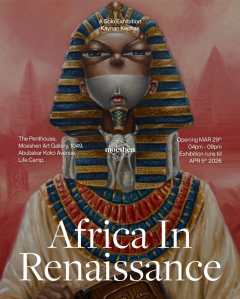
“Africa In Renaissance,” a new exhibition by Kaynan Kephas, opens on March 29, 2026, at The Penthouse, Moeshen Art Gallery in Abuja. Running through April 5, 2026, the exhibition reflects more than a presentation of artworks. Rather, it signals a cultural reawakening rooted in rediscovery and reinterpretation.
This body of work emerges from a creative awakening which is a deep desire to reconnect with Africa’s intellectual, spiritual, and cultural heritage while speaking directly to the present moment.
Drawing inspiration from ancient civilisations, particularly the enduring legacy of Egyptian visual culture, Kaynan Kephas bridges time with a distinctive modern aesthetic influenced by manga and contemporary illustration. The result is a collection that feels both familiar and strikingly new where symbolism meets simplicity, and identity is expressed not through realism, but through essence.
What stands out is the deliberate balance between depth and accessibility. The works invite reflection, yet remain open and engaging, especially for younger audiences navigating their relationship with heritage in a globalised world. Each piece becomes a portal into memory, meaning, and the evolving possibilities of self-definition.
In this conversation with iBAND Magazine, the artist offers insight into the ideas, influences, and intentions behind “Africa In Renaissance.” From the symbolism embedded in each figure to the evolution of his creative process, the dialogue reveals an artist committed not only to making art, but to shaping narratives.
Words and interview Ireho Aito | Don’t Keep Your Art in the Finger! Artwork and images courtesy Kaynan Kephas
What inspired “Africa In Renaissance,” and what does renaissance mean to you?
“Africa In Renaissance” came from a desire to reawaken something that already exists within us. When I think of renaissance, I don’t just think of rebirth, I think of rediscovery. Africa has always had depth, power, and knowledge, but a lot of it has been forgotten or distorted. This body of work is about bringing that essence back into focus and presenting it in a way that feels alive today.
Your work draws from ancient Egyptian imagery. Why is that important?
Ancient Egyptian imagery carries a strong sense of identity, spirituality, and structure. It’s not just aesthetic, it’s symbolic. I use it because it connects us to a time when African civilisations were deeply rooted in knowledge and expression. It helps me tell stories that feel timeless, not just modern.
The masked figure in your artwork is striking. What does the mask symbolise?
Actually, it’s not a mask. I can see why it might come across that way, but the face is inspired by manga and anime styling, which naturally simplifies and exaggerates certain features.
For me, that choice is intentional. It allows me to strip the face down to its essence and focus more on emotion and presence rather than realism. So instead of hiding identity like a mask would, it’s more about expressing identity in a distilled form.
It also helps me connect with a younger audience, bringing a contemporary visual language into work that is rooted in African themes and history. Though the faces may appear playful or unusual at first glance, behind those expressions are stories meant to be remembered.
How do you balance historical references with contemporary realities in your art?
For me, it’s about making the past speak in the present. I draw from history, but I express it through a modern visual language and emotion. So even if the reference is ancient, the feeling is current. That way, the work doesn’t feel distant, it feels relatable.
What message do you hope African audiences, especially young creatives, take away?
I want them to understand that their roots are powerful. There’s so much value in our history and culture, and it doesn’t need to be copied from outside to be relevant. You can look inward, reinterpret it, and still create something global.
Can you walk us through your creative process?
It usually starts with an idea or a feeling, sometimes spiritual, sometimes visual. I begin with loose sketches to capture the energy. Then I refine the composition, focusing on posture, symbols, and emotion. From there, I build the piece layer by layer, paying close attention to texture and detail until it feels complete.
How many artworks will be showcased at the exhibition?
I will be showcasing a total of 17 art pieces. Each one connects to the larger theme, while still standing strongly on its own.
How has your artistic style evolved leading up to this exhibition?
My style has become more intentional. I call this state “Flow.” In the past, I focused more on photorealism, but now I think more about meaning, storytelling, and structure not because photorealism wasn’t working, but because I wanted to go deeper. I have also grown more confident in blending influences like manga and African history in a way that feels natural.
What role do you believe art plays in shaping Africa’s global narrative today?
Art is one of the strongest ways we tell our own story. For a long time, Africa has been interpreted from the outside. Now, artists have the opportunity to define the narrative ourselves, showing the depth, complexity, and beauty of the continent in our own voice.
Were there any particular challenges you faced while preparing for this exhibition?
One challenge was staying true to the vision without overcomplicating it. Also, translating deep ideas into visuals that people can easily connect with isn’t always simple. But those challenges ultimately helped refine the work.
Quickly tell us more about yourself, your family, childhood, and education?
I grew up with a strong interest in art and storytelling. From a young age, I was drawn to drawing and visual expression. Over time, I developed my style by combining influences from African history and contemporary art forms. My journey has been about finding my voice and using it to tell meaningful stories.
Why did you choose Moeschen Gallery for this collaboration?
I chose Moeshen Gallery because it aligns with the kind of work I am trying to present. It’s a space that appreciates depth and narrative, and I felt it was the right environment for this body of work.
Looking ahead, what is next for you after “Africa In Renaissance”?
I am looking to begin a new series titled “Negro-Mancy” with “Negro” representing Black identity and “mancy” referring to prophecy. The series explores the origins of mankind and the role of the Black race in the final moments of life, questioning whether eschatology, as described by religion or science, truly exists.
The goal is to keep building and pushing the idea of Africa as a living, evolving narrative.
iBAND Magazine, Celebrating Visual Arts from the Original.
Africa | Visual Art | Lifestyle | Culture

