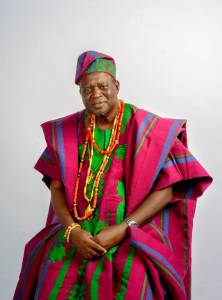
Dr. Kunle Adeyemi s a printmaking grandmaster whose legacy extends beyond ink and plates. A retired lecturer from the revered Yaba College of Technology Lagos, he remains deeply active, producing new works, exploring fresh forms, and sustaining a dynamic artistic rhythm. This weekend, he joins renowned and emerging artists at the , opening of Art Arising Festival by Art Alliance 51, April 18 at the National Museum Onikan in Lagos.
Words: Ireho Aito | Don’t Keep Your Art in the Finger!
Photographs courtesy, KAS Studios archives
For those who truly want to capture Lagos and its many nuances, Monday offers a front-row seat to its quiet drama. This is a city of cities easing into motion. For me, Catholic Mass is inevitable, a grounding ritual before stepping out from my small community to meet one of Africa’s great artistic minds.
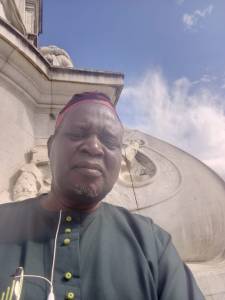
Dr. Kunle Adeyemi embodies a rare balance, deeply rooted in tradition yet effortlessly contemporary. Stylish without trying, composed without effort, his presence reflects a life shaped by discipline, culture, and craft. He does not merely create art, he lives it, wears it, and, quite fittingly, deserves every bit of that adornment.
If you can survive a Monday rush in Lagos, you have earned the right to call yourself a conqueror of the universe and no ceremony required.
Do not take it personally when the famous yellow buses, unofficial rulers of the road, suddenly decide your lane belongs to them. You, meanwhile, are left performing acrobatics behind the wheel, dodging potholes that seem to have permanent residency.
And just when you think you have mastered the rhythm, a dispatch rider appears swift, sharp, and already announcing his presence from your right like a familiar warning siren. One wrong move, even a slight brush, and within seconds, reinforcements arrive. Fellow riders gather, not invited, but expectedly united in a dramatic show of brotherhood, in shared outrage, and Monday morning intensity.
In Lagos, the week does not begin gently. It announces itself.
On a Monday morning that already felt like it needed permission to begin, one of the street preachers, known as traffic evangelism, decided to add a little theatre to the chaos. It was not just preaching, it became a performance that renowned performance artist Jelili Atiku would be green with envy.
In a move that could rival a magician’s grand reveal, he dipped his hand deep into his pockets and dramatically flashed crisp, high-denomination naira notes, as if he had just unlocked a financial breakthrough the rest of Lagos somehow missed and trudging out to go and find.
“Do you have this in your pocket to start your week?” he boomed in a confident American accent that had clearly travelled farther than most of us that morning. He retorted, “I know many of you would think I am a beggar using the gospel to make money.” That was a fast jibe he threw.
Before anyone could mentally check their account balance, he fired the next shot: “I’m not sure… you may be in your over-starched outfits but you don’t have depth.”
Clutching his famous black book like a seasoned headliner, he leaned into his message with the swagger of someone who clearly understood his audience and their pockets. “The only one that can give you what I am holding without making you a slave is the Creator of heaven and earth,” he declared, pausing just long enough for effect. “So come… all you that labour and are heavily burdened. He will give you rest today.”
Rest and apparently, a chance at premium currency notes. Beautiful point to acknowledge was his confidence in his delivery while feeling like the anointed.
Somewhere between the sermon, the sarcasm, and the subtle financial flex, you realise this isn’t just preaching. It’s branding. It’s street evangelism marketing. This is a performance art with a moral compass and a microphone. Sheer performance art to behold.
In Lagos, even salvation sometimes comes with a demo. And honestly? Only here can a man preach against materialism while casually conducting a live exhibition of it.
Lagos is not just a city. It’s a stage where faith, hustle, and a little bit of dramatic art collide beautifully.
Finding yourself in Oshodi in Lagos is a complete theater of dreams, don’t mind me using the moniker of one of the most successful English Football Clubsides.
The suburb is the bedrock of Lagos full of artistic impression. From a traffic enforcement officer chasing a traffic defaulter, down to street urchins harassing commuters for identity and the big rush, every where is like a splash of paint on canvas.
One begins to understand why the iconic Nigerian footballer an AFCON 1980 winner and former captain of the Green Eagles, Chief Segun Odegbami popularly known as “The Mathematical” once wrote so vividly in his weekly column about the suburb, boldly titling his piece “Oshodi As A Tourist Attraction.” It almost sounds ironic until you experience it. Because Oshodi is not just a place; it is a living theatre.
It is no surprise that artists such as photographers, painters, sculptors are endlessly drawn to it, each attempting to relive and reinterpret its energy. The suburb breathes with a raw, unfiltered rhythm that captures Lagos in its most honest form. In many ways, Oshodi is not just part of Lagos but a movement, and one that defines the city with striking clarity.
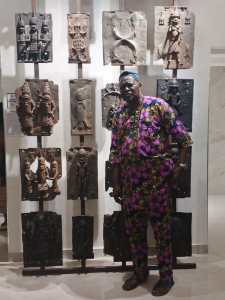
It was a breath of sanity when I found myself at the doorsteps of Dr. Kunle Adeyemi – KAS Studios in Mushin. A visual art evangelist with massive portfolio to prove.
This is one of the smartest investment from a Nigerian artist and the power of thinking ahead. As they say “time waits for no one.” Dr. Adeyemi owns the property and he is a community leader here as his name is well respected since he became a resident in 1986, what a journey!
Strategically embossed on the entrance of his studio downstairs is the symbolic “Tree of Life “ full of green, looking so harvesting with life quotes The Tree of Life
Tomorrow Belongs to People Who Prepare For It Today; The Axe Forgets But The Tree Remembers; Wisdom is Wealth.
Beyond the bold inscriptions of the “Tree of Life,” the studio itself opens like a quiet archive of thought, discipline, and lived experience. Inside KAS Studios, time does not rush, it settles. Works in different stages of completion lean against the walls, some whispering in ink, others speaking loudly in texture, colour, and form. It is here that Dr. Kunle Adeyemi’s philosophy becomes less of a statement and more of a lived reality.
Every time I make a visit to KAS Studios, one refreshing experience is the myriad of interns in the place. Since 1986, mentees or protege keep coming to KAS Studios to navigate their part and earn their future. It is one of the most important legacy KAS Studios continues to give all the time. They have besieged the studio on this Monday morning.
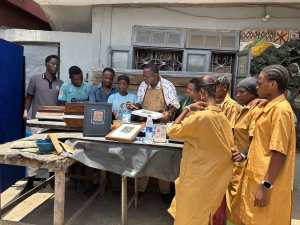
You begin to understand very quickly that this is not just a studio, it is a working mind.
On one side of his office sits a modest but deeply intentional library with titles like Nigerian Images, Artforms, Cartoonist’s Workshop, Connecting Evidential Grace, Visual Vanguard, and The Spirit of Leadership by Dr. Myles Munroe, quietly reveal the intellectual backbone of the practice. And then there is The Artist’s Handbook, written by Ray Smith a book he speaks about with the clarity of someone who understands both its utility and its limits. The book he is currently reading at the moment.
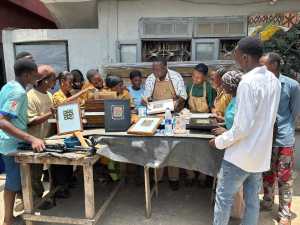
For Adeyemi, materials, techniques, and procedures are only half the journey. “What is left,” he insists, “is the creativity behind it. What is your subject?” It is a question that lingers long after he asks it, hanging in the air like the scent of turpentine.
Our conversation shifts easily, almost like one of his prints transitioning from plate to paper.
“How expensive is art to existence?” I ask.
His response is immediate, almost amused by the premise. Art, he explains, is not reserved for the elite. It adapts. It finds its way into different forms, different scales, different pockets. “If you have a deep pocket, you can get Kunle. If you don’t have a deep pocket, you can still get Kunle.”
And just like that, the myth of exclusivity dissolves.
I continued my interaction and actually asked about life after retirement from the classroom, the prestigious Yaba College of Technology Lagos. He is busy on the circuit but how has life been since dropping the chalk?
He smiles with affirmative response.
“Some of my works are in miniatures. If I have the opportunity, miniatures can become keyholders. The prints may find their way onto cards. Works evolve into objects that can sit comfortably in homes, offices, hotel lobbies, even in the everyday rhythm of life. It is not dilution, it is expansion. This is a deliberate democratisation of art.
“The artist is an entrepreneur,” he says firmly. “The artist has no business being hungry.”
It is a line that sounds simple but carries the weight of decades of practice, observation, and survival within a complex art economy.
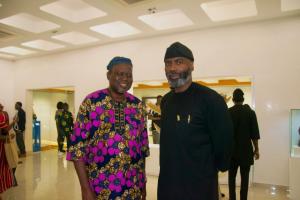
Retirement, in his case, is clearly a technical term, not a lived experience. If anything, it has amplified his output. Each invitation to exhibit becomes a reason to create new work. Each exhibition demands fresh thinking, fresh energy, fresh relevance.
“I feel I haven’t done enough,” he admits, not as a complaint but as a quiet commitment. And that commitment extends beyond his own practice into the ecosystem of art itself.
At the upcoming Art alliance 51 organised Art Arising Festival exhibition at the National Museum Onikan, where generations of artists converge, Adeyemi is not just showing work, he is participating in a dialogue. A dialogue between masters and emerging voices, between tradition and experimentation, between legacy and possibility.
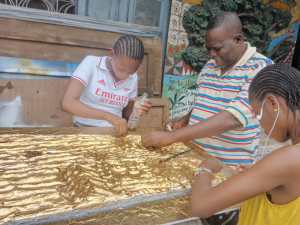
For younger artists, his advice is both practical and uncompromising. Show up prepared. Understand your audience. Use exhibitions not just to sell, but to introduce yourself, to invite curiosity, to open doors that may not even be visible yet.
“From there, anything can happen,” he says.
And then comes the word he returns to repeatedly, like a refrain that defines his entire philosophy: integrity. I asked what has it got to do with creativity when they are not typical politicians, what has integrity got to do with art entrepreneurship?
The huge personality did not blink before emphasising. “Integrity is the most important factor for any artist to have and not compromised with it. It makes you eschew from copying other people’s work,” he submits.
“Because Onobrakpeya is at a certain period and you feel that is where you belong, it means you are operating at inferior class. Such attitude surely backfires. If you don’t have integrity, you can’t be original. Run away from plagiarism!” He fires back.
“Such behaviour gives the art industry a lot of problems. Integrity should be watchword of artists when they are meeting their clients either in commissioned works, private or public and other relationships that might build their profile.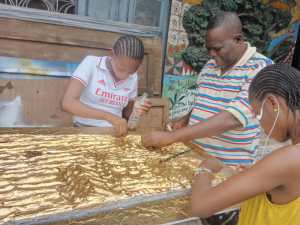
Deliver projects at agreed times, do not compromise quality.
Integrity comes with time consciousness. You are part of a group exhibition or solo show, a day or hours to the exhibition, you are battling with completion of works, then you may be losing some good opportunities. Curators may not trust such artist or artists.
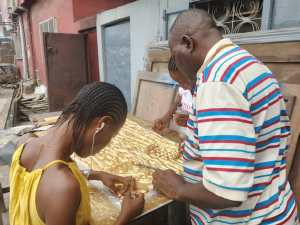
Now that you mentioned the curator. Can we look at integrity from the curators perspective?
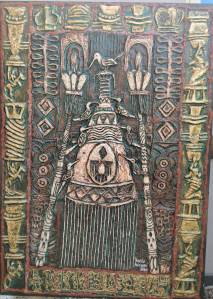
“The curator must be plain to the artist. And the artist must also be plain to the curator. There should not be mistrust at anywhere, he explained.
It is a rare kind of clarity, the kind that only comes from experience, from navigating both the visible and invisible structures of the art world.
I became more curious myself and asked who owns the market. The curator or the artist?
Dr. Adeyemi did not need to break his back before answering.
“Both of them own the market.”
But he explained that the curator has the fare share of the market. That ample authority is there with the curator and the reason is not far fetched as the curator meets the connoisseurs of the business for negotiations, having meetings with corporate organisations.
“The artist most of the time is in the studio working. The curator is also outside working.”
The bottom line is to move from the artist to the curator to where the money is. The bottom line is the money still come down to the artist.
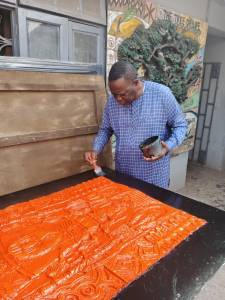
He also enlightened further, “however, if the artist is made, somehow he can push aside the curator. Picasso bluffed the curators because he had a name in the market.
Have you been in that situation?
“ I stylishly move away from curators who are dubious. I don’t block them. Everyone has a particular path the industry accommodates. One needs wisdom to deal with people generally, he positions”
The question came without hesitation, direct and necessary. When is the right time to start making money in this business?
He remarked that anytime he is in the studio and in the classroom, the answer is often sobering, especially for young artists eager for quick returns. Art does not reward impatience. It resists the idea of instant success, the fantasy of fast money, the illusion of a life lived on the fast lane. Anyone stepping into visual arts with that expectation is, quite frankly, in the wrong place.
“When I lecture my students, I let them know that if you are looking for quick money, you are in the wrong profession.”
He insists that there is money in art that is real, tangible, and sustaining. The difference lies in understanding its rhythm.
Earning does not suddenly arrive at some distant peak of mastery; it can begin much earlier. Even at the student level, the process can quietly take root. Small commissions, experimental sales, modest recognitions these are often the first signals. They may not be loud, but they are significant.
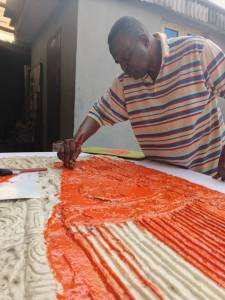
What truly determines that early shift is raw talent. When it is present, it creates openings. It attracts attention. It builds confidence, both within the artist and among those who encounter the work. Talent, when nurtured with discipline, becomes the bridge between learning and earning.
So the timeline is not fixed. It is shaped by growth, persistence, and clarity of purpose. Money in art is not a sprint but a gradual unfolding, one that rewards those willing to stay the course
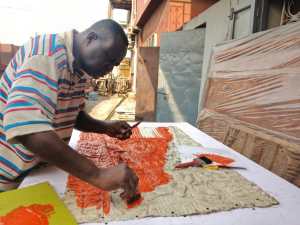
Our conversation around branding in the creative space often circles back to a deceptively simple question – does how an artist looks really matter?
“It does but not in the way many expect,” he remarks
“In the early stages of an artist’s journey, appearance is rarely the decisive factor. What speaks first, and often loudest, is the work itself, the honesty of the lines, the depth of thought, the discipline behind the practice. Collectors, especially seasoned ones, are trained to look beyond surface impressions. They are searching for substance, for voice, for consistency. In that immediate sense, appearance may not open the door,” Dr. Adekunle stated.
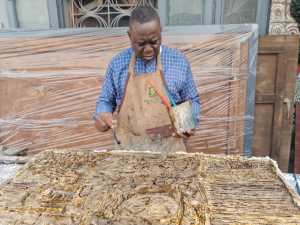
But over time, something shifts. And he enthuses further
“As the artist begins to move beyond the studio into exhibitions, conversations, studio visits, and the wider ecosystem of the art world, identity becomes more visible, more performative. This is where appearance begins to matter, not as vanity, but as language. It communicates seriousness, self-awareness, and a sense of place within the cultural and professional landscape.”
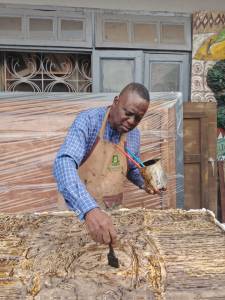
He continues by explaining this is also where the role of the curator becomes crucial. Acting as an intermediary, the curator often bridges that initial gap, presenting the artist’s work to collectors in a context that emphasises value over appearance. In those early encounters, the artist may be absent, but the work is framed, interpreted, and positioned with care.
Yet, in the long run, the artist steps fully into view.
Furthermore, Dr. Adeyemi explains that with all honesty, there is an unspoken expectation for the creator of beauty should have and in some measure, embody it. Not in a rigid or superficial way, but through a cultivated presence, to have an identity that feels intentional. Whether expressed through cultural attire or corporate elegance, appearance becomes part of the artist’s narrative.
“And so, the old saying holds a quiet truth: you are often addressed the way you present yourself.”
In the creative business, appearance will not replace talent, but it can amplify perception.
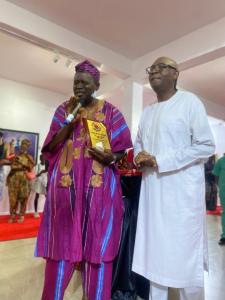
There’s a quiet honesty in the way he tells this story, one that strips the glamour off the art world and reveals the raw, human moments beneath it.
He recalls a day in 1994, during the Children of Africa bronze project, when urgency overtook presentation. There was no time for careful dressing, no pause to consider optics. Just a shared mission and a car ride into the heart of Lagos’ financial district.
“We had an appointment to see the Managing Director of a reputable bank,” he recounts. “A few of us got into my car exactly as we were dusty, rough, looking more like labourers from a building site than artists on a professional call.”
At Marina, where polished shoes and pressed suits often signal credibility before a word is spoken, their arrival disrupted expectation. Heads turned. There was visible disbelief. The contrast was stark, men dressed in the language of labour stepping into a space coded for corporate refinement.
“Everyone that saw us was surprised we wanted to see the MD of a bank this way,” he says, almost amused by the memory now.
But beneath the humour lies a deeper reflection on perception and access. In that moment, appearance became a silent negotiator that could either open doors or quietly complicate entry. Yet, the experience didn’t deter him. Instead, it sharpened his understanding of the invisible codes that govern creative industries and corporate spaces alike.
It’s a story that lingers not because of embarrassment, but because it captures a turning point. The realisation that while talent and vision drive the work, presentation often escorts it into the rooms where decisions are made.
He has hinted me about Art Arising Festival right there in Abeokuta and everything shows that he is a man of his words who prepares ahead.
Well, let’s look at Art Arising Festival which is a mix of grandmasters like you and emerging artists. What lessons are the young ones should be picking from you?
“Lessons to learn by young people collaborating with the Masters at Art Arising Festival, it is an Art Fair. In such kind of exhibition what do you present?” he questions.
“How can people get interested in your product? How can you attract people from that show down to your studio?
The exhibition is not just channelled to sell, it is for you to give account of yourself and from their, anything can happen. You may get commissions, get invitation for more projects or something great that will take your studio to another level,” he teaches like the teacher he still is.
“What if young people are looking for collectors, what is the strategy for them?”
He knows the terrain like an old soldier on the battle field and he opens up.
“You must have e – mails of people coming around you. An artist must be visible. Your work must have that identity. Your work must always have a message. You may decide to be documenting history or become contemporary. Even social criticism of the system, we saw that in Fela Kuti and his kind of music. The artist is a prophet. The artist work must address the consciousness of collectors.
Sustaining a collector’s relationship involves communication,” he wraps it up here.
Kunle Adeyemi has moved from the analogue era to technology age in the business. I quickly want his opinion on education and technology and I asked him what significant impact is education and technology making in the life of an artist?
Kunle Adeyemi leans forward on the question, as though weighing decades of practice against the speed of a changing world. For him, the conversation around education and technology is not abstract, such conversation is lived, layered, and essential.
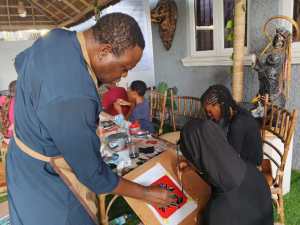
Education, he suggests, is the quiet foundation beneath every serious artist. It is not merely about certificates or formal schooling, but about discipline, exposure, and the ability to think critically about one’s own work. An artist, in his view, must be informed and grounded in history, aware of context, also constantly learning.
Without that base, creativity risks becoming directionless, unable to engage meaningfully with either tradition or innovation.
“You have to be educated to be an artist. And that part of education, technology is very important.”
Then comes technology, which he treats not as a replacement for artistic skill, but as an extension of it. Moving from the analogue era into the digital age, he has witnessed how tools have transformed both process and possibility. Technology accelerates production, expands access, and opens new platforms for visibility. It allows artists to document, reproduce, and share their work beyond physical boundaries, connecting studios in Lagos to audiences across continents.
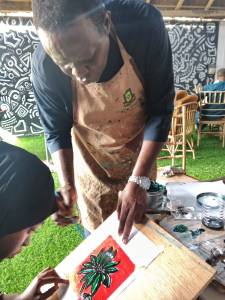
Yet, he is careful not to romanticise it. Technology, he implies, is only as powerful as the mind guiding it. Without education, the tools can be misused or underutilised. But when both are aligned, something powerful happens and that is the artist becomes not just a creator, but a communicator, meaning someone equipped to navigate both the depth of tradition and the reach of the modern world.
In conversation, Kunle Adeyemi speaks with the calm assurance of someone who understands both the intimacy of the studio and the wider end of the art market. His responses move fluidly between the practical and the philosophical, well grounded, yet forward-looking.
Medium: Paintocast and Metal foil.
On the scale of his participation at the Art Arising Festival, he offers a modest but telling insight. The space, he explains, is limited, and so he has chosen to present miniatures. It’s a decision that reflects both adaptability and precision, an artist adjusting not just to physical constraints, but to the rhythm of the exhibition itself. In many ways, miniatures demand a different kind of attention, inviting viewers to come closer, to linger, to engage more intimately with the work.
When the focus shifts to younger artists, his tone becomes almost instructive. Opportunities like those created by Art Alliance 51 are, in his view, not optional but they are essential. Group exhibitions and art fairs, he notes, serve as real-world classrooms. They expose emerging artists to diverse audiences, introduce them to the mechanics of the market, and provide a safe yet dynamic space to test ideas. It is in these shared environments that artists begin to understand not just how to create, but how to position themselves within a larger ecosystem.
Then comes his reflection on the organisers themselves, and here, there is unmistakable respect. He acknowledges the deliberate effort it takes to step beyond the solitude of the studio and build something communal. Initiatives like this, he points out, are not easy, especially in an industry where the number of artists often outweighs the available demand. Yet, by securing venues and creating platforms for engagement, the organisers are doing more than hosting exhibitions; they are actively shaping the marketplace.
There’s a quiet optimism in how he frames it. By building the structure, by gathering artists and audiences in one space, they are setting the conditions for growth. The market, he suggests, will eventually respond. And when it does, it will be because of foundations like these that are carefully, persistently laid.
Kunle Adeyemi’s next move unfolds like a return that is deliberate, rooted, and quietly defiant. After years of navigating materials and methods, he is turning his attention to something deeply embedded in identity which is fabric, form, and cultural memory.
At the center of this new chapter is an embroidery series “Agbada” inspired by the grandeur of the specifically but expansive, flowing style known as “Jakan.” It is not just about clothing, but about presence. The silhouette carries weight: of history, of status, of ceremony. And for him, it becomes a visual language waiting to be translated across mediums.
“This year I am coming out with embroidery series. A lot of work has been done in our culture and I am bringing the fabric out in different medium this year. I am talking about the Agbada ‘Jakan’ that is big and flowing.”
His urgency is unmistakable. There is a concern that what is local and original can easily be reframed and even claimed by outsiders if it is not actively preserved and projected.
“I don’t want to wait until a foreigner like a Chinese coming in and start promoting what is entirely ours. Once foreigners hijacked our culture, people subscribe to it because that is what is available. If I am living here and frown at my own culture, then there is a problem. We need to let the world know that the originality of such fabric and fashion is here.”
The process itself begins simply with a sketch. The outline of the Agbada forms the backbone, but from there, it expands into something more collaborative and interdisciplinary.
“I sketch the Agbada first. And the way it is, I can collaborate with fashion designers, collaborate with people who sells this culture. It is an Ondo culture to wear big flowing, flamboyant Agbada embroidery. It occurred to me that I need to start documenting the fashion through visual arts.”
What starts as a garment becomes an archive, that will lives in prints, sculpture, painting, and beyond.
“It also has to do with royalty. The series will come in prints, sculpture, painting and other medium.”
There is also a strong geographical and cultural anchor. He traces the flamboyance of this embroidered tradition to , where the style carries a distinct identity that is bold, elaborate, and unmistakably regal.
The project will surely culminate in an exhibition with a clear dedication that ties the work back to its roots in status, symbolism, and cultural pride.
“The exhibition will be dedicated to one man, the Asiwaju of Ijesaland , a fabric user. He uses embroidery clothes a lot. If art is of the royalty, and I need to take it down there. The culture must be sustained and documented.”
For Dr. Kunle Adeyemi PhD, this is more than a series. It becomes a declaration of ownership, preservation, and the enduring power of seeing one’s own culture clearly, and presenting it boldly to the world.
The conversation shifts to a subject many artists approach with caution, the AI debate. Yet Kunle Adeyemi meets it with measured clarity rather than fear. For him, artificial intelligence is not a threat looming over the studio at anytime. Rather, it is a tool, and one that reflects the intention and effort of the artist behind it.
“I don’t think there is any problem. AI is garbage in, garbage out. AI cannot do the job for me.”
There is a firmness in that position. He draws a clear boundary between authorship and assistance. The creative act, in his view, remains human which is rooted in experience, discipline, and imagination. No algorithm can replace that.
But he is not dismissive of its reach. Instead, he acknowledges the subtle ways AI intersects with visibility and access.
“If your work goes to the cloud, AI can get it out. And put it in its store. People can search, for instance, Agbada in Yorubaland, this can pop up for the searcher. So, it is what I did that AI would feed its audience.”
In that sense, AI becomes an amplifier. It does not originate the work, it only redistributes it. What surfaces in digital spaces is still anchored in the artist’s original labour. The implication is clear, that the stronger the work, the more meaningful what AI circulates.
He also places AI within a broader continuum of effort and innovation.
“Don’t forget that AI itself is a product of hardwork. AI works with hardworking person.”
It’s a subtle but important reframing. Rather than positioning AI as an effortless shortcut, he sees it as something that responds best to those already committed to their craft. It rewards depth, not shortcuts.
And finally, he situates its role where it is most useful not in creation, but in inquiry.
“However, AI helps to enhance your research but not doing the work for you. AI has come to help.”
In Kunle Adeyemi’s world, the studio remains sacred. The hand still leads. And AI, for all its complexity, simply becomes another instrument that extends the artist’s reach, but never replaces the artist’s voice.
The conversation opens into a wider horizon when Kunle Adeyemi begins to reflect on the future of his techniques, particularly his self-defined “Paintocast” and his engagement with “Paintograph.”
There is no hesitation in his outlook; instead, a sense of continuity, as though the future is simply an extension of a journey already in motion.
“The future is very bright and broad,” he says, situating his practice within a lineage that includes time spent at the school of Onobrakpeya . That experience, he notes, was formative not just in technique, but in philosophy. It was there he absorbed a principle that continues to guide him which is the necessity of artistic identity.
“My supervisors would always tell me and other students never to forget to create an identity for ourselves.”
From that foundation emerges one of his most distinctive contributions Paintocast. It is not just a technique, but a language he has coined, born out of movement across mediums.
“Moving from painting to printmaking and down to casting on a particular work gives paint-to-cast! You get Paintocast. It is a vocabulary I created. This gives you authority.”
There is something deliberate in the way he frames it. Naming, for him, is not ornamental but foundational. It is how innovation claims its space.
This naturally leads into a deeper reflection on the relationship between authority and language, a theme he approaches with striking clarity.
“You use language to define authority. They are twins. When you get the authority, it is the language that will drive it. The language in art is the medium.”
It is a statement that folds back into his own practice. By naming his process, by articulating it, he not only defines it, he legitimises it within a global conversation. Technique becomes terminology; terminology becomes influence.
Alongside this evolving practice is a quieter, equally important discipline and that is reading. His studio is not only a place of making, but of continuous learning.
“One of the books I am reading presently is ‘The Artist Handbook’ by Ray Smith.”
He speaks of the book not casually, but with the tone of someone who understands the value of structured knowledge.
“I would like to highlight the inclusion of The Artist’s Handbook by Ray Smith as a valuable addition to our resource collection. The book serves as a comprehensive and practical guide, offering extensive insights into artistic materials, techniques, and processes across both traditional and contemporary practices.”
For him, the significance lies in its accessibility and depth forming a bridge between emerging curiosity and refined expertise.
“Its structured approach, supported by clear illustrations and step-by-step guidance, makes it particularly useful for a wide range of users from emerging creatives to more experienced practitioners seeking a reliable reference.”
In many ways, this mirrors his own philosophy that art as a continuum, where learning, experimentation, and identity evolve together.
“I believe this acquisition aligns with my commitment to providing accessible, well-rounded learning tools that support creativity, experimentation, and continuous artistic development within the community.”
And so, the future he envisions is not just about new techniques or global relevance. It is about building a language, sustaining a culture of learning, and ensuring that both the work and the words that define it travel far beyond the studio.
Where else can one have a type of engagement such as this if not at KAS Studios with Dr. Kunle Adeyemi himself. What a super Monday opening the week. A week nobody prays for failure. Monday is so superstitious to Nigerians. I decided to ask him too if failure is a beautiful story?
“Failure is not an end. Failure is a story.”
He doesn’t celebrate it, but neither does he dismiss it. Instead, he reframes it as a necessary passage that sharpens awareness and redirects intention.
“It is good when an artist fails, it helps to know what next to do not to plunge into the abyss again. Failure inspires success.”
In his world, failure is not a closed door but a draft, somehow like a sketch, an unfinished narrative that points toward refinement. It is no surprise, then, that he is channeling this philosophy into a forthcoming book, “Failure of the Artist” a title that suggests not defeat, but examination.
From there, the conversation moves naturally into storytelling itself where it comes from, and how artists find it. His answer is disarmingly simple.
“Our storyline is simple. We have it all around us.”
There is no need, he implies, to search too far or look outward for validation. Stories are embedded in daily life, in culture, in the ordinary details often overlooked. What matters is direction what the artist chooses to see, and how deeply they are willing to look.
“It depends on where you want to get to. You can actually be digging for stories in different angles.”
And then, he grounds this idea in a striking example that blends culture, commerce, and identity.
“Adire is our story but today the same Adire is being created in China and we are running there to buy.”
For Kunle Adeyemi, the task of the artist is clear: to reclaim, reinterpret, and retell these stories before they are rewritten by others.
In this way, failure and storytelling begin to mirror each other. Both require reflection. Both demand honesty. And both, when embraced fully, become powerful tools for shaping not just art but identity itself.
Art Arising Festival Exhibition by Art Alliance 51 opens on the 18th of April 2026 at the National Museum Onikan in Lagos.
iBAND Magazine, Celebrating Visual Arts from the Original.
Africa | Visual Art | Lifestyle | Culture

