For nearly three decades, Andrew Esiebo has insisted that photography should not merely document society but it should participate in it. From his celebrated visual investigations into religion, migration, football culture, identity and everyday urban life, to his multimedia collaborations across Africa and Europe, the Nigerian photographer has consistently challenged viewers to look beyond familiar narratives. iBAND Magazine has followed that journey for years, recognising a visual storyteller whose camera does not seek spectacle as much as understanding.
Words Ireho Aito | Don’t Keep Your Art in the Finger! Photographs credit Andrew Esiebo
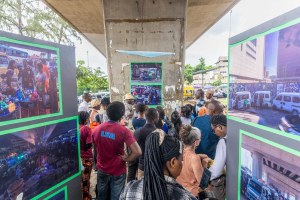
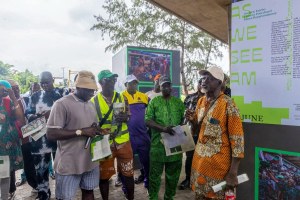
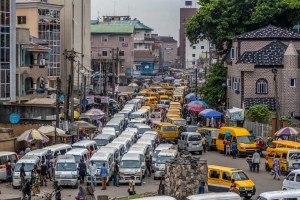
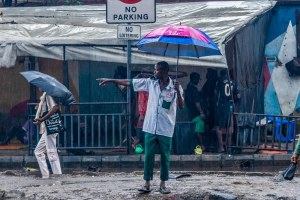
His latest collaborative public exhibition, As We See Am, continues that lifelong conversation which he openly shares his muse on his Facebook page. The exhibition was presented on 20 June 2026, the project transformed some of Lagos’ busiest transport corridors into an open-air exhibition, replacing the conventional silence of gallery walls with the constant rhythm of buses, commuters, conductors and transport workers.
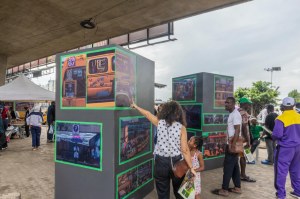
It was conceived by Andrew Esiebo and historian Laurent Fourchard, developed, curated and produced by Miora Ranaivoarinosy, following eight years of ethnographic research and two years of visual investigation into the everyday realities of the National Union of Road Transport Workers in Lagos.
Rather than invite audiences into an art institution, or gallery, the collaborators reversed the journey. The city itself became the museum.
It is an exhibition that unfolded across Obalende Roundabout and Oshodi, where thousands of Lagosians encounter public transport every day.
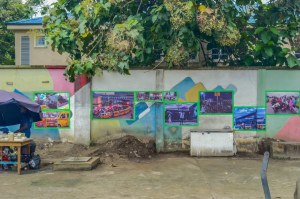 Reflecting on the experience, Esiebo wrote on his Facebook for his followers to enjoy the process;
“On 20 June 2026, As We See Am was presented as a public exhibition and community engagement project in Lagos. Conceived by Laurent Fourchard and myself, and developed, curated and produced by Miora Ranaivoarinosy, the project draws on eight years of ethnographic research and two years of visual research to (Un)make clichés of Lagos’ transport union.”
Instead of exhibiting inside a gallery, the work returned to the people whose lives shaped it.
As Esiebo explained once more;
“Rather than presenting the work in a gallery, we used Obalende Roundabout and Oshodi with major Lagos bus stops into an open-air exhibition, returning the research to the very spaces where it was conducted. The city itself became the exhibition, inviting commuters, transport workers and passers-by to pause, look again and ask a simple but important question.”
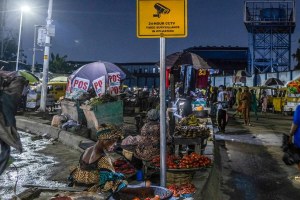
That decision captures what has distinguished Esiebo’s practice throughout his career. Whether documenting Pentecostal worship, African football such as the 2010 World Cup in South Africa, migration, West African barbershops or the changing landscape of Lagos, his photographs have always resisted reducing communities to stereotypes. Instead, they ask audiences to enter complex conversations.
Perhaps the most moving outcome of As We See Am came after the photographs had been installed.
The people represented in the exhibition became its guides. Esiebo also recalled;
“One of the most rewarding moments was seeing members of the transport workers’ union take ownership of the project. They helped install the exhibition, welcomed visitors, led guided tours and answered questions, sharing their own experiences and perspectives. They were no longer simply the subjects of representation, they became active participants in shaping how their stories were told.”
 For documentary photographers, this is an important shift. Photography is often criticised for extracting stories from communities. But here, the community reclaimed the narrative.
That transformation is precisely what Esiebo believes socially engaged artistic practice should accomplish.
The photographer reflected;
“For me, this is what socially engaged art and research can achieve. It is not only about producing knowledge but about returning it to the communities that made it possible, creating space for dialogue, reflection and new ways of seeing.”
Those words resonate strongly with the philosophy that has defined his career.
Born in Lagos, Esiebo began documenting Nigeria’s rapidly changing urban landscape before expanding into multimedia storytelling examining migration, religion, gender, popular culture and social identity. His work has appeared internationally, from Tate Modern and the São Paulo Biennial to the Havana Biennial and National Geographic, always seeking human stories beyond headlines.
In a previous reflection highlighted by iBAND Magazine, Esiebo once observed that “sniffing around is so important to me as imagination creeps into one’s mind faster than being stone cold in a place.”
That curiosity remains evident in As We See Am.
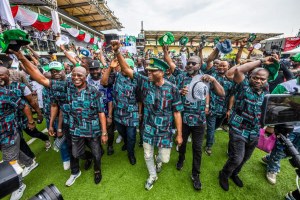
Rather than photographing Lagos from a distance, he continues walking into its busiest intersections, listening before photographing, collaborating before exhibiting.
Concluding his reflections, Esiebo acknowledged the many collaborators who shaped the project;
“My sincere thanks to Laurent Fourchard for an inspiring collaboration; to Miora Ranaivoarinosy for her vision in curating and producing the project; to the teams at CERI–Sciences Po and Heinrich Böll Stiftung for their support; to Peter Okotor, Christopher Nelson and Samuel Okechukwu, and everyone involved in the production and installation of the exhibition; and, above all, to the members of the National Union of Road Transport Workers (NURTW) across the Lagos State Council, branches, units and motor parks who welcomed us, shared their knowledge and trusted us with their stories.”
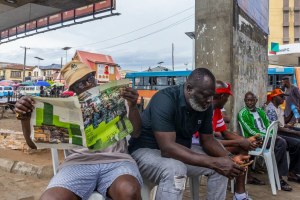
Ultimately, As We See Am is far more than a photography exhibition. It is a quiet yet compelling argument for another way of seeing Lagos from one that resists inherited clichés and simplistic narratives. Instead, it invites viewers into a city revealed through collaboration, shared authorship, and lived experience.
Rather than speaking for communities, the project creates space for communities to speak through the work itself. Every photograph, conversation, and encounter becomes part of a larger collective portrait, reminding us that the most authentic stories of Lagos emerge not from distant observation, but from participation, trust, and dialogue.
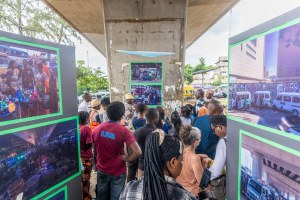
In doing so, As We See Am leaves behind more than memorable images. It offers a model for documentary practice rooted in listening, reciprocity, and respect where photography becomes not merely a way of looking at a city, but a way of seeing with it.
That may well be Andrew Esiebo’s greatest photograph yet not a single image, but an entire city invited to see itself differently.
iBAND Magazine, Celebrating Visual Arts from the Original.
Africa | Visual Art | Lifestyle | Culture

