There are moments in an artist’s journey when making art becomes more than producing another work. It becomes a process of questioning, unlearning, experimenting and discovering what else the artist is capable of doing. For Solomon Oguvre, his recently concluded Mind Calories Residency became one of those moments.
Words Ireho Aito | Don’t Keep Your Art in the Finger! Photographs/Images courtesy Solomon Oguvre
The residency did not simply give him time and space to make art. It gave him permission to play.
Our conversation about his journey, his leather practice and the experience of the residency gave us the opportunity to know the destination of the artist with A – Can – Spirit. It was fitting that the conversation happened in an artist’s studio space where ideas are tested, materials are touched and creative decisions are made. This is precisely the kind of encounter iBAND Magazine continues to represent: going beyond the finished artwork to visit artists where the work begins, where the smell of materials, the unfinished pieces and the evidence of labour reveal another side of the artist.
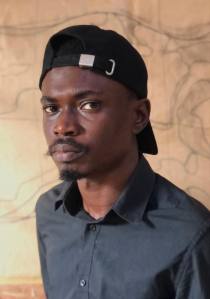
For Solomon Oguvre, the story began much earlier in Warri, Delta State. He was born on June 12, 1994, to Shedrack and Joy Oguvre, and what a day to come alive.
June 12 carries a special place in Nigeria’s history. It is a date forever associated with the country’s long struggle for democracy and the sacrifices made by those who stood for democratic ideals. Today, June 12 is observed as Democracy Day, a reminder of a defining chapter in Nigeria’s political journey.
For Oguvre, however, the date carries a more personal meaning. Born on a day that has since become a national symbol of democratic freedom, he sees a certain symbolism in the coincidence.
“I was born on Democracy Day, and this is symbolic for me also,” he remarked.
Perhaps that symbolism is worth holding on to. From Warri to his evolving journey as a creative merchant, Oguvre’s story has been shaped by movement, curiosity and a willingness to explore the possibilities that exist where creativity and enterprise meet.
Solomon grew up in a household where making things with the hands was already part of everyday life. His father was a carpenter, while his mother was involved in hairdressing and other businesses. Today, Oguvre is a painter who has increasingly found his voice through leather.
Perhaps there is something almost genetic about his relationship with materials.
His father’s engagement with wood and furniture-making may have quietly introduced him to the possibilities of transforming raw materials into objects of meaning and function. But the young Solomon’s first artistic fascination came through something much more familiar to children and that is super hero comics.
He remembers being fascinated by drawings of superheroes made by his classmates in primary school. That fascination stayed with him. Eventually, during the long vacation after primary school, he produced a portrait of Mickey Mouse from one of his T-shirts. His mother saw something in the attempt.
“My mother was fascinated about it and got me fixed up with a local artist for me not to be idle in the neighbourhood while waiting to go to secondary school. I would say my mother actually discovered me,” he recalls with gratitude.
Honestly, that intervention mattered in Solomon’s life at the time. It was an act of a mother’s love that opened a new pathway for him, a pathway towards freedom, possibility and a different understanding of what his life could become. Sometimes, the most important turning points in a person’s story do not arrive with grand announcements. They come quietly, through the courage and intervention of someone who believes in you. For Solomon, that person was his mother.
Rather than seeing art as a distraction, his mother found a way to give his curiosity direction. His community in Warri also played its part. Oguvre remembers the support he received from the small community around him, including his encounter with PLADDS — Press, Literary, Arts and Dramatic Society.
He recalls one of the organisation’s zonal coordinators telling him that if he became a member, he would automatically become their Art Editor. He was still in junior school and eventually did not join because of academic demands, but the encouragement stayed with him.
“I got unflinching support from the small community in Warri, back then,” he says.
From Warri, Oguvre travelled to Auchi, where he studied Painting at the School of Art and Design, Federal Polytechnic, Auchi. He gained admission at 18 and graduated in 2019. The colourists school that has produced world class artists and art entrepreneurs globally. Solomon had no choice but to come and qrite his name in gold.
His recollection of Auchi is marked by gratitude rather than entitlement.
“I have always believed not to expect so much on a platter of gold. Instead, one should strive for it,” he says.
He remembers entering the institution alongside more than a hundred classmates and describes the atmosphere among them as one without rivalry. There were students who already possessed considerable experience, but Oguvre continued to find his own path.
After graduation, he initially worked with conventional painting materials, including acrylic. Like many young artists, however, he encountered the difficult question of visibility and marketability. “I have been stranded without any monetary gains for eight months in my career path,” Solomon recollected while still smiling.
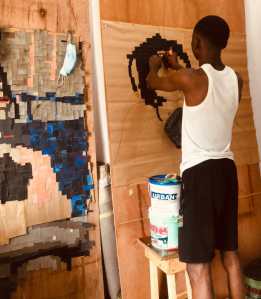
He could paint, but deep within him was a restless search for something beyond simply putting paint on canvas. He was looking for another way to express his creativity, another material through which his ideas could take form. The answer eventually came through leather.
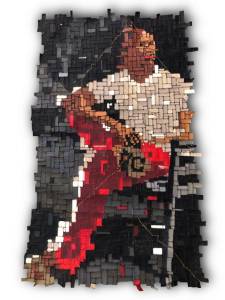
His decision to move into leather was not merely a technical experiment. It became a form of reinvention. He began to cut, arrange, sew and assemble leather pieces into compositions that allowed him to approach the figure differently.
“I did not see the need to look for jobs or other means because I knew I would start immediately,” he says of his decision to commit himself to artistic practice after graduation.
That determination would later become important to the direction his work took, as leather became the new language. But the search did not end with finding a new material. If anything, leather opened another chapter in Oguvre’s creative journey that required him to keep questioning his methods, pushing his imagination and remaining open to new possibilities. It was this spirit of exploration that would eventually lead him to the Mind Calories Residency.
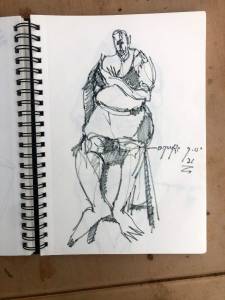
For Solomon Oguvre, the Mind Calories Residency became an important extension of this search beyond the familiar. The residency offered him the space to step away from the demands of everyday practice, experiment with new ideas and reconsider the possibilities within his creative language. More than a temporary change of environment, it became a period of learning, experimentation and self-discovery, an opportunity to test what happens when an artist is given the freedom to think beyond the studio and engage with new processes, conversations and perspectives. In this sense, Oguvre’s experience reflects the growing value of artist residencies in Nigeria, where such platforms are increasingly becoming spaces for artists to question, evolve and discover new directions in contemporary practice.
Artist residencies have become some of the most transformative experiences in contemporary art, offering far more than a temporary studio or a change of scenery. They are spaces where artists are challenged to rethink their practice, exchange ideas across cultures, and create work that often marks a new chapter in their careers. For Nigerian artists, residencies have increasingly become gateways to international dialogue, experimentation, and artistic growth.
When an artist returns from a residency, the conversation naturally extends beyond the artworks themselves. It becomes a story about discovery, adaptation, and the influence of place on creative expression. Every residency begins with a decision. What inspired the artist to apply? Was it the opportunity to immerse themselves in a new environment, access facilities unavailable at home, or simply step away from the familiar rhythms of studio life?
Residencies often test an artist’s confidence as much as their creativity. Working in a different cultural setting can challenge long-held methods and encourage experimentation with new materials, techniques, or ideas. Many artists describe moments of uncertainty during these periods, but those moments frequently become turning points that redefine their artistic language.
Ato Arinze, the Nigerian sculptor and one of the facilitators of Oguvre’s Mind Calories Residency, sees the young artist’s leather practice as evidence of a generation searching for new ways to work.
“He is good at what he does,” Arinze says. “The trend for artists, particularly the young ones, is to be inventive and experimental with materials and their techniques.”
But Arinze is also interested in what comes after invention.
He points out that technical proficiency alone does not necessarily constitute art. For him, the deeper question is what the artist is able to communicate through the material.
“Art is feeling, something hidden in the way you use your materials, hidden in whatever technique you employed,” he explains.
Arinze acknowledges Oguvre’s technical ability, particularly his skill in sewing different colours of leather together, but challenges artists to move beyond mastering a material.
“Having invented or mastered the use of a material and the technique that comes with it, when are they going to be creative? Because that’s what art is all about.”
It is a question that sits comfortably within Oguvre’s own search.
His movement away from conventional pigments was partly an attempt to find a material that felt more natural to him.
“In colours and pigments, it is mentally draining for me unlike working with leather, which is a simpler form of rendition,” Oguvre says.
But simplicity should not be mistaken for ease. Inside the studio, leather demands physical labour. Pieces have to be selected, cut and sewn. The sewing machine becomes part of the artist’s vocabulary. What eventually appears as an image is the result of a rigorous process that the viewer may never see.
Adebimpe Ajarat, a Curator and another facilitator of the residency, was already familiar with Oguvre’s leather experiments before the residency. She was fascinated by his choice of material and became even more interested when she encountered the process behind it.
“How he has chosen to work with leather during the residency was the exceptionality of it,” she says. “Also, how to have come into the studio to see the process of the leather technique and the work is an amazing experience.”
For Ajarat, there is something important about witnessing the labour behind the finished piece.
“Having to cut and sew materials. He was practically using a sewing machine to work.” It is the kind of detail that photographs of finished artworks often conceal.
Mind Calories Residency was conceived as an extension of an earlier workshop initiative. The idea was to create a space where artists could explore their creativity without the rigidity that sometimes accompanies the idea of being a “professional artist.”
The philosophy was partly inspired by children and the freedom with which they play. A workshop might give an artist three or four hours but a residency can provide weeks. That difference actually matters.
The first Mind Calories Residency was held for Naomi Atinuke and lasted a month. Since then, the residency has continued to provide artists with time and space to explore, supported through various forms of funding.
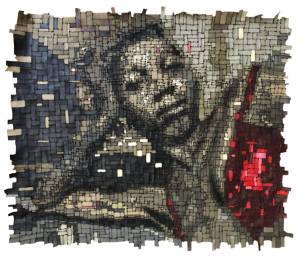
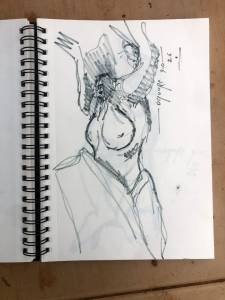
Oguvre’s participation gave him an opportunity to step further into a direction he had already begun exploring. For the residency, he chose the theme “Nude Without Ceremony,” a subject that allowed him to look beyond the conventional representation of the nude and examine the human form through a more personal and exploratory lens. The theme became another space for him to question, experiment and push his creative language, connecting his evolving practice with the freedom and possibilities that the residency provided.
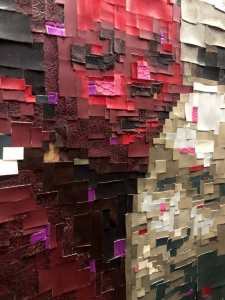
Over one month at the Mind Calories Residency in Ogun State, between May and June 2026, Oguvre immersed himself in an intensive period of experimentation and making. During the residency, he produced six works, each contributing to his exploration of “Nude Without Ceremony” and reflecting the freedom to push his ideas beyond the familiar boundaries of his practice.
For Oguvre, the human body carries a tremendous amount of emotion. The theme offered him an opportunity to examine the figure through observation rather than simply imagination. Working with life models brought another dimension to the process. He was no longer responding only to an image in his mind; he was observing the body as it existed before him its posture, movement, vulnerability and quiet expressions.
And that changed something. It brought immediacy to the work and challenged him to look more closely, respond instinctively and allow observation to guide the direction of each piece. What emerged was not simply an exercise in drawing or representing the human form, but a deeper encounter with the emotional possibilities contained within it.
Ajarat describes the difference she saw between Oguvre’s work before and during the residency as a movement towards greater freedom.
“His earlier works were figurative, although not strictly realistic.” During the residency, however, working directly from life gave him another kind of relationship with the figure.
“Of course you would see freedom in the body of work done,” Ajarat says. “Imagine the kind of freedom you have, having a life-model in front of you and just taking what you can take. That, I think, is another kind of freedom to express himself.”
She considers the finished body of work exceptional and believes the residency brought out a stronger sense of freedom in his practice.
Oguvre himself describes the residency in simple terms. “The residency gave me the environment to play.”
That sentence may be one of the most revealing descriptions of what happened during the period. The residency gave him permission to experiment without the pressure of arriving at a predetermined answer. He was not simply trying to prove that leather worked. He was testing what else leather could do, how far he could push the material and what new possibilities might emerge when he allowed himself to play.
“The outcome was astounding and I am still working with it and enlarging my coast in what I have done,” he says.
The experimentation, he insists, did not end when the residency ended. Instead, it became part of an evolving process that continues to influence his practice.
“I am developing the technique from the residency more.”
Ajarat, a graduate of Fine Art from the University of Benin where she had her first and second degree is careful about the word “facilitator.” Her role was never to tell Oguvre what his work should become, but to create the conditions in which he could discover that for himself. The residency, in her view, was about providing the space, support and conversations that allowed the artist to experiment freely, take risks and arrive at his own conclusions. For Oguvre, that distinction mattered as he was not being directed towards an outcome; he was being given the freedom to find one.
“The aim of facilitating was not to dictate for the artist on how his work should go,” she explains. “The normal procedure for facilitating is to guide, and the aim was to have conversation with what he is already doing and how he has been able to express himself .” For her, facilitation is conversation and Oguvre agrees.
“It wasn’t as if I was expecting a teacher but I was able to know more and explore more with profound information by the facilitators,” he says.
That exchange is perhaps one of the strongest values of a residency which is, the artist remains responsible for the work, but the presence of another experienced mind can open questions that may not have emerged in isolation.
Ato Arinze brought another layer to that conversation. For him, Oguvre’s material experimentation is commendable, but the challenge is to ensure that the material does not become the entire story.
“The artist must still ask: What am I saying? What am I feeling? Why does this work need to exist?”
It is a particularly relevant question at a time when young artists are increasingly experimenting with unconventional materials in response to economic realities, changing audiences and the desire to distinguish themselves.
Arinze believes all three factors can be at play. He also points towards art education, arguing that the school system can place too much emphasis on technical proficiency without giving enough attention to developing creative capabilities.
His suggestion is that art education could benefit from stronger engagement with philosophy and social sciences.
The implication is clear: artists need more than hands that can make. They need minds that can question.
Beyond the finished works, one of the most interesting aspects of Oguvre’s residency experience is that he was not attempting to make a sudden departure from everything he had done before. There was a continuity beneath the experimentation that is a thread connecting the new works to questions and ideas that had already been present in his practice. There was a pattern and he wanted viewers to notice it.
“It was not just an abrupt movement,” he explains. “The first couple of works, you would see the figures clearly. You can see the figure but you are not seeing it. You have to pay a closer attention to it.”
That idea of visibility and concealment becomes important. The body is there, but it is not necessarily offered immediately. The viewer has to look again. Perhaps this is also a metaphor for Oguvre’s own artistic journey. The painter was there before the leather artist became visible. The experimentation was there before the confidence.
The child who drew superheroes was there before the artist who began cutting and sewing leather.
And the young man who entered Auchi with more than a hundred classmates was already carrying the instinct to make something of his own. Art is made by people, and people have stories.
Ajarat believes artists should be careful not to put marketing ahead of their work.
“At the end of the day, we are not documenting what people like to buy but what the artist has done,” she says. “The work and artist journey should be more important.”
That philosophy speaks directly to where Oguvre finds himself now. Mind Calories did not give him a finished answer but it gave him room to ask better questions. He has found a material that speaks to him, developed a process around it and begun to understand how far he can push it.
iBAND Magazine, Celebrating Visual Art from the Original.
Africa | Visual Art | Lifestyle | Culture

