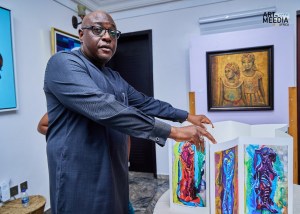
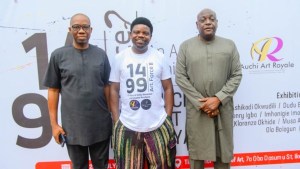
The first time Olawale Fasuyi played host to the Auchi Art Royale ’99 exhibition 1499 Art Force at his gallery, on Sunday, July 12, 2026, his humility and attention to the exhibiting artists and enthusiasts despite the downpour on that fateful Sunday left a lasting impression. It was a small gesture that revealed something larger about the man behind the gallery. Ireho Aito of iBAND Magazine had an encounter with Fasuyi, exploring family, art, legacy, collecting and the responsibility of carrying a name deeply rooted in Nigeria’s art history.
The Fasuyi name already carries weight in Nigerian art history. His father, T.A. Fasuyi, was among the modernist generation that helped shape the path for those who came after. Now, with two of his works returning to public view at Lineage of Masters II at the Yusuf Grillo Museum in October, there is something deeply nostalgic about seeing a modernist voice from that generation speak again through his paintings.
As the Yoruba say, “Orúkọ rere sàn ju wúrà lọ” a good name is better than gold. In Igbo, “Afamefuna” speaks to the enduring significance of a name and what it carries forward. The Fasuyi name is etched into Nigeria’s art and cultural history, and today it remains an art behemoth.
In this Cover Edition, Fasuyi reflects on growing up in a home he describes as “a gallery and museum fused together,” his journey from almost three decades in the Corporate sector to becoming a collector and gallery owner, and the responsibility of preserving a family legacy while creating his own chapter in the story of Nigerian art.
Words Ireho Aito | Don’t Keep Your Art in the Finger! Photographs courtesy Olawale Fasuyi and Youngbishoppictures
Art was part of Olawale Fasuyi’s childhood long before it became his business. He grew up in a home shaped by the artistic practice and collecting passion of his father, Pa Timothy Adebanjo Fasuyi, an artist and major collector whose commitment to art made the family environment an extension of his creative and cultural life. “Our house was a gallery and museum fused together at that time,” Fasuyi recalls.
That early exposure became a compass. Although Fasuyi would spend almost three decades in the banking industry, the influence of his father and the collection surrounding him never disappeared. Years later, after leaving banking, taking inventory of his own growing collection and discovering that some works were beginning to deteriorate in storage, he found himself drawn into a new chapter: the gallery business.
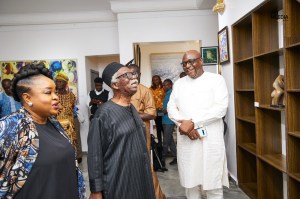
Today, through Tim & Carol Gallery of Art in Ikeja GRA, the name of the gallery coined from his parents names to celebrate them, Fasuyi brings together the experiences of a collector, businessman and custodian of Nigerian art. His story, however, extends beyond the gallery. It is also about inheritance, preservation and the responsibility of carrying an artistic legacy into another generation.
With his father’s works set to feature in Lineage of Masters II at the Yusuf Grillo Museum, that legacy becomes part of a wider conversation between generations of Nigerian artists. For Fasuyi, it is both personal and symbolic: a return of his father’s work to public view and another chapter in a family relationship with art that began long before the gallery.
“I see myself not as the beginning of the story, but as a bridge between generations.”
“The experience actually played a major role in my art journey,” Fasuyi says. “My father should be amongst the first 15 major collectors of art in the ’70s and ’80s.”
His father’s work and public responsibilities also gave him the opportunity to encounter art beyond Nigeria. As Nigeria’s Permanent Representative to UNESCO at one point, he travelled frequently, returning home with works collected from different destinations.
“Wherever he went, he collected works and brought them back,” Fasuyi recalls. “Our house was a gallery and museum fused together at that time. His passion for art collection provided a compass for me to follow.”
Youngbishoppictures
That compass would eventually lead Fasuyi into collecting himself, although his professional career initially took him in another direction. He spent almost three decades in the banking and financial services industry before leaving the sector. Gallery business was not his immediate plan.
“When I left the banking industry, gallery business was not one of the businesses I thought about,” he explains.
The turning point came about two years after he left banking, when he took a thorough inventory of his collection.
“I realised the amount of works I had was quite large and some of them had started deteriorating in storage,” he says. “I realised that I had to do something about them. This was what led me to the decision to consider the art gallery business.”
That decision eventually became Tim & Carol Gallery of Art, a space that has added another dimension to Fasuyi’s longstanding relationship with art.
Located in that opulence Ikeja GRA, the gallery also reflects his belief that Lagos’s art ecosystem should not be defined solely by its traditional centres on the Island.
“We just felt that the Mainland was under-represented in terms of gallery location,” he says.
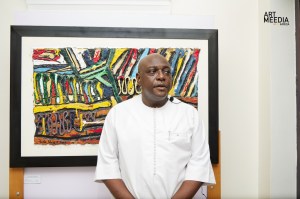
For Fasuyi, Ikeja presented its own possibilities, with its affluent residential community, corporate presence, international hotels and growing commercial activity.
“We felt the need to take advantage of that captive market,” he explains. “To me, I don’t see the Mainland as disadvantaged at all. We all will have our fair share of the art market.”
Behind the gallery is also the eye of a collector. Fasuyi’s approach to acquiring art is not based on one consideration alone.
“Honestly, all of the above play a role in my investment decision,” he says, referring to an artist’s reputation, technical excellence, cultural value, emotional connection and investment potential.
That combination of appreciation and investment has become central to his philosophy. He sees art as an asset capable of preserving value while simultaneously carrying cultural meaning.
“Globally, art has become a major instrument of value and wealth preservation and growth,” Fasuyi says. “Nigeria is not an exception.”
For him, the opportunity lies in encouraging more people to see art not simply as decoration but as a serious form of cultural and financial investment.
“What we preach to collectors and potential collectors is that investment in art and reward from art is the next big boom for discerning investors,” he says.
Yet commercial value is only one part of the story. Fasuyi’s own journey is rooted in preservation, particularly the preservation of Nigerian artistic heritage. His father’s attitude towards his own works remains significant in this regard.
“My father was never commercial with his works,” Fasuyi says. “He just didn’t believe in selling his works. He believed they should be kept for posterity to view and appreciate.”
That philosophy takes on new meaning this year as his father’s works enter Lineage of Masters II at the Yusuf Grillo Museum. The exhibition brings together works across generations, creating a conversation between established masters and contemporary artists.
“For us, this is an honour and pleasure to display his works amongst those of other masters, albeit posthumously,” he says.
It is also a reminder that the Fasuyi relationship with Nigerian art extends beyond a single generation.
Fasuyi now works with artists at different stages of their careers, from established masters to emerging voices. His interest in young artists is shaped by an ability to recognise potential, whether that potential comes naturally or is developed through education and experience.
“I honestly believe that some artists are born and others made,” he says. “Some have the innate talent whilst others have to be developed through training.”
For Fasuyi, recognising potential is part of understanding where Nigerian art may be heading.
“In both situations, it is easy to know those who have potentials and have the potential to command respect and followership in the medium to long term.”
The transition from banking to the art business has also reinforced something he already understood and that certain principles remain universal.
“In any business, clear vision and strategy, strong leadership, knowledge, sound financial management and understanding of customers’ needs are critical,” he says. “So, whether in arts, finance or any other field, these critical elements cannot be discounted. The principles are universal.”
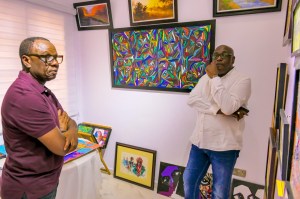
But perhaps what makes his present chapter different is the opportunity to work within a field where business intersects so directly with culture and memory.
Olawale Fasuyi wants Tim & Carol to become more than a commercial gallery.
“We want to be a gallery of reference to all our stakeholders such as artists, collectors, students and upcoming and potential art enthusiasts,” he says. “This is the ecosystem we wish to service and maintain and we would strive to meet their art needs.”
That ambition connects his present work to the foundation laid by his father. The older Fasuyi created, collected and preserved. The younger Fasuyi is building a platform through which artists, collectors and new audiences can continue that conversation.
It is a responsibility he does not take lightly.
“I have always believed that art is more than an object of decoration and embellishment,” he says. “It is a record of our history, our identity, our experiences and our aspirations as a people.”
Through his involvement in the art world, he hopes to have contributed to preserving that record while creating opportunities for artists, particularly Nigerian artists, to be heard.
“The Fasuyi family story in Nigerian art is, however, much bigger than me,” he says. “I am conscious that I inherited a foundation built by the generation before me, and particularly by my father, whose generation helped establish a culture of appreciation, patronage and engagement with Nigerian art.”
And perhaps that is where his story finds its clearest meaning.
“I see myself not as the beginning of the story, but as a bridge between generations.”
For a collector who grew up in a house that was once “a gallery and museum fused together,” the journey has come full circle. What began as a family inheritance has become a public commitment to collecting, to artists, to audiences and to the continuing story of Nigerian art.
iBAND Magazine, Celebrating Visual Art from the Original.
Africa | Visual Art | Lifestyle | Culture

