

Long before he became a globally respected engineer, educator, military scholar, author and systems expert, a young boy in Ebute-Metta was filling exercise books with sketches, cartoons and illustrations. His name? Simply Adedeji Badiru
Words Ireho Aito | Don’t Keep Your Art in the Finger! Photographs courtesy Prof. Deji Badiru, Badiru.com

For a man whose professional life has been defined by systems, structure and precision, Professor Adedeji Badiru speaks surprisingly often about art.
Not the art that hangs quietly on gallery walls, but the art hidden in everyday life, in the curve of a landscape, the character of a face, the rhythm of culture, the stories embedded in ordinary moments. It is a way of seeing that has accompanied him throughout his journey, from his formative years in Lagos to an accomplished international career as a systems engineer, scholar, author and educator.
Over the decades, Prof. Badiru has earned global recognition in the fields of systems engineering and industrial engineering, authoring numerous books and scholarly works while building a distinguished academic and professional legacy. Yet beyond the accolades lies a lifelong observer whose fascination with visual expression, culture and human creativity reveals another dimension of his personality.

Art, for him, is neither a hobby nor a decorative afterthought. It is a lens through which he interprets the world. It informs how he understands people, appreciates heritage and finds meaning in experiences that others might overlook. The same curiosity that made him successful as an engineer also nurtured a deep appreciation for artistic expression, allowing him to discover beauty and significance in places where most people never think to look.

His artistic journey is inseparable from his personal story. It is shaped by family heritage, cultural identity, childhood experiences and an enduring belief that creativity exists all around us. Whether reflecting on Nigerian artists who influenced his thinking, discussing the relationship between observation and imagination, or explaining why certain images linger in his memory, Prof. Badiru speaks with the enthusiasm of someone who has spent a lifetime learning to see.
In this conversation with iBAND Magazine, the distinguished professor graces the Cover edition this week and invites us into that world, that is, a world where art is not confined to canvas, where culture is a living inheritance, and where the ability to truly observe may be one of life’s greatest gifts.

Today, Prof. Adedeji Bodunde Badiru’s life story reads like several biographies merged into one. He is an engineer whose heart beats for art, a scholar obsessed with documentation, a family historian who embraces technology, a collector who began as a creator, and a Nigerian whose roots remain firmly planted in the soil of Epe despite decades of international accomplishments.
It was in 2025 that our paths first crossed, thanks to Emmanuel Dudu Arugha, the Nigerian visual artist and entrepreneur who is also an alumnus of Federal Polytechnic, Auchi. Dudu had strongly recommended Professor Adedeji Badiru as one of the reviewers of his art career for a book project, a suggestion that would introduce us to a remarkable voice in both academia and the arts.

Professor Badiru, the distinguished engineer, scholar and retired university administrator, responded with a review that read as a masterclass in art appreciation. Reflecting on a relationship that has spanned more than a decade, he offered a glowing assessment of Dudu’s creative journey and enduring talent.
“The more I get to know him and see more of his works, the more I am in awe of his artistic prowess. We have since grown to become friends and intellectual collaborators,” he wrote.

The statement reveals a relationship built on mutual respect and shared intellectual curiosity. For Professor Badiru, Dudu is not merely an artist whose works command attention; he is a creative thinker whose ideas continue to inspire meaningful engagement. It is a tribute that speaks not only to the quality of Dudu’s artistry but also to his ability to forge lasting connections across disciplines, bringing together the worlds of visual expression, scholarship and innovation.
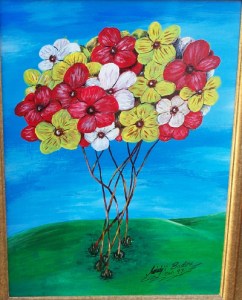
He did not stop there. Professor Badiru went further to highlight the enduring impact of Emmanuel Dudu’s artistic brilliance and the depth of imagination that characterises his work.
“One commissioned piece that he created for me has enjoyed a life of its own,” he recalled. “It now appears regularly in the quarterly newsletter of a social club, illustrating a satirical column titled The Village Bathman.”
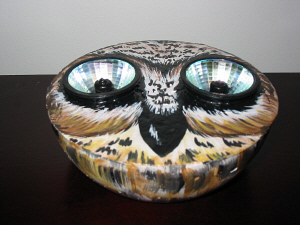
The distinguished scholar also recounted another notable achievement by the artist. “A drawing he completed for me was competitively selected as the cover illustration for a social-responsibility book titled Margin of Death: How Close We Come Each Day,” he said.
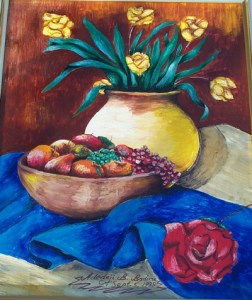
Perhaps most personal among the commissions was a portrait that captured a treasured family moment. “Emmanuel Dudu also completed a portrait of my wife and me as part of our family’s historical record. Today, that artwork occupies a prominent place in our living room, where it continues to serve as a cherished reminder of our journey together,” Professor Badiru stated.
At first glance, his website, Badiru.com, appears to be a personal archive. Spend a little more time exploring its pages and another picture emerges. It is a digital museum of memory, creativity, family heritage and lifelong curiosity.

The journey that eventually became Badiru.com began in 2003. At the time, his nephew, Dr. Olufemi Omitaomu, was pursuing a doctoral degree in Industrial Engineering at the University of Tennessee under his supervision. Recognising his nephew’s talent for website development, Prof. Badiru requested a platform where he could display some of his artworks.
The initial contents were paintings he had created decades earlier in Nigeria during the 1970s. What began as a simple online gallery soon evolved into an expansive archive documenting family milestones, personal achievements, creative experiments and historical records.
For Prof. Badiru, documentation is not merely a hobby. It is a philosophy.
“As far back as I can remember,” he explains, “I have always been fascinated by records, collections and documentation. I am usually the one who has and retains copies of family records.”

His belief is straightforward and unwavering.
“If something is not documented visually, it has not happened.”
That conviction has guided much of his life’s work.
Human memories fade, he says, but records persist. Documentation creates bridges between generations and provides inspiration for those who come after us.
Yet the story of Prof. Badiru’s relationship with art begins long before websites and digital archives. It takes us back to Saint Finbarr’s College in Akoka, Yaba.

There, as a secondary school student, he discovered that his natural talent for drawing was more than a pastime. “I knew I had a natural talent in drawing,” he remembers. “But I did not realise the full potential until I took an art class in Form Three at Saint Finbarr’s College.”
An art teacher recognised something special in the young student and repeatedly encouraged him to pursue art professionally. Although the teacher’s name has faded from memory, the influence remains vivid.
“I was just enjoying my art moments,” he says. “Drawing a variety of things at school and at home.”

He graduated from Saint Finbarr’s in December 1972. “I had served as the classroom illustrator for our Biology notes,” he explained.
Back to school too, he mentioned heartily, “Yes, I still have my Biology notebook with my illustrations from that epoch. It remains my prized possession to this day.”

Prof. Badiru spent his school days drawing illustrations and producing humorous cartoons inspired by everyday life around Ebute-Metta. His sketches reflected the people, situations and humour of the neighbourhood that shaped him.
“With a natural funny side to my personality, I enjoyed drawing funny cartoons that depicted everyday life around my Ebute-Metta neighbourhood. It was a lot of fun.”

That fun would soon become history and the turning point came in 1970 when his art teacher introduced him to the cartoon team at the Daily Times newspaper. Among the celebrated artists there were Josy Ajiboye and Dele Jegede, names that would later become legendary in Nigerian visual culture.
“The newspaper liked my children-themed cartoons so much, and I was in Form 3 at that time” Prof. Badiru says, “that they created a weekly cartoon column for me called ‘Fun with BB,’ based on my popular nickname from Bodunde Badiru.”

The publication marked a major milestone.
The payment he received for that first cartoon became his first earned income. His cartoons reached readers across the country. Even more memorable was what followed. “My first income in life was what Daily Times paid me for my first published cartoon.”
And more than five decades later, he still keeps the original agreement signed with the newspaper. “It was a landmark contribution to the early days of TV-based distance education,” he says.

Unfortunately for him, many of his early works disappeared forever. “I still regret losing many of those early drawings,” he says.
That commitment to preserving records has become one of the defining characteristics of his life.
While many people know him today for his academic accomplishments, Prof. Badiru remembers himself first as a creative mind.
In fact, he credits creativity for drawing him toward engineering.
“The profession of engineering is predicated on creativity,” he says.
To him, engineering and art are not separate worlds. They are complementary expressions of the same impulse to create.
“I have always had a natural interest in creating things, whatever it might be,” he says. “This is why I went into engineering in the first place,” he reveals.
“I see art where most people see nothing.”
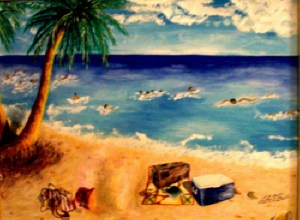
The great masters of history such as Leonardo da Vinci and Michelangelo inspire him precisely because they refused to be confined to one discipline. Prof. Badiru approaches life similarly.
Painting, photography, woodworking, sand art, concrete art, technical writing and engineering design all emerge from the same restless curiosity.
“I see art where most people see nothing,” he says.
That artistic perspective continues to influence his professional work. Even his technical writings often carry traces of visual storytelling and creative expression.

His relationship with visual art deepened after leaving Saint Finbarr’s.
The same art teacher who introduced him to Daily Times later connected him with Mr. Nupo Samuel of the Audio-Visual Aids Section of the Lagos State Ministry of Education on Broad Street. Nupo Samuel and the art teacher had been classmates at Ahmadu Bello University in Zaria. Through that introduction, Prof. Badiru met Mrs. F. R. K. Thanni, who headed the section and was pioneering children’s educational television programming in Lagos.
Eventually, he became a Graphic Artist for the Ministry’s Audio-Visual Aids Section, reportedly the first position of its kind within the Lagos State Ministry of Education.

His illustrations appeared in educational television programmes designed for children. Dogs, cats, fish and countless educational drawings helped bring English lessons to life for young viewers during the formative years of television-based distance learning in Nigeria.
It was an important chapter in his creative development and also taught him a painful lesson.
Many of those early drawings were lost when he relocated to the United States in 1975. Without digital technology to preserve them, countless original works disappeared forever.
That experience strengthened his lifelong commitment to archiving and preservation.
Today, visitors to Badiru.com encounter a fascinating range of artistic expressions.

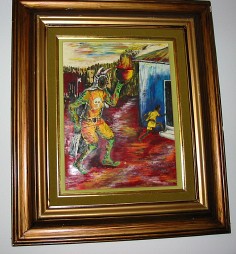
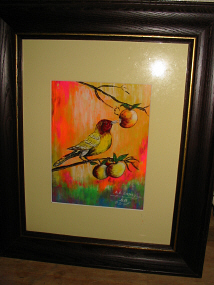
His Painting Gallery contains works dating back to approximately 1973. Most are executed in watercolour, a medium through which he expresses his love for vibrant colour combinations. Yellow and red, his favourite colours, frequently dominate the compositions.
His Sand Art Creations represent a more recent exploration that began around 2022. Using specially selected glass containers and coloured sand, he creates intricate visual arrangements that blend simplicity with elegance.

The Prof’s Woodworking Products reveal an admiration for carpentry and craftsmanship. To him, wood is one of nature’s greatest artistic gifts, capable of becoming anything from furniture to aircraft components in the hands of skilled creators.

Meanwhile, his Concrete Art Creations emerged unexpectedly around 1994. What started as a practical solution to support a piece of furniture gradually evolved into a creative pursuit. He intentionally uses the term “concrete art” rather than “cement art” because the word concrete suggests permanence, seriousness and durability.
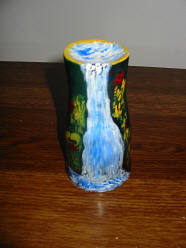
Among all these disciplines, choosing a favourite remains difficult.
“It is like choosing among your children,” he laughs.
Yet if pressed, he admits that sand art currently occupies a special place in his heart. Unlike painting, which can be expensive and temperamental, or woodworking, which involves sharp tools and occasional injuries, sand art offers a quicker, safer and more affordable creative outlet.

His artistic interests extend beyond visual forms. Writing has been another lifelong companion and he traces this passion which are the expressive language of the Bible and the vivid imagery found in classic American Western novels.

As a young reader, he devoured countless cowboy stories borrowed from the Yaba Library in Lagos. The descriptions of landscapes, frontier towns, sheriffs, saloons and everyday life left lasting impressions.
“Those were the good days of libraries in Nigeria,” he recollects.
Combined with biblical language, these influences shaped a writing style that often blends technical knowledge with reflections on morality, self-discipline and social responsibility.

“The influence of the Bible language expressions can still be seen in my “preachy” style of writing. My writings often tend to contain advice on morality, behaviour, social responsibility, and self-discipline.”

He readily admits that even copy – editors of his technical publications have occasionally remarked on this tendency. But Prof. Badiru remains unapologetic and if given the opportunity, he says, he intends to continue writing for as long as he lives.

His evolution into an art collector came much later. For him, Art creation preceded collecting by many years.
However, becoming an artist gave him a deeper appreciation for the work of others. He now sees collecting as a natural extension of artistic practice.

Among Nigerian artists, one figure towers above all others in shaping his understanding of art. The person is no other than Dele Jegede, now a professor of Art History.
He speaks with deep admiration for the veteran artist, describing his mastery of visual storytelling as a continuing source of inspiration. The way Jegede weaves narrative, social commentary, and visual expression into a single frame has left a lasting impression on his artistic outlook and appreciation of the power of images.

On the other hand, when discussing a younger generation of practitioners, his attention turns to Dudu Emmanuel. He regards him as one of the contemporary talents whose creativity, technical skill, and commitment to artistic excellence continue to attract attention within Nigeria’s evolving art landscape.
For him, the admiration is not merely about artistic ability. It is also about the capacity of both artists to connect with audiences through compelling visual narratives. Their works, he believes, demonstrate the enduring relevance of art as a tool for storytelling, reflection, and social engagement.

Beyond art, family remains central to Professor Badiru’s worldview and one of the reasons Badiru.com is alive. His roots run deep into the cultural and historical landscape of Lagos. He is a proud son of Epe. he traces his heritage through the Onisarotu family on his paternal side and the Shabi lineage on his maternal side. These ancestral connections reach into significant chapters of Lagos history, including ties to the lineage of one of the most influential figures in the history of Lagos.

Speaking about his ancestry, Professor Badiru reflects on it not as a distant historical footnote but as a living inheritance, as he claims talking about it, is a book in itself.
“Suffices to say that I am of Epe origin in Lagos State of Nigeria. My lineage is traced back to the Kosoko King of Lagos, which was exiled to Epe from Lagos Island. My direct paternal family belongs to the Onisarotu family of Epe. My maternal family is from the Shabi lineage of Epe. The Onisarotu name itself is uniquely singular and affiliated with only Epe. If you hear or see Onisarotu anywhere in the world, it can be traced only to the same Onisarotu family of Epe.”

For the distinguished scholar, engineer, and art enthusiast, heritage is more than a collection of names on a family tree. It is a source of identity and continuity.
“I have always been proud of where I come from. Family history provides a sense of belonging and a connection to those who came before us.”

Although his academic and professional career has taken him across continents and into some of the highest levels of international scholarship and leadership, he believes cultural identity should never be abandoned in the pursuit of global success.
That conviction has remained a guiding principle throughout his life. Even after decades abroad, he continues to maintain a strong connection with Nigeria, particularly Lagos and Epe, where family history, tradition, and community continue to hold deep meaning.

“The world is becoming increasingly interconnected, but that does not diminish the importance of knowing who you are and where you come from.”
For a man whose life has bridged cultures, disciplines, and continents, that philosophy continues to serve as a steady anchor, linking the accomplished international professional to the enduring legacy of family and home.
“We are whoever we are regardless of where we may be,” he says.

His Nigerian heritage has strengthened rather than limited his global outlook. Exposure to different cultures and perspectives has helped him navigate international environments while remaining grounded in his origins.
“This is a topic of special interest to me. We are whoever we are regardless of where we may be. I am a Nigerian by heritage and culture. This is a part of me that cannot be disconnected.”
Equally important are the lessons family life has taught him. They instilled in him a resilient spirit, a resourceful mindset, and a deep sense of humility. For Prof. Adedeji Badiru, growing up through periods of challenge and hardship provided an education that no classroom or boardroom could offer.

Those early experiences shaped his character, teaching him how to remain focused amid uncertainty and adaptable in changing circumstances, without becoming overly consumed by material pursuits. They also nurtured an appreciation for the diverse influences that heritage and culture can bring to one’s understanding of the world.
“Approaching problems from different perspectives of heritage and culture makes me adaptable to different worldviews,” he reflects.
The lesson has served him well throughout a distinguished international career that has taken him across disciplines, institutions, and continents. Rather than seeing cultural differences as barriers, he views them as opportunities for learning, collaboration, and growth.
“If you can accept and embrace different worldviews, you can accomplish international distinction in your career,” he says.

It is a philosophy that has guided his journey as an engineer, educator, author, administrator, and art enthusiast. Throughout his life, the ability to listen, learn, and adapt has remained one of his greatest strengths, allowing him to build bridges across cultures while maintaining a firm connection to his own roots.
As the conversation drew to a close, Prof. Adedeji Badiru shifted his attention from personal reflections to the broader role of Nigerian creativity on the global stage. In his view, contemporary Nigerian artists are telling stories that the world urgently needs to hear, these are stories of resilience, innovation, adaptability, and cultural richness. He believes that Nigerian creatives, whether working in visual arts, music, dance, literature, or other forms of expression, continue to demonstrate an extraordinary capacity to transform challenges into inspiration.

“Creativity, resilience, and the vast global reach of Nigerian artists are being recognised more and more around the world,” he observed, noting that the country’s artistic voice has become impossible to ignore. For him, the growing international appreciation of Nigerian art is not simply a matter of visibility but a recognition of the depth, originality, and humanity embedded in the nation’s creative output.

Asked what theme would unite an exhibition drawn from his personal collection and curated for young Nigerians, Badiru responded without hesitation: “Engaging diversity and flexibility of expressions.” It is a theme that mirrors both his collection and his worldview. The works he has gathered over the decades celebrate multiple perspectives, varied techniques, and the freedom of artistic interpretation. They encourage young people to appreciate differences, embrace creativity, and understand that there is never only one way to see the world.

Looking around his collection today, however, Badiru sees something even deeper than a gallery of treasured works. He sees a lifetime of experiences preserved through art. “I see the investment of time and emotion to project my personal history,” he reflected. “This creates a linkage between what I am and what I want my audience to see in me. My art represents me accurately.”

That connection between collector, artist, scholar, and storyteller perhaps best defines the man himself. The paintings, drawings, and sculptures that surround him are not merely acquisitions; they are chapters in an ongoing autobiography rendered in colour, form, and imagination. They speak to a life spent pursuing excellence in many fields while remaining deeply connected to the transformative power of creativity.
A professional colleague once summed him up with a simple but memorable observation: “Nothing is dull about you.”

After spending time in the world of Prof. Adedeji Badiru, it is difficult to disagree. Whether in engineering, academia, leadership, or the arts, he continues to embody a restless curiosity and an enduring appreciation for beauty, proving that the most meaningful collections are often not the ones displayed on walls, but the ones that tell the story of a life fully lived.
Kindly visit Badiru.com to know more about Prof. Adedeji Badiru and his illustrious art travels from the 1970s till date.
iBAND Magazine, Celebrating Visual Arts from the Original.
Africa | Visual Art | Lifestyle | Culture

