
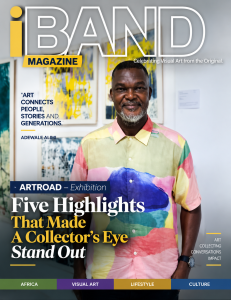
At Quintessence Gallery, Lagos, Prof. Ebun Clark’s collection of Adewale Alimi’s works became more than an exhibition. It became a meeting of an artist, a collector, a gallery and years of looking, collecting and remembering.
Words Ireho Aito | Don’t Keep Your Art in the Finger! Photographs courtesy Joseph Okotiti
There was something different about Collector Studies: A Collector’s Eye – Prof. Ebun Clark on Artist Alimi Adewale. It was not simply about putting 26 works by one artist on a gallery wall. It was about showing what happens when an artist’s journey is followed closely enough for another person to become part of its history.
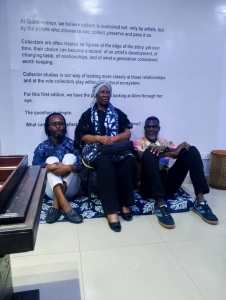
Inside Quintessence Gallery on Saturday, 12 September 2026, the audience encountered Alimi through the eyes of Prof. Ebun Clark, whose relationship with the artist has grown over years. Here are five highlights that made the exhibition particularly memorable.
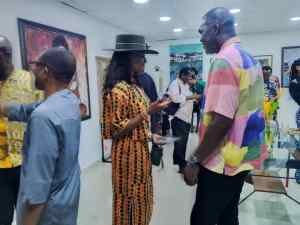
Quintessence Was Where the Story Began
The relationship between Ebun Clark and Adewale Alimi cannot be told without Quintessence Gallery.
Clark’s own relationship with Quintessence goes back to September 1980, when she visited the gallery in search of an Adire dress by Betty O, Betty Ogunlesi, after her eldest daughter gained admission to study Medicine at the University of Lagos. What began with three dresses developed over decades into a deeper relationship with artists, artworks and the stories behind them.
It was through Quintessence that Clark encountered Alimi’s work. In 2010, she bought two paintings on paper, MegaCity and Urban Shanties. A year later, Chief Mrs Aino Oni-Okpaku, founder of Quintessence, invited her to open Alimi’s first solo exhibition, Sublime.
That connection makes Saturday’s exhibition particularly satisfying. The same gallery that helped bring collector and artist together became the place where their long relationship was finally opened for a wider audience to see.
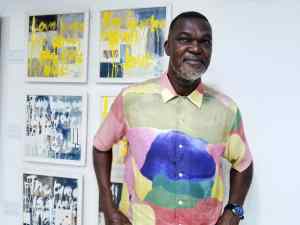
Twenty-Six Works, One Artistic Journey
One of the strongest attractions was the sheer spread of Alimi’s practice. Clark has collected 26 works, allowing the audience to travel through different periods of the artist’s career.
From Regatta I and Regatta II of 2004 to the more intimate Between Us, In Each Other and The Quiet of Noon of 2025, the collection showed change without losing continuity.
There were portraits, urban scenes, mixed-media works, steel heads, bronze and paintings dealing with migration, history, love, congestion and human relationships.
The exhibition therefore did something a normal single-period presentation may not always achieve: it allowed the audience to watch an artist change.

Clark Was Not Just Looking at Paintings. She Was Reading Lagos.
Perhaps the most captivating part of the exhibition was hearing Professor Ebun Clark explain what she saw in Alimi’s works.
Looking at MegaCity, she did not simply see buildings and crowded spaces. She remembered Lagos as it was when she began working at the University of Lagos in 1965, when the population was just over 800,000 to one million.
In Alimi’s urban paintings, she saw a city growing under pressure. His Urban Shanties and migration works also opened another conversation about Nigerians leaving home the contemporary “Japa” experience.
This is what made Clark’s collection fascinating. She had lived with the works long enough to attach memories to them.
The audience was therefore not only looking at Alimi’s Lagos. It was looking at Lagos through Clark’s memory of Lagos.
The Collector and the Artist Met Again Through the Works
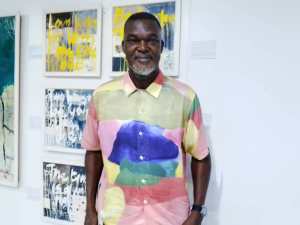
There was a quiet drama in watching Alimi encounter works he had created years ago.
An artist makes a work, releases it into the world and moves on. But the collector may continue living with it, studying it and finding new meanings in it.
That was exactly what happened at Quintessence.
Alimi described the exhibition as less a conventional retrospective than a return. Standing before works from different periods, he was seeing parts of his own journey through the person who had chosen to preserve them.
Clark, in turn, revealed how deeply she had followed that journey. She said she likes to “go wide” when collecting artists, digging into their stories and occupying different spaces to understand them better.
She has not merely accumulated Alimi’s works. She has accumulated years of looking at Alimi.

The Works Became a Conversation About Legacy
The most important highlight may have been what the exhibition said beyond Alimi and Clark.
Duke Asidere, President of the Guild of Fine Artists of Nigeria, described the commemorative exhibitions drawn from Clark’s collections as a way of celebrating artists and their career odysseys in the hands of collectors. He also saw them as a legacy for those coming behind.
That is where A Collector’s Eye became bigger than a private collection.
Through the Oluwani Creative Arts Foundation and exhibitions of works from Clark’s collection, artworks that could have remained inside private spaces are being brought back into public conversation.
The audience is given another opportunity to encounter artists through the eyes of someone who collected them, lived with their works and remembered the circumstances around acquiring them.
At Quintessence, the audience was not simply meeting Adewale Alimi again. It was meeting the relationship between Alimi, Clark and t
From Clark’s first relationship with Quintessence in 1980, to the gallery’s introduction of her to Alimi, to her acquisition of MegaCity and Urban Shanties in 2010, to opening Sublime in 2011, and finally to this 2026 presentation of 26 works, the story has taken more than a decade to fully reveal itself.
A Collector’s Eye therefore did not merely open a collection, it opened a history.
iBAND Magazine, Celebrating Visual Art from the Original.
Africa | Visual Art | Lifestyle | Culture

