

On Saturday, 12 September 2026, at Quintessence Gallery, Lagos, Prof. Ebun Clark presented a selection from her collection of Adewale Alimi’s works, bringing years of the artist’s creative journey into one exhibition. A Collector’s Eye offers a rare look at Alimi’s evolving practice through the works chosen and preserved by one of Nigeria’s foremost art collectors.
Words Ireho Aito | Don’t Keep Your Art in the Finger! Photographs Joseph Okotiti
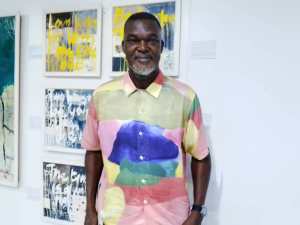
I remember my first visit to Adewale Alimi’s studio-house at Atican Beach, along Ibeju Lekki expressway, Lagos.0 It was one of those visits that reminded me why following artists through writing is worthwhile. You enter a studio expecting to see works, but sometimes you leave carrying something beyond the images being fired up in those studios. One thing for sure, is you carry the artist’s environment, his conversations, his way of looking at things and perhaps a better understanding of where the works are coming from.
Atican Beach gave that first encounter another texture. Away from the familiar rhythm of central Lagos, Alimi’s home and studio sat within an environment where the coastal landscape, the developing community, the buildings, the sea and the changing human presence around him became part of his everyday visual experience. It was not difficult to imagine an artist observing the city differently from there. The beach was not simply his address. It was another studio.

I remember moving through that space and seeing an artist whose journey had already travelled a long distance, away from engineering into art, from the discipline of structures and systems into the freedom of painting, sculpture and mixed media, and from the studio into a practice increasingly concerned with the human being, the city and the things that happen between them. Despite the experience, he still engineers through art discovery. What a sacred talent he behold.
Years away from my Adewale Alimi and Atican beach experience, on Saturday, 12 September 2026, at Quintessence Gallery, Lagos, I found myself looking at that journey again, but this time through the eyes of someone who had been collecting it for years in an exhibition entitled, Collector Studies: A Collector’s Eye – Prof. Ebun Clark on Artist Alimi Adewale brought together a remarkable body of works from Alimi’s journey, giving the public an opportunity to see what happens when an artist’s work leaves the studio and begins another life in the hands of a collector.

For me, it was also a personal moment. This is one of the worthwhile things about following an artist through writing. You may first meet the artist in a studio, return to the work through an interview, encounter another exhibition years later and eventually find yourself standing before earlier works that have acquired an entirely different meaning. The artist has moved. The collector has moved. The work has remained, gathering time.
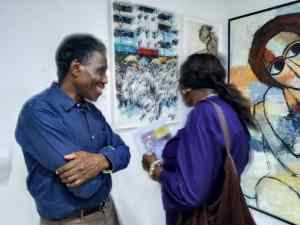
Jude Oni-Okpaku’s, the Creative Director of Quintessence Gallery, welcome speech acknowledged precisely that moment. He celebrated Prof. Ebun Clark for opening her “chest of collections,” a fitting description of a woman who has spent decades building a private collection and is now allowing sections of that collection to tell their stories publicly.
But this particular chest contained more than paintings. It contained a relationship with Alimi Adewale from 2004 to the present. Again, it contained the eyes of Prof. Ebun Clark in a story Quintessence Gallery had helped begin.
I have followed Alimi’s story for years, and his artistic journey has always been one of the more interesting transitions to document. He studied Mechanical Engineering at the University of Ilorin, entered the engineering profession and worked in the corporate environment. But art kept returning to him. He had already sought practical artistic exposure through apprenticeship and his interactions with artists and art teachers, and eventually the engineering career could no longer contain the creative direction he wanted. One day, tendered his resignation and the artist in him took over.
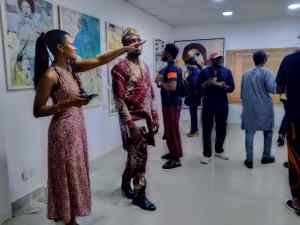
That decision opened the road to the Alimi Adewale we know today: a painter, sculptor, installation artist whose practice has moved through different materials and ideas without allowing one period to imprison the next. While with him at Atican beach abode, he confessed supervising the entire project of his house there. His engineering inclination helped him a lot.
Atican Beach became one of the places where that practice continued to evolve. The environment gave him another relationship with Lagos. The city could be observed from its pressure points, its architecture, its congestion, its movement and its human contradictions. Those concerns would become visible in works that later found their way into Prof. Clark’s collection.
The connection between Clark and Alimi began in 2010 when she bought two of his paintings on paper, MegaCity and Urban Shanties. Quintessence had introduced her to the artist.
But there was an important chapter before the collection became what it is today.
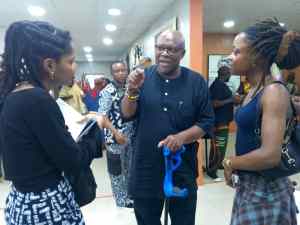
In 2011, Chief Mrs Aino Oni-Okpaku, founder of Quintessence, invited Prof. Ebun Clark to open Alimi Adewale’s first solo exhibition, Sublime. That invitation was significant. Clark was not simply a distinguished guest asked to cut a ribbon. By then, she had already acquired Alimi’s work and was developing an interest in the artist’s practice. Sublime therefore became one of those moments when a collector’s eye and an artist’s emerging career met publicly.
The exhibition helped announce an artist who had moved decisively away from his engineering background and was building a visual language of his own. It also gave Clark another opportunity to encounter Alimi’s work beyond the individual pieces she had acquired. The relationship would grow. And so would the collection.
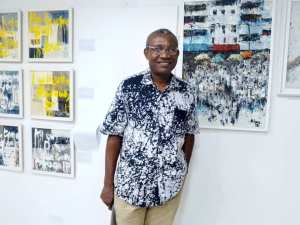
“She recalls in her statement, “The central work of the exhibition was an Oil on Canvas painting called “The Look of Love.” It greatly fascinated my late husband, JP Clark.” Ebun Clark confesses, “he asked me to buy it, saying the mask was not a Yoruba mask but an Ijaw shark mask. Or, as he informed me, an Ogubere mask,” she writes with nostalgia. Professor Ebun Clark eventually bought the work.
This commemorative exhibition therefore felt less like a sudden retrospective and more like the public opening of a relationship that had been developing quietly for years.

Alimi himself sees it that way. “For me, the exhibition feels like a conventional retrospective and more like a return,” he said. “It allows me to see earlier works alongside the person who chose them and to consider what that sustained relationship might reveal about my practice.”
That is a powerful way for an artist to look at his own work. A painting leaves the studio and begins another life. A collector lives with it. Years pass. The artist changes. The collector keeps looking. Then the artist encounters the work again and discovers that somebody else has been carrying part of his journey.
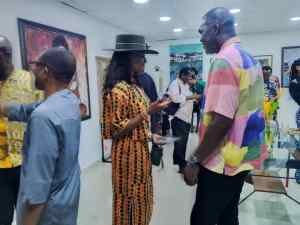
Prof. Clark’s relationship with Alimi is particularly revealing because she does not collect narrowly. “I like going wide in collecting with artists,” she explained. “I dig into their stories. I like staying in different space to know more about artists. I keep collecting.”
She is interested in the artist’s story, not just the artwork’s immediate appeal. That explains why her Alimi collection stretches across periods and materials. She has collected 26 works from him.
When asked whether there was a particular feeling in seeing the individual pieces she had acquired now assembled together, her answer was simple: “Every piece is special. You must love what you are collecting.”
That statement says a great deal about the woman behind the collection.
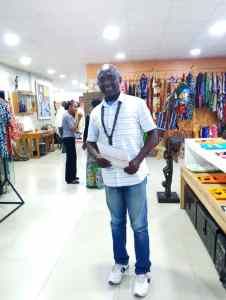
Prof. Ebun Clark’s collecting journey stretches back decades. Her father was widely travelled, and she believes that exposure helped shape her own relationship with art. She recalled growing up from around the age of nine with a strong awareness of the art and life of the colonial period and receiving a strong art education.
Her journey with Quintessence itself began in September 1980, when her eldest daughter gained admission to study Medicine at the University of Lagos and Clark went looking for an Adire dress by Betty O, Betty Ogunlesi. She eventually bought three dresses.
From there, the relationship with Quintessence developed into something much larger which one of them is a connection to artists, art objects and the stories behind them.
Her collecting philosophy is equally clear when she advises collectors to find a good gallery through which to discover artists and their works. She rarely buys directly from artists at the beginning of a relationship. She prefers the gallery to provide that introduction, allowing her to understand the work and the artist before the relationship grows.
That philosophy played directly into the Alimi story. Quintessence introduced them. Clark bought MegaCity and Urban Shanties in 2010. A year later she opened Sublime. And over the years, she continued collecting.
Looking at MegaCity, Clark saw a Lagos that she had witnessed changing before her eyes. “In 1965 when I started work at the University of Lagos the population was just over 800,000 to 1 million people,” she recalled.
The urban congestion in Alimi’s paintings reminded her of the Ajegunle boundaries she knew. His buildings and crowded spaces became more than architectural studies. She saw frustration, pressure and the growing scarcity of human resources.

She also came across his migration series over a period of more than 16 years. The urban shanties, she suggested, could be understood as a form of what Nigerians now call the “Japa syndrome.” In her words, it was “Andrew checking out” a humorous but pointed way of describing the impulse to leave.
This is where the collector’s eye becomes different from the casual viewer’s eye. The casual viewer may see buildings. Clark sees Lagos. The viewer may see movement. Clark sees migration. The viewer may see congestion. Clark remembers the city before the congestion became what it is today.
And Alimi, standing before the collection on Saturday, could see his own concerns travelling across time. “As an artist being in the studio, you have a theme you are working on. The moment a collection comes and likes a theme you see yourself going with that direction,” he explained.
There is another fascinating detail in Clark’s reading of Alimi. She could see “the draughtsmanship of an engineer” in his works. Perhaps that is one of the hidden threads connecting the man he was with the artist he became. Engineering did not disappear. It changed language. Structure became composition. Systems became rhythm. Observation became form. The artist’s training remained somewhere inside the art.
Alimi himself acknowledged the influence of Clark’s encounters with him. He confessed that he had been “tutored” by Prof. Clark each time they met over the years. To him, she is an exemplary teacher and collector, and he said he was proud to have had the encounter.
That relationship was visible on Saturday.
So was Clark’s belief that collecting is about more than financial value. “The beauty about wealth is not about money,” she said. “I am grateful when I have artworks around me.” She also reminded the audience: “Artists are business men too.”

The comments brought collecting down from abstraction into real life. Artists create, but they must also understand the economic life of what they create. Collectors acquire, but they also become custodians of cultural memory.
Pastor Tony Rapu, while celebrating Clark during the exhibition, asked whether there was a place for strengthening the artist’s hearing from the collector and bonding with the painting.
Clark’s answer returned to her own field; “Theatre and visual art are related.” As a theatre historian, she understands the relationship between object, creator, audience and story. This means an artwork can perform even when nobody is speaking.
And Clark has spent decades listening to those performances.
She revealed another deeply human side of collecting when she said she had sold four of her collections and regretted three of them. You can sell an artwork but you cannot necessarily sell the memory attached to it.
That is perhaps why she keeps collecting. And why she keeps opening the collection.
Upstairs at Quintessence, the public encountered Alimi through works stretching from 2004 to 2025. The chronology is revealing. Regatta I and Regatta II, both oil on canvas from 2004, introduce an artist already interested in movement and atmosphere rather than literal description. Mimi – Portrait of a Girl, from 2009, strips portraiture toward structure and presence. In Repose, an acrylic on paper from 2010, reduces the figure almost to a trace.
Then come MegaCity, Urban Shanties and Metropolis, all from 2010, bringing the city firmly into the conversation. Thoughts of Things to Come and The Look of Love follow in 2011. Female Figure II and Urban Congestion arrive in 2012. Then 2013 opens into a rich mixed-media period with The Time is Always Right, All Our Dreams Can Come Through If…, Two Ways to Live Your Life, One is…, Be Cautious to All But…, I Will Either Find A Way Or… and Love Looks Not With The Eyes But…
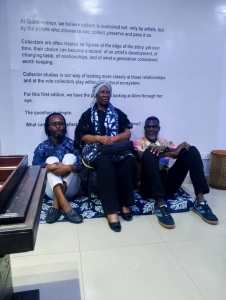
There is Virtuous. There is Lineament II. Then Alimi turns to steel. Steel Head 1 (Female) and Steel Head 2 (Male), both from 2014, interested Clark because she saw in them a contemporary engagement with the ancient metal sculpture traditions of Benin and Ife.
Destination Europe from 2015 and Migration from 2016 carry the story into movement and departure. Funmilayo Ransom, the 2018 oil on canvas, brings historical memory into the collection through the pixelated image of one of Nigeria’s powerful women. Anonymous, a bronze edition from 2019, Sisi from the same year and the Courage Series from 2020 continue the progression.
The recent works bring another kind of intimacy. Between Us, an acrylic on Kilim from 2025, presents a husband and wife solidly together. In Each Other, also from 2025, reduces the body to rhythm, shape and presence. The Quiet of Noon, acrylic on stitched heavy cotton, returns to the figure with greater economy.
It is a long way from Regatta. But it is still the same artist asking questions.
Duke Asidere, President of the Guild of Fine Artists of Nigeria, understood the larger significance of what was happening. Asidere described the series of commemorative exhibitions showcasing Prof. Clark’s collections from various artists as “a remarkable way to keep celebrating artists and their career odyssey in the hands of collectors.”

For him, these exhibitions are also about those coming behind. They are “a beautiful step of leaving a legacy to people coming behind and an encouragement to artists, regardless of their pedestal, not to relent in their efforts and their stories,” Asidere maintains.
It is also where the work of Oluwani Creative Arts Foundation becomes significant. Through exhibitions drawn from Clark’s collection, the Foundation has helped move private collecting into public cultural conversation. Rather than allowing important works to remain permanently hidden in private spaces, these commemorative exhibitions create opportunities for audiences to encounter artists through the eyes of someone who has lived with their works.
The approach has already been evident in the exhibitions devoted to Bruce Onobrakpeya and Jefferson Jonahan, among others. Each presentation has transformed a collector’s holdings into an opportunity to revisit an artist’s career, place works in context and allow another generation to encounter them.
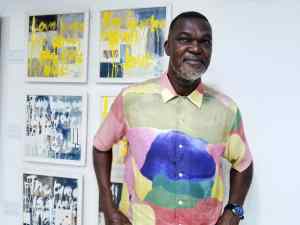
A Collector’s Eye extends that work through Alimi Adewale.
And standing there, on September 12, I could not help returning mentally to that first visit to Alimi’s studio and house at Atican Beach.
Back then, the works were still closely connected to the artist’s immediate environment and the conversations we were having around his practice. Yesterday, some of those works stood before me again, but they had acquired another biography.
They had belonged to Clark and lived with her. They had become part of her own story collecting those witnesses
iBAND Magazine, Celebrating Visual Art from the Original.
Africa | Visual Art | Lifestyle | Culture

