
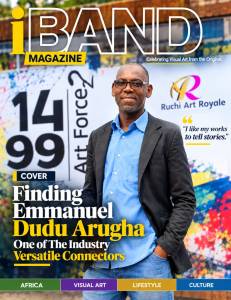
From Benin City to Lagos, Emmanuel Arugha Dudu’s journey is a story of art, survival, relationships and the courage to keep moving and winning the inaugural Spain Through Nigerian Eyes competition with Mama’s Favourite Wrapper. We unfold some of his conquests through grits and character from the wrap.
Words Ireho Aito | Don’t Keep Your Art in the Finger! Cover Photograph credit: Youngbishoppictures. Courtesy Emmanuel Dudu Arugha. Artworks credit Emmanuel Arugha Dudu
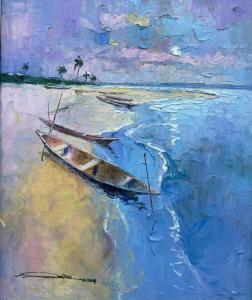
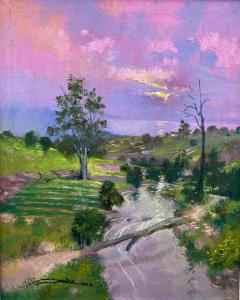
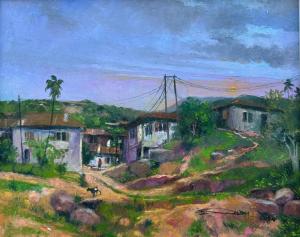
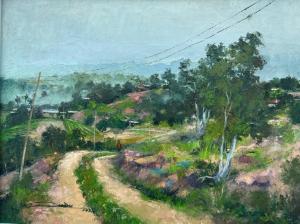
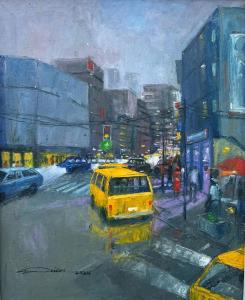
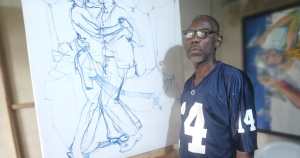
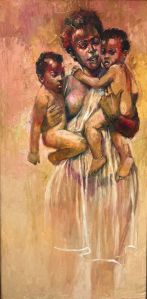
Emmanuel Dudu Arugha is an artist whose paintings announce his presence without needing much introduction. The palette knife is central to his language, giving his surfaces a physical character, while bold colours and expressive figures bring movement and meaning to his work. His landscapes, too, are rarely just landscapes. They carry traces of places, people and experiences that have stayed with him. Behind the paintings is an artist who has spent years connecting creativity with enterprise, people and purpose.
“I like my works to tell stories,” Dudu says.
That storytelling has taken him from the School of Art and Design, Federal Polytechnic Auchi, to Lagos, Madrid, Venice, Amsterdam and exhibitions across Nigeria and beyond. But the journey has never been his alone. It has been shaped by friendship, family, classmates, mentors, collectors, clients and a remarkable group of artists who graduated together in 1999 and have refused to let three decades separate them.
My sojourn to Ikorodu on a beautiful Sunday brought me into an up, close and personal encounter with the artist fondly called Dudu by everyone that knows him. His big country-home-styled property, sitting alongside his brother’s, Stanley, on expansive land acquired years ago, offered a comfortable setting for the conversation. Their beloved mother also lives in one of the apartments. An almost completed apartment is going to be a place for artists’ residencies as Dudu has explained to me as we both saunter into their abode, appreciating the investment portfolio of one smart dude in the business. Dudu quickly hints me: “I told my brother early about our choice of career that money comes and goes in this type of business. Ours is to tie the money that comes and let it multiply more for us,” he concludes.
Before I got to Dudu’s abode, Ikorodu gave me an unexpected reunion. I ran into Sunkanmi, a childhood friend I had not seen in ages. He was as surprised to see me as I was to see him. For a moment, the journey to Dudu took a different turn as we caught up with each other.
Interestingly, we were both heading to work that Sunday. Sunkanmi still lives in Ikorodu, and the spectacles and his huge frame made him instantly recognisable. After the surprise reunion, he helped me find my way towards Emmanuel Arugha Dudu’s side of Ikorodu. Sometimes, the road to an artist begins with a face from your own past.
How did Dudu find himself in Ikorodu is a simple intervention by an elderly and charismatic Nigerian at his old residence who saw him, always driving flashy automobiles and living in a rented apartment. The elderly but thoughtful Nigerian warned him about life and its accompany tinsel. He warned Dudu to be wise with his earnings, especially, being in a creative business. This is the turning point for Emmanuel Arugha Dudu and appreciating the words of the elders. He didn’t reneged in his promise to the sage to change his lifestyle and here we are, as they say, in his careful investments.
As Dudu was leading me in, from the adjoining streets came the sounds of praise, worship and sermons from one or two churches, while inside the house the conversation moved between art, family, business, friendship and the long road that brought him here. We began in a cosy part of the apartment before moving to the cool bar in the serene neighbourhood to round off. Yours truly even left behind a piece of artwork, originally signed from Dudu on the table, a souvenir lying away from the conversation. With this artist, art was never far from the room.
I got to remind Dudu when I found out something was missing among my valuables when I got to Lagos later that evening. Yes, the artwork. The gift from Dudu for finding him, he confirmed that the bar boys returned the princely work but he will gift me another one. He hasn’t at the moment.
Before moving into our conversations, I must confess that inside Dudu’s abode, the setting is quieter. One could only say Nigerian artists are richly loaded and smiling in wads.
We sit at a cosy part of the apartment to conduct the interview. Later, we move to the cool bar in question to round it off. The formal questions gradually become conversation, and Dudu’s laughter repeatedly interrupts the seriousness of his own history.
There is plenty to laugh about as Dudu says he is a traditionalist in nature.
The artistic odyssey began with a question. His inquisitive attitude, education, both saved him from poverty and earned him self control.
In 1994, Dudu entered the School of Art and Design at Federal Polytechnic Auchi. One day, he visited the hostel of an OND II student, Ola Balogun, who was already rocking the Lagos visual art circle and saw a huge painting on canvas.
“How did you guys get this kind of paper that is this big?” he asked.
Deji, another student in the room found it amusing and couldn’t hide from making a fun of Dudu. Deji’s answer came with a teasing Yoruba remark:
“Ode ni eleyi sa.” Which means this guy is a fool.
It was Ola Balogun who later explained it to Dudu. What he had thought was some kind of unusually large paper was actually canvas stretched over wood. “That was when I knew about canvas,” Dudu recalls.
A simple question had opened a much larger door.
“I am a typical Benin boy!” he says when talking about his roots.
Dudu is a painter who tells stories, but he is also a man whose own life has accumulated enough stories to fill several canvases.
It is tempting to begin his story from the comfort of Ikorodu, but Dudu’s story is more interesting when one remembers how far the young artist had to travel before arriving here. He grew up in Benin City, although his family roots are in Obedani, Warri North, Delta State. Ask him about that part of his identity and he is quick to declare, “I am a typical Benin boy!” Behind that confidence, however, was a childhood shaped by family difficulties. His parents’ relationship became strained towards the end of the 1980s, his mother moved to Lagos with the youngest child while Dudu and his siblings remained with their father in Benin. Their father had worked with institutions including Cooperative and Commerce Bank, New Nigerian Bank, the Magistrate Court and the Police Service Commission, but his work also kept him away from home. The boys had freedom, but their education began to suffer and truancy was order of the day. It was a moment during the interview that Dudu himself, felt so sober to explain.
Providence played its part through Arthur Ogedegbe, a neighbour and teacher back then, too, who would later become a professor at the University of Benin, that noticed what was happening. His intervention was direct. “You must go to school!” he told them severally not to lose focus but pursue education which should be the ultimate. Those words helped redirect Dudu towards education and eventually the School of Art and Design, Federal Polytechnic Auchi.
Possibility, however, did not mean convenience. At Auchi, Dudu’s allowance was about ₦1,500 while his tuition was ₦1,450. Materials and transportation had to come from almost nothing. He learnt to improvise, using whatever could help him complete his work. “I was using gloss paint with Plaster of Paris,” he recalls. Friends shared materials, while lecturers such as Adisa Ajanaku also helped students who were struggling by making leftover colours and materials from his private studio available to them. Dudu was learning an important lesson that would remain with him, that is, lack of money could slow the artist down, but it did not necessarily have to stop the work.
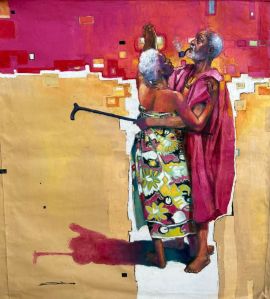
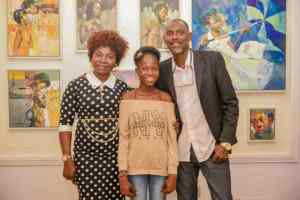
Tina, his lovely and adorable wife was also part of those formative years. Their relationship began around the Auchi period and eventually became marriage. Her support became significant at a time when Dudu was struggling with the practical demands of school and art. Years later, his description of her role in his life remains beautifully uncomplicated. She is, in his words, “the pillar, the backbone.” It is a phrase that says as much about the journey as any detailed account could.
Then came 1998 and a scholarship from Chevron Nigeria Limited worth ₦500,000 bounced into his life. For a young artist who had been counting every naira spent on materials, the money was almost overwhelming. “I almost fainted when I saw the balance in my account,” he says. The scholarship allowed him to buy colours and materials in bulk and even share some with Opeyemi Adeloye who was like another indigent student at the school. His academic performance improved, and while Titus Agbara emerged as the best student overall in painting, Dudu finished fourth among the painting students. The scholarship gave him materials, but Auchi had already given him something else that money could not buy: a network of people who would remain part of his life long after graduation. For the money again, it brought diligence, focus and brilliance that led to beautiful academic performance.
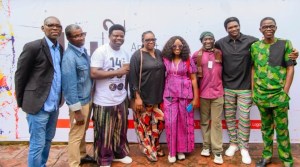
Another great member of Auchi Art Royale 1499 Class, Joe Nsek was one of those people that came into Emmanuel Arugha Dudu’s life. Through Joe, Dudu discovered acrylic and the possibilities it offered. “I actually got to know about acrylic when I met Joe at Auchi Polytechnic and I was blown apart,” he says. Sam Ovraiti became another significant encounter during his industrial training. Dudu spent three days in Sam’s studio while Colour Masters was being prepared, with Pita Ohiwerei also around. Three days may appear insignificant on paper, but Dudu describes the experience as “so enriching and impactful” and says Sam “took me to another level in that short period.” Those encounters became part of the artistic foundation that Dudu carried with him into the wider world.
His journey for the compulsory National Youth Service Scheme, NYSC, made the numbers even more revealing. From Dudu’s gunny side but interesting storytelling, he says he travelled to Maiduguri with just ₦1,500. The journey took him through Abuja and Jos. At one point, he slept at a transport park for ₦20 and played snooker to keep warm. By the time he continued the journey, he had about ₦700 left.
Maiduguri came with another challenge. The prevailing “Ba Shiga” restrictions made finding accommodation difficult. So, he stayed around the orientation camp while trying to find his way.
Then Dele Babatunde Ojoye came into the story. A genuine life – saver
During Dudu’s NYSC period in Maiduguri, Dele was working at a gaming and pool house. He later became an important support for Dudu, allowing him to stay with him during the week and return at weekends as Dudu continued to struggle with accommodation.
What began as assistance became a lifelong friendship. Dudu’s description of the relationship carries the gratitude of a man who remembers what kindness meant when he had very little: “Nigeria gave Dudu one of the best humans on earth in the name of Dele Babatunde Ojoye.” When Dudu’s father died in 2020, Dele played a huge role towards the funeral preparations. Some friendships survive because people continue to remember what brought them together in the first place.
One thing about Lagos was another kind of education it presented to Dudu. Through his mother’s connection with Vanguard Newspapers founder, Sam Amuka-Pemu, Dudu secured a job at Vanguard. It was his first conventional 9-to 5 employment, but the newsroom could not keep his attention for long. There were deadlines, overtime and the possibility of additional income, yet his mind was already somewhere else. “My mind was already in the studio by four o’clock,” he says. His boss, Mrs Flora Archibong, noticed the restlessness. After about six months, Dudu left. His mother was disappointed, but the decision had already been made inside him. He wanted the studio.
Lagos did not exactly welcome Dudu with open arms. His first accommodation in Ajangbadi end came through an estate agent who, according to Dudu’s account, showed him a beautiful apartment but eventually handed him the keys to a different place built on stilts. A man living in the same compound saw what was happening and advised the young artist on how to deal with the situation. Dudu took the advice and, in his own words, “laid siege” at the agent’s residence. He made it clear that he had not come to cause trouble. “I wasn’t there to cause commotion or fight,” he explained. “Since I had paid for one year, I would stay for one year and one month until my rent expires.” The agent eventually allowed him to stay with his family, but the arrangement soon became uncomfortable.
Then came the arrest. The agent reported Dudu to the police at Ajangbadi for constituting nuisance and reneging on agreement. So,what began as an accommodation disagreement suddenly became a police matter. But the other residents in the compound protested the agent’s action, and, as luck would have it, the Divisional Police Officer was at the station that day. The DPO called Dudu and asked him to explain how he had found himself in such a mess. Dudu told his side of the story, explaining that he had paid for one accommodation but was given another. The DPO listened to both sides before making his position clear: if the accommodation on the receipt had not been provided, the agent had to provide it or refund Dudu’s money.
The agent resisted. The DPO ordered that he be locked up until the refund was produced. According to Dudu’s account, the agent was kept in what he described as a “Canine,” with tear gas rubbed on his face. The twist was that the agent was popular among road transport workers in the area, and within about an hour, the ₦7,800 Dudu had paid was raised. That ₦7,800 was not just rent money; it was “Dudu’s entire savings from Youth Service Scheme.” The DPO rejected the appreciation Dudu tried to give him and told him to go and find another place.
Dudu did exactly that. Just a few poles away from the police station, he found another accommodation, met the elderly owner, paid for the room and moved in. Then came the next surprise. “Unfortunately, there was no window to the apartment.” After the arrest, the police station drama, the recovered ₦7,800 and the search for another room, Lagos had given the young artist another lesson in survival. His Lagos story had barely begun.
His friends became part of that survival network for him. Friends such as Joel Otuedon, Soji Yomioye and Dare Ogunbunmi were among those around him as he began finding his way into the city’s art market. Andy Innih of Krabas Ventures became his first client to pay him for a painting, giving him ₦3,500. Then came the Durbar painting that would teach him another lesson about the value of keeping one’s word.
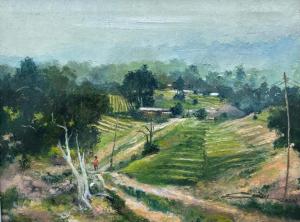
Dudu had carried the large work towards Opebi when a man in a vehicle stopped and wanted to buy it. The offer was attractive, but the painting had already been paid for by another client. Dudu refused. “I refused to sell it.” The original client later failed to pay him properly, but Dudu had collected the business card of the man who had tried to buy the work. He followed the lead and eventually found himself at an architectural firm, where he secured an order for four paintings. One was abstract, so he brought Titus Agbara into the project. The agreement was ₦25,000. When the client offered ₦20,000 immediately or the full amount later, Dudu insisted on the agreed figure. He got his ₦25,000 and remembers the feeling simply: “I was so excited.”
The money was immediately useful. He bought a large mattress at Alaba Rago, replacing the termite-ridden mat on which he had been sleeping. It was not the kind of purchase that makes headlines, but for Dudu it represented progress. One painting had produced one commission, the commission had produced money, and the money had produced a better night of sleep. This was how the Lagos art journey was unfolding for him: one painting, one relationship, one opportunity at a time.
Ajangbadi, however, was too far from the centre of the art market. Ajegunle brought him closer. His mother found an apartment at No. 43 Olayinka Street and paid ₦27,000 rent. Dudu promised to repay her. “I promised to pay her back,” he says, before admitting that he never did. Ajegunle became an important artistic environment, bringing him closer to artists including Christopher Ayaoge, Titus Agbara, Nelson Okoh and Ejoor Wallace, while also putting him closer to the conversations taking place around Victoria Island and Ikoyi.
Then he attended Kainebi Osayenhe’s exhibition, The Cross Took Me for a Walk, at Goethe-Institut. One artwork was priced at ₦350,000. For Dudu, that figure was not merely a price; it was an education about what Lagos could offer an artist. “That was when I realised that Lagos was where art was thriving.” The young painter began to see a bigger market and, with it, a bigger possibility for his own work.
Another important chapter in that Lagos journey was his relationship with Chief Mrs Nike Okundaye. Dudu speaks of her with genuine appreciation for the recognition and encouragement she gave him at a time when he was still finding his place in the Lagos art world. Her influence became part of the network of relationships that helped him understand that his art could travel beyond the immediate environment in which he was creating. For Dudu, Nike was more than an established name in Nigerian art. “She became like a mother to me.” That is how he chooses to remember that relationship, and it says something about the people he values: those who recognise possibility in others and encourage them to keep going.
His education continued, including further study at the University of Lagos, where Professor Peju Layiwola introduced him to etching. Yet Dudu remained conscious of what Auchi had already given him. His assessment was characteristically direct: “University of Lagos was like reinventing the wheel.” He had learnt the practical discipline of making at Auchi; university gave him another opportunity to interrogate and deepen that knowledge.
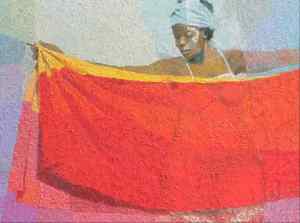
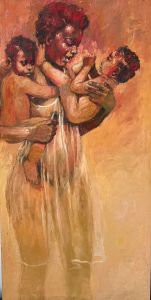
The journey widened beyond Nigeria. In 2006, Dudu won the inaugural Spain Through Nigerian Eyes competition with Mama’s Favourite Wrapper, earning a trip to Madrid the following year. ARCO became an eye-opener, exposing him to a much larger art environment. He remembers the experience with the humour of someone who had arrived determined to absorb everything: “I didn’t even have time to eat; ARCO was such an eye-opener, it consumed all my time in Madrid.” He went on to win Imagining Venice in 2007, became a winner in Unbreakable Nigerian Spirit in 2008, took first prize in Africanice 08 that same year and later won the Lagos Recyclart Art Competition in 2017.
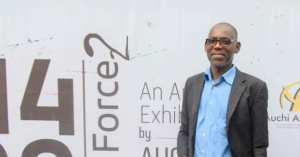
The prizes expanded his artistic horizon, but they also reinforced another lesson: talent has to be accompanied by planning. The young man who once had ₦1,500 for a journey and almost nothing left after tuition had gradually learnt to think beyond the next sale. His interests expanded into framing, property and investment, and his Ikorodu property now includes a framing operation. His advice to younger people comes from experience rather than theory: “Invest wisely and plan for the future.”
Yet the entrepreneur has never swallowed the artist. Dudu’s paintings remain at the centre of the story. The palette knife, the strong colours, the figures, the landscapes and the narratives continue to define his visual language. His life may have expanded into business and investment, but the studio remains where the original conversation began.
Perhaps that is why his relationships have remained so important. Dudu remembers the people who helped him when he had little: the lecturers who shared materials, the friends who opened doors, Dele who provided shelter and food in Maiduguri, Tina who stood beside him during the difficult years and the established figures who recognised his potential. He has carried those relationships forward rather than allowing success to erase where he came from.
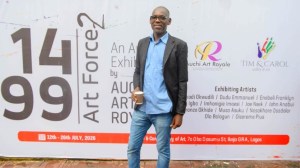
The Auchi Class of ’99 is perhaps the clearest example. What began as a school friendship has grown into Auchi Art Royale, with regular Wednesday meetings, shared ideas, networking and exhibitions. In 2026, the group presented 1499 Art Force II at Tim & Carol Gallery in Ikeja, bringing together more than 40 works across painting, sculpture and mixed media. Dudu presented Exhausted Parties, Feeling Blue and He and She, all 2026 works. Joe Nsek explains the continuing bond simply: “Auchi Art Royale is a way of keeping ourselves together and sharing ideas, networking and business outlook among ourselves.”
I have sat through two of their Wednesday meetings myself, and what stays with you is not simply the laughter but the familiarity. These are people who have watched one another move from students into artists, parents, entrepreneurs and professionals. Time has changed them, but it has not erased the connection. Dudu remains one of the people helping to keep that history alive.
The same instinct extends into his family. Tina remains, in his words, “the pillar, the backbone.” His biological children are growing into their own paths, while four adopted children are also part of the family. The man who once depended on friends for shelter and support has built a home in which the idea of family stretches beyond biology. Perhaps his understanding of connection was shaped long before the word became associated with his career.
Today, sitting in Ikorodu, Dudu has travelled a remarkable distance from the student who had to calculate how much he had for tuition, the young man who travelled to Maiduguri with little money, the artist who slept on a termite-ridden mat, the worker whose mind was already in the studio by four o’clock and the painter who saw a ₦350,000 artwork and realised that Lagos had a serious market for art. But he does not tell the story as though every step was carefully planned. Much of it was discovery, persistence, friendship and the willingness to take the next opportunity when it appeared.
Auchi Art Royale 1499: A biographical book by 13 members, sharing their journeys and Auchi connection coming out soon.
iBAND Magazine, Celebrating Visual Art from the Original.
Africa | Visual Art | Lifestyle | Culture

