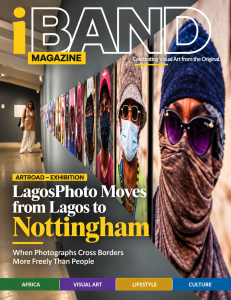
The way and style Nigerian artist Gerald Chukwuma has reflected the journey of LagosPhoto to Nottingham remains exemplary and thoughtfully captivating. His reflection, shared on Facebook, does not merely celebrate an exhibition. It gives us opportunity to consider what happens when photographs travel across borders while the people and realities represented in those photographs may not enjoy the same freedom of movement.
Words Ireho Aito | Don’t Keep Your Art in the Finger! Quotes Gerald Chukwuma Facebook page. Photographs courtesy Gerald Chukwuma/Facebook. Cover photograph courtesy Gerald Chukwuma photo archive/Facebook.
“What if your photograph had more freedom than you?” Chukwuma asks, giving the movement of an image a deeply human dimension.
It is a striking opening to his account of LagosPhoto 2026: Stories of Movement and Belonging, now presented at Lakeside Arts, University of Nottingham. His words give the exhibition another layer, because LagosPhoto has always been about more than photographs on walls. For iBAND Magazine, its continuing story has been about looking, power, freedom, memory and the right to tell African stories from African perspectives.
Many art enthusiasts and not just photography enthusiasts have followed LagosPhoto through its transformation and more so, from what iBAND Magazine 2025 report described as Azu Nwagbogu’s bold experiment in 2010 into a major visual platform. That report noted that LagosPhoto had moved beyond being simply a festival to becoming a conversation about “power, truth, and the politics of looking.”
Now, the movement is literal.
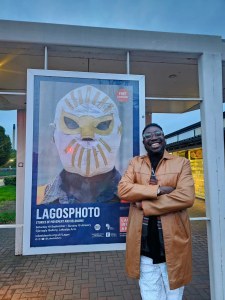
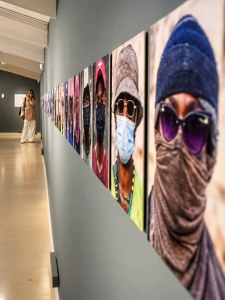
LagosPhoto has moved from Lagos to Nottingham, carrying with it stories about movement and belonging. The poster announcing the Nottingham exhibition captures that journey with a masked figure staring directly at the viewer. Beside the image are the words
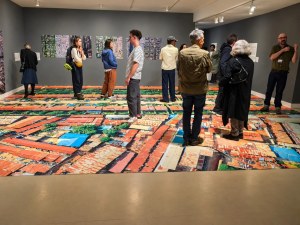
“LAGOSPHOTO – STORIES OF MOVEMENT AND BELONGING.” The exhibition is at Djanogly Gallery, Lakeside Arts, and the poster identifies it as a free exhibition running from Saturday, September 19 to Sunday, January 10.
For Chukwuma, the movement of the photographs creates an uncomfortable but important contrast as he observes them.
“The photographs crossed the border without visas, bank statements or explanations. They simply travelled,” he writes from his account on Facebook. “Yet some of the people whose realities they carry could not move so freely.”
That thought connects naturally with the direction LagosPhoto has taken over the years. In the Magazine’s coverage of the 2025 LagosPhoto Biennial, it was distinctly observed how the festival had grown into a space where photography could question the invisible boundaries around people, societies and individual freedom. Back then, its theme, Incarceration, was presented not simply as imprisonment behind physical walls, but as an exploration of the many forms of confinement that shape human lives.
Chukwuma’s Nottingham reflection takes that conversation beyond the gallery.
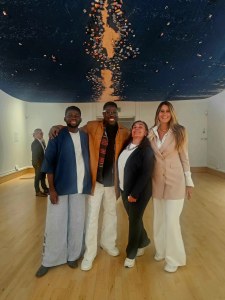
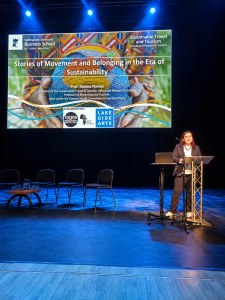
He recognises the exhibition as a creation of Azu Nwagbogu’s African Artists’ Foundation, while acknowledging the curatorial work of Maria Pia Bernardoni and Courage Dzidula Kpodo. He also recounts a lecture by Professor Marina Novelli, Stories of Movement and Belonging in the Era of Sustainability, and holds on to one sentence from it: “Data explains patterns. Stories explain people.”
That sentence becomes central to Chukwuma’s reading of the photographs.
Statistics can count migrants, refugees, arrivals and departures. But a photograph can bring the person behind the number back into view. As Chukwuma puts it, “Data sees the category. Story returns the human being.”
It is an idea that sits comfortably within the trajectory of LagosPhoto that is well documented. Let’s go back on a journey through memory lane. In our 2025 report, we wrote about the way the festival’s photographers and exhibitions challenge viewers to reconsider how they look and what they are prepared to see. The photograph becomes more than an object; it becomes a way of asking questions about society, memory, identity and freedom.
This is also where the impact of Azu Nwagbogu becomes difficult to separate from the story of LagosPhoto itself.
Sixteen years after its beginnings, the platform has demonstrated how an initiative rooted in Lagos can develop a conversation that travels. The significance is not only that photographs are now being exhibited in Nottingham in England. It is that a platform born out of an African artistic environment continues to create room for African and international photographers to examine questions that do not stop at national borders.
Azu Nwagbogu’s project could be described as having become “one of Africa’s most powerful visual movements.” More importantly, and noted, is its transformation into a continuing conversation about power, truth and the politics of looking. Well photographed by Azu Nwagbogu, a genius who graduated as a science student at College.
Gerald Chukwuma’s words now provide another way of entering that conversation.
“A number records the crossing. A story reveals what crossed with them: memory, fear, love, loss, hope, home.”
That is, honestly, the heart of Stories of Movement and Belonging. Movement is not only about getting from Lagos to Nottingham, or from one country to another. Every person carries something across a border that we may not even know. Memory travels just as culture travels. Trauma travels just as hope travels. Sometimes, even when the person cannot travel, the photograph carries a piece of that person’s story farther than the individual could have imagined.
Chukwuma concludes his reflection with another memorable line: “Data counts people. Stories make people count.”
And that is where LagosPhoto’s journey becomes bigger than the exhibition poster in Nottingham.
Azu Nwagbogu started something in Lagos. Over the time, that platform has continued to create spaces where photographers can question how Africa is represented, how people are seen and whose stories deserve to be heard. LagosPhoto’s arrival in Nottingham is another chapter in that continuing journey.
iBAND Magazine, Celebrating Visual Art from the Original.
Africa | Visual Art | Lifestyle | Culture

