
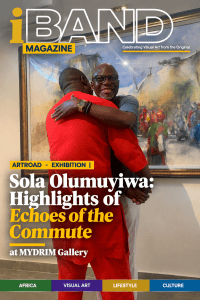
Out of curiosity, three of Sola Olumuyiwa’s contemporaries found themselves transfixed by The Red Roof, Ibadan, a watercolour painting that held their attention as they examined the technique behind the work. Each had something to say about the patience, control and movement required to achieve the result on display at MYDRIM Gallery. Their admiration was a reminder that even among artists, a painting can raise questions about how it was made and what the artist had to overcome to bring it to life.
That was one of the many moments that defined the opening of Echoes of the Commute, an exhibition featuring more than 35 works by Olumuyiwa. While some visitors struggled to hide their amazement at the works on the walls, others took time to study the details, engage the artist and consider the stories behind the paintings.
The exhibition’s theme speaks to experiences that many people share. The daily journey from one place to another, the people encountered along the way, the sights that stay with us and the memories we carry are all part of life. Through watercolour, Olumuyiwa brings these familiar experiences into focus, inviting his audience to look again at the world around them.
iBAND Magazine presents some of the highlights from the opening on the 10th of October 2026.
Words Ireho Aito | Don’t Keep Your Art in the Finger! Photographs Taofeek Olaniyi.
MYDRIM, The Dream…
For Simidele Ogunsanya, founder of MYDRIM Gallery, the opening of Echoes of the Commute was an occasion to look back at the journey that brought the gallery to where it is today.
In her welcome address, she expressed gratitude to the patrons, members of the media, artists and everyone who had contributed to the gallery’s growth. But beneath the formalities was a personal story of beginnings, friendship and the passage of time.
“It is a very emotional feeling for me to see some of the artists we started with, such as Sola Olumuyiwa, who is exhibiting today,” she recalled.
The remark drew a warm response from the gathering, with some artists clapping in affirmation. Ogunsanya remembered when she was barely 35 and the gallery was operating from a small apartment on Bode Thomas Street, Surulere, Lagos. Looking around the room, which had attracted a considerable number of young people, she seemed pleased to see how far the journey had come.
She also recalled the contribution of the media during the gallery’s early years, when social media was not available to spread the word about exhibitions and artists.
“Journalists such as Mr. Ozolua Uhakheme and others were our fax machines,” she recounted. “There was no social media back then.”
It was a telling description of a time when relationships with journalists were central to getting news of exhibitions beyond the immediate art community. For galleries trying to build an audience, the media helped carry their stories to people who might otherwise never have heard about them.
As MYDRIM Gallery established its place in the art scene, Ogunsanya encouraged it to give more attention to demanding techniques such as watercolour and pastel. The gallery’s engagement with these mediums has since become part of its exhibition programme.
She also suggested that the gallery should consider establishing a roll of honour to celebrate artists who have worked with MYDRIM over the years. It was an important reminder that the story of an art institution is also the story of the artists who have grown alongside it.
“MYDRIM’s story is like watercolour,” she said. “As we were also commuting, you could barely know the end, but we believed we were on the right path. We were just patient, like artists who genuinely want to work with watercolour. Our story cannot be well documented enough without paying homage to a watercolour icon like Sola Olumuyiwa.”
Her words connected the gallery’s own journey with the very medium at the centre of the exhibition. Both require patience, commitment and a willingness to keep going without knowing exactly where the journey will lead.
Divine Inspiration Messages
For Olumuyiwa, the body of work presented at Echoes of the Commute did not emerge from a single moment of inspiration. He described the inspiration behind the works as divine, explaining that the ideas came to him as echoes that continued to demand his attention.
From First Insight to A Few Minutes After… and now Echoes of the Commute, he sees a relationship between the messages running through the different bodies of work.
The titles suggest moments of observation and reflection, but the connection goes beyond words. They form part of an ongoing artistic exploration in which everyday experiences can become the starting point for deeper thoughts about life, movement and the things people encounter along the way.
For an artist working with watercolour, such exploration also demands a willingness to respond to the medium itself. The movement of water and pigment can influence the outcome, requiring the artist to work with a degree of patience while remaining alert to what is happening on the paper.
King’s Arrival: Everybody Is a King
Two works at the exhibition share the title King’s Arrival, but their settings offer different cultural expressions of royalty.
The first presents a Northern Nigerian scene in which the Emir’s arrival draws a gathering of people eager to catch a glimpse of the royal figure and pay their respects. The second takes the viewer to a Southern Nigerian setting, where women and drummers move in an energetic, eclectic dance towards the arrival of a king.
Although the scenes differ, both paintings capture the excitement, ceremony and collective participation that accompany royal occasions. The people are not merely background figures; their movements and presence help tell the story of the event.
Olumuyiwa, however, offered the audience another way to understand the works. Beyond the traditional idea of kingship, he explained that everyone is a king and possesses a royal presence, irrespective of position or personal endeavour.
It was a thought that extended the meaning of the paintings beyond the scenes represented. Royalty, in this interpretation, is not restricted to a palace, a crown or a title. It also speaks to the dignity and worth that every individual carries.
The scale of King’s Arrival further reinforces its presence within the exhibition. Measuring 48 by 96 inches, the work has been confirmed as the largest watercolour painting in Nigeria at the moment. Its size is particularly noteworthy in a medium often associated with works on a much smaller scale.
Patience on the Red Roof
Among the works that attracted particular attention was The Red Roof, Ibadan. The painting became a talking point among Olumuyiwa’s contemporaries, who were curious about the technique and the patience required to achieve its final appearance.
Another work, Cashless POS, also tested the artist during its creation. According to Olumuyiwa, both paintings demanded repeated attempts as he struggled with the behaviour of the watercolour.
“I painted each one of them thrice as I was adding the watercolour; they were spilling away,” he explained.
His experience offers a glimpse into the challenges of working with the medium. Watercolour does not always follow the artist’s plans. Water and pigment spread across the paper, and an adjustment made in one area can affect another. The artist must understand when to intervene and when to allow the medium to produce its own effects.
For Olumuyiwa, the process required persistence. The finished paintings on the gallery walls did not tell the full story of the attempts that came before them. Visitors could admire the result, but the artist’s account revealed the patience behind it.
That patience was also what caught the attention of the three contemporaries who stood examining The Red Roof, Ibadan. Their discussion showed that the appreciation of a painting does not end with its subject. Sometimes, the technique itself becomes the conversation.
One observation is the presence of powerlines in the work. And he explained that apart from the works that depicts northern scenes, the power lines were there to illustrate the environments we found ourselves
The Power of Coffee
The inspiration behind A Royal Welcome, a coffee-on-paper work measuring 31 by 45 inches, came during one of Olumuyiwa’s visits to Italy.
He had travelled with fellow artist Sam Ebohon for an art competition, where Ebohon won the top prize while Olumuyiwa came third. Beyond the competition, the trip provided an experience that would later find its way into his work.
“I was smelling the aroma of coffee on the streets of Italy,” he recalled.
It was a simple observation, but one that stayed with him. The aroma of coffee, encountered in the streets, became the starting point for a painting that brought together memory, atmosphere and artistic interpretation.
The work also shows how inspiration can emerge from experiences that may seem ordinary at first. A journey undertaken for an art competition became an opportunity to observe another environment and retain an impression that could later be explored on paper.
In Echoes of the Commute, such moments are important. The things people encounter while moving from one place to another do not always reveal their significance immediately. Sometimes, an impression remains in the mind until the artist finds a way to express it.
A Watercolour Practice Built on Experience
Most of the works in the exhibition were produced in 2026, a notable achievement given the demands of watercolour. Olumuyiwa has developed considerable experience with the medium and is particularly associated with the wet-on-wet technique, which he identifies as his favourite among the three watercolour techniques he uses.
Wet-on-wet involves applying watercolour to a wet surface or introducing wet pigment to an area that is already wet. The colours can spread, blend and create effects that are difficult to control completely. The technique calls for an understanding of how water and pigment interact, as well as the judgement to know when to allow the process to continue.
Olumuyiwa’s account of the difficulties he encountered with The Red Roof, Ibadan and Cashless POS makes this knowledge of the medium even more significant. His works are the result of years of engagement with a technique that can demand as much patience as it does skill.
His contribution to art and culture has also received recognition beyond the studio. He has been conferred with an ambassadorial honour by Goge Africa, the television programme known for its coverage of African art, culture and tourism.
A Chance Meeting with a Fobally Art World Africa Competition Alumnus
The opening also offered an opportunity for a younger artist to encounter the work of someone he regards as a mentor.
Nurudeen Taofeek Olaniyi, popularly known as Babotee, from Lagos State University of Science and Technology, Ikorodu, was present to see Olumuyiwa’s works at first hand. Olaniyi participated in the 2025 edition of the Fobally Art World Africa Competition for Secondary Schools and Higher Institutions.
For an emerging artist, an exhibition can provide more than an opportunity to see finished works. It can also open a window into the thinking, discipline and experience behind an established artist’s practice.
Olaniyi’s presence at MYDRIM Gallery brought that connection between generations into the exhibition space. While visitors responded to the paintings in different ways, his encounter carried the additional significance of seeing the work of a mentor beyond photographs or reproductions.
It was another reminder that exhibitions do more than present art to an audience. They create opportunities for artists, students, collectors and other visitors to meet, exchange ideas and learn from one another.
At MYDRIM Gallery, Echoes of the Commute brought together personal memories, everyday observations, cultural scenes and the technical demands of watercolour. Through more than 35 works, Sola Olumuyiwa invited visitors to look again at the experiences that accompany the journeys they make and the impressions they leave behind.
For those who paused before The Red Roof, Ibadan, the conversation went beyond what they saw on the paper. It was also about how the artist had achieved it. And in that exchange between the work, its maker and the people who came to see it, the echoes of the commute continued.
iBAND Magazine, Celebrating Visual Art from the Original.
Africa | Visual Art | Lifestyle | Culture

