
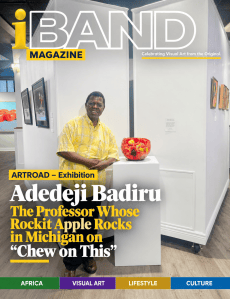
Long before Professor Adedeji Badiru became an internationally recognised systems engineer, educator, author and academic leader, he was a young boy growing up in Ebute-Metta, Lagos, who enjoyed filling his exercise books with drawings, illustrations and humorous cartoons. What began as an instinctive love of drawing would eventually take him into newspaper cartooning, educational television and, decades later, an expanding world of artistic experimentation. Today, in retirement, that creative instinct continues to find new expressions, including an unusual artwork that has earned him a place in Chew on This, a food-themed juried exhibition in Michigan, United States.
Words Ireho Aito | Don’t Keep Your Art in the Finger! Photographs courtesy Prof. Adedeji Badiru
“I am driving 8 hours back home to Ohio from the Michigan exhibition today. It is my “labour of art” as I tell my family and friends.”
This statement was the exact words Professor Adedeji Badiru shared with me through our conversations on WhatsApp. He was so enthusiastic about the new begining in his life. On my part, I felt elated and encouraged by such enthusiasm. He is so inspirational. I truly enjoys his literary prowess which brings one closer to him while reading him or interacting with him. Prof is so attentive and very detail. He will continue on his exchange with you, “please recognise that your earlier interview sparked my interest in pursuing this kind of open outreach for my diverse artworks,” he would then end with his signature that is so creatively captivating, just like an advertising copywriter, “Cheers ABB” then with dates. He never misses his dates neither his archives, his early formative years. We now actually got the point he was trying to make in our earlier interview
An eight – hour seems impossible, but the Master of Masters sees a turning point where most of us see nothing. Adedeji Badiru is a rare gem, indeed.
When Professor Adedeji Badiru, a retired Systems Engineer told me his artwork titled Rockit Apple got selected for “Chew on This” exhibition at Michigan, it was like a prophesy foretold when he was growing up on the streets of Lagos. “Chew on This” has opened everyone’s eyes now agree with the Prof, that he sees creativity where we see obstacles exhibition.
For the sceptics, or uninitiated, Badiru’s artistic journey began to take shape during his secondary school years at Saint Finbarr’s College, Akoka, Yaba. He knew he could draw, but an art class in Form Three helped him recognise the possibilities in his natural talent. His teacher encouraged him to take his ability seriously, while the everyday life of Ebute-Metta supplied subjects for the cartoons he enjoyed creating. His drawings were not simply exercises in technique. They captured familiar people, neighbourhood experiences and the humour of ordinary life.
In 1970, while he was still a student, Adedeji’s art teacher introduced him to the cartoon team at the Daily Times, where he encountered young artists who are now established artists and scholars of today, such as Josy Ajiboye and Dele Jegede. The newspaper took an interest in his children’s cartoons and created a weekly column for him, “Fun with BB,” drawing on his nickname, BB, from Bodunde Badiru. The young artist was already earning money from his drawings before his professional life in engineering had begun.
Just the same way he has grown in engineering inventions, he would not settle for less, an act that has been part of his DNA. his interest in illustration also took him into educational television. Through an introduction to Mr Nupo Samuel of the Audio-Visual Aids Section of the Lagos State Ministry of Education, Badiru came into contact with Mrs F. R. K. Thanni, who headed the section and was involved in pioneering children’s educational television programming. He subsequently worked as a graphic artist, producing illustrations to support lessons for young viewers. It was an early opportunity to use visual art not only to entertain but also to communicate knowledge. And this he did in his academic career in the United States by building systems to communicate knowledge.
These experiences formed part of the story Badiru shared with iBAND Magazine in our earlier comprehensive interview, The Engineer Who Never Stopped Drawing But Says, “I See Art Where Most People See Nothing.” His recollections showed how drawing, observation and experimentation had remained part of his life even as his academic and professional responsibilities grew.
In 1975, he left Nigeria for the United States. Many of his early drawings were lost during the relocation, a disappointment that strengthened his appreciation for documentation and preservation. Yet the creative instinct behind those missing works never disappeared. While engineering and academia demanded much of his time, art remained an important part of how he understood the world.
Adedeji Badiru’s career would take him to considerable heights in systems engineering and industrial engineering, including academic leadership and service as Dean of Engineering at the US Air Force Institute of Technology. He became an author of numerous technical and scholarly works, a systems thinker and an educator whose professional life was built around understanding how different elements work together to produce a result. But he never saw creativity as the exclusive property of artists. One of the reasons he runs a website that one can explores his creative journey. He has confessed how his family are supporting joyfully his artistic journey.
For Badiru, engineering and art are connected by the need to imagine, test possibilities and make something meaningful. The same curiosity that drives an engineer to ask how a system might work can lead an artist to see potential in an object that other people might overlook. As he has often expressed it, “I see art where most people see nothing.”
That way of seeing is at the heart of his participation in “Chew on This,” a juried exhibition organised by the Ludington Area Center for the Arts (LACA) in Ludington, Michigan. Running from October 2 to 31, 2026, the exhibition invited artists to explore food beyond its familiar place on the table. Food could be approached through memory, culture, community, nourishment and personal experience, with artists working across different media and styles.
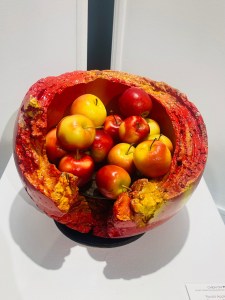
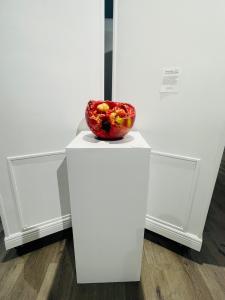
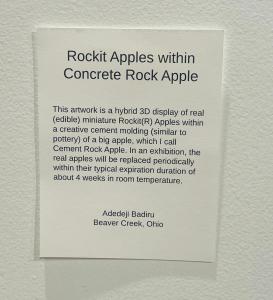
Surprisingly for Prof, he found himself among the participating artists and his work “Rockit Apple,” brings together food, sculpture, humour and a personal fascination with a particular variety of apple.
When Professor Badiru told me that his work had been selected for the exhibition, I was reminded of the young Lagos boy whose drawings once appeared in the Daily Times. The journey from cartooning and educational illustration to a cement sculpture designed to display apples may seem unusual, but it belongs to the same story we know of a man who continues to look at familiar things and ask what else they might become.
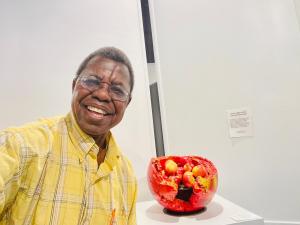
Standing beside Rockit Apple at the exhibition, Badiru felt elated. He had not imagined that his recreational artwork would lead him into this kind of exhibition. For years, he had treated his creative experiments as a personal pursuit, something he called his “labour of art”. His retirement has given him more room to follow these interests, but the work itself began long before the invitation from Michigan arrived.
“I never imagined participating in any art pursuit of this kind,” he explained. “Over the decades, I have pursued my recreational artworks as a ‘labour of art’ just for occasional fun.”
The cement rock apple was not originally made for an exhibition. Badiru created it for his own creative exploration, just to display at home and on his website where he keeps his records. The idea of using it to contain and present real apples came later, when he recognised that it could respond to the theme of “Chew on This.” There was no elaborate plan behind the connection. He had an object, an opportunity appeared, and he saw a way to bring them together.
That willingness to experiment is also evident in his relationship with food. Badiru has long enjoyed asking “what if?” in the kitchen, a curiosity he shares with his wife. Together, they wrote a playful food – experiment book titled “Physics in the Nigerian Kitchen,” bringing scientific thinking into the everyday experience of preparing food.
His relationship with Rockit apples began by chance in 2022, when he discovered them at a Walmart grocery store in Beavercreek, Ohio. Until then, he had not been particularly fond of apples. The small, portable fruit changed his mind. He became such an enthusiastic consumer that he began buying them in bulk whenever he found them, keeping a dedicated refrigerator for his household’s supply and sharing them with family, friends and colleagues.
During his time as Dean of Engineering at the Air Force Institute of Technology, he regularly took the apples to work, encouraging colleagues to eat healthily. He would invoke the familiar saying, “An apple a day keeps the doctor away,” and remind them that he needed everyone to be healthy for the educational task ahead.
He had no idea that this personal enthusiasm would eventually become part of an artwork. The apple was already a familiar presence in his life; the cement sculpture supplied a different way to present it. The word “Rockit” also appealed to him, with its suggestion of movement and energy. The name of the fruit and the rock-like form of his sculpture gave the work an unexpected connection.
For Badiru, the work goes beyond the object itself. Food, he believes, can inspire other forms of creativity and enrich our experience of life. It sustains the body, connects people and carries memories of family, culture and everyday routines. When food enters an exhibition, it also becomes something to look at, interpret and question.
His engineering background offers another way of understanding the work. Systems engineering considers how separate elements interact to produce an outcome greater than what each could achieve alone. Badiru sees a similar relationship between food, health, knowledge and art. An apple can be something to eat, a subject to observe, a reminder of personal experiences and, in this case, part of a sculptural display.
“In systems engineering, a system is defined as a collection of interrelated elements whose total output (in unison) is higher than the mere addition of the individual outputs of the elements,” he explained.
He applies this thinking to the human senses and the experience of art. Seeing, tasting, smelling, hearing and touching can work together to shape how people experience the world. A work of art can bring these different responses into conversation, even when the viewer is not expected to touch or taste the object on display.
Getting Rockit Apple to Michigan was an adventure in itself. The artwork was delicate, and Badiru decided to drive it from his home in Beavercreek, Ohio, to Ludington. The journey took about eight hours. Along the way, he questioned whether the trip was worth the effort, especially when heavy rain created difficult driving conditions about two hours into the journey.
He considered turning back more than once. There was no promise of fame or financial reward to justify the effort. What kept him going was the desire to experience something new and fulfil a personal creative ambition. In the end, he arrived safely and on time, and the gallery welcomed his dedication to the exhibition.
For a man whose professional life has involved engineering systems, academic responsibilities and the discipline of research, this journey offered a different kind of test. It was a commitment to an artistic opportunity whose outcome he could not fully predict. He made the trip because he wanted to see what participation in an exhibition might bring.
The experience also raises a question about what artists see in objects that other people might take for granted. Badiru hopes that Rockit Apple will encourage curiosity and invite viewers to wonder about the thinking behind the work. He does not insist that everyone should immediately understand its meaning. Questions and different interpretations are part of the experience.
He is particularly interested in what visitors might say after the exhibition closes. Some, he imagines, may ask what goes on in the minds of artists. To him, that curiosity is a compliment. It recognises that artists can approach familiar subjects from unexpected directions and find possibilities where others see none.
His creative practice is also connected to his continuing interest in knowledge-sharing. Badiru’s Ask the Prof initiative and his DEJI Systems Model—Design, Evaluation, Justification and Integration—reflect his interest in how questions lead to learning and how different parts of a system can be brought together. He sees knowledge as a form of nourishment, just as food sustains the body and art can deepen our understanding of the world.
These ideas are especially meaningful to a Nigerian who has spent decades abroad but continues to maintain a strong relationship with home. In July 2026, he participated in Nigerian Diaspora Day in Abuja, an experience he described as an opportunity to reconnect with family, friends, colleagues and the country that shaped him. His international career has not erased his sense of belonging. Instead, he sees his Nigerian identity as a permanent part of who he is.
That connection between his roots and his wider world has long informed his outlook. His journey from the streets of Ebute-Metta to an international engineering career, and now to a food-themed art exhibition in Michigan, is not a story of one profession replacing another. It is a reminder that a person’s creative life can continue to develop alongside professional achievement.
Professor Adedeji Badiru has spent much of his life building systems, teaching, writing and solving problems. Yet the young artist who drew cartoons of everyday Lagos life is still present in the man who made a cement apple and found a new use for it. The medium has changed; the curiosity remains.
Rockit Apple may have started as an object for personal enjoyment, but its selection for Chew on This has given it another life. It brings together a fruit that has become part of Badiru’s daily routine, a sculpture made through experimentation and a systems engineer’s belief that meaning often emerges when different things are connected.
As Badiru continues to demonstrate, sometimes the most interesting artistic possibilities begin with a simple question: What if?
Kindly enjoy our conversation below:

How did you feel standing by the work to take this picture at such an exhibition?
Badiru : I feel elated. I never imagined participating in any art pursuit of this kind. Over the decades, I have pursued my recreational artworks as a “labour of art” just for occasional fun. I had never invested that much time before because I was too engrossed in conventional academic pursuits. My retirement has opened up new avenues to pursue my heart’s art desires.
It is a delicate artwork indeed. What occupied your mind while creating this piece?
Badiru : I had no preconceived notion of what this artwork might end up being used for. I created the cement rock apple just for fun and personal display at home. So, nothing occupied my mind when I was creating the cement piece. The idea of using it to contain and display real apples came surreptitiously later on when I saw the opportunity for the “Chew on This” art exhibition. I just reacted to the opportunity because I happened to have something that could fit the bill of what the exhibition was looking for.
From the exhibition’s theme, “Food is something we all have in common, but we all experience it differently,” can we explore Rockit Apple through its creative, cultural and visual power to reveal how something as familiar as an apple can carry different meanings and experiences?
Badiru : Yes, indeed. The story of my falling in love with Rockit Apple is another interesting story entirely. Something that had no relationship to art at all. It is a short long story.
I have been a Rockit Apple addict for over four years, having discovered them by chance in a local Walmart grocery store in Beavercreek, Ohio, USA in 2022. I wasn’t particularly a lover of apples until I discovered Rockit by accident. I have been hooked ever since. Because Rockit is not always readily available in grocery stores, I buy it in bulk whenever and wherever I can find it. Because it needs to be kept cool or refrigerated, I have a dedicated refrigerator for stockpiling Rockit apples for my household consumption. Over the years, I have shared my Rockit Apples with family, friends, and colleagues, encouraging them to discover and purchase them regularly themselves. I have noticed that my local Walmart store now carries Rockit Apples more regularly.
I joke with everyone that this is due to my own frequent purchases that influenced the store about the demand and “selling movability” of the product. This could very well be true because I have a ceiling-high storage of empty rectangular plastic boxes that my consumed apples came in.
In fact, when I travel around the USA, the first thing I do is to find which stores carry Rockit Apples. Many stores claim never to have heard of it. One success case was the Walmart Story is Roanoke, Texas (a suburb of Dallas, Texas). Whenever I travel to Dallas, I go to Roanoke Walmart to buy Rockit Apples. When I was the Dean of Engineering at the USA Air Force Institute of Technology (AFIT), I regularly took Rockit Apples to work to share with my colleagues while quoting the popular adage of “An apple a day keeps the doctor away” and the exhortation of “I need all of you to be healthy for the education task at hand.” I guess I am a Rockit Apples mover. I had even taken the apples with me as a handy snack on my travels to Nigeria. I had no idea that innocent healthful push of the apples could turn out to have an art display implication later on.
What was the first idea or image that led you to this work, and what does the title mean to you?
Badiru : I have always been an experimenter of food and art. Experimenting with food has been a passion of mine for a long time. In fact, my wife and I wrote a fun food experiment book entitled “Physics in the Nigerian Kitchen,” which contains some of my hilarious experimentations with food preparation. Always asking the question, “what if?” in food recipes. So, the idea of linking apples as a food option to an art display came to me naturally. I had already created the cement rock apple in its own right, as an artwork. It just happened that the “rock” connotation aligns with the name of “Rockit Apple.”
The word “Rockit” immediately gives the impression of movement, energy or something being launched. How does this idea come into the work?
Badiru : I wondered why the producer named their brand of apples as “Rockit Apple.” I was not sure of the implication of the word “rock” in the name Rockit Apple. In preparation for this interview, I did a quick research of the Rockit name. Below is what I found:
[The Rockit apple was named as part of a branding strategy that emphasizes its small size, portability, and energetic appeal as a healthy snack. The company behind the apple wanted a name that suggested action, speed, and modern convenience, much like a “rocket.” The brand positions the fruit as a grab-and-go snack for busy lifestyles, and the name Rockit™ evokes the idea of “rocketing” through your day with a healthy boost. The apple itself is a naturally bred miniature apple cultivar developed in Hawke’s Bay, New Zealand. It was marketed as the world’s first snack-sized apple, and the distinctive name became a key part of its global branding. “Rockit” combines the idea of a rocket (energy, movement, convenience) with a catchy, modern brand identity for a small, portable apple.]
This turns out to be a creative labelling of a unique product. I was certainly sold on it even before my art exhibition idea.
Your background in engineering and systems thinking is well known. How does that way of thinking enter your visual art practice, particularly in Rockit Apple?
Badiru : In systems engineering, a system is defined as a collection of interrelated elements whose total output (in unison) is higher than the mere addition of the individual outputs of the elements. To me, this signifies how linking the healthful contribution of apples to other senses of humans (seeing, tasting, smelling, hearing, and touching). All these work well together to create a pleasing experience for humans, particularly for the area of visual arts.
You told me it is a delicate artwork and you would have to personally drive it down for submission. What were the moments or mixed feelings you experienced when conveying such an artwork to the venue?
Badiru: This is an interesting question that touches on my mixed feelings while doing the eight-hour drive from my home in Beavercreek, Ohio to Ludington, Michigan. Several times, I thought of turning back because of the silliness of embarking on such a long drive. But the fun or what was to come and the curiosity of what participation in an art exhibition could entail kept me going. At about two hours on the drive, I encountered a heavy rainstorm that impeded my progress and created a sense of travel danger. I questioned my own sanity in continuing. It was not an issue of fame, funds, or faith. So, there was no justification. However, the desire for personal art fulfillment kept me going. In the end, I was happy and fulfilled that I made the journey safely and on time. The gallery was happy and delighted about my dedication to the art course.
Is Rockit Apple more about the object we see, or is there a larger idea you want the viewer to discover behind it?
Badiru: The larger idea in this pursuit beyond visual art is how food could inspire other things that we pursue in life. Food may have an implication beyond being a life preserver. It could also be an enhancer of the quality of life along the five senses of humans.
What do you hope happens when a viewer stands before Rockit Apple, should they immediately understand the idea, or should the work leave them with questions?
Badiru: I am anxious to see if we get curiosity comments and wonderment inquiries after the exhibition closes. I am sure some of the gallery visitors would ask “what goes on in the heads of artists?” This is a compliment in recognizing the uniqueness of the extraterrestrial perspectives of artists. Yes, artists see art where other people see nothing.

You were part of the Diaspora contingent to Nigeria for the World Diaspora Day in Abuja this year. How significant was that experience for you, and how did it connect with your identity, your practice and your relationship with Nigeria?
Badiru: The most rewarding part of my participation in the 2026 Nigerian Diaspora Day in Abuja in July 2026 was the down-to-earth connectivity with the homeland after living abroad for so long. I am delighted to have frequent opportunities to connect with my kindreds in Nigeria on the diverse platforms of education, culture, national development, and youth empowerment. I love being seen by family, friends, and colleagues in Nigeria as the guy next door in the local neighbourhoods of Nigeria. I feel at home and I fell fulfilled when I connect with Nigeria. Despite the challenges and inconveniences, the fact is that Nigeria is where real life exists. Anything from that is just a fake existence.
Your new tool is “Ask the Prof,” and we all know that food is medicine. With Rockit Apple, how are you bringing together the ideas of food, health, knowledge and art, and what conversation would you like the work to start with the viewer?
Badiru: From a systems perspective, these elements are sub-systems of the overall system of the enhancement of life. They all have innate interconnections. Food enhances health. Knowledge enhances life. Art improves our understanding of our abode. This is particularly important to me in my practice of my DEJI Systems Model (www.DEJImodel.com), which structurally articulates the concept of Design, Evaluation, Justification, and Integration. AskProf is an elemental component of how things link together in terms of questions, answers, knowledge acquisition, and retention. The ultimate message of DEJI is that everything we do should be within the context of integration into our prevailing environment and situational awareness. This helps me (and other DEJI disciples) to adapt, embrace, and leverage whatever opportunities exist within reach. A misalignment in a system creates a sense of disconnection, discontent, and disenfranchisement. So, AskProf provides a “food” for learning. Rockit Apple provides a “food” for health.
iBAND Magazine, Celebrating Visual Art from the Original.
Africa | Visual Art | Lifestyle | Culture

