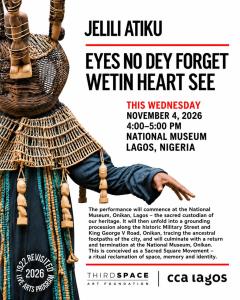
Performance artist Jelili Atiku presents Eyes No Dey Forget Wetin Heart See, a ritual performance exploring memory, ancestry, identity and historical reclamation. Part of the 1922 Revisited 2026 Live Arts Program, the performance will begin at the National Museum, Onikan, before moving through the historic streets of Lagos Island.
Words Jelili Atiku | Artwork courtesy Jelili Atiku
There are things the eyes see that the mouth cannot say, but the heart never forgets. It is within this profound tension between seeing, remembering and refusing to forget that internationally recognised Nigerian performance artist Jelili Atiku situates his new performance work, Eyes No Dey Forget Wetin Heart See. Presented as a foundational pillar of the 1922 Revisited 2026 Live Arts Program, the performance is conceived as both a quiet meditation and a radical provocation.
The work interrogates memory as a living archive, trauma as an embodied inheritance, and resilience as a recurring ritual act. Atiku walks because, as he explains, the modern concrete has a memory, and the ancient soil trapped beneath it is gasping for air.
On the sacred Ọ̀sẹ̀ Òrìṣà, as the traditional four-day cycle folds time back into itself, Atiku’s body becomes a nomadic altar. He steps into the urban grid not as an isolated wanderer, but as an antenna channeling ancient, unyielding Àṣẹ. This Luminous Pilgrimage becomes a slow, trance-like rupture in the clinical noise of the globalised city. Stretching across a conceptual and physical landscape from the historic alleys of Ìsàlẹ̀ Èkó (Lagos Island) to the post-colonial urbanity of Cologne, Germany, the performance is a deliberate dérive, designed to reframe the public gaze, reclaim silenced lineages and demand historical recognition and restitution.
His body becomes the canvas for this historical reclamation. Painted in the pure, quiet rectitude of Ọbàtálá’s Ẹfun (white chalk), and marked by the sanctified ancestral lines of Osùn (camwood), Eérú (ashes), and Lálá/Ẹ̀dù (charcoal), his physical form is anchored by the cool, maternal endurance of Yemòó. Thus adorned, he carries the heavy, grounding weight of Òrìṣà Òkè into spaces explicitly built to make people feel weightless, displaced and forgotten.
Guided by Èṣù at every volatile crossroad, his footsteps trace the invisible architecture of resistance. He fluidly adapts to changing spaces with the chameleon mastery of Agẹmọ, calling out to the ancestral peers of Ẹgbẹ́-Ọ̀gbà and Alárá-Igbó who still dwell beneath the pavement, waiting to be remembered.
This is not a spectacle for the passive consumer; it is an uncompromising act of historical decolonisation. As Atiku’s painted skin and the 150 Ère Igi Kékèké (miniature wooden figurines) gather the raw dust of the streets, they transform into a living ancestral regalia of the returned, dragging the suppressed archives of African epistemology directly into contemporary light.
Utilising the hidden, cleansing frequencies of Orò and Ẹ̀lúkú, the performance seeks to purify these traumatised spaces, while the warrior fire of Ògìyán ensures that Africans stand not as victims of history, but in absolute, unyielding sovereignty. The work surrenders to the frantic rhythm of the city only to rewrite its script, stepping entirely into the unknown so that the raw essence of indigenous being can be revealed.
The physical manifestation of the work will unfold as a Sacred Square Movement, establishing a localised geography of remembrance. The ritual will commence at precisely 4:00 pm on Wednesday, November 4, 2026, at the National Museum, Onikan, Lagos, the sacred custodian of our collective heritage. From there, it will progress into a grounding procession along historic Military Street and King George V Road, Onikan, tracing the ancestral footpaths of the city before making a full circle back to the National Museum.
In this circular, ritualistic movement, the street ceases to be merely a colonial thoroughfare or commercial passage; it is radically reclaimed as a sacred corridor of transition, memory and identity.
Atiku extends a sincere and urgent invitation to the public, including artists, scholars, students, cultural custodians and all seekers of truth, to join the performance. The invitation is not simply to attend as spectators, but to come as active participants, co-witnesses and keepers of the flame.
Look closely, because while the colonial gaze is powerful, it cannot blind the spirit. The systems of this world may look away, but the eyes no dey forget wetin heart see.
Let us walk together.
Jelili Atiku Invites Everyone.
Know the Event Details and Movement
Performance: Eyes No Dey Forget Wetin Heart See
Artist: Jelili Atiku
Programme: 1922 Revisited 2026 Live Arts Program
Date: Wednesday, November 4, 2026
Time: 4:00 pm – 5:00 pm
Starting Point: National Museum, Onikan, Lagos
Procession Route: Military Street and King George V Road, Onikan, Lagos
Organisers/Partners: Third Space Art Foundation and CCA Lagos.
iBAND Magazine, Celebrating Visual Art from the Original.
Africa | Visual Art | Lifestyle | Culture

