
Archive resubmission originally by Segun Obasa
“Source: “Drum,” July, 1974 On October 1, 1972,
Ayinde Bakare was the first musician to use the electric guitar in Juju music, and in 1956, he became the first Juju musician to visit the United Kingdom with a band. Tunde King was the first Juju
Ayinde Bakare, the original king of Juju, had an afternoon engagement in Lagos and a night engagement in Ijebu Ode. On account of that, he sent some members of his Meranda Band ahead to Ijebu Ode in the hope of joining them later in the day. He led the remaining members of the band to play at a wedding party at Isalegangan Street, Lagos.
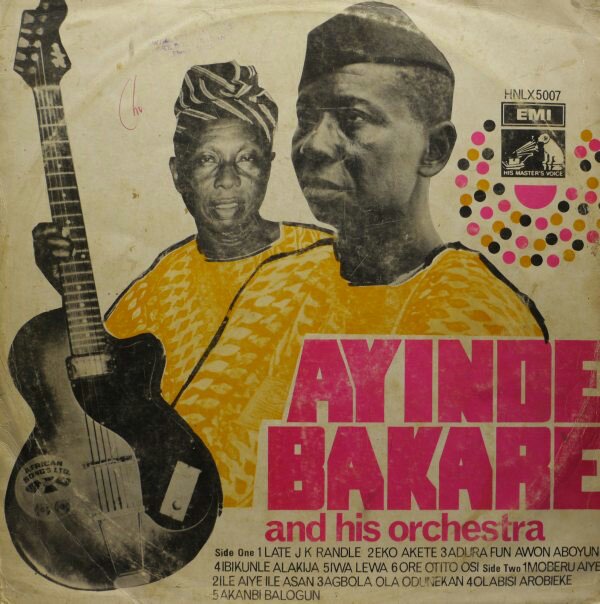
He disappeared when the band was on recess and was later declared missing. After a fruitless search, the police decided to check on a body found in the Lagos lagoon shore near Bonny Camp on October 5, 1972. It was Ayinde Bakare’s. The body was mistaken for that of a vagrant and was buried as such. It was an embarrassment to the police, the Lagos City Council which registered deaths, his family, his numerous friends and fans who were fond of him and his music.
Meanwhile, his eldest son, Shina, then aged 29, had arrived from Mubi, now in present-day Adamawa State where he was the leader of a pop group. Shina’s mother, Alhaja Amudatu Lemomu sent him a telegram informing him of the death of his father. Shina was there when his father’s corpse was exhumed at Atan Cemetry, Yaba. Shina recalled with grief: “I was there with a few friends, members of my father’s Meranda Band, and some of his other relatives. He was buried naked on top of 41 other bodies. I was the first to see his leg. Then I shouted ‘yes’ this is my father’s leg. I became dazed at that stage. I then realized my good old man was dead for ever. The condition of his body made me suspicious that he did not die a natural death.”
The police immediately ordered an autopsy to be carried out on Bakare’s body. In addition, a coroner’s inquest into the circumstances leading to his death was also set in motion. The coroner, Mrs. Grace Akinboboye, began the inquest on Monday, April 30th, 1973. The first witness was Dr. Olaseni Akinlade, the consultant pathologist that performed the autopsy. He said he found bruises all over the body. He also found a tattoo that read “A. S. Bakare” (Ajikobi Saibu) on the deceased’s right hand. In his opinion, Bakare’s death was due to drowning. One of his wives, Risikatu Dabiri, was also a witness. She told the coroner that she suspected two members of her husband’s band to be responsible for his death. Before his death, she added, there was a quarrel between Bakare and the two men over a sum of 60 Naira. She alleged that while her husband was missing, the band continued to play at parties.
Ayinde Bakare was the first musician to use the electric guitar in Juju music, and in 1956, he became the first Juju musician to visit the United Kingdom with a band. Tunde King was the first Juju musician to go to the United Kingdom, but he did not go with his band. The Meranda Band was well received by African residents in London in 1956, playing at what was then called “Abilabi Club” in the Soho District of West End. To a certain degree, Ayinde Bakare contributed to the international acceptance of Juju as a popular music genre.
It is puzzling to note that in spite of the bruises on his body and the allegation by the coroner that three witnesses knew more than they said, the police failed to fish out the killer(s) of Ayinde Bakare fifty years after. The answer to the maestro’s death remains unanswered.
Photograph /Google

