
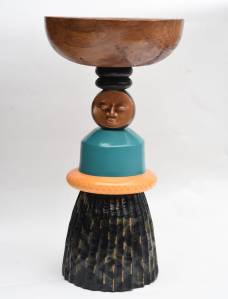
We are actually experiencing new directions in contemporary African exhibitions, Seun Alli and the team at June Creative Art Advisory are not merely curating shows, they are reframing how we see, feel, and ultimately value everyday lives. Their curatorial voice is bold yet intimate, drawing collectors, thinkers, and casual viewers into a deeper appreciation of narratives often overlooked.
Words Ireho Aito | Don’t Keep Your Art in the Finger! All Artwork credit: Tunde Owolabi. All Artwork courtesy June Creative Art Advisory
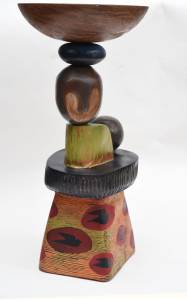
With Without Rest: The Crown We Gain, a compelling solo exhibition by Tunde Owolabi, the team delivers a body of work that is both culturally grounded and emotionally stirring. To be hosted at No Parking Lagos, the exhibition becomes more than a display as it is a lived experience, a mirror held up to the rhythms of Nigerian life. This exhibition opens on the 11th of April 2026 and runs till 9th of May 2026.
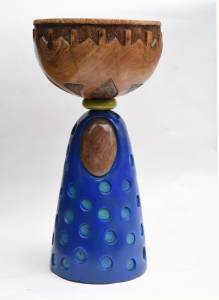
Owolabi’s works this time, spanning sculpture, photography, and print are anchored in the dignity of labour. His hand-carved Eledere stools stand as both functional objects and symbolic thrones, quietly asserting that the women who occupy our streets, markets, and neighbourhoods are, in fact, crowned by their endurance.
For me, this exhibition is deeply personal. It returns me to Mokola a community in the ancient city of Ibadan, Oyo State where my upbringing, my formation chiselled me to understand the gains of resilience. I remember Mama Onigo, the elderly bottle buyer whose voice cut through the air on hilltop Nupe Street, “Onigo deee!” meaning the bottle buyer is here. The chant was both announcement and identity. We, as children, echoed her calls in playful solidarity, drawing attention to her trade.
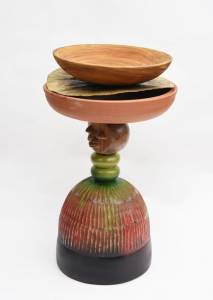
Bent with age yet unbroken in spirit, Mama Onigo was a study in strength. With bottles stacked in a basket on her head for barter for cash stashed in her pouch, she moved through the streets with purpose while using one hand to hold the basket on her head. This basket would always sit on her head like a crown. She spoke only Yoruba, yet language was never a barrier as commerce created its own fluency. My mother, known fondly as Mama Dele or Mama Bendel, would sit with her, both grabbing available stools, exchanging not just goods but stories and gossips, laughter and reflection while Mama Onigo enjoyed that fleeting rest from the sun.
There was pride in her work. In fact, believe it that there was structure. She knew her clients and googled her routes with strict accountability. There were profits. Mama Onigo had a bank account that was not built on privilege, but on persistence and hardwork. She invested wisely in landed property too. For her savings at the bank, thumbprints became signatures of independence. This is the crown.
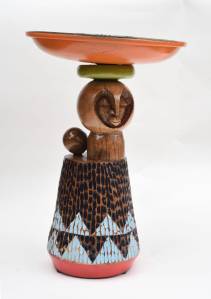
Owolabi’s titled works read like a roll call of familiar figures across Nigerian communities. Each one a tribute and each one a narrative. In Agege Bread that locally made famous bread whose history dates back pre – independence is well regarded to command the rhythm of city of Lagos in the morning. Very few things arrive with as much quiet authority as Agege bread. Born out of the working-class heartbeat of Agege, this iconic loaf is more than food, we all know it as a culture you can hold. It celebrates the power of women who hawk it as symbol of sustenance and daily hustle, reflecting the iconic street-side commerce that fuels Lagos mornings.
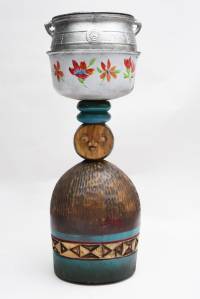
Ewa Agoyin – Agoyin Beans, another locally made bean flavour complements Agege bread in the morning and everywhere and everyday, especially for perennial Lagos bachelors, it remains staple for them. Also, among working class communities, pupils and families. The rush in Lagos brings this locally made beans of Togolese history a breakfast daily item. Originated from Togo, Ewa Agoyin rich in flavour and simmers with cultural migration, this work honours cross-border influences and the women who sustain them. When you look at Ewa Agoyin, you could see the pots looking adorable on the hawker head with affirmation of profits.
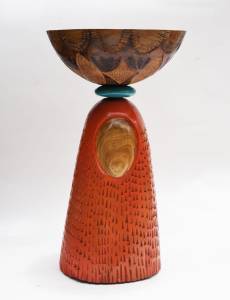
In another captivating work, Tunde Owolabi shares Hadiza, a northern voice, evoking the quiet resilience of women navigating layered identities. Hadiza stands quietly, holding within her the layered negotiations of culture and place.
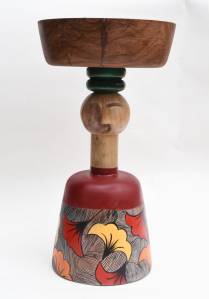
Who can easily forget Iya Eleja the fish monger whose presence is as constant as the tide? She does not merely arrive on the scene, she is announced through her own echoes on the streets and communities while the bowl of fish is on her head. This act is still very common where children are sent running down the street in urgent excitement, voices raised in chorus “ Iya Eleja, Mama Kemi wants to buy!” This is a coded call that is both invitation and advertisement. By the time they catch up with her, breathless and proud, the transaction has already begun in spirit.
Iya Eleja moves with the authority of one who understands her terrain. A matriarch of the waterside markets, she carries more than baskets of fish, this hardworking woman carries an economy on her head and a reputation that precedes her. Her trade is not just commerce; it is negotiation, memory, and mastery, built over years of rising before dawn and returning long after the sun has softened.
There is respect in the way she is addressed because trust is wealth and endurance is non – negotiable. Iya Eleja does not simply sell fish, she sustains households, and anchors a system that feeds the city.
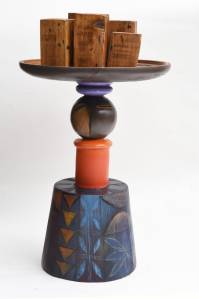
While Iya Kemi Eleko with Kemi strapped on her back, moves with a quieter rhythm, her presence is no less profound. She is the well known local pap seller, that hawks her craft through streets and neighbourhood corners, preserving a delicacy rooted in memory and technique, the pap is sold with inherited precision. This is hard pap, carefully wrapped in local leaves, and Iya Eleko makes its quiet rounds in the mornings and returns again in the cool of the evening, a rhythm she knows by heart. Our dailies, our first bites of the day, and evening feel, are carried quite literally by women like Iya Eleko, whose quiet endurance and steady movement keep tradition alive on the streets.
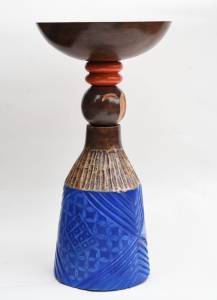
In Ki le n ta Mama means Mama, What Are You Selling? This curiosity becomes narrative. It is a commerce language very popular on our street. People try to know what the hawker has on her head when they are not sure. It announces awareness and creates room for business.
From the Northern part of Nigeria, Mai Fura maidens are very popular and they move with pastoral echoes, balancing heritage and livelihood. Mai Fura the Milk Seller is a nod to northern dairy traditions, balancing mobility with cultural continuity.
While Mama Nkem broadens the story of the exhibition, she reminds us that hard work and enterprise are not tied to one culture. She stands as a strong symbol of the Igbo woman’s industrious spirit, resilient, resourceful, and ever-enterprising. One could see Nkem strapped on the back of Mama Nkem.
And then there is Sisi Shalewa, where youth and beauty meet labour without contradiction, redefining what it means to participate, to contribute, to endure. Each piece is not just a subject, each work evolves from a system, with a story, and the survival code.
At its core, Without Rest: The Crown We Gain is a meditation on labour as legacy. These women do not wait for recognition, instead they embody it. Their crowns are invisible to the hurried eye but unmistakable to those who choose to look closely. Some of them even carry their babies on their backs while hawking to eke a living.
The exhibition draws attention to endurance as a form of wealth among women, especially female hawkers, where the ability to persist in the face of physical and economic strain becomes its own currency of survival and dignity. It also highlights skill as inheritance, showing how knowledge passed among women is not through formal instruction alone but through observation, repetition, and lived experience across generations of trading and caregiving.
More so, it celebrates presence as power, affirming female hawkers’ strength in occupying space unapologetically from bustling markets to crowded motor parks where everyday life itself becomes a statement of visibility, resilience, and survival.
There is something profoundly instructive here, especially for young Africans navigating uncertainty, and even more so through the lived realities of women, particularly female hawkers. This exhibtion is a call to know that resilience is lived daily, often without applause, sometimes in the early mornings, long walks, and restless hours of making a living. Dignity is self-defined, as work no matter how humble, it carries honour when it is sustained by effort and integrity. Community is currency, with relationships sustaining both business and spirit, as women trade not only goods but trust, familiarity, and mutual support.
Above all, these women remind us that courage is not always loud. Sometimes, it is the quiet decision to rise each day, balance the weight, and walk again.
The philosophy underpinning Without Rest: The Crown We Gain by Tunde Owolabi is neither sentimental nor exaggerated. It is observational. It interprets that labour, especially the kind performed daily and without ceremony, accumulates into something far greater than survival. It becomes identity and legacy. It becomes a crown that is earned.
What Seun Alli and June Creative Art Advisory have achieved here is significant. They are shifting the collector’s gaze from the grandiose to the grounded, and from spectacle to substance. They challenge us to see value not just in rarity, but in relatability.
Just like Mama Onigo, these are the women who wear the crown.
Without Rest: The Crown We Gain, a solo exhibition of sculptures, photographs and prints by Tunde Owolabi and curated by Seun Alli opens on Saturday 11th of April 2026 at No Parking Lagos 15, Military Street, Onikan, Lagos. The exhibition runs till May 9th 2026.
iBAND Magazine, Celebrating Visual Arts from the Original.
Africa | Visual Art | Lifestyle | Culture

