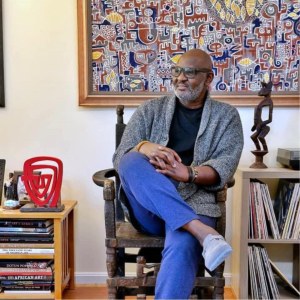
From Ibibio cultural memory to global contemporary art, Victor Ekpuk reflects on identity, nsibidi, journalism, migration and the enduring power of Africa’s visual language.
Words Ireho Aito | Don’t Keep Your Art in the Finger! Photographs credit Victor Ekpuk Archives
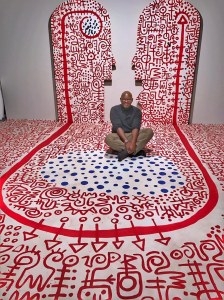
For decades, the Nigerian-born, internationally acclaimed artist has built a visual language that transcends geography. Rooted in the philosophical depth of nsibidi, the ancient symbolic writing tradition of southeastern Nigeria, his drawings, paintings, sculptures and public installations have become some of the most recognisable expressions of contemporary African art on the global stage. Whether in museums, galleries or public spaces, his work invites viewers to look beyond representation and enter a world where line becomes language, memory becomes form, and symbols become living conversations.
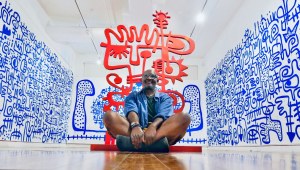
Yet there is another Victor Ekpuk that many encounter long before stepping into an exhibition. While spending time on his Facebook page, it quickly becomes apparent that it is far more than a social media platform. It reads like the pages of a metropolitan arts magazine, alive with colour, thoughtful observations, travel reflections, cultural memories and an extraordinary archive of artistic practice.
Every post reveals not only an accomplished visual artist but also a gifted writer whose words carry the rhythm, discipline and curiosity of a seasoned journalist.
That should come as no surprise.
Before establishing himself as one of Africa’s most respected contemporary artists, Ekpuk worked as an illustrator and cartoonist with Daily Times Nigeria during one of the country’s most politically charged periods in the early 90s. The newsroom sharpened his ability to observe society, communicate complex ideas with clarity and use visual language to question power. Those experiences continue to echo through his practice today, where every line carries intention and every symbol holds multiple meanings.
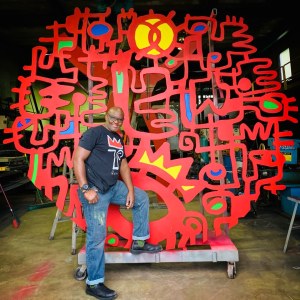
His artistic journey has since stretched from Nigeria to the United States and to audiences across Europe, Africa, Asia and the Americas. Along the way, he has remained deeply committed to the cultural traditions that shaped him as a child. Rather than treating Ibibio heritage as nostalgia, he has transformed it into a contemporary language capable of speaking across generations and cultures.
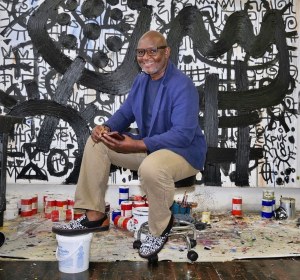
Professor Toyin Falola, one of his colleqgues and ally, once described him as an artist who “reimagines nsibidi as an aesthetic and philosophical language.” It is an observation that captures the essence of Ekpuk’s practice. His works are neither fully abstract nor entirely figurative. They exist in a compelling space where drawing becomes writing, sculpture becomes memory, and viewers are invited to complete the conversation through their own interpretations.
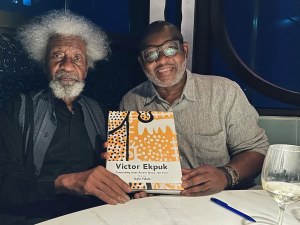 Migration has expanded his geography without diminishing his roots. Living and working in the United States has allowed him to build bridges between Africa and its diaspora through public art, exhibitions and cultural dialogue. Whether creating monumental sculptures for communities or intimate drawings in the studio, his work continues to affirm that African visual traditions possess intellectual depth, philosophical richness and enduring global relevance.
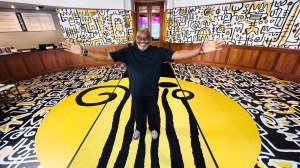
What makes Victor Ekpuk particularly compelling is his refusal to separate art from life. Family history, childhood memories, indigenous knowledge, food, plants, landscapes and everyday encounters all become part of an evolving creative philosophy. Home, for him, is no longer confined to a single location. It is a living space shaped equally by ancestry, memory and imagination.
In this week’s Cover Feature, iBAND Magazine is honoured to present an extensive conversation with one of the defining artists of his generation.
Speaking with warmth, humility and remarkable clarity, Victor Ekpuk reflects on his family name, his artistic beginnings, journalism, Professor Obiora Udechukwu, nsibidi, migration, public art, colour, identity and the enduring power of African cultural memory.
Most importantly, he reminds us that the greatest artistic journeys often begin by looking inward.
From his Ibibio roots and journalism career to the global language of nsibidi, Victor Ekpuk speaks with iBAND Magazine about art, memory, migration, identity and the enduring power of African cultural heritage
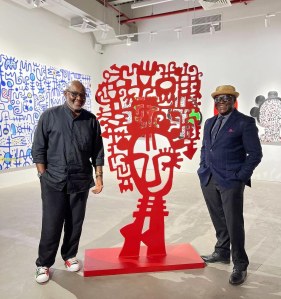
Thank you so much for this honour. Let’s start with your name Ekpuk. We know you are an Ibibio by birth but kindly tell us the meaning of Ekpuk?
The name is worth celebrating.
Ekpuk pronounced as Ékpùk means a knot, family unit or clan depending on the context it is used in Ibibio language. So metaphorically and literally, I am all those meanings.
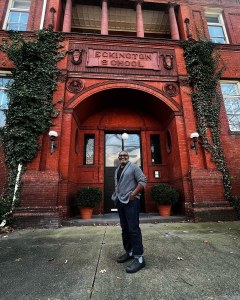
Let’s allow our readers to feel your root which is very important. Tell us more about your illustrious family and background we may not have read or heard?
I am from Ikot Afaha Idung Ukpa, a clan that my paternal great grandfather Obong Ekpuk Ukpa Itauma founded in Eket in Akwa Ibom state.
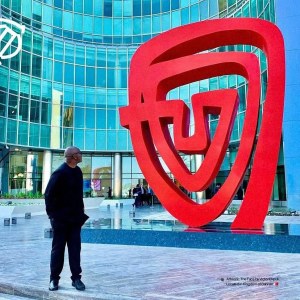
You studied at Obafemi Awolowo University and later worked with Daily Times Nigeria in the 1990s as an illustrator. How did those early experiences shape the artist you became?
While studying at the University of Ife, now Obafemi Awolowo University, our tutelage emphasised drawing from African aesthetics while also studying European art traditions. It instigated my research into nsibidi art forms, I discovered their remarkable beauty, complexity, and richness qualities that have continued to shape my contemporary style ever since. This knowledge has given me profound pride in the intellectual wealth of African culture, and I continue to find creative inspiration within its immense creative legacy.
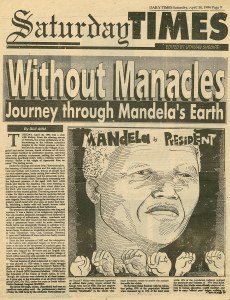
Your Daily Times illustrations from the 1990s captured important cultural and historical moments, including the celebration of Nelson Mandela’s release and the end of apartheid. Looking back, what did it mean for you as a young Nigerian artist to visually document moments that carried such emotional weight across Africa?
Looking back to those years, I’d consider working at the Daily Times as a cartoonist and illustrator to be privilege of a lifetime. Having a platform where I could use my art to challenge and question the oppressive power structures in Nigeria and Africa during a tumultuous period in our history fills me with immense gratitude.
At the Daily Times, I embraced the newspaper’s longstanding tradition of cartooning, where artists like Josy Ajiboye, Dele Jegede, and others used humour to comment on socio-political issues. That work significantly enhanced my political awareness and honed my skills in political satire through drawing.
You recently reflected on the influence of Professor Obiora Udechukwu, describing him as a mentor whose work sparked your creative journey. What was it about his art and philosophy that opened a door for you?
As a young art student, I faced a challenging tutelage where I was asked to draw inspiration from my own culture for artistic expression. This meant I had to unlearn my preconceived notions of what art should be drawing or painting representations of objects in European traditions, which I had seen in art books and even in our religious texts.
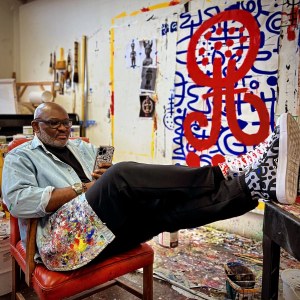
Attending university in western Nigeria, I was surrounded by Yoruba traditional motifs and aesthetics, which found their way into my work. However, it was the drawings of Obiora Udechukwu which I found in his illustrations of the publication of Christopher Okigbo’s poetry that truly lit a light bulb in my head. His work combined Igbo Uli linear and Ibibio nsibidi symbolic motifs, and it inspired me to explore the formal potential of applying the aesthetics of my Ibibio heritage to my own artistic expressions.
My maternal grandfather, the late Obong “Nwotnda” Asuquo Akpan Umo, held high ranks in several indigenous Ibibio fraternities, including the Ekpe and Ekpo societies. As a child, I spent time with him and was captivated by the Ekpo masquerades who visited his efe (meeting house) to pay their respects. This was where I had witnessed nsibidi performances up close.
Obiora’s work reintroduced me to nsibidi, which I was very familiar with having grown up within that culture. The encounter with Obiora’s art encapsulated all the tutelages I was receiving at Ife from art professors Folarin, Lawal, Abiodun, Okediji, and others.
 Professor Toyin Falola describes you as an artist who “reimagines nsibidi as an aesthetic and philosophical language.” When did you realise that nsibidi was not just a cultural reference but a powerful contemporary artistic language?
Nsibidi wasn’t something I “discovered” from the outside, it was already in my childhood memory, and art school gave me the tools and motivation to turn that inherited visual language into a personal artistic practice. My formal education at the University opened me to critically think of my culture and encouraged introspection and deeper research into the cultural and aesthetic philosophy of nsibidi. I saw how leaning on that aesthetic to inform my own creation would give deeper meaning to my work.
Many people describe your works as something between drawing, writing, and visual poetry. You once said your favourite thing is “molding lines to forms and breaking forms into lines.” Can you explain this relationship between line, symbol, and meaning in your practice?
I believe that my work resides between the threshold of figuration and abstraction. It is never fully abstract, never fully figurative, it sits in that tension. Visual poetry operates within that threshold: meaning is felt before it is decoded, the way a poem moves you before you’ve parsed every word.
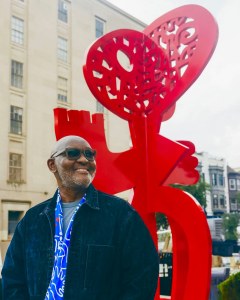
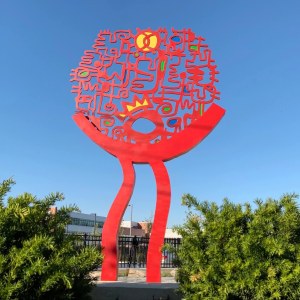
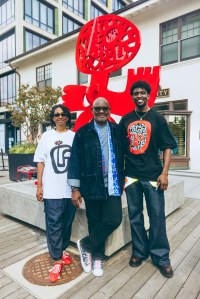
By “molding lines to forms”, I am describing the process of creating my sculpture. My drawing mark becomes physical structure. It holds weight, occupies space, and exists in the round. I leave the line on the form. The mark remains visible in the object, so the figure reads as both recognisable form and encoded script simultaneously. At 17 feet tall, “The Face” an intimate drawn line becomes architectural, a personal mark scaled into a public monument, carrying the memory and identity of an entire community.
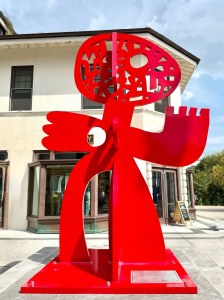
“Breaking forms into lines” Is a process of decomposing the recognisable back into pure mark. Figures dissolves into script, into rhythm, into something that reads almost like text even when it isn’t. This is where the “writing” quality enters: the work looks like it is saying something in a language you can almost grasp.
Your artworks often do not give viewers an immediate explanation but invite them to feel and interpret. Do you see your art as a conversation between what is known and what remains mysterious?
As I said earlier, in my work figures are dissolved into script, into rhythm, into something that reads almost like text even when it isn’t. This is where the “writing” looks like it is saying something in a language you can almost grasp, but not really. It invites you to feel it wholistically rather literally and bring your own interpretation to it.
As an artist of Ibibio origin living in the United States, how has migration shaped the way you think about identity, memory, and belonging, considering the reports we keep getting about African artists and migration. Many African migrants find it difficult to continue their practice which makes them disappear from the scene due to policies and life demands. Why is your story different?
I suppose I can credit my story to dogged perseverance and special grace from my ancestors.
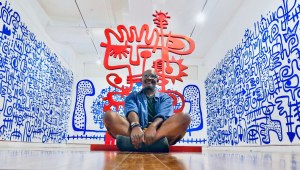
You created “Hope and Dream Under Glory,” your first public sculpture in the United States, inspired by the black panther and the symbolism of nsibidi. How important is public art to you as a way of connecting African histories with new communities and younger generations?
I believe that my art serves as a bridge connecting the African continent with its diaspora. It explores a shared cultural heritage, historical trauma, and the enduring spirit of resilience.
Public art is where that bridge becomes literal, it’s placed in cities with diaspora populations (Washington, D.C., where I am based, has significant Black and African immigrant communities) rather than in a gallery where people must seek out.
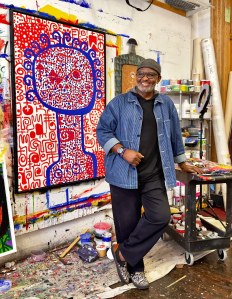
My hope is for the work to connect contemporary audiences with the aesthetic traditions of Africa and public placement is how you reach people who won’t walk into a museum. A permanent sculpture at a street corner gets seen daily by people in that neighborhood, whether they have any connection to African art institutions. Over years, it becomes part of their visual vocabulary of home, the way a public library or church might. That’s a different kind of transmission than a gallery show, which reaches people already inclined to seek out African contemporary art.
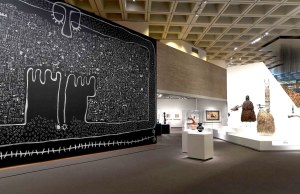
Your work has travelled internationally, from museums and galleries to public spaces, including your installation at Disney’s Animal Kingdom. How do you approach creating art for different audiences and cultural environments?
The difference between public art and the work I do in my studio is that public art demands that I respond to a specific theme or make it relatable to the community where the artwork is located. I approach this sort of projects by first doing research to understand the community, its story and people.
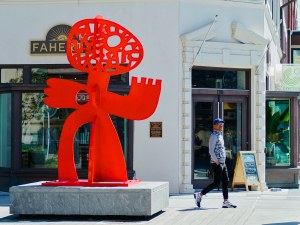 Your reflections on returning to Akwa Ibom also reveal a deep connection to indigenous knowledge food, plants, environment, and community. How much does your cultural experience beyond the studio influence your visual language?
These trips are always opportunity to replenish cultural memory which in turn feed my work.
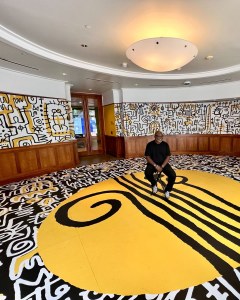
You have moved between journalism, illustration, sculpture, installation, and contemporary drawing. Do you see yourself as an artist working across disciplines, or is everything connected through one larger creative philosophy?
I see myself first as a creator, who manifests his imagination. I am not confined or defined by the listed categories, rather I bring my creativity to respond to those categories.
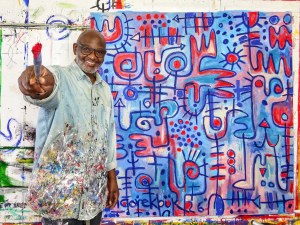 After years working with a minimal palette, you recently wrote that a multicolour palette “sneaked up” on you and you might let it stay. What does this change in colour mean for where your work is today?
Painting with minimal palette was a deliberate act to reduce colour so I could explore and emphasis the linear aspect in my work. Now that colour has unconsciously “sneaked” back on my canvas, perhaps it is time to welcome it back and enjoy expressing with both lines and color again.
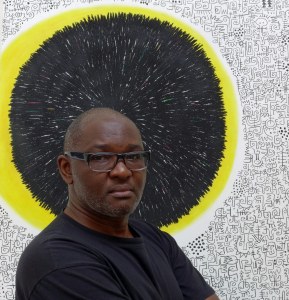 From Nigeria to America and international exhibitions, your journey reflects movement across cultures. What has this journey taught you about the meaning of home?
Home is an expanded space which includes where one presently plants their root and where one has been uprooted from and only mental geography remains.
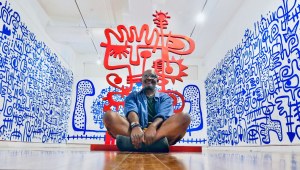 What do you hope a young African artist discovering your work today understands about the power of cultural memory, symbols, and storytelling?
For a young artist today, I hope she/he see a permission to look inward. To understand that our heritage contains all the philosophical complexity needed to speak to global truths. They do not need to choose between being deeply African and fiercely contemporary; the magic happens when the two are woven together to tell your own story.
iBAND Magazine, Celebrating Visual Arts from the Original.
Africa | Visual Art | Lifestyle | Culture

