
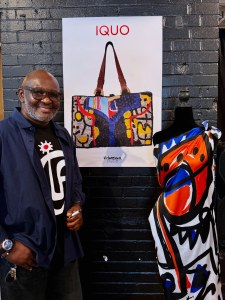
Our recent conversation with Victor Ekpuk did not end when the interview was over. It continued as I wandered through his photographs, writings and wearable art, where I discovered that the language of Nsibidi was no longer confined to canvas or sculpture. It had become something people could wear. That discovery inspired this week’s Don’t Keep Your Art in the Finger!, a reflection on an artist who understands that culture lives most powerfully when it becomes part of everyday life.
Words Ireho Aito | Don’t Keep Your Art in the Finger! Photographs credit Victor Ekpuk Archives
When iBAND Magazine recently check one of Nigerìa’s most celebrated artists in the diaspora – Victor Ekpuk for our Cover Feature, we spent time talking about Nsibidi, memory, migration, identity and the enduring power of African visual language.
Yet, as I reflected on that conversation afterwards, I realised there was another chapter of his artistic journey that deserved attention. It was not beneath the lights of a museum or standing in a public square. It was hanging quietly in a wardrobe. That was when I realised Victor Ekpuk’s art had travelled beyond the gallery and into everyday life. That is where this week’s Don’t Keep Your Art in the Finger! begins.
Victor Ekpuk has never believed that art should remain confined to gallery walls. The same Nsibidi language that has travelled through his paintings, books illustrations, drawings, sculptures and public installations has also found its way onto scarves, hoodies, T-shirts, caps, tote bags and other wearable pieces that allow people to carry African visual culture wherever they go.
The collection is not a departure from his artistic practice. It is an extension of it.
During his conversation with iBAND Magazine, Ekpuk reminded us that he has always looked inward rather than outward for creative inspiration.
“Nsibidi wasn’t something I ‘discovered’ from the outside, it was already in my childhood memory, and art school gave me the tools and motivation to turn that inherited visual language into a personal artistic practice.”
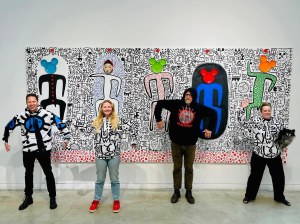 Perhaps that is why his fashion collection feels so authentic. These are not decorative patterns borrowed from tradition. They are symbols that have lived with him since childhood, transformed into a contemporary visual language that now moves comfortably between museums, public art and everyday fashion.
One of the ideas that stayed with me from our interview was his advice to young African artists.
“I hope she/he see a permission to look inward. To understand that our heritage contains all the philosophical complexity needed to speak to global truths. They do not need to choose between being deeply African and fiercely contemporary; the magic happens when the two are woven together to tell your own story.”
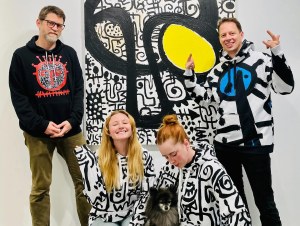 That statement could well serve as the manifesto for Victor Ekpuk’s wearable art. Every scarf, hoodie, T-shirt and cap carries more than a design; each becomes a moving canvas, taking the language of nsibidi beyond the gallery and into everyday life.

Victor Ekpuk once worked as an illustrator and cartoonist at Daily Times Nigeria, where visual communication had to be immediate, engaging and meaningful. Looking at his fashion collections today, I cannot help but think that the journalist in him still understands how images travel. Instead of remaining inside exhibitions, they now walk through airports, universities, cafés and city streets.

On his wearable art platform, Ekpuk captures this philosophy in four simple words:
“WEAR YOUR ART OUT!”

Those words are more than an invitation to buy clothing. They are an invitation to live with art.
When asked by iBAND Magazine how he sees himself after moving between journalism, illustration, sculpture, installation and drawing, his answer explained everything.
“I see myself first as a creator, who manifests his imagination. I am not confined or defined by the listed categories, rather I bring my creativity to respond to those categories.”

That refusal to be confined explains why his creativity naturally flows into fashion. The medium changes, but the philosophy remains constant.
Another response from our conversation now carries even greater meaning.
When we asked him what home means after living and working across cultures, he replied:
“Home is an expanded space which includes where one presently plants their root and where one has been uprooted from and only mental geography remains.”
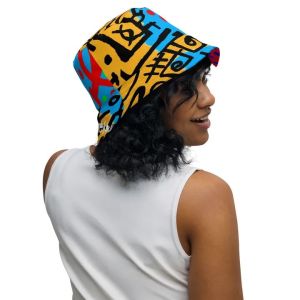
His wearable art reflects that expanded space. A scarf worn in Lagos, London, Washington or Tokyo still carries the same visual memory of Ibibio heritage and nsibidi philosophy. Home travels with the wearer.
That is the beauty of Victor Ekpuk’s fashion. It is more than merchandise or branding; it is cultural memory made wearable, allowing the language of Nsibidi to become part of everyday life.
It reminds us that African contemporary art does not have to stop when an exhibition ends. It can enter everyday life without losing its intellectual depth or cultural dignity. And that, perhaps, is the greatest lesson Victor Ekpuk offers this week.
Don’t Keep Your Art in the Finger! Let the world wear it.
iBAND Magazine, Celebrating Visual Arts from the Original.
Africa | Visual Art | Lifestyle | Culture

