Cover | Beyond the Artwork: How the Collector Has Changed
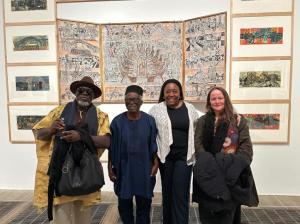
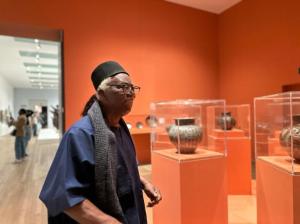
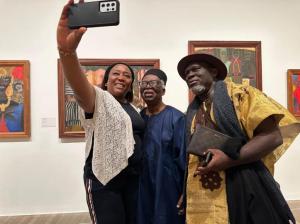
From left : Dr. Mudiare Onobrakpeya, Professor Bruce Onobrakpeya, Bofu Nwoko – Ugbodaga and Selma Etareri at Tate Modern Museum in London. Photo courtesy Selma Etareri
How exhibitions and artistic ideas are redefining what serious Nigerian collectors seek in contemporary art.
Words Ireho Aito | Don’t Keep Your Art in the Finger! Photographs iBAND Magazine archives. Photographs Selma Etareri archives
There was a time when a visit to an art exhibition in Nigeria followed a familiar rhythm. Guests admired paintings for their colours, paused before sculptures polished to perfection, exchanged pleasantries over glasses of wine and, if fortunate, left with an artwork that complemented a living room, a corporate boardroom or the entrance of a newly built home. Beauty was often enough. Craftsmanship closed the conversation. The collector’s eye settled on what looked impressive, while the artist’s success was measured by the number of red dots appearing beside exhibited works before the closing ceremony.
That rhythm is changing.
Walk into many of today’s exhibitions and a different conversation is taking place. Collectors still admire technique, but they linger longer before making decisions. They ask about previous exhibitions. They want to know how a body of work evolved. They are interested in the artist’s research, influences and philosophy. Some enquire about museum collections, public commissions, residencies and publications. Others ask whether the work belongs to a larger series or represents a turning point in the artist’s practice.
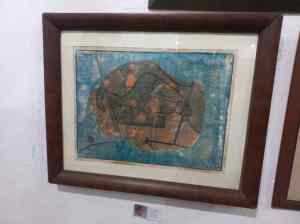
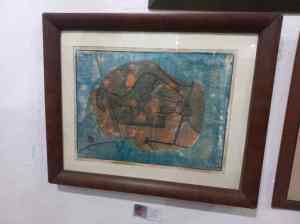
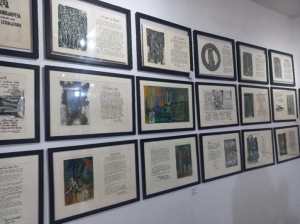
“Moon and Offending Christian,” a lino print by Bruce Onobrakpeya. This artwork started the journey renowned collector Prof. Ebun Clark’s collection with Bruce Onobrakpeya in 1965.
The artwork has become the beginning of the conversation rather than its conclusion.
This quiet transformation may not always dominate headlines, but it is one of the most significant developments in Nigeria’s contemporary art ecosystem. It reflects the emergence of collectors who increasingly understand that enduring value is rarely created by aesthetics alone. It is built through ideas, consistency, documentation and an artist’s ability to contribute meaningfully to culture.
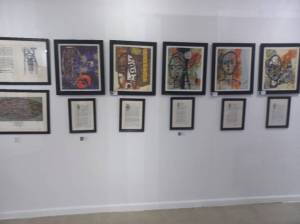
“Six Decades of Vision: Bruce Onobrakpeya’s Prints and The Global Print Family in the Collection of Prof. Ebun Clark.”
The evolution has not happened by accident.
Over the years, iBAND Magazine has chronicled artists who have consistently argued that success in art cannot be separated from vision, discipline and intellectual growth. Their interviews, exhibition reviews and reflective essays now read like chapters in a larger story, a story about the maturation of Nigerian art and the changing expectations of those who collect it.
Renowned curator Mr Moses Ohiomokhare at the landmark exhibition titled “Six Decades of Vision: Bruce Onobrakpeya’s Prints and The Global Print Family in the Collection of Prof. Ebun Clark.”
Perhaps few voices have articulated this transformation more clearly than Miabo Enyadike, whose Art Clinic conversations and the ArtMiabo International Art Festival have repeatedly challenged artists to think beyond producing beautiful objects. Writing on her Instagram, Enyadike reminds artists that consistency is not the mechanical repetition of familiar ideas but the patient development of an authentic artistic voice. Her philosophy carries an important implication for collectors as well. If artists are expected to grow, collectors must also learn to collect growth rather than merely accumulate objects.
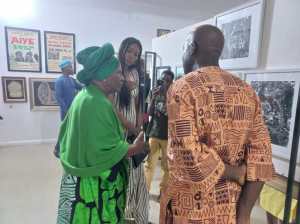
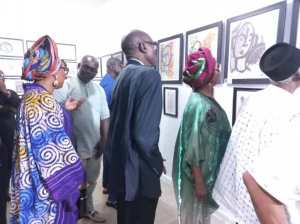
Guests, patrons and friends awestruck at the on October 19, 2025, at the National Museum, Onikan for the landmark exhibition titled “Six Decades of Vision: Bruce Onobrakpeya’s Prints and The Global Print Family in the Collection of Prof. Ebun Clark.”
The distinction is subtle but significant. A painting may decorate a wall, but a body of work tells the story of an artist’s life. One offers immediate pleasure; the other becomes part of a nation’s cultural memory. Encouragingly, more Nigerian collectors are beginning to recognise this difference.
Bofu Nwoko – Ugbodaga, Prof. Bruce Onobrakpeya and Dr. Mudiare Onobrakpeya at Tate Modern Museum in London for Nigerian Modernism exhibition. Photo credit: Selma Etareri
The changing mindset becomes clearer when one examines the exhibitions that have captured attention in recent years. The excitement surrounding many contemporary exhibitions is no longer generated solely by the unveiling of new works. It is driven by curiosity about the questions artists are asking, the materials they are exploring and the conversations they are inviting audiences to join.
In this respect, collecting has become an act of participation.
Owning a work by an artist whose practice continues to evolve is no longer merely a financial investment. It is an investment in an unfolding narrative. That narrative matters.
When iBAND Magazine featured Dr. Kunle Adeyemi, the accomplished artist and scholar, offered observations that extended far beyond technique. His interview challenged long-held assumptions about artistic success and the relationship between creativity and enterprise. “The artist has no business being hungry,” he declared, refusing to romanticise suffering as an essential condition for artistic greatness. It was more than a memorable quote but a philosophy.
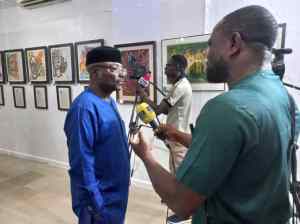
Dr. Kunle Adeyemi and Mr. Moses Ohiomokhare at the National Museum, Onikan for the landmark exhibition titled “Six Decades of Vision: Bruce Onobrakpeya’s Prints and The Global Print Family in the Collection of Prof. Ebun Clark.”
Adeyemi argued that artists should understand their practice as both cultural and entrepreneurial. They should not wait passively for recognition but actively shape their careers through discipline, visibility and strategic thinking.
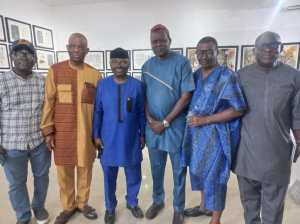
Dr. Kunle Adeyemi, Mr. Moses Ohiomokhare, Ekpo Udo – Udoma and stakeholders at the National Museum, Onikan for the landmark exhibition titled “Six Decades of Vision: Bruce Onobrakpeya’s Prints and The Global Print Family in the Collection of Prof. Ebun Clark.”
For collectors, this way of thinking changes the equation entirely that the artist is no longer viewed as an isolated producer of beautiful objects. The artist becomes the architect of an enduring practice whose exhibitions, publications and ideas collectively shape the value of every artwork produced.
It becomes imperative to also know that the artwork is no longer purchased in isolation but acquired as one chapter within a much larger story. This is precisely why exhibitions have become increasingly important in contemporary Nigerian art.
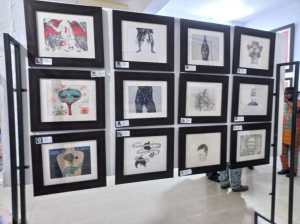
An exhibition does more than present finished artworks. It offers a glimpse into how an artist thinks, creates, and sees the world.
The sequence of works, the curatorial decisions, the exhibition title, accompanying essays and conversations with audiences all contribute to understanding artistic intention. Collectors who pay attention to these details are not simply purchasing paintings or sculptures. They are collecting evidence of an artist’s intellectual journey.
That intellectual curiosity is becoming increasingly visible across Nigeria’s cultural institutions.
Museums, galleries and independent art spaces are investing greater attention in interpretation, education and documentation. Exhibition catalogues have become more than souvenirs. Artist talks have become extensions of the creative process. Journalists and critics are expected to move beyond descriptive reporting towards deeper engagement with artistic ideas.
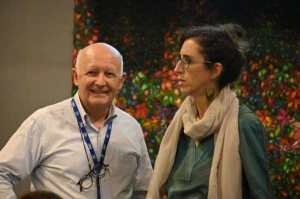
Dr. Jess Castelotte and Eva Barta at Shyllon Museum of Art in Lagos
This was one of the central messages shared during the media workshop on the 10th and 11th of June 2026, organised at the Yemisi Shyllon Museum of Art, where Dr. Jess Castellote challenged participants to rethink the role of art journalism. As reported by iBAND Magazine, his reflections encouraged journalists to look beyond surface impressions and develop the knowledge necessary to interpret artworks within broader historical and cultural contexts.
His message reaches beyond journalism to the heart of collecting. An informed collector sees more than colour or technical skill, recognising symbolism, years of experimentation, and an artist’s dialogue with history. Knowledge deepens appreciation, appreciation shapes collecting, and collecting ultimately becomes an act of cultural stewardship. This is the truth reflected most clearly in artists whose practices defy easy categorisation.
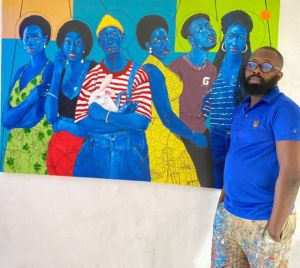
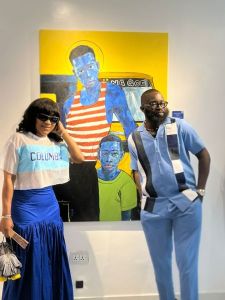
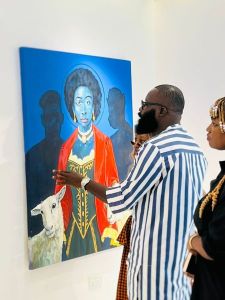
When painter Nurudeen Popoola unveiled We Are All Blue and later The Quiet Between Us, the colour blue ceased to function merely as a visual element. Through iBAND Magazine, Popoola described blue as an emotional presence rather than an absence, inviting audiences to consider silence, reflection and shared humanity through an evolving visual language.
Collectors encountering these paintings are not simply buying blue canvases, rather, they are entering an ongoing philosophical conversation.
Nurudeen Popoola. Photo courtesy Nurudeen Popoola
Every subsequent exhibition deepens that conversation, adding layers of meaning to earlier works and reinforcing the coherence of Popoola’s artistic journey.
This is precisely the kind of continuity that increasingly attracts serious collectors who are searching for isolated masterpieces from artists whose ideas continue to mature.
Such maturity also explains why documentation has become indispensable to contemporary art practice. A well-documented exhibition extends far beyond its opening night. Photographs preserve installation moments, essays deepen interpretation, interviews capture the artist’s intentions, and critical reviews record public engagement. Together, these materials become an enduring archive that continues to shape how an exhibition is remembered.
Over time, that archive becomes part of an artwork’s provenance, enriching both scholarship and collecting. The collector who acquires an artwork also acquires its documented history. Increasingly, that history contributes to the work’s value as much as the object itself, adding layers of meaning that cannot be seen on the surface.
Perhaps this is the most significant lesson emerging from Nigeria’s contemporary art landscape. The market is undoubtedly growing, but more importantly, understanding is growing. Collectors are beginning to appreciate that the future belongs not only to artists who create compelling works, but also to those who sustain meaningful conversations throughout their careers.
“Moon and Offending Christian,” a lino print by Bruce Onobrakpeya. This artwork started the journey renowned collector Prof. Ebun Clark’s collection with Bruce Onobrakpeya in 1965.
As this shift continues, the question asked at exhibition openings may also change. Instead of simply asking, “How much does this cost?”, collectors may increasingly ask, “What journey does this artwork represent?” That may prove to be the most important question of all.
The future of Nigerian collecting will not be defined solely by what hangs on the wall. It will be shaped by the ideas, stories and conversations that continue to live long after the exhibition has ended.
iBAND Magazine, Celebrating Visual Arts from the Original. Africa | Visual Art | Lifestyle | Culture

 Owning a work by an artist whose practice continues to evolve is no longer merely a financial investment. It is an investment in an unfolding narrative. That narrative matters.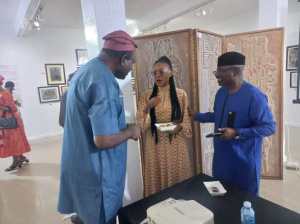
 Perhaps this is the most significant lesson emerging from Nigeria’s contemporary art landscape. The market is undoubtedly growing, but more importantly, understanding is growing. Collectors are beginning to appreciate that the future belongs not only to artists who create compelling works, but also to those who sustain meaningful conversations throughout their careers.