
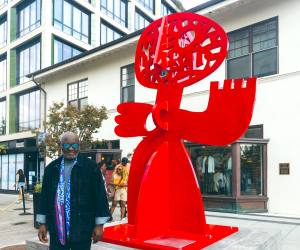
 From the streets of Washington, D.C., to the intimacy of the gallery, Victor Ekpuk’s Dancer continues its remarkable journey. In Dancer, Still Moving, the celebrated Nigerian-American artist revisits his landmark public sculpture, drawing from reflections shared on his widely acclaimed Facebook page to reveal the symbolic language, creative process, and artistic philosophy behind one of his most compelling contemporary works now in exhibition. The exhibition offers visitors a rare opportunity to encounter the ideas, stories, and cultural meanings that continue to animate Dancer beyond its monumental public presence.
Words Ireho Aito | Don’t Keep Your Art in the Finger! Photographs courtesy Victor Ekpuk
When Victor Ekpuk unveiled Dancer on a street corner in Washington, D.C., in the autumn of 2025, he did more than install a sculpture. He introduced a new conversation into the city, that conversation about movement, memory, identity and the enduring rhythm of African visual language. Nearly a year later, that dialogue enters a more intimate space with Dancer, Still Moving, opening on August 26, 2026, at the Goethe-Institut Washington.
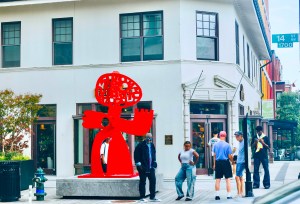
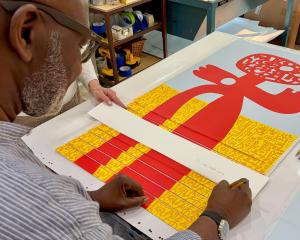
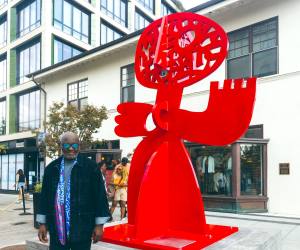
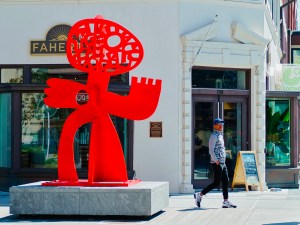 For audiences familiar with Ekpuk’s practice, the exhibition feels like a return to one of the defining ideas of his career. The ten-foot bright red steel figure that has become a landmark at the intersection of 14th and R Streets is reimagined through a newly released limited-edition serigraph, accompanied by sculptures and works on paper that reveal how a public monument grows from a single line and an ancient philosophy.
Speaking recently with iBAND Magazine, Ekpuk reflected on the foundation of that philosophy.
“Nsibidi wasn’t something I ‘discovered’ from the outside; it was already in my childhood memory, and art school gave me the tools and motivation to turn that inherited visual language into a personal artistic practice.”
That inherited language runs through every work in Dancer, Still Moving. Long before the sculpture stood proudly on a Washington street corner, its essence existed in Ekpuk’s drawings, symbols and flowing lines inspired by Nsibidi, the ancient graphic communication system of southeastern Nigeria.
The exhibition also reveals the remarkable transformation that has become one of the artist’s signatures of turning drawing into sculpture while allowing sculpture to remain a drawing in space.
 As Ekpuk explained to iBAND Magazine in his Cover feature,
By ‘molding lines to forms’, I am describing the process of creating my sculpture. My drawing mark becomes physical structure… I leave the line on the form.”
It is this philosophy that gives Dancer its unusual presence. Although constructed in steel, the sculpture still appears to move like a line across paper. It carries the freedom of drawing into architecture, inviting passers-by to experience movement even in stillness.
Yet the exhibition goes beyond sculpture. By presenting prints and smaller works alongside the monumental figure, Ekpuk encourages visitors to slow down and enter the symbolic world that lies beneath the surface.
“I believe that my work resides between the threshold of figuration and abstraction,” he told iBAND Magazine. “Meaning is felt before it is decoded.”
Those words may well become the key to understanding Dancer, Still Moving. Rather than offering fixed interpretations, the exhibition invites each visitor to discover personal meanings through rhythm, gesture and symbol.
For Ekpuk, public art has always been about creating connections beyond museum walls.
“My art serves as a bridge connecting the African continent with its diaspora… My hope is for the work to connect contemporary audiences with the aesthetic traditions of Africa.”
That bridge is precisely what Dancer has become in Washington. Standing at a busy street corner, it has quietly entered the visual memory of the city. Inside the Goethe-Institut, however, visitors encounter the same figure differently not simply as an urban landmark, but as the product of decades of artistic research, cultural memory and philosophical reflection.
Perhaps the exhibition’s greatest achievement is that it proves movement is not confined to the body. Ideas, symbols and culture, all move together. And as Victor Ekpuk has demonstrated throughout his remarkable career, African visual traditions continue to move confidently across continents without ever losing sight of their origins.
Dancer, Still Moving runs from August 26 to September 29, 2026, at the Goethe-Institut Washington, offering another compelling chapter in the evolving story of one of Nigeria’s most influential contemporary artists.
iBAND Magazine, Celebrating Visual Arts from the Original.
Africa | Visual Art | Lifestyle | Culture

