
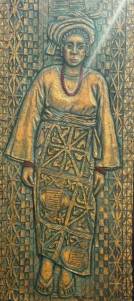
This first day of September, our “Don’t Keep Your Art in the Finger!” series features one of Professor Yusuf Grillo’s protégés, Dr. Kunle Adeyemi, now a printmaking grandmaster in his own right. A grandmaster honours a grandmaster, turning memory, material and Yoruba identity into a contemporary tribute to Professor Yusuf Adebayo Cameron Grillo with Yoruba Woman (Ode to Yusuf Grillo).
Words Ireho Aito | Don’t Keep Your Art in the Finger! Artwork credit Dr. Kunle Adeyemi
As Lagos prepares to welcome Lineage of Masters II: Remembering Yusuf Grillo, the Master Behind the Masters, Adeyemi, himself a grandmaster of Nigerian visual art, is bringing a particularly personal voice to the conversation. His work does not attempt to reproduce Yusuf Grillo. Instead, it enters the master’s world through memory, identity, material and the enduring presence of the Yoruba Woman.
Measuring an imposing 6 feet 6 inches by 3 feet, Yoruba Woman (Ode to Yusuf Grillo) is a 2026 Paintocast relief finished in gold plating. It is at once a portrait, a cultural statement and an artistic salute. The choice of the Yoruba woman is significant. In Grillo’s visual language, the human figure was never merely a body occupying space. It could carry elegance, dignity, culture and an unmistakable sense of place. Adeyemi takes that conversation forward, giving the figure another physical presence through relief.
This is where the tribute becomes more interesting.
Adeyemi is not a young artist looking backwards at a distant master. He is himself part of the generation that experienced the Nigerian modernist tradition and helped carry its lessons into contemporary practice. His tribute therefore feels less like an outsider’s interpretation and more like one master speaking to another through the language of art.
That sense of lineage is at the heart of the forthcoming exhibition.
Lineage of Masters II, scheduled for October 24 to December 16, 2026, at the Yusuf Grillo Museum, 74 Ogunlowo Street, Ikeja, Lagos, brings together artists from different generations to examine what happens when the influence of a great artist continues long after his physical departure. The exhibition carries the theme “Continuity and Contemporary Expression”, placing Grillo’s generation of Nigerian modernists in conversation with succeeding and contemporary generations.
And Adeyemi’s Yoruba Woman seems almost perfectly positioned within that conversation.
The work carries Yoruba woman’s influence and it is a contemporary work, made in 2026, but it looks backwards with respect. The gold-plated surface adds another dimension to the idea of honour. Gold traditionally carries associations of value, permanence and prestige, and here it gives the female figure an almost commemorative presence. She is not simply a subject. She becomes an emblem.
Adeyemi has spent decades proving that his own artistic journey is built on constant exploration. A versatile practitioner working across painting, printmaking and sculpture, he has also built a reputation as an educator and mentor and a student of Grillo.
His former academic career at Yaba College of Technology and his continuing commitment to young artists have made him one of those practitioners whose influence exists both inside and outside the studio.
That background makes his tribute to Grillo particularly meaningful.
Grillo was not only a celebrated painter. He was a teacher, administrator, mentor and one of the important figures of Nigerian modernism. His influence travelled through generations, helping shape artists and the wider development of Nigerian visual culture. As Adeyemi himself explained during the media briefing for Lineage of Masters II, the power of the modernists “can never be undermined.”
It is this continuing influence that Adeyemi appears to acknowledge through Yoruba Woman.
The work also reminds us that artistic inheritance is not always about receiving an object. Sometimes it is about receiving a way of looking.
Grillo looked at the Nigerian environment and developed a visual vocabulary that became recognisable far beyond the country. Today, the strongest tribute to a master is not simply to remember what he made, but to allow what he taught to continue evolving. In Adeyemi’s hands, Grillo’s legacy is not being preserved behind the glass it is being given another life, another surface and another voice.
And when Yoruba Woman (Ode to Yusuf Grillo) takes its place at the Yusuf Grillo Museum this October, it will do more than honour a departed master.
The work will remind us that the true measure of a master is not only the work he leaves behind, but the artists who continue to make the lineage move.
iBAND Magazine, Celebrating Visual Art from the Original.
Africa | Visual Art | Lifestyle | Culture
 iBAND Magazine