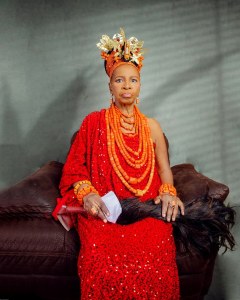
Princess Elizabeth Udinoghameyan Olowu (née Akenzua), 1939–2026
Princess Elizabeth Olowu was a lioness who gave birth to a cub that would grow into a lioness herself. But Elizabeth Olowu’s place in Nigerian art history will be difficult to fill. She broke a barrier no Nigerian woman had broken before her, becoming the country’s first female bronze caster. What an Amazon!
Her life story belongs on the screen. It has all the elements of a great film tradition, courage, the palace, bronze, rebellion, motherhood and two generations of remarkable women connected by art and heritage.
Words Ireho Aito | Don’t Keep Your Art in the Finger! Photographs courtesy Peju Layiwola Facebook archives, Google therepublic.com, X.com
For Professor Peju Layiwola, her daughter, Princess Elizabeth, her mother, was more than the woman who gave her life. She was a colleague, mentor, partner and friend. Her mother was a woman whose own journey through art and culture became part of the inheritance Peju would carry forward.
And this is the most fitting way to remember Elizabeth Olowu not simply through the sadness of her departure, but through the formidable life she lived and the artistic lineage she helped set in motion.
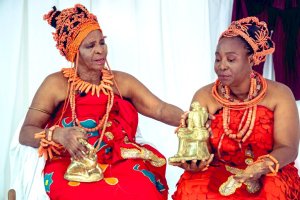
For her famous daughter, the loss is deeply personal, but it is also the loss of an artistic inheritance, a family history and a cultural presence that had shaped generations.
“No words were made for a loss like this!” Peju wrote in her tribute to her mother. Then she described the woman she had lost in words that say more about Elizabeth than any formal biography could, “You were not only my mother, you were my professional colleague, my partner, my mentor and my friend.”
It is a daughter speaking, but it is also one artist acknowledging another. And perhaps that is where the story of Elizabeth Olowu should begin, not simply as the mother of an accomplished daughter, but as an artist whose own life became part of the artistic vocabulary of the generation that followed her.
Born in 1939 into the Benin Royal Family, Princess Elizabeth was a daughter of Oba Akenzua II, the Oba of Benin who reigned from 1933 to 1978. But royal birth did not define the life she chose. Art did. Elizabeth Olowu became one of the pioneering women in Nigerian sculpture and bronze casting, entering a field deeply associated with men and with the centuries-old traditions of Benin.
The old restriction was blunt as they say – “Okhuo-ise-eronmwon” which translate to a woman does not cast bronze. Elizabeth challenged that prohibition not with a declaration, but with her hands. She learnt, practised, cast and became an artist in her own right. In doing so, she became a pioneer whose significance extended beyond the sculptures she produced. Her presence in bronze casting challenged assumptions about gender, tradition and who had the right to participate in the making of cultural heritage.
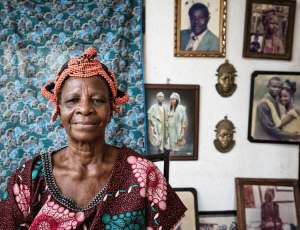
For Peju Layiwola, the story was never simply one of watching her mother succeed. She grew up inside it. The daughter followed her mother into art, eventually studying Metal Design at the University of Benin and developing her own career as an artist, curator, educator and art historian. The connection between them was therefore not symbolic. It was lived.
Elizabeth’s influence entered Peju’s understanding of materials, Benin history, women artists and cultural inheritance. The mother became part of the intellectual foundation upon which the daughter built her own career. Peju would later investigate the position of women in Benin bronze casting in her scholarship, including her 1997 essay, “Gender Tempered Through Metal: Women in Bronze Casting in Benin, Nigeria.” The title itself carries an echo of the woman who had already demonstrated that gender did not have to determine artistic possibility.
One of the most beautiful public expressions of their relationship came in 2003, when mother and daughter exhibited together at the Goethe-Institut in Lagos in Of Bronzes and Prints: A Mother/Daughter Perspective. Elizabeth’s bronze sculptures and Peju’s prints occupied the same exhibition space, creating a conversation across generations between mother and daughter, bronze and print, experience and inheritance.
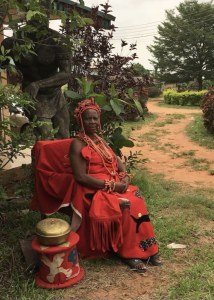
The exhibition was accompanied by the publication Of Bronzes and Prints: A Mother/Daughter, published in Lagos in 2003. That detail matters. Peju was not merely exhibiting beside her mother, rather, she was helping to create a lasting record of her mother’s artistic life.
This may ultimately be one of the most important parts of Peju Layiwola’s relationship with Elizabeth Olowu. She became a witness and photographed her mother, wrote about her, exhibited with her, also created platforms where Elizabeth could speak about her own career. She helped place her mother’s story within broader conversations about Nigerian art, women and cultural heritage.
In 2019, during Peju’s Indigo Reimagined, Elizabeth participated in a public conversation about her daughter’s artistic journey and her own experience of entering bronze casting. Again, the daughter did not simply speak about her mother. She gave the mother a platform to speak for herself.
It would be easy to remember Princess Elizabeth Olowu primarily because she was born into the Benin Royal Family. But that would be to remember her for the circumstance of her birth rather than the force of her life. She was an artist, an educator, a sculptor and a pioneer. She was a woman who expanded the possibilities available to other women.
Her art explored womanhood, motherhood, family and cultural identity, while her own life became a demonstration of what happens when tradition is questioned without being abandoned. Elizabeth did not have to reject Benin tradition to become modern. She entered one of its deepest artistic traditions and expanded the space within it.
There was also something particularly Nigerian about Elizabeth’s life. She belonged to the Benin Royal Family, yet married Babatunde Olowu, a Yoruba man. Her life crossed cultural boundaries that are often discussed abstractly but are lived intimately through marriage, family, art and identity. Her daughter inherited that layered history.
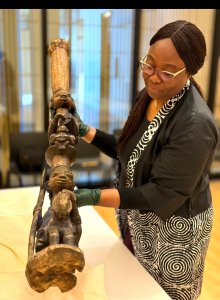
In Peju’s own practice, Benin is never merely a place. Benin is history, memory, inheritance, loss, creativity and responsibility. Her work on Benin1897.com: Art and the Restitution Question and her wider engagement with Benin’s cultural heritage belong to this continuing conversation. The daughter kept returning to questions of where culture comes from, who owns it, who remembers it and who gets written into its history. Perhaps some of those questions began at home.
There is another side to Elizabeth Olowu that survives beyond titles and milestones. Peju has recalled growing up around her mother’s creative activities and watching her work with different materials. From coconut shells and bones to discarded bags, calabashes and other materials, Elizabeth demonstrated that art could be found in the ordinary. The lesson was bigger than technique. It was a way of seeing.
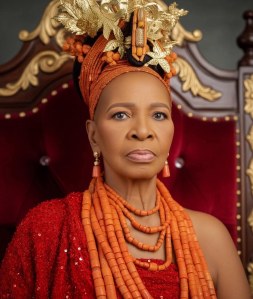
That way of seeing travelled with Peju. The mother passed on more than a profession. She passed on a responsibility that is the responsibility to look closely, to create, to teach and to preserve.
And now the daughter stands at the other end of that inheritance.
“As your children, we are endlessly proud of your legacy,” Peju wrote. “We carry your name and your enduring legacy in the arts you so loved; in the minds you shaped through education; and in the family you built and held, always, at the center of it all.”
It is an extraordinary description because it refuses to separate the artist from the mother. Elizabeth’s legacy is in the bronze, the classroom and the artists she influenced. It is in her children. It is in the cultural history she helped change. Her legacy is in the daughter who has spent much of her own life making sure that history remains visible.
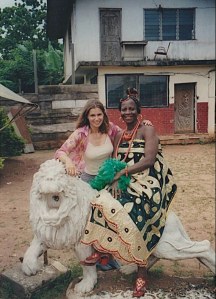
The “Big Bronze Player” is more than a playful description. It is an affectionate acknowledgment of the scale of Elizabeth Olowu’s contribution to Africa’s story. She entered a bronze tradition that seemed to have no room for her and made room. The princess came from a royal household but chose the demanding life of an artist. She became a mother and raised another artist. Princess Elizabeth Olowu became an educator and shaped minds. She became a bridge between inherited tradition and contemporary expression.
And, most importantly, she became a precedent.
Before many conversations about women breaking barriers in Nigerian art became fashionable, Elizabeth Olowu had already broken one. She had entered the bronze world and made her presence impossible to ignore.
That is why Peju’s final words are perhaps the most fitting place to leave this tribute: “We are proud beyond words. We always will be. Rest now. Your light stays with us.”
iBAND Magazine, Celebrating Visual Art from the Original.
Africa | Visual Art | Lifestyle | Culture

