
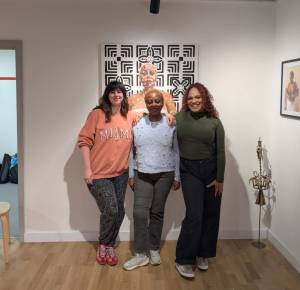
From Brazil to Lagos, independent curator Lison Sabrina Musset reflects on Yoruba heritage, ancestral connections and the power of art as she joins Angie Aniwura in presenting IYABEJI to Nigerian audiences.
Interview by Ireho Aito | Don’t Keep Your Art in the Finger! Photographs courtesy lisonmusset@gmail.com
Lison, let’s begin with you. Can you tell us a little about yourself, your background and how you found your way into the art world? What first attracted you to curating exhibitions?
Lison: I am an independent curator based in London, where I also run an artist collective. I’ve had a passion for the arts since childhood, but I officially entered the art world in 2019, both as an artist and through my growing interest in curating.
My curatorial journey really began in 2021, when I noticed a lack of representation in the area where I was living. I felt there was a need to create space for Black artists and their stories, so I decided to curate what became the first Black art exhibition in that area. It was an incredible experience, and it really set things in motion for me.
Since then, I’ve had the opportunity to curate exhibitions and develop programmes with institutions such as the National Maritime Museum, alongside other organisations across London. My work has ranged from contemporary art exhibitions in institutional settings to grassroots, community-led projects.
What I particularly love, however, is working with emerging artists, especially those whose work hasn’t yet received the recognition it deserves. There’s something incredibly rewarding about helping an artist bring their vision to life.
For me, curating is about connecting the dots between artists, communities, institutions and ideas. It’s about building relationships, opening doors and, above all, being there for the artists. That’s what continues to inspire me.
Every curator has a story about how the journey began. How would you describe your curatorial journey so far? What kind of art, artists and cultural ideas interest you most, and how have these interests shaped the exhibitions you have worked on?
Lison: My curatorial journey has been quite unconventional because I don’t come from a traditional art background. My background is actually in business, and I think that has shaped the way I approach curating.
Rather than studying curation academically, I’ve learned by doing: working directly with artists, building relationships, creating exhibitions and developing my own understanding of what curatorial practice can be.
I am interested in exploring new frameworks and methodologies that challenge conventional ideas of what a curator should be. For me, curating isn’t simply about selecting artworks and placing them in a space. It’s about collaboration, exchange and creating the conditions for artists and their narratives to be seen and heard.
I have worked with artists from many different backgrounds, but I’m particularly drawn to Afro-diasporic artists, untold stories and Indigenous cultural knowledge. I’m interested in bringing narratives that have often been overlooked into the foreground, while connecting contemporary artistic practices with ancestral traditions.
I am originally from Brazil, so there is also a deeply personal dimension to this interest. Brazil and Nigeria share profound historical and cultural connections, particularly through Yoruba traditions that continue to be practised in Brazil today. In my own village, there are still people who speak Yoruba, so this culture has always felt familiar to me.
In many ways, IYABEJI represents a point of departure in my curatorial practice. It’s an opportunity to explore these connections more deeply, understand the roots of traditions that travelled across the Atlantic, and honour the cultures and knowledge systems from which they originate.
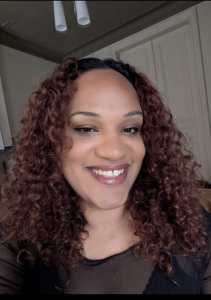
You are co-curating IYABEJI with Angie Aniwura, founder of Aniwura Collective. How did you and Angie meet, and what brought you together to work on this exhibition? Was there something about her story or artistic vision that particularly interested you?
Lison: I met Angie in 2025 when I was producing a group exhibition in London featuring Afro-Brazilian artists. Angie was one of the participating artists, and although it was a wonderful opportunity to get to know everyone involved, I remember feeling that her practice needed more room to breathe.
There was something deeper in her work, something almost asking to come out, but perhaps hadn’t yet been given the space to fully express itself artistically.
About two months after the exhibition, Angie called me and asked whether I would curate her first solo exhibition. Of course, I said yes!
That led to our presentation of Iya Beji at Waterloo Station in London in April 2026. As we spent more time together, I began to understand the depth of her personal story, the challenges she had experienced and how her relationship with Yoruba spirituality had played such a significant role in her healing journey.
Something particularly meaningful for me has been working with Angie as an elder. In the contemporary art world, there’s often so much emphasis on discovering the next young emerging artist. But working with an elder has brought an entirely different dimension to my curatorial practice.
There is storytelling, lived experience, wisdom, protection and life lessons that go far beyond the artworks themselves.
With a subject like IYABEJI, which explores motherhood, spiritual kinship and care, I could genuinely feel that maternal presence in Angie through our conversations. There were moments when she wasn’t simply speaking to me as an artist, but also as an elder sharing something much deeper.
What I find extraordinary about Angie’s work is its honesty. It is collaborative, brave, vulnerable and deeply emotional. She isn’t afraid to bring her personal experiences into her artistic practice, and I think that takes tremendous courage.
I feel incredibly privileged to be presenting her work again, this time in Lagos. For me, this exhibition is also about legacy. There is something within Angie’s story, and within the collective relationships that have shaped it, that deserves to be shared with a wider public.
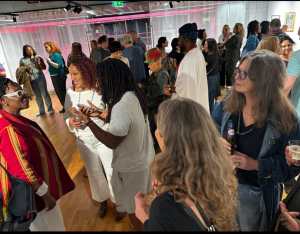
IYABEJI explores Yoruba cosmology, spirituality, ancestral knowledge, healing and the importance of community. As a curator, what drew you to these themes, and what makes this exhibition personally important to you?
Lison: Yoruba cosmology feels very familiar to me because of my Brazilian background. There’s something about ancestral knowledge that is difficult to explain. Sometimes you find yourself drawn towards certain practices, beliefs or ways of understanding the world without necessarily knowing why. It’s almost instinctive, as though something ancestral is guiding you.
I also think many Afro-diasporic artists working in Europe would like to engage more deeply with ancestral cosmologies, Indigenous knowledge systems and spirituality, but don’t always have access to the knowledge or spaces that would allow them to do so.
What makes Angie’s practice so important to me is that Yoruba spirituality isn’t simply a theme she explores through her art. It’s her way of life. These are traditions she actively practises and lives by every day, and that gives her work a depth and authenticity that I find incredibly moving.
Working with Angie has taught me a great deal about faith, spirituality and what it means to live in alignment with your beliefs. I’ve also learned from her commitment to being authentically herself, without feeling the need to conform to what institutions or the contemporary art world might expect from an African artist.
For me, IYABEJI creates space for these ways of knowing and being to exist on their own terms. It isn’t an attempt to illustrate spirituality from a distance. It’s an invitation to encounter it through someone’s life, artistic practice and relationships with others.
This is the first time Aniwura Collective is presenting an exhibition in Nigeria, and Lagos is the chosen city. Why is it important to bring IYABEJI to Nigeria? Why Lagos in particular, and what does presenting this exhibition here mean to you?
Lison: First of all, this was Angie’s dream. And the fact that something she envisioned has now manifested into reality is a blessing in itself. We have to give thanks for that. Àṣẹ!
For Angie, bringing IYABEJI to Nigeria represents something much deeper than presenting an exhibition. It’s part of her healing journey. Having recently completed her treatment in London, returning to where she comes from and sharing her story with her own people feels like a moment of surrender, gratitude and giving back.
There is something incredibly powerful about bringing a story shaped by Yoruba spirituality, ancestral knowledge and community back to the place where so much of that knowledge originates. It feels like a full-circle moment.
For me, Lagos is also a significant point of departure in my curatorial practice. This is my first international exhibition, and I feel genuinely honoured that it’s happening in Nigeria.
As someone originally from Brazil, I feel a profound connection to the historical and cultural relationships between our two countries. Coming to Lagos feels, in some ways, like reconnecting with a place where part of my own ancestral history began.
This exhibition carries different meanings for both of us, but I think we’re connected by a shared sense of gratitude, belonging and responsibility towards the stories we’re bringing into the space.
It’s a beautiful journey, and I am incredibly excited to share it with audiences in Lagos.
You are working with ideas rooted in Yoruba culture and spiritual traditions. As a curator, how do you approach cultural knowledge that may be different from your own background? How do you ensure that the exhibition respects these traditions while making them accessible to people from different cultures?
Lison: I think one of the most important responsibilities of a curator is to think about the audience, but equally, to support the artists in communicating their vision.
For me, curating is about creating a space where the work can be experienced and understood by people from different backgrounds, without losing the depth or authenticity of the stories being told.
With IYABEJI, collaboration has been fundamental. Angie and I are co-curating the exhibition, and I constantly lean on her knowledge and experience. I ask questions, I listen, and in many ways, I follow her lead, particularly when it comes to the spiritual and cultural dimensions of the work.
I have also spent time speaking with other Yoruba practitioners throughout the research and development of the exhibition. Those conversations have been incredibly valuable in helping me approach the subject with care and respect.
I don’t believe that making an exhibition accessible means simplifying the culture or removing its complexity. It’s about finding ways to communicate that allow people to connect with the work while remaining faithful to the knowledge and traditions that inform it.
We want to create an exhibition that feels relatable, authentic and welcoming: a safe space where people can encounter these stories, ask questions and perhaps recognise something of their own experiences.
On a personal level, IYABEJI is also a spiritual ode to Yoruba people, who are my people too, through the ancestral connections I carry from Brazil. So, for me, it’s not just about presenting a culture. It’s about honouring its origins and learning from those who practise it.
IYABEJI brings together painting, photography, moving image, installation, performance and spoken word. How have you approached the task of bringing these different art forms together? What conversations or decisions have been most important in shaping the exhibition?
Lison: When you’re telling a story as complex, personal and emotionally layered as Angie’s, six paintings alone could never fully capture its depth.
When Angie suggested bringing in emerging photographers who had documented her spiritual initiations, her journeys to Osogbo and other significant moments in her life, it was a no-brainer for me. Collaboration is at the centre of everything she does, so it felt natural that the exhibition should reflect that.
The paintings she developed with Lucy SM Johnston represent one part of her healing journey, particularly the process of creating together here in the UK. But photography, moving image and the other artistic contributions allow audiences to experience different dimensions of that same story.
I also find it incredibly meaningful that Angie, in returning to Nigeria, has created opportunities for emerging artists to showcase their own practices and skills. There is a generosity in that decision, and a willingness to trust other artists with such a personal narrative.
The spoken-word recitation by Peju Alatise at the opening is equally important. It offers a way of activating the space and bringing another dimension to the paintings, photography, film and installations. I want audiences to feel something through the experience.
Sometimes an entire experience might be held within a single photograph. Sometimes it’s five seconds of moving image. It might be a private exchange Angie had with Araba Ifayemi Elebuibon, the way Jelili Atiku approached directing the film, or the conversations that unfolded as Angie and Lucy met every Sunday to complete their paintings.
These moments are precious because they carry the emotional truth of the exhibition.
What I admire enormously about Angie is her discipline, generosity and determination. I have rarely encountered an artist so committed to bringing a project into existence. At times, it almost feels as though creating this exhibition has been a form of survival for her.
And I think that is why I feel such a responsibility to do justice to the work. Every artistic decision, collaboration and detail needs to honour the courage, vulnerability and care that have brought us to this point.
The exhibition also touches on illness, recovery, spiritual experiences and the support people receive from their communities. How can art help people understand difficult personal experiences, and what role do you think a curator plays in telling such stories with care and sensitivity?
Lison: For me, art has always been about healing, transformation and well-being. It can be a coping mechanism, particularly when life doesn’t unfold in the way we imagined it would.
Sometimes there are experiences that are simply too difficult to communicate through ordinary language, and art becomes a way of translating pain, sorrow and grief into something that can be expressed, shared and understood.
Art doesn’t necessarily take the pain away, but it can give it meaning and create space for reflection, understanding and, potentially, healing.
As a curator, I think the responsibility is to find a balance. You don’t want to expose so much of an artist’s personal life that the work becomes overwhelming or intrusive, but you also don’t want to be so conservative that you lose the emotional truth of the story. You have to find that space where vulnerability can exist with dignity.
With IYABEJI, I also want to communicate the possibility of healing through authenticity, faith and connection to one’s spiritual reality. Angie’s journey reminds us of the importance of being true to ourselves and remaining open to the forms of support and guidance that may come into our lives.
I believe that sometimes we have to trust the process, even when we don’t fully understand where it is taking us.
In many ways, I see the curator almost as a midwife to the birth of an exhibition. You’re helping something deeply personal come into the world. You have to nurture it, protect it and make sure the artist feels safe throughout that process.
At the same time, you’re thinking about the people who will receive the work. How will they experience it? How do you create a space that is sensitive, respectful and welcoming?
So, I think a curator is also a guardian, someone who helps safeguard both the artist’s intentions and the audience’s experience.
For me, that responsibility goes far beyond arranging artworks in a room. It’s about care, trust and understanding the emotional weight of what you’re helping to bring into the world.
This is your opportunity to experience Lagos through an exhibition at the J. Randle Centre for Yoruba Culture & History. What are your impressions of Lagos so far? How do you see the city as a place for contemporary art, cultural exchange and conversations about African heritage?
Lison: This will actually be my first time in Lagos, and I honestly cannot tell you how excited I am!
I have always been aware of the extraordinary creativity and talent coming out of Nigeria. Through my work in London, I have had opportunities to connect with Nigerian artists and galleries with links to Lagos, so I have already had glimpses of the energy and ambition within its creative scene.
But I have a feeling that experiencing Lagos in person is going to be something entirely different. I genuinely expect it to blow my mind!
I believe Lagos is the future. When you look at the creativity, artistic ambition and cultural influence emerging from Nigeria, it’s difficult not to feel that something significant is happening.
What excites me most is the opportunity to experience that creative energy firsthand, to meet artists and cultural practitioners, and to engage with conversations about contemporary art and African heritage.
And on a personal level, the fact that my first international exhibition is taking place in Lagos is something I could never have imagined when I began curating.
It feels almost surreal, in the best possible way. I’m incredibly grateful, inspired and excited to see what this experience will bring.
As you look forward to the opening of IYABEJI from 14 to 21 November 2026, what are your expectations? What would you like Nigerian audiences, particularly young artists and cultural practitioners, to take away from the exhibition? And do you see this first presentation in Lagos opening the door to future projects in Nigeria?
Lison : I hope IYABEJI will remind people, particularly young artists and cultural practitioners, that anything is possible. When you have a vision, believe in it and commit yourself to making it happen, extraordinary things can emerge.
I think Angie’s story is something many people will be able to relate to, even if their personal experiences are different from hers. We all encounter challenges, moments of uncertainty and situations that force us to rethink the direction of our lives.
What I find inspiring about this exhibition is the possibility of transforming those experiences into something creative and meaningful.
I would love young people to leave feeling encouraged to explore their own stories, including the difficult parts, and to consider how those experiences might become a painting, a photograph, a film, a piece of creative writing or something entirely different.
Whatever their ambitions, my message would be: the main thing is to start. You don’t need to have everything figured out. Sometimes the most important thing is simply to begin and trust that the process will teach you something along the way.
As for the future, I would absolutely love to return to Lagos and develop more projects in Nigeria. I see enormous potential for cultural exchange, particularly in creating stronger connections between Nigeria, Brazil and Afro-diasporic communities in the UK.
There are so many shared histories, artistic practices and cultural conversations that could be explored through exhibitions, collaborations and creative programmes.
I also genuinely love working with Nigerian artists. There’s an ambition, determination and problem-solving mentality that I find incredibly inspiring. That willingness to make things happen, to find solutions and keep moving forward really resonates with me.
So, I sincerely hope IYABEJI is the beginning of a much longer relationship with Nigeria and its creative community.
For me, this exhibition represents both an achievement and a new beginning. And I’m excited to see where it takes us next.
Iyabeji Mother of Twins by Angie Aniwura opens at J. Randle Center for Yoruba Culture and History, Onikan, Lagos on the 14th of November and runs till 21st of November 2026.
iBAND Magazine, Celebrating Visual Art from the Original.
Africa | Visual Art | Lifestyle | Culture

