
Art should never be confined to the fingers alone. At Oshodi Art Gallery, it becomes a language of care, patience, and belonging for children with special needs who are too often unseen.
This story reminds us that true culture is not only what we display, but how we make room for others and allow creativity to meet humanity.
Words Ireho Aito | Don’t Keep Your Art in the Finger!

Solomon runs to the gate before anyone asks him to. There is joy in his movement, urgency in his steps, and pride in the way he swings it open. His smile is wide, unfiltered, and confident, just like someone who knows this place belongs to him as much as it belongs to anyone else. Solomon Adebiyi is sixteen. He is a child with special needs. And at Oshodi Art Gallery, he is not an exception.
He is the story.

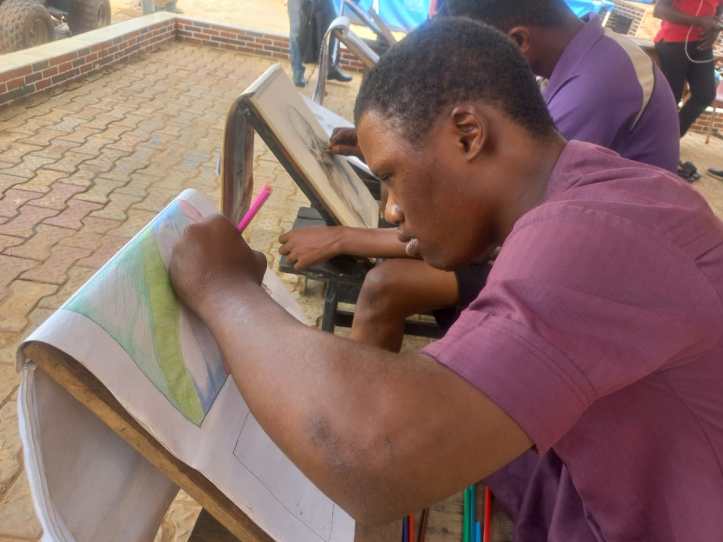
A few steps inside the gallery premises at a section designed for some of the students and mentees, thirteen-year-old Blessing looks up briefly from her work and waves. She doesn’t linger. There is something important unfolding in front of her and those are dots turning into lines, lines negotiating space, colours slowly learning how to speak. Blessing, too, is a child with special needs. And here, she has a task for the day. Blessing must work on her brief and the reason to be focus.

This is not a gallery defined by silence or fragile rules. It is alive. It hums with movement, patience, repetition, and care. At Oshodi Art Gallery, art is not about what hangs on the wall alone; neither a sculpture that stands to be collected alone; it includes what awakens inside children whose voices are often misunderstood or unheard.


A School Hidden in Plain Sight
Tucked within Oshodi Art Gallery is a special art school designed specifically for children with special needs. It does not need to announce itself loudly. There are no banners screaming intervention or pity. But its presence is unmistakable.

Parents arrive with children who have struggled in conventional classrooms, just like every other day. They are children who could not keep pace, not because they lacked ability, but because the system lacked flexibility. Here, learning is reshaped to meet them where they are.

“Art has to start from the dot,” explains Dr. Seyi Paul Oshodi, an artist, creative consultant, collector, and founder of the gallery.

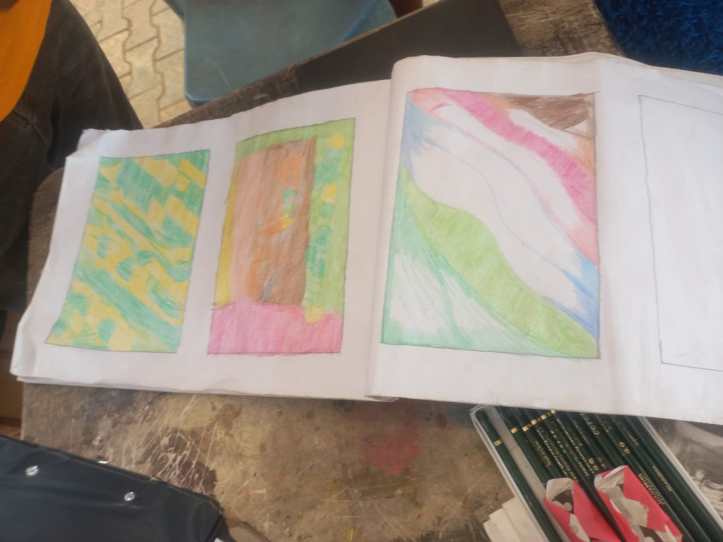
Before letters, before numbers, before expectations, the children are introduced to dots. They get to know the different kinds of dots. Subsequently, they move from dots, and move gently into lines. Straight lines, curved lines, broken lines, vertical and horizontal.
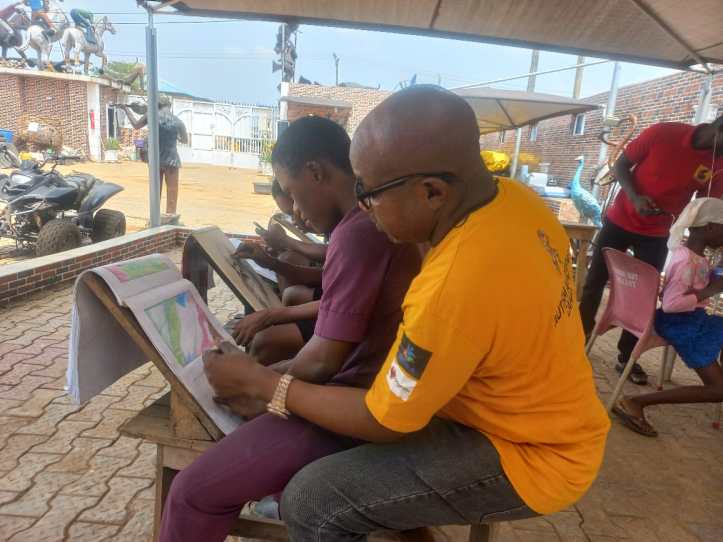
From lines, shapes begin to emerge. Circles, squares, triangles. Gradually, geometrical forms take root but not as theory, instead as discovery. The children learn how lines can come together to form shapes, and how shapes can be arranged to create objects such as squares stacked vertically, patterns repeated horizontally, forms finding rhythm.


“They are special children,” Dr. Oshodi says softly. “Many cannot read. Many cannot fully understand in the conventional sense. So we start from the basics, handling them like babies. They need attention and that attention is one-on-one.” And attention is exactly what they receive.


Art as Language, Not Just Therapy
At Oshodi Art Gallery, art is not framed as therapy in the clinical sense. It is treated as language to recognise form and organise thought. It is treated as a way to express beauty without the pressure of explanation.


When colours are introduced, something shifts. The children recognise them instinctively. They know what is beautiful and usually they respond to it.
From recognising colours, they move into drawing methodology, ability to learning very simple, and systematic ways of making marks that make sense to them. Nothing is rushed neither forced.
“They are catching up,” Dr. Oshodi says. “What they need dearly is attention.”

The children are also taught how to create colour. Including the traditional methods by extracting pigments from plants, flowers, leaves. They learn traditional methods used in earlier times, connecting them not just to art, but to history and environment. Colour becomes something alive, something made, not merely bought.
Learning by Seeing, Belonging by Being
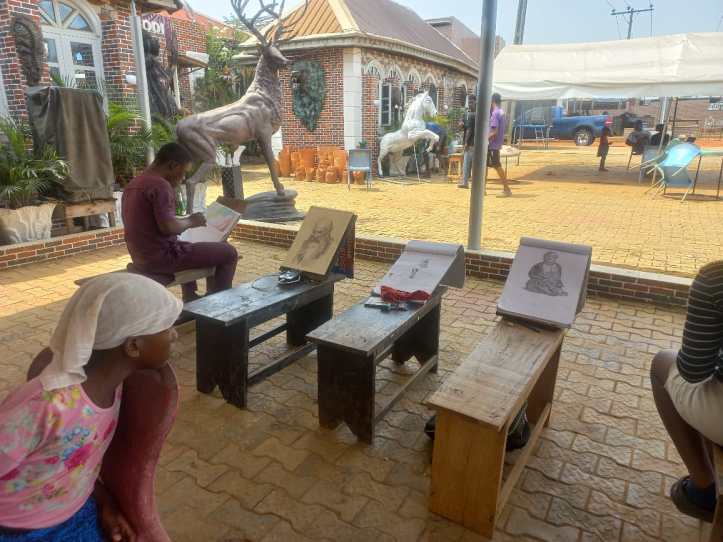
Beyond the classroom, the children are taken on guided tours of the gallery itself where they encounter sculptures, paintings, textures, forms. In the gallery, they learn to recognise objects and name them. They are made to understand that what they are learning has a place in the wider world.

This exposure for them is deliberate. It easily affirms that they are not separated from culture and they are part of it. This is the quiet radicalism of Oshodi Art Gallery.
Children with special needs are not treated as visitors to the margins of creativity. They are allowed to open gates. They exchange and wave greetings while also working on their briefs. They honestly have a sense of belonging.

One Vision Rooted in Humanity
While Oshodi Art Gallery houses thousands of African artworks, its most powerful expressions may be happening in moments that will never be framed or sold when a child concentrates for longer than before, when anxiety softens, when confidence stands a little taller.
Dr. Oshodi believes these children are integral to society.
“When they are well guided, they churn out excellent results,” he says. “At a certain age, many outgrow the condition. It becomes invisible. They can marry. They can work. They can belong fully.”
But only if they are not neglected and compassion is paired with structure, only if someone makes room for them.

Where Lifestyle Meets Meaning
In the language of lifestyle, Oshodi Art Gallery offers a different kind of luxury which is time, patience, and intentional care. It reminds us that culture is not only preserved in bronze and wood, but in how we nurture the most vulnerable among us.
As the visit ends, Solomon stands taller than when it began. Blessing looks up once more, her eyes bright with quiet certainty.
Here, art does not ask these children to fit in; it adjusts itself to fit them and in doing so, Oshodi Art Gallery quietly redefines what creativity, inclusion, and community can look like in Africa today.
iBAND Magazine, Celebrating Visual Arts from the Original.
Africa | Visual Art | Lifestyle | Culture


What a discovery . I never heard ,or to talk of knowing a place like this existed.. Welldone for a good job there👍🏾👍🏾
LikeLiked by 1 person
Thank you so much
LikeLike
There is a place like that. Thank you so much for your support always
LikeLike