
What stories do our bodies, everyday objects and living spaces tell? At Kolanut Gallery, Abuja, INHABITED FORMS brought Timi Kakandar and Gbemi Elekula together in an intriguing exploration of art, identity and design.
Words Ireho Aito | Don’t Keep Your Art in the Finger! Photographs courtesy Timi Kakandar
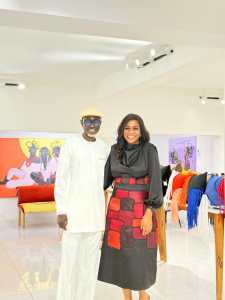
Abuja is gradually becoming one of Nigeria’s and even Africa’s most exciting destinations for visual art, creative expression and cultural exchange. The country’s administrative capital is increasingly winning the attention of artists, galleries, collectors and art enthusiasts, with exhibitions and festivals taking place across the city. From Kaynan Kephas’ Africa in Renaissance at Moeshen Art Gallery to Emmanuel Chidis Ubamadu’s Ije’Uwa: A Convocation of Inspirations, Abuja has continued to welcome artists and creative projects offering different perspectives on contemporary African art.
The 3rd International Art Fair, organised by the National Gallery of Art in collaboration with the School of Creativity, brought another dimension to the city’s growing art calendar in April. By September, the fifth edition of ArtMiabo International Art Festival had further strengthened the conversation around African art, heritage and legacy. October was equally eventful, with Theophilus Adewuyi presenting Meeting Point: Every Viewer Leaves with a Memory at Orisun Gallery, while the Abuja International Photo Festival continued to expand its international connections and opportunities for Nigerian photographers.
These are not isolated creative gatherings. They are signs of a city steadily building an identity beyond its familiar political and administrative profile. Abuja is beginning to give Lagos a serious run for its money as a destination for exhibitions, artistic showcases and cultural encounters.
Interestingly, invitations extended to artists living outside Abuja to bring their works to the capital have become increasingly noticeable. Artists from Lagos and other parts of Nigeria are finding reasons to travel to the city, engage new audiences, meet collectors and explore opportunities within an expanding creative environment. The presence of diplomatic missions, international organisations, business communities, corporate institutions and a growing population of professionals offers an interesting foundation for an art market with considerable possibilities.
Even against the country’s prevailing economic difficulties and insecurity challenges, the creative community continues to find ways to move forward. Artists and galleries are taking advantage of Abuja’s emerging opportunities, and the city is gradually establishing itself as a formidable destination for contemporary art.
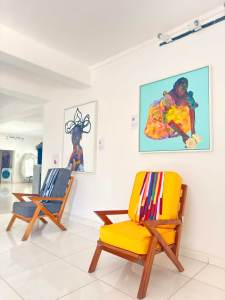
It is against this developing background that INHABITED FORMS: Objects. Figures. Rooms. arrived at Kolanut Gallery, Abuja, bringing together two creative practitioners, Timi Kakandar and Gbemi Elekula, for a two-person exhibition that ran from October 30 to November 7, 2026.
There is something particularly interesting about the title INHABITED FORMS: Objects. Figures. Rooms. It immediately draws attention to three elements of everyday existence that we often take for granted. We inhabit rooms, interact with objects and live in human bodies that carry our identities, experiences and memories. Yet, how often do we stop to consider the stories these familiar forms hold?
The exhibition brings this question into focus through the creative practices of Timi Kakandar and Gbemi Elekula. Although they approach their work from different disciplines, their ideas meet around a common interest in how physical forms acquire meaning through human experience.
It is a meeting of contemporary art and furniture design, but more importantly, it is a conversation about how we relate to the things we create, the spaces we occupy and the identities we carry.
For Timi Kakandar, the human figure is much more than a subject to be represented on canvas. It is a vessel for ideas, identity, memory and lived experiences. An accomplished master of his craft, Kakandar has developed a distinctive artistic language through which he explores the complexities of the human experience. His command of painting, drawing, collage and sculpture reflects years of artistic commitment, experimentation and engagement with the world around him.
Readers of iBAND Magazine will recall our earlier feature on the artist, particularly his Art Mentorship 101 series and his solo exhibition, Efik Elegance: Onyonyo and the Art of Adornment, at Quintessence Gallery, Lagos. Both offer valuable insights into the depth of his practice and the ideas that continue to inform his artistic journey.
The mentorship series reveals another important dimension of Kakandar’s contribution to the visual arts. Beyond creating works for galleries and collectors, he is concerned about the quality of artistic training and the foundations upon which young artists build their careers. Through Art Mentorship 101, he consistently challenges emerging creatives to understand the fundamentals of drawing, structure and composition before rushing into abstraction.

His position is straightforward: artistic freedom must be earned through knowledge and practice. He reminds young artists that even the most experimental approaches are grounded in years of learning. As he puts it, artists must learn the rules effectively before breaking them.
This philosophy is particularly revealing of Kakandar’s own artistic journey. His mastery is not simply about producing visually appealing paintings; it is about understanding the discipline, knowledge and technical decisions that make artistic expression meaningful.
His solo exhibition, Efik Elegance: Onyonyo and the Art of Adornment, offered another compelling demonstration of his artistic depth.
Through a body of paintings celebrating the Onyonyo ceremonial attire, Kakandar explored the cultural significance of Efik dress traditions, presenting adornment as an expression of identity, authority, feminine dignity and cultural memory.
The exhibition moved beyond fashion and physical appearance. The Onyonyo became a visual language through which the artist celebrated heritage, femininity and the historical importance of cultural identity. One memorable statement from the exhibition captured its central idea: “She doesn’t just wear the Onyonyo. She commands it.”
This treatment of the human figure is consistent with Kakandar’s wider artistic philosophy. His subjects are not merely people occupying a canvas. They carry histories, cultural references, emotions and experiences. Through colour, gesture, texture and composition, he gives these elements a visual presence.
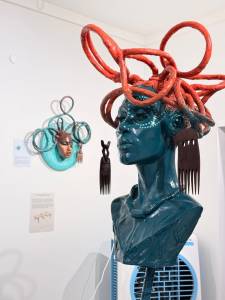
One fascinating aspect of his practice is his treatment of hair and adornment. Rather than approaching these elements as decorative features, he transforms them into expressive visual languages. Hair, for instance, can become architecture, a garden, a machine or an entire landscape of possibilities. These imaginative interpretations allow him to explore identity, transformation and belonging through familiar physical features.
His command of materials has also extended his exploration beyond the painted surface. Working with different media, including fibreglass, metal and plastic, Kakandar creates sculptural forms that challenge familiar perceptions of the human figure. His ability to move between painting, sculpture and object-making reflects an established practice sustained by curiosity, technical knowledge and a deep understanding of form.
In INHABITED FORMS, Kakandar brings this mature artistic vocabulary into another conversation. His contribution explores the idea that figures and objects carry far more than their physical presence. They hold identities, memories, histories and imagined worlds. His work invites us to look beyond what is immediately visible and discover the extraordinary possibilities contained within familiar forms.
While Kakandar explores the stories that inhabit the human figure, Gbemi Elekula approaches the exhibition through furniture and the objects that define our everyday spaces. This is where the conversation takes an interesting turn. Having considered how the human body can become a landscape of identity and cultural memory, we are invited to examine the objects that accompany us through life and the spaces we create around ourselves.
Elekula’s creative practice is rooted in an enduring curiosity about the relationship between people and the spaces they inhabit. For her, furniture is not simply about filling a room or providing functional support. It is part of the human experience, witnessing routines, relationships and the intimate moments that take place within our homes and working environments.
Her journey began in 2012, driven by a desire to transform spaces through design. Over the years, however, her practice has moved beyond the conventional arrangement of interiors into an exploration of objects as expressions of thought, identity and emotion.
Consider the familiar objects around us. A table is often regarded as a surface, while a chair is simply somewhere to sit. Yet, these objects participate in our daily lives in ways that go beyond their immediate functions. They become part of our routines, conversations, celebrations and personal histories.
Elekula’s work encourages us to reconsider these everyday relationships.
Through material, form, texture, pattern and unexpected visual references, she challenges conventional perceptions of furniture and expands the possibilities of how it can be experienced. Her interest lies in the tension between function and expression, structure and spontaneity, familiarity and reinvention.
It is this approach that makes her contribution particularly relevant to the exhibition. She is not merely interested in producing objects for a space; she is interested in creating objects that give a space character, presence and meaning.
Her approach captures an important idea about design: an object’s significance is not restricted to what it does but also includes what it communicates, the memories it evokes and the emotions it inspires.
Furniture, in this context, becomes more than an arrangement of materials. It becomes part of the stories we tell about ourselves and the environments we create.
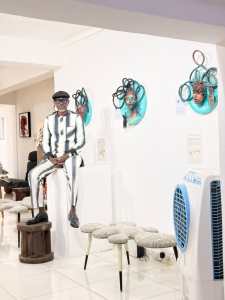
In our opinion, the most compelling aspect of INHABITED FORMS is the relationship between the two artists. Their creative disciplines may be different, but their interests are not far apart.
Kakandar looks at the human figure and asks us to consider the experiences, memories and identities that exist beneath its physical appearance. Elekula examines furniture and everyday objects, drawing attention to the emotions, relationships and histories that develop around them.
Both are looking beyond what is immediately visible.
This is where the exhibition becomes more than a presentation of contemporary artworks and furniture designs. It becomes an invitation to reconsider our relationship with the physical world.
The connection between art, architecture and design is hardly new. Throughout history, the spaces people inhabit have been shaped by artistic expression, craftsmanship and the objects they choose to surround themselves with. From traditional African domestic environments to contemporary architectural spaces, art and functional objects have always contributed to how people express identity, status, memory and belonging.
What INHABITED FORMS does is bring this longstanding relationship into a contemporary conversation.
The exhibition therefore encourages visitors to look again at familiar things. It asks us to appreciate the possibilities within objects, figures and rooms, and to recognise that the ordinary can hold extraordinary meanings.
For Abuja’s growing art community, such interdisciplinary presentations are particularly important. They create opportunities for different creative practices to meet, attract audiences beyond conventional gallery visitors and introduce collectors to new ways of appreciating contemporary African creativity.
The coming together of Kakandar and Elekula also demonstrates the value of exhibitions that do not restrict themselves to one creative discipline.
As the exhibition concluded on November 7, it left behind an interesting conversation about the relationship between the things we make and the lives we live around them.
iBAND Magazine, Celebrating Visual Art from the Original.
Africa | Visual Art | Lifestyle | Culture

