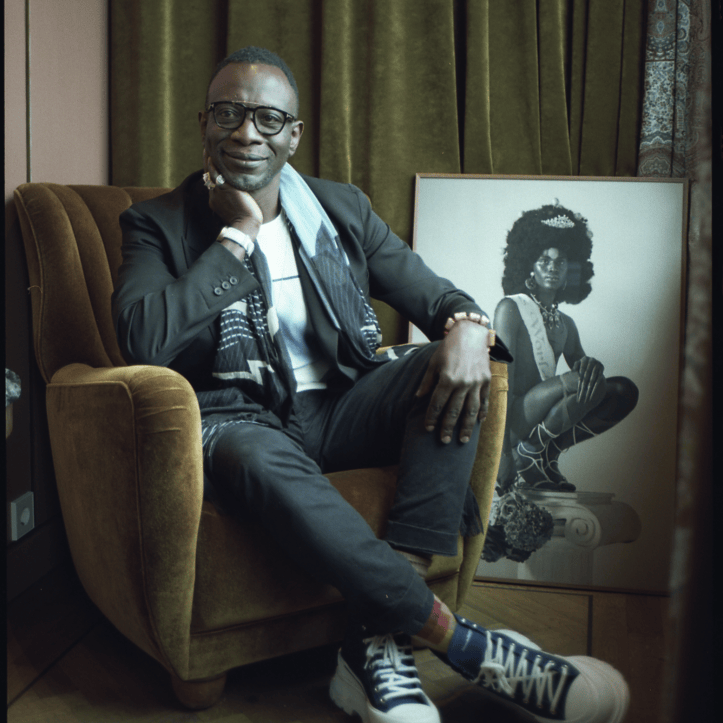
What began as Azu Nwagbogu’s bold experiment in 2010 has become one of Africa’s most powerful visual movements. LagosPhoto is no longer just a festival but a conversation about power, truth, and the politics of looking, now running as a biennial.
Words Ireho Aito | Don’t Keep Your Art in the Finger!
The month of October always feels like rebellion on the streets, in the galleries, and in the collective pulse of the city. This year, as Nigeria marks five years since EndSARS, the spirit of defiance finds new expression across art and memory. From Afrobeat Rebellion to the LagosPhoto Biennial 2025, October resists silence.
At LagosPhoto, the rebellion takes a visual form in images that confront systems, question narratives, and insist on freedom in all its dimensions. Beyond the festival, the conversation echoes through the health sector, where freedom is measured not just in rights but in well-being. October commemorates World Polio Day, World Arthritis Day, Breast Cancer Awareness, and World Stroke Day all converging this month, one question lingers across every wall, every frame, every heartbeat: Are we truly free? Are we not being incarcerated?
In the end, “Incarceration” feels less like a theme and more like a mirror. It reflects the quiet confinements we carry in our cities, our histories, our bodies, our minds.
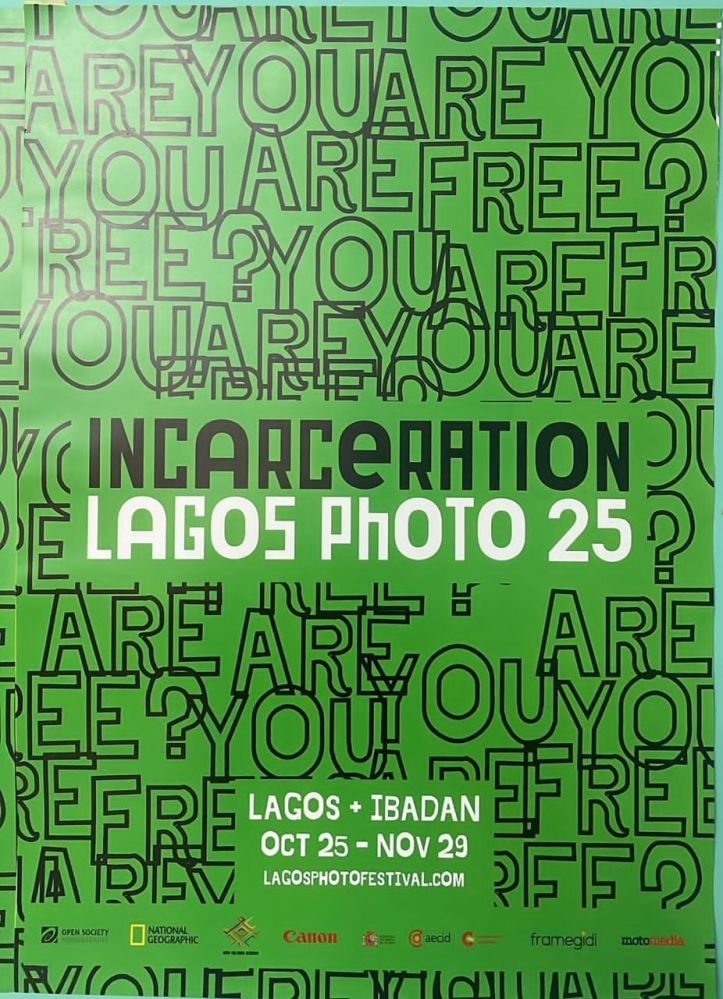
The question comes softly, like a whisper in the Lagos breeze: Are you free? It appears on a green poster stretched across the city bold, repetitive, insistent and for a moment, you might think it’s speaking directly to you. This year, LagosPhoto asks that question with a certain urgency, transforming its 15th edition into something more meditative, more searching. The theme is Incarceration, but not only in the way we have come to understand it.
This is not just about prisons or punishment; it’s about the invisible architecture of confinement that surrounds us all. The walls built by fear, the borders drawn by class, the cages constructed by thought and power. LagosPhoto 2025 wants to explore these boundaries and the quiet rebellions that emerge when art chooses to see beyond them.
The festival itself has taken on a new rhythm. After fifteen years of annual editions, it now returns as a biennial, stretching from October 25 to November 29, across Lagos and Ibadan. The pause between editions seems intentional as a way to breathe, to look longer, to think deeper. It is a necessary slowing down, a way to let the city and the artists speak to each other.
This year’s Biennial gathers artists who see freedom not as a destination, but as an ongoing negotiation between body, space, and society. Their works blur the borders between art and activism, between the seen and the silenced. Each image becomes a question, a fragment of collective memory challenging how we look and what we choose to look away from. In a world saturated with spectacle, LagosPhoto 2025 dares us to see differently to confront beauty as protest, and photography as the language of survival.
Everywhere you turn, the theme finds form. At Freedom Park, the irony is heavy and poetic. Freedom Park, once a colonial prison, now a site of liberation through art. At the African Artists’ Foundation, conversations flicker like light through a lens, each image questioning what freedom really means. And in Ibadan, the legendary New Culture Studio built by Demas Nwoko opens its gates to another kind of dialogue, where architecture and photography meet as old friends trying to understand time.
The artists themselves come from everywhere and nowhere all at once. There is Ayobami Ogungbe, weaving memory and migration through fabric and film; Yagazie Emezi, whose fearless lens has long challenged how the world sees the African woman; Geremew Tigabu, tracing scars of displacement across unfamiliar terrains; Shirin Neshat, with her poetic meditations on exile and silence. Their works are not just images, they are arguments, prayers, sometimes wounds. Each one reminds us that the act of seeing can be both a form of resistance and of healing.
To walk through LagosPhoto this year is to move through layers of meaning. The city itself becomes an exhibition. Check the streets, walls, parks, rooftops. You begin to notice how easily freedom and confinement coexist here. The open chaos of Lagos traffic, the quiet discipline of Ibadan’s old architecture, the laughter breaking through the noise. Somewhere between these contradictions, LagosPhoto thrives.
Fifteen years ago, Azu Nwagbogu founded LagosPhoto as a space for Africa to define its own gaze. Over time, it became more than a festival, it became a conversation about power, truth, and the politics of looking. With this biennial shift, the conversation deepens. It’s not just about showing photographs; it’s about asking what those photographs do to us and how they expand or limit our sense of freedom.
In the end, “Incarceration” feels less like a theme and more like a mirror. It reflects the quiet confinements we carry in our cities, our histories, our bodies, our minds. LagosPhoto 2025 doesn’t offer easy answers. Instead, it leaves you with that same haunting question, looping like a refrain long after you have left the gallery: Are you free?

