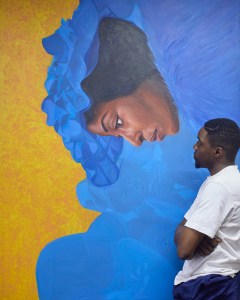
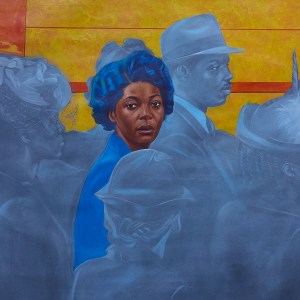
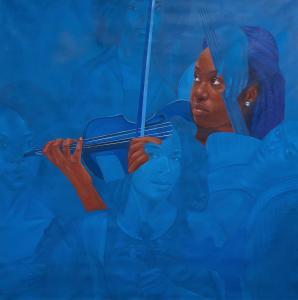
Theophilus Adewuyi’s Meeting Point portfolio is a series of 12 paintings creating genuine memories and connecting with people. It is a pathway we all walk every day, whether we recognise it or not. We meet people in different places, under different circumstances and at different moments in our lives. Some encounters last for years; others last only for a few minutes. Yet, somehow, each meeting leaves something behind.
Instantly, as one encounters this body of work, the mind travels to Portfolio of Art and Literature by Bruce Onobrakpeya that masterclass treasure filled with a remarkable body of illustrations from one of Nigeria’s grandmasters.
Words Ireho Aito | Don’t Keep Your Art in the Finger! Artwork and photographs courtesy Theophilus Adewuyi
Theophilus Adewuyi new series, Meeting Point, a body of 12 paintings, grows from this fascination with encounters of the people we meet as we move through different places, the impressions they leave behind and the possibility that paths separated by time and distance may cross again. But for anyone who has followed Adewuyi’s work, the idea is hardly new. It has been quietly present in his practice for years, appearing in his fascination with familiar faces, women and their hairstyles, couples, families, music, movement, cultural identity and the emotional lives of ordinary people.
“I didn’t want to stay stuck in one place,” Adewuyi says. “I wanted to explore how people from different backgrounds live and express themselves.”
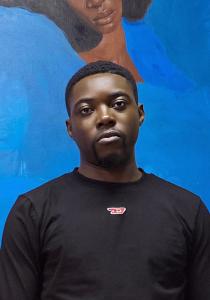
That desire to keep moving has a lot to do with his own story. Born in 1998 and raised in Ada, Osun State, Adewuyi grew up around images before he began making them. His father was a photographer, and the young Theophilus became fascinated by the family’s collection of black-and-white photographs. Those old photographs introduced him to something that would later become central to his painting that is the ability of an image to preserve a person, a place or a moment long after the original experience has disappeared.
Perhaps painting became his way of continuing that family conversation with memory. Only, unlike a photograph, a painting allows him to change what memory looks like. He can stretch it, surround it with colour, add symbols, distort the environment and invite the viewer into that story.
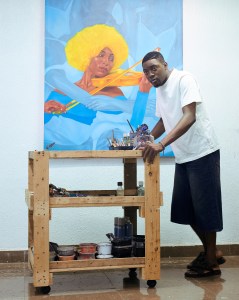
That is one reason his faces have always mattered. And in Familiar Faces, recognition becomes the subject itself. A face can return from the past and suddenly make the distance between then and now feel very small. Elsewhere, his fascination with women and their hairstyles has given his figures another layer of identity. Hair is not merely something on the head in Adewuyi’s world. It can become a crown, a statement of beauty, self-expression and cultural identity. He looks at the arrangement, volume and texture of hair with the same attention another painter might give landscape.
Then there are his couples, his families and the solitary figures that appear to be carrying private thoughts. There is Through the Lens of Calm, where the intimacy between two people creates a quiet emotional space. There is What We Get in Return, where the human figure meets nature and personal reflection. There is Light Around, where the human experience takes on a more contemplative and spiritual dimension. There is Rhythm and Blues, where music, women and the human figure come together. Different works, different moods, but beneath them is the same curiosity which is what does it mean to be human in relation to another human being?
That question has become even more visible in Adewuyi’s recent work.
His commissioned portrait of the Baloni family, for example, was not approached simply as a matter of reproducing four faces accurately on a large canvas. The 60-by-60-inch oil painting became an opportunity to explore what he calls “the spirit of togetherness.” The family had been referred to him by a collector, but what mattered to the artist was the trust they placed in his creativity.
“What attracted me first was the belief they have in my creativity,” he explained.
That trust gave him room to bring his own visual language into the portrait.
“The composition and the inclusion of motifs at the back are part of my style,” he said. And because the painting was about more than individual likenesses, he put himself fully into it.
“I felt so happy while working on it. I put in all my energy.”
It is easy to see how that same spirit finds its way into Meeting Point. The family portrait looks at people already connected by blood and affection. Meeting Point looks at the unpredictable ways people become connected in the first place.
Adewuyi’s own journey has been a succession of such connections. Ada gave him his earliest visual memories. Then, while at school to acquire knowledge, Obafemi Awolowo University gave him the environment in which his practice expanded beyond the pencil-based work of his early years. Moving between Ile-Ife, Ibadan and Lagos exposed him to different people and environments. Exhibitions introduced him to new audiences and social media took his paintings beyond the physical walls of his studio. Even it is on record that for him, Instagram became a meeting point.
“Technology has really helped me a lot,” he says. “With just a post on Instagram or other platforms, your work can reach people around the world.”
One of his international opportunities came through precisely that kind of digital encounter.
“An international exhibition I participated in, an international art festival in Turkey, actually came through Instagram. The organisers saw my work online.”
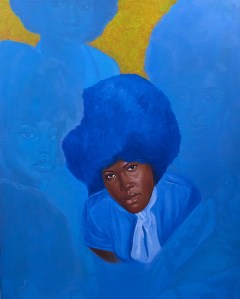
That movement in Adewuyi’s practice was also visible earlier this year when he participated in SOTO Art Fair, bringing his work into another space of encounters between artists, collectors, curators and audiences. The fair became another point in his continuing journey, placing his paintings before people who may have encountered his work for the first time, while reinforcing his growing presence within Nigeria’s contemporary art landscape. From that public meeting of art and audience, Meeting Point feels like a natural next step as Adewuyi turns his attention from simply presenting paintings to reflecting on the very encounters, people and memories that give such works their meaning.
There is something almost perfect about that story when placed beside Meeting Point and for Adewuyi, movement is not simply geographical. It is emotional and cultural too. His paintings move between African traditions and contemporary life, between personal memory and public experience, between the familiar and the foreign. His use of colour is part of that movement. He is attracted to strong, expressive colours, associated with African visual traditions, but he refuses to treat African heritage as something that must remain untouched.
“Being from Africa doesn’t mean we must stick only to tradition,” he says. “We can evolve and experiment.”
That philosophy is visible in the way he paints. African references can exist beside contemporary fashion. Traditional ideas can meet modern compositions. A Yoruba concept can become part of an abstract flowing background. Music from different generations can fill his studio while he works.
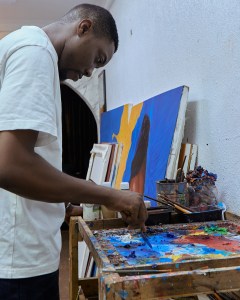
And yes, there is often music. Tupac, Wizkid, Rema and Naeto C have all appeared in the soundtrack of his studio life as he shares the making of his paintings online. It is another interesting contradiction in an artist whose work is so contemplative as the studio can be full of rhythm while the artist himself is thinking quietly.
“I love listening to music, reading, and being in a silent place just meditating,” he says.
Perhaps the music and the silence are not opposites after all. Both give him room to think. Both create an atmosphere in which memory can surface.
That idea of movement becomes particularly important in Meeting Point through his use of water. Across the series, Adewuyi combines acrylic and oil, allowing different textures and surfaces to interact. In the first work, the orange area is created with acrylic while oil contributes to the other elements. Behind the figures, the surface appears to flow like water.
Such connection is deliberate. “The Yoruba expression “Omi l’eyan” the idea of human beings as water offers a key to understanding the series. Water moves. It leaves one place and enters another. It meets other streams and sometimes changes direction. It can be calm one moment and restless the next. So can people,” Adewuyi confidently explained.
Theophilus Adewuyi explained further from his studio, “we leave home, enter schools, move to new cities and meet strangers who may become friends, lovers, mentors or people who challenge and change the way we think. Some remain in our lives, while others disappear almost as quickly as they arrive. But disappearance does not always mean absence. Sometimes a person remains as a memory, a feeling, a lesson or a moment that quietly stays with us. It is this residue that interests me. I am not painting the meeting alone; I am painting what the meeting leaves behind.”
This is also why he does not want the viewer to approach his paintings simply as finished objects to be admired and moved away from. He wants the viewer to stop.
“When you are seeing the artwork, I want you to meditate and be seeing yourself in the work,” he says. “That the story is written for you personally.”
It may be the most important invitation in Meeting Point.
Adewuyi may have started with his own encounters, but he does not want to dictate what the viewer must remember. A face in one of the paintings may remind someone of a childhood friend. A hairstyle may bring back a mother or sister. A family may remind another viewer of home. The movement of water may become a memory of a journey from one city to another. A colour may suddenly evoke a person who has not been seen in years.
The painting changes according to the person looking at it.
That openness is one of the strengths of Adewuyi’s practice. His work is personal without becoming inaccessible. He brings his own experiences into the painting but leaves enough space for someone else to enter.
Maybe, that is why, his recurring muses matter so much. The women, the faces, the families, the couples, the familiar strangers, the people encountered in different places that they are not separate subjects competing for attention. They are fragments of the same larger story.
Adewuyi is interested in people because people carry stories.
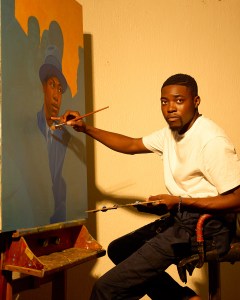
And he is interested in faces because, perhaps more than anything else, faces are where memory begins. Perhaps this is why Meeting Point feels like a natural continuation of his practice rather than a departure from it.
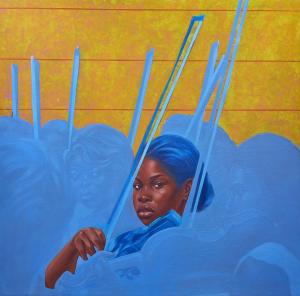
The title describes the subject, but it also describes Adewuyi’s artistic journey. His work has repeatedly become a place where different things meet such as African heritage and contemporary expression, painting and digital technology, music and silence, memory and imagination, individual identity and collective experience.
“We are all connected,” he says.
After spending time with his work, the statement begins to feel less like a slogan and more like an explanation of what he has been painting all along.
At the end, it is obvious that Theophilus Adewuyi, himself, is connected to the people he paints and he is not standing outside the story but moving through it with everyone else. That is why Meeting Point does not ask us to look at Adewuyi’s encounters from a distance, but to remember our own like the face we cannot forget, or the stranger who became a friend.
Again, the friend who became a stranger, the place we left and the place we returned to, the person we met only once or thought we would never see again, the family that reminds us where we came from and the journey that changed where we were going. These are the fragments that make up the private archive of a life, and for Adewuyi, that archive has become paint.
The most beautiful thing about Meeting Point is that once the paintings leave his studio, the memories no longer belong entirely to him. They become meeting points for everyone who stands before them.
iBAND Magazine, Celebrating Visual Art from the Original.
Africa | Visual Art | Lifestyle | Culture


Theophilus an artist who is not just painting faces, but he is actively archiving the emotional and cultural connections that define the human experience.
Keep doing what you’re doing brother. The sky is your starting point.
LikeLike