
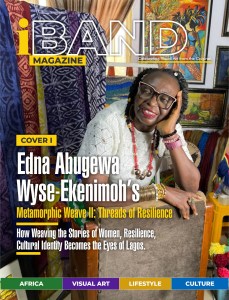
The December festivities are here again, and so is the much-awaited second edition of Edna Ekenimoh’s new offering at the National Museum, Onikan, Lagos, set within the cultural and symbolic atmosphere of one of the city’s historic destinations for visitors.
The artist, who is in a class of her own, returns with Metamorphic Weave II: Threads of Resilience on 12 December 2026.
Words Ireho Aito | Don’t Keep Your Art in the Finger! Photographs and artworks courtesy Edna Ekenimoh’s library. iBAND Magazine Cover graphics and design Adewale Oseni
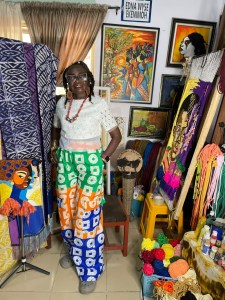
Months after the first Metamorphic Weave: The Alchemy of Fibre and Pigment ended in December 2025, with its beautiful and incredible success stories, this writer received a call sometime in late February 2026 from one of the exhibition visitors, a great and fascinating Nigerian-American, Kehinde Ayinde, popularly known as Kendoo.
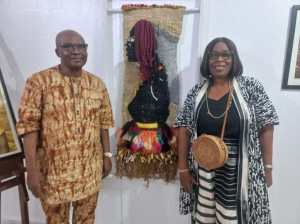
Kendoo was a former band aide and manager to Afrobeat music legend Fela Anikulapo Kuti. He had visited Nigeria for his holidays with his lovely wife, Carol Thompson, an American and renowned curator. He called to request the acquisition of some of the works he had asked to be tagged during the Metamorphic Weave: The Alchemy of Fibre and Pigment exhibition. It was a sunny Sunday in February, and we had to quickly arrange the dispatch of the works to him at his base as he was preparing to return to America after rounding off his holiday.
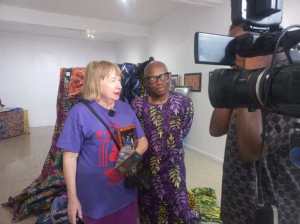
Kehinde Ayinde Kendoo and his lovely wife, Carol Thompson, had a wonderful time connecting with art and culture in Nigeria. They showed tremendous support for Nigerian creatives in several ways, demonstrating their generosity and appreciation for the arts. They were also taken on a guided tour of the National Museum, an experience that created an emotional connection for Carol Thompson.
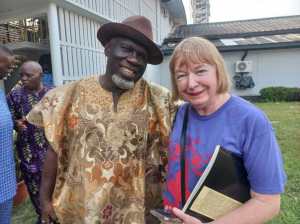
This act of investment and appreciation by the couple speaks volumes about the value of Edna Ekenimoh’s art and its appeal to the wider international art community.
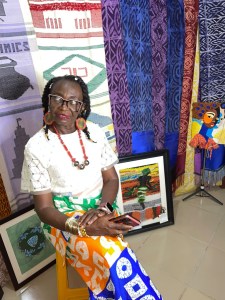
The second edition is raising the bar once again in December 2026, promising another memorable exhibition and what could be a befitting Christmas present for art lovers.
It will be on record that definitively, there are artists, due to vocation, spend years preparing for their moment, and there are those whose moment arrives after years of preparing others to discover theirs. For Edna Abugewa Wyse-Ekenimoh, the journey has been a combination of both. An accomplished art educator, textile artist and creative personality, Edna has spent a considerable part of her life nurturing young talents, experimenting with materials and exploring the possibilities of artistic expression. Today, she is enjoying a different kind of fulfilment, one that allows her to tell her own stories through the language of textiles, colours, discarded materials and carefully constructed visual narratives.
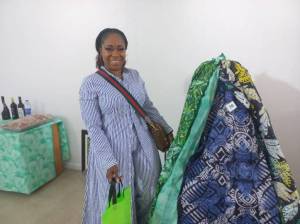
Her return to the National Museum, Onikan, Lagos, for Metamorphic Weave II: Threads of Resilience, is therefore more than another solo exhibition. It is a continuation of a creative journey that began attracting considerable attention in December 2025, when she presented Metamorphic Weave: The Alchemy of Fiber and Pigment at the same institution. This time, however, the conversation is becoming more pointed. Women, their labour, their dignity, their struggles and the future of the girl child occupy the centre of her artistic thinking.
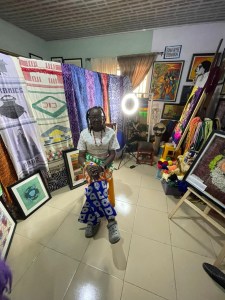
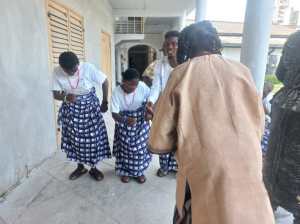
This exhibition comes alive on Saturday, December 12, 2026, and it brings Edna back to a venue that has already played an important role in her artistic development. The first outing was a remarkable experience, with collectors, art enthusiasts, international visitors, friends, family members and former students turning up to celebrate an artist who had spent 23 years teaching before giving her creative practice the full attention it deserved. In fact, the first edition was a like a festival of sort with Itsekiri tradition so conspicuously displayed through Itsekiri music and dance ensemble.
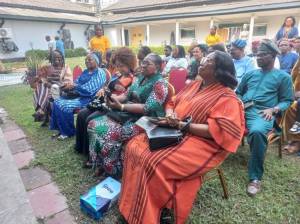
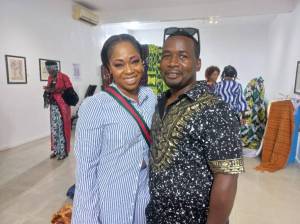
The reception was encouraging. There was considerable interest in the works, particularly the textile pieces, with some acquired even before the official opening reception. The exhibition also became a meeting point for different generations of people who had encountered Edna at various stages of her life. Her husband, Moses Ekenimoh, was among those who shared in the excitement, reflecting on more than four decades of knowing the woman whose determination had brought the exhibition to life.
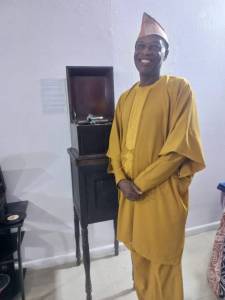
“I have known my wife for over 40 years. She is a hardworking woman. When she mentioned having her solo exhibition, I never imagined it was going to be this big,” Moses recalled.
He also spoke about her perfectionist nature, organisation and patience, pointing out that some of the works on display dated back to her years at the Polytechnic in Auchi, before her subsequent academic journey. For him, the exhibition was an affirmation of years of dedication and the beginning of another chapter.
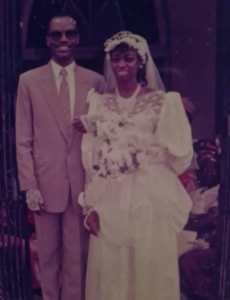
The couple celebrated their 37th year anniversary of marital bliss in October 2026
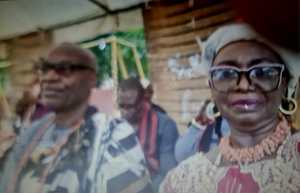
Edna herself was almost overwhelmed by the reception. She recalled waking up on the opening day with mixed feelings, describing the experience as being like a bride on her wedding day, excited but uncertain about what awaited her. The response from the audience, however, exceeded her expectations. With more than 50 works presented at the National Museum, she had finally brought together years of experimentation, personal memories and artistic development in one place.
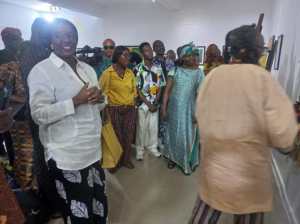
But perhaps one of the most touching experiences was the presence of her former students. Some travelled to the museum, while others sent video messages and tributes celebrating the woman who had influenced their formative years. It was a reminder that the work of a teacher does not end when the classroom door closes. Sometimes, the most enduring works are the lives that have been shaped along the way.
For Edna, the story of becoming an artist did not begin with her retirement from teaching. It was already deeply rooted in her upbringing in Warri, Delta State, where she grew up in a family that understood creativity as part of everyday living.
Her father was Itshekiri, just like her grandfather. Both men worked with John Holt and were remembered by Edna as disciplined and industrious. Her mother was Sierra Leonean, with a Creole background, and possessed an extraordinary range of practical talents.
“My mother was everything,” she recalls with affection.
Her mother was a fashion designer and seamstress who undertook sewing assignments, including work for Federal Government Colleges. She was also a baker, managed funeral services and was influential in the Warri Women’s Tennis Club. In a home where creativity was not restricted to one occupation, Edna grew up watching a woman who could turn her hands to several things.
“My mother could cook very well. She was a seamstress that also sewed for the Federal Government Colleges back then,” the graduate from Ahmadu Bello University in Zaria recounts.
The family home was equally a place where discipline, presentation and personal responsibility mattered. Edna remembers the emphasis her mother placed on cleanliness, particularly during festive seasons when even the household furniture received renewed attention. Her mother’s friends would visit to have their hair styled for different occasions and social gatherings in Warri. These experiences, although ordinary at the time, became part of Edna’s understanding of fashion, adornment, colour and the visual identity of women.
Her father was equally creative. Much of the furniture in the family home was his handiwork. It was a household where making things was almost second nature.
Art, therefore, was not an accidental destination for Edna.
Her late elder brother, Major Wyse, played a particularly important role in recognising her artistic abilities. He was a talented artist himself and encouraged her to take her creative interests seriously. Having noticed her natural flair, he advised her to pursue a formal education in art rather than allow her talent to go to waste.
That encouragement eventually led her to the School of Art and Design at the Federal Polytechnic, Auchi. She subsequently continued her academic journey at Ahmadu Bello University, Zaria, developing the foundation that would later inform her professional practice.
Edna’s educational journey also took her to Anglican Girls Grammar School, Ughelli, where she spent a year before transferring to Federal Government Girls College, Kano. Her upbringing across different environments gave her a broad cultural outlook. She speaks her native Itshekiri, Yoruba, some Hausa and Creole, reflecting the different cultural influences that have shaped her identity.
Her Itshekiri heritage, in particular, remains an important part of her artistic expression. It is a cultural connection she has continued to explore through names, traditional values, symbols and the stories embedded in everyday life.
After her education, Edna’s life took several interesting turns. She explored fashion and sewing, developed entrepreneurial interests and travelled to Cotonou, Benin Republic, for trading activities. Teaching, however, continued to find its way into her life. Even while staying with her brother, who was then serving in the military, she found herself teaching officers’ children during their holidays.
It was a natural calling.
Her eventual appointment at Lagoon School, Lagos, marked the beginning of a remarkable 23-year career in art education. Working in an all-girls school provided her with an opportunity to combine her professional knowledge with a sustained interest in the development of young women.
Edna was not simply interested in teaching students how to draw, paint or work with different materials. She wanted them to think independently, explore possibilities and appreciate the value of creativity. She led several school exhibitions, including projects that focused on the girl child and the importance of education. Distinguished personalities such as Chief Mrs Nike Okundaye and Professor Bruce Onobrakpeya were among the special guests who attended exhibitions organised during her years at the school.
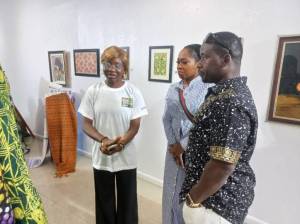
Her department became a place where students were encouraged to experiment and compete. She took them to competitions, challenged them to think outside the box and ensured that art received the attention it deserved within the school environment.
“I never left any stone unturned at my exhibitions,” she recalls.
“My experience at Lagoon School speaks for itself. In terms of space, art direction, interpretation of the works, my department was one among equals. I set the pace in my 23 years of working at that prestigious school.”
That statement is particularly significant when considered against the background of her present artistic direction. The discipline of teaching, the ability to research, the patience required to explain an idea and the understanding of how different materials work together have all found their way into her studio practice.
Retirement from the classroom did not mean retirement from education. If anything, it gave Edna more time to explore her creative possibilities.
Even during her teaching years, she remained visible within the Nigerian art ecosystem. She attended exhibitions, maintained relationships with artists and continued to participate in artistic activities. Her presence at exhibitions and art competitions, including projects organised by Fobally Art World Africa, has also helped her maintain relationships across generations of artists and emerging creatives.
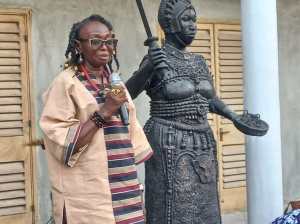
“If you don’t attend people’s exhibitions, nobody would attend yours,” she advises.
For her, the art ecosystem thrives when artists create opportunities to interact, learn and support one another.
Attending exhibitions exposes artists to different approaches, materials and creative possibilities. It is also an opportunity to understand how audiences respond to works and how the business of art continues to evolve.
Her own experience is proof of the value of that philosophy.
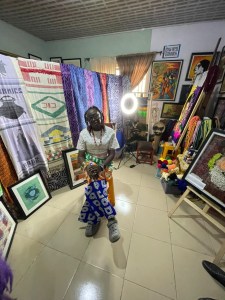
The first Metamorphic Weave exhibition brought together a wide range of artistic expressions. There were paintings, installations, tapestry weaving, fabrics, mixed-media works, wooden pieces and other experimental presentations. She even introduced personal family objects that helped viewers understand the relationship between memory, identity and artistic expression.
Among the memorable installations was the presentation of her father’s vintage gramophone, alongside other objects that carried personal and cultural significance. These were not merely decorative additions. They provided a glimpse into the world that shaped the artist and the memories she continues to carry.
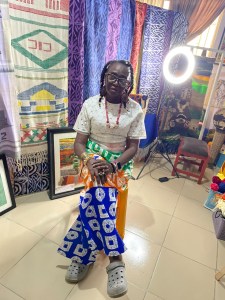
The exhibition was also a celebration of fashion, textiles and cultural identity. Her own appearance, choice of African fabrics and elaborate hairstyles became an extension of the artistic experience. For Edna, fashion is not separate from the creative process. It is another language through which identity and personal expression can be communicated.
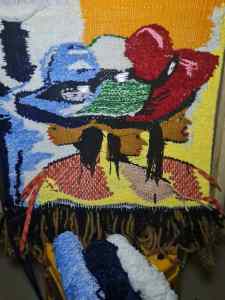
Now, returning to the National Museum, she is making a more deliberate selection of materials and artistic expressions.
Metamorphic Weave II: Threads of Resilience will concentrate more strongly on tapestry, fabrics and mixed media. Rather than repeat the variety of the first edition, Edna is building on the materials and ideas introduced previously, transforming them into works that address the experiences of women and the girl child.
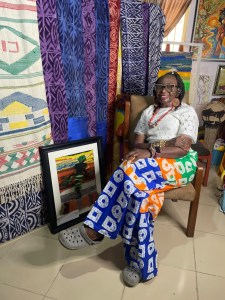
“I am kind of bringing out the dignity of labour in women,” she explains.
This statement provides a useful entry point into the new exhibition. Women are often celebrated for their contributions to the family, yet the extent of their labour, sacrifices and personal struggles is not always fully acknowledged. Beyond taking care of the home, women work, build businesses, nurture communities, contribute to national development and carry responsibilities that are sometimes invisible to the people around them.
Through Threads of Resilience, Edna wants viewers to reconsider how society understands womanhood.
One of the interesting directions in the new body of work is her use of fruits as representations of the values of womanhood. Each fruit carries a symbolic meaning, inviting viewers to consider what women bear, nurture and contribute beyond the conventional expectations of domestic life.
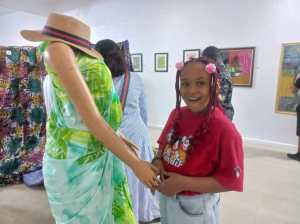
Her interpretation is particularly important because she is not interested in presenting women simply as mothers, wives or caregivers. She wants audiences to appreciate their individuality, productive capacity, aspirations and the many challenges they overcome.
The girl child also receives considerable attention. Edna believes that society must do more to protect and provide opportunities for young girls, particularly in the areas of education, healthcare, personal development and protection against early marriage.
Her concern is not new. It is a continuation of the advocacy work she pursued during her years at Lagoon School. Having worked closely with young girls and witnessed their development, she understands that the opportunities provided to a girl child can influence the future of an entire family and society.
One of the works in the forthcoming exhibition takes this conversation into the cultural identity of the Itshekiri people. The work explores heritage through the transformation of discarded materials into an expression of cultural belonging.
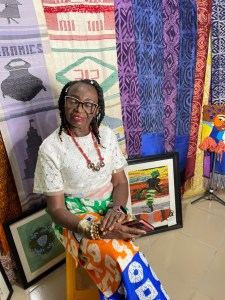
Edna has incorporated green, white and green elements to reflect the Nigerian national colours, using discarded identification tags and their straps collected from commemorative national events. Materials that would ordinarily be thrown away after an event have found another purpose in her hands.
The work is also an opportunity to communicate where the artist comes from. It is a meeting point between her Nigerian identity and her Itshekiri heritage.
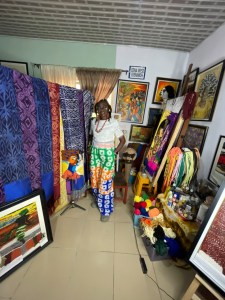
Another work, Urowoli, explores the significance of the first girl child in Itshekiri culture. Urowoli, which can be shortened to Roli, is a name given to the first girl child and means a child who brings peace.
“The girl child in Itshekiri is seen as a builder. She comes with that perpetual peace for the family,” Edna reveals.
Her interpretation extends beyond the family. The girl child, in her understanding, is also a builder of the nation, someone whose presence and contribution can multiply across generations.
The work incorporates everyday materials such as trimmings, shoelaces and trouser straps. Each material has a role in communicating togetherness and the relationships that bind people.
“What does the zipper really do on a fabric? It brings together,” she explains.
For Edna, the zipper becomes more than a functional object. It represents the connection between different parts of a story, while the trimmings provide adornment and beauty. The overall composition becomes an expression of the possibilities and beauty of the African woman and girl child.
She has also introduced synthetic fibre, particularly the type commonly used in contemporary women’s hairstyles and wigs. This addition reflects changing times, beauty trends and the movement of culture from one generation to another.
Her interest in women’s hair is equally personal. It is connected to memories of her mother and the values she was taught while growing up.
Edna remembers that attending church on Sundays was an important family tradition. Her mother insisted that the children should appear neat and appropriately dressed. Women were expected to cover their hair with a hat or scarf when attending church, while traditional attire called for the use of a gele.
“I was brought up to know that the best place you can dress to is the place where you reverence God, which is the church,” she recalls.
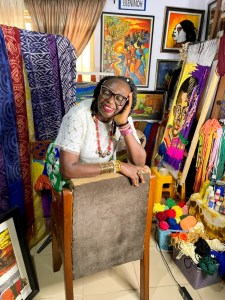
Her reflections on hair, beauty and adornment have also influenced some of the works she is preparing for the exhibition. She believes the hair of a woman has traditionally been regarded as her crown, a significant aspect of African identity and presentation.
But beneath the conversation about beauty lies another concern: what happens when the outward appearance of a woman conceals the difficulties she is experiencing?
One of her particularly thought-provoking works is constructed entirely from shoelaces. It presents the face of a beautiful woman whose expression appears different depending on how closely the viewer examines it. One side suggests fullness and confidence, while another communicates sadness and emotional pain.
At first glance, the work may appear to celebrate beauty and adornment. A closer examination, however, reveals a woman who may be struggling, seeking attention or silently asking to be understood.
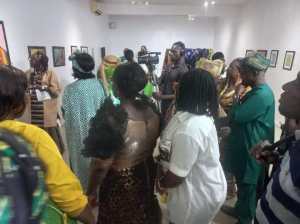
Edna draws attention to the positioning of the eyes, explaining that the woman’s appearance changes with the viewer’s perspective.
“She is actually seeking for attention if you look at her eyes from another angle,” she says.
“There is fullness of life on this side. But there is a lot of pain on this side. Yet, despite all, she is adorned.”
It is a powerful interpretation. The woman in the artwork could be somebody’s daughter, sister or wife. She could be living close to us, smiling in public while dealing with circumstances that remain unknown to those around her.
The work challenges viewers to look beyond appearances and pay attention to the emotional realities of women.
This is not entirely new territory for Edna. During the first Metamorphic Weave exhibition, she presented The Unravel Star, a work that explored the different ways people perceive women. Some may be attracted to beauty, others to intelligence, physical appearance or contributions to society. Yet, the qualities that make a woman remarkable are not necessarily the same things that attract everyone to her.
With this new series, she appears to be taking that conversation further, examining the difference between what society sees and what women actually experience.
Her creative process is equally revealing. Edna does not simply assemble materials for decorative effect. She researches, sketches, experiments and considers the relationships between colours, textures and the messages she wants to communicate.
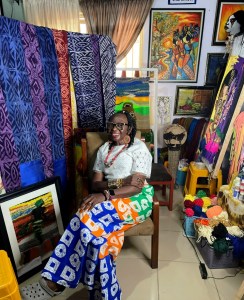
In explaining one of her mixed-media works, she describes how she stretched the canvas to accommodate her concept, drew directly on the surface and employed painting techniques to establish the landscape. Market scenes also feature in her explorations, bringing familiar everyday experiences into the artistic conversation.
Her academic background in textiles remains central to her practice.
“Every medium I am using here are put under fabrics,” she explains.
The discarded materials are particularly important because they allow her to explore transformation and sustainability. Shoelaces, synthetic fibres, trimmings, identification straps and other materials that might otherwise be discarded are given another life.
Her approach also extends into research on Yoruba textile traditions, particularly the motifs associated with Adire Eleko. She has been studying the different patterns, symbols and everyday objects that inspire traditional Yoruba textile expressions, including references to animals, reptiles, trees and elements of nature.
For an educator who spent more than two decades teaching, research remains an important part of her creative responsibility.
“Nigerian art is very rich,” she says. “I would advise that artists should start spreading their tentacles. They should evolve and not be strapped in their comfort zones.”
This is perhaps one of the strongest messages emerging from her present creative direction. Edna is not content to remain within the familiar boundaries of textile practice. She is interested in what happens when different materials, traditions and artistic ideas meet.
Her commitment to patience is another defining feature of her work.
“Patience brings out resilience. Art comes from the soul. The different art that we have drives our inner strength,” she says.
She believes the meticulous nature of textile work has influenced her temperament, particularly the endurance required to place colours carefully and achieve the desired harmony. It is a process that demands time and concentration, sometimes keeping her in the studio long after nightfall.
Her studio in Magboro, Ogun State, has become the centre of this continuing exploration. Away from the busy exhibition circuit, the quiet environment provides the space she needs to experiment, develop ideas and work through different creative possibilities.
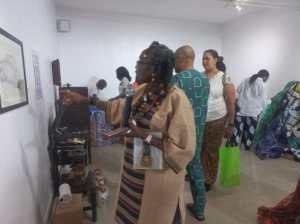
Since stepping away from her teaching career, she has become increasingly active as a full-time studio artist. Her participation in group exhibitions and other art projects during 2026 has kept her connected to the wider creative community.
Yet, her commitment to education has not disappeared. She continues to engage young people in her neighbourhood, particularly where schools lack dedicated art teachers. It is another expression of the belief that access to art and creative education should not be limited by a child’s circumstances.
Her own experience has shown her how parents sometimes discourage children from pursuing art-related courses, believing they offer limited opportunities for financial independence. However, she has watched some of her former students move into professions such as cinematography and graphics, demonstrating the possibilities that can emerge from a creative education.
For Edna, this is a source of fulfilment.
The forthcoming exhibition is expected to present more than 30 works, with a carefully developed exhibition direction spread across two sections. She promises an experience that will invite audiences to look more deeply at the works and the messages behind them.
There is also a personal dimension to this promise. She wants visitors to leave with something more than an appreciation of colour, texture and craftsmanship.
“The audience will go home with a piece of me with them after going through the exhibition,” she says.
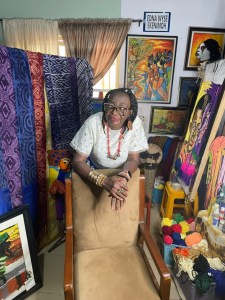
It is a statement that captures the essence of her artistic journey. The materials may be discarded, the threads may be ordinary and the fabrics may be familiar, but the stories they carry are deeply personal and socially relevant.
From her childhood in Warri to her years of formal training, from the encouragement of her late brother to the support of her husband and family, and from 23 years of teaching to her present life as a full-time artist, Edna Abugewa Wyse-Ekenimoh has continually found ways to reinvent herself.
Her first Metamorphic Weave exhibition announced her arrival as an artist ready to take ownership of her creative journey. The second edition is an opportunity to demonstrate how much further that journey can go.
This time, the threads are carrying the stories of women. Their labour, their dignity, their sacrifices, their pain, their beauty and their resilience. The girl child, too, has a place in this conversation, not merely as someone to be protected, but as a future builder whose potential must be recognised and nurtured.
And in Edna’s admission, the act of weaving is therefore more than an artistic technique. It is a way of bringing different experiences together, giving discarded materials another purpose and allowing overlooked stories to find expression.
At the National Museum, Onikan, from December 12, 2026, audiences will encounter an artist who has not stopped learning, researching or experimenting. More importantly, they will encounter a woman whose own life reflects the resilience she is now asking society to recognise in others.
Metamorphic Weave II: Threads of Resilience, brings another chapter, new conversation, and more stories waiting to be discovered.
iBAND Magazine, Celebrating Visual Art from the Original.
Africa | Visual Art | Lifestyle | Culture

