
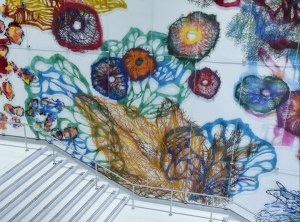
Beyond the physical unveiling of An Ætiology of Things, what followed was equally powerful. When Nnenna Okore shared the milestone with her global community on Facebook, it became more than an announcement. It became a moment of collective pride.
In this week’s edition of Don’t Keep Your Art in the Finger! our attention turns to the deeply evocative practice of Nnenna Okore, whose recent announcement on Facebook reveals yet another powerful milestone in her evolving artistic journey. Titled An Ætiology of Things, this monumental glass installation now finds its home within the contemplative environment of The Johns Hopkins Hospital, a space where art and healing intersect in profound and unexpected ways.
Words Ireho Aito | Don’t Keep Your Art in the Finger! Photo credit: Tom Holdsworth @holdsworthphoto
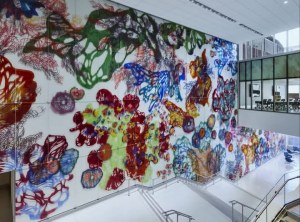
After four years of meticulous experimentation and conceptual refinement, Nigerian-born, internationally celebrated artist Nnenna Okore has unveiled a monumental 4,000-square-foot glass installation titled An Ætiology of Things at The Johns Hopkins Hospital.
This installation is situated within the lobby of the Health Sciences Building, the work does more than occupy space, it transforms it. Okore’s installation operates at the intersection of art, science, and healing, embedding organic narratives into a clinical environment often defined by precision. Nnenna celebrates on her Facebook page to her followers, “After four years of dedicated work, my new 4,000-square-foot glass installation has finally been unveiled at The Johns Hopkins Hospital in Baltimore, Maryland.”
Nnenna Okore is well known for her mastery of organic materials, be it paper, clay, and found matter, Okore extends her practice into glass, a medium that simultaneously suggests fragility and resilience. In An Ætiology of Things, the artist interrogates origins of illness, of healing, and of existence itself.
Her forms, often reminiscent of cellular structures, vascular systems, and natural erosion, evoke the unseen processes that sustain life. The translucency of glass becomes symbolic, thereby allowing light to penetrate, refract, and animate the work throughout the day. It is a living installation, constantly shifting with its environment.
This evolution of material signals a deeper inquiry on how can art mirror the body’s complexity, and how might it soothe the psychological weight carried within medical spaces?
One point to know, is that, the scale and ambition of this installation were made possible through a network of collaborators. She appreciated her collaborators with profound joy and in highly spirted manner, “this has been an incredible journey, made possible through collaboration with Nancy Rosen Incorporated, the Johns Hopkins Health System team, @mayerofmunich, and many others. Thank you all for your trust, support, and for making this opportunity possible.”
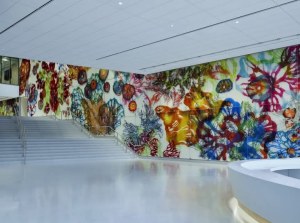
Each partner contributed to translating Okore’s, process-driven studio practice into a large-scale architectural intervention. The result is a seamless integration of artistic vision and technical precision where handcrafted sensibility meets industrial fabrication.
Having art in spaces of care is now a necessary intervention as hospitals are increasingly recognising the role of art in patient recovery and emotional well-being. Okore’s installation aligns with a growing global discourse around “healing architecture,” where aesthetics and environment become part of therapeutic care.
Rather than offering decorative distraction, An Ætiology of Things invites contemplation. It slows the viewer down and asks questions. This is a rare and necessary moment within the urgency of a hospital setting.
For visitors, patients, and medical professionals alike, the installation becomes a site of quiet reflection, bridging the emotional and the empirical.

She is the queen of amazing grace. But long before global institutions began commissioning her large-scale works, Nnenna Okore had already begun shaping a distinct artistic language that would later define her international trajectory.
Her first exhibition in Nigeria, Of Earth…Banks and Topography Installations, opened on June 20, 2009, at Goethe-Institut Lagos. The exhibition introduced local audiences to her deeply material-driven approach that draws from the physicality of earth, erosion, and transformation.
However, it was the late Bisi Silva that we all got to know as a formidable force in shaping contemporary art discourse in Nigeria that brought Okore more fully into the national consciousness. Through her leadership at Centre for Contemporary Art Lagos, Silva created platforms that amplified critical voices and emerging narratives.

In 2013, Okore featured in the landmark exhibition No One Belongs Here More Than You at CCA Lagos, alongside Ruby Amanze and Wura-Natasha Ogunji. The exhibition was more than a showcase, as it became a statement on belonging, identity, and the fluidity of place, themes that continue to echo through Okore’s work today.
Beyond the physical unveiling of An Ætiology of Things, what followed was equally powerful. When Nnenna Okore shared the milestone with her global community on Facebook, it became an announcement and a moment of collective pride.
The social media exploded in celebration after her announcement. From Lagos to America, from emerging artists to established curators, the response was immediate and deeply affirming. Messages poured in, celebrating not just the scale of the work, but the years of persistence, experimentation, and quiet dedication that made it possible. In that digital space, geography dissolved, and what remained was recognition: of excellence, of consistency, and of a journey that has been anything but accidental.
Okore’s story resonates because it is rooted in concerted effort buoyed down to a steady, intentional commitment to process over spectacle. Her rise has never been defined by haste, but by a deliberate unfolding of ideas, materials, and meaning. Each body of work builds on the last, forming a continuum that reflects both personal inquiry and universal themes.
To call Okore a trailblazer is not merely to celebrate her achievements, but to acknowledge the pathways she is carving for others. In a global art ecosystem that often demands conformity, she has remained steadfast in her language that draws from nature, erosion, regeneration, and the overlooked beauty of impermanence.
Her installation at The Johns Hopkins Hospital stands as a proof to what becomes possible when authenticity meets opportunity. It is also a reminder that representation matters and not as tokenism, but as presence grounded in excellence.
For many young African artists watching, this moment carries weight. Such moment affirms that it is possible to remain rooted in one’s material and conceptual identity while engaging meaningfully on a global stage.
‘An Ætiology of Things’ is now on view in the lobby of the Health Sciences Building:
The Johns Hopkins Hospital
1729 East Monument Street
Baltimore, Maryland.
Photo credit: Tom Holdsworth @holdsworthphoto
iBAND Magazine, Celebrating Visual Arts from the Original.
Africa | Visual Art | Lifestyle | Culture

