
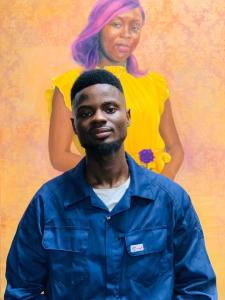
In the paintings of Afolayan Emmanuel, silence is not emptiness. It is a place where the mind speaks, memories settle and a person begins to see himself again.
Words Ireho Aito | Don’t Keep Your Art in the Finger! Photographs and images courtesy Afolayan Emmanuel
There is something unusually quiet about Afolayan Emmanuel’s paintings. One can see the paintings do not rush towards the viewer or shout for attention with loud colours or dramatic gestures. Instead, they seem to wait. One can see a face looks away and a figure pauses. As one looks more deeply, one can see a pair of eyes appears to be somewhere between the world we can see and another world that exists only inside the mind. And if one stays with the painting long enough, that quietness begins to speak.
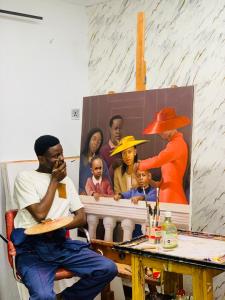
This is perhaps the most interesting thing about the 25-year-old Nigerian artist. He is painting figures, but his real subject is the space behind the figures, that is, the private territory of thought, memory, self-esteem, belonging and the difficult business of learning to be comfortable with oneself.
For Emmanuel, the mind is not a side subject. It is the centre of everything. “My art delves into the profound concept of the mind,” he says, describing the distinction between what he calls “two worlds apart” – our internal thoughts and the external reality. “Our mind forms the most integral part of our being, making it essential to guard it diligently.”
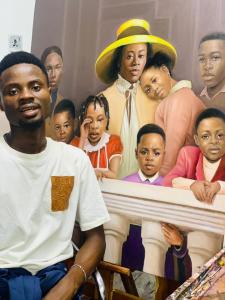
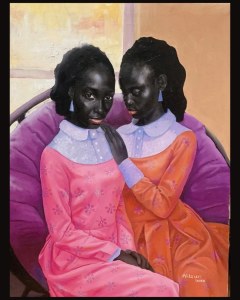
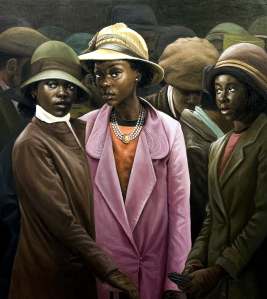
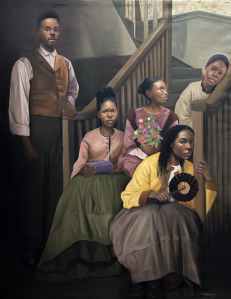
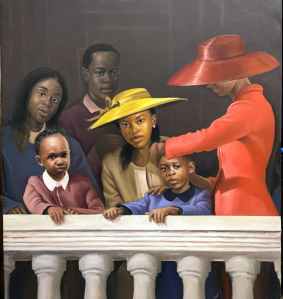
That idea gives his work its emotional temperature. His paintings often arrive in muted colours, softened greys and restrained tones. Then, almost unexpectedly, a small area of brighter colour appears. It is never accidental. The brightness becomes a little opening and this is a suggestion that even inside uncertainty, there can still be hope.
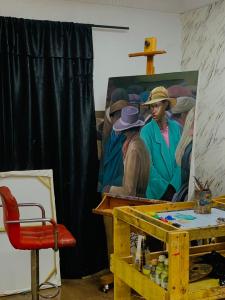
“I love my works toned down,” Emmanuel says. “I enjoyed how the grey toned down colours speaks to my soul.”
It is a statement that says as much about the artist as it does about his technique. His muted palette is not simply an aesthetic decision. It is part of how he sees the world. In a culture and an art scene where colour can sometimes be expected to announce itself loudly, Emmanuel has discovered that quietness can have its own power.
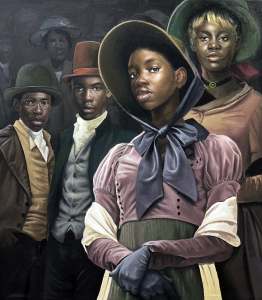
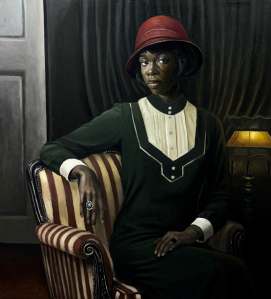
His interest in this language developed through an unexpected relationship with old photographs, vintage imagery and European clothing. He became fascinated by the atmosphere of old pictures and the way clothing can carry memories of another time. But rather than reproduce that history literally, he began putting Black faces into these visual worlds.
“My style came from my love for Old and Vintage pictures,” he explains. “Speaking about memories.”
Then came the question of what would happen when those visual references met his own African identity. “In my quest looking for a way to bring that idea to my works that’s when I found about vintage and European wears with which I found fascinating. Doing this I introduced black faces to them to talk about fusion of two different cultures.”
It is an important part of his practice. Emmanuel is not simply borrowing an old visual language. He is placing Black subjects inside it, creating a meeting point between different cultural histories while allowing memory, identity and contemporary African experience to enter the picture.
The story of this young painter, however, did not begin in a gallery. It began much earlier, when he was still a child.
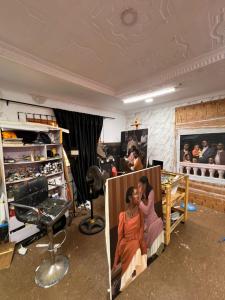
His connection with the Aké Arts & Book Festival in 2013 came through a school excursion and workshop experience. At about 12 years old, he was not yet an established artist building an exhibition résumé. He was simply a schoolboy being exposed to an environment where literature, ideas and the arts could be encountered outside the classroom. Although the details of the exhibition component have been difficult to fully document today, the experience remains part of his early developmental journey and an interesting encounter with the arts.
Sometimes the moments that shape an artist do not look important when they happen. A child attends a programme. Someone introduces him to an artwork. He sees artists working. He watches people looking seriously at paintings. Something settles quietly in the mind. Years later, the child begins to understand that those encounters were perhaps preparing him for another life.
Emmanuel’s more deliberate journey into painting developed through practice. His earliest oil paintings were exercises, attempts to understand the medium and become better at painting. Then came Contentment in 2022.
He remembers the work differently from those early exercises. It was not simply another painting.
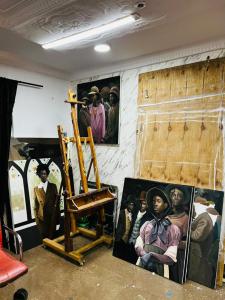
“It was the work I made and I was amazed how people engaged it,” he says. “That made me to want to paint something in that line.”
That moment became significant. A young painter had discovered not only that he could make a painting, but that a painting could make people stop, look and respond.
From there, his visual language began to take shape. His figures became vehicles for conversations about self-love, contentment, confidence and self-esteem. His paintings began to explore the space between how people see themselves and how the outside world sees them.
That balance between the personal and the universal is what makes his work particularly engaging. Emmanuel is not painting the human figure simply because the figure is beautiful. He is interested in what the figure carries.
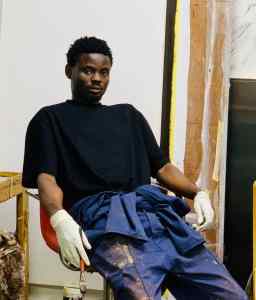
His figures become a way of exploring what happens inside the mind, with confidence, belonging, self-love, contentment and self-esteem. The face may be what we see, but for Emmanuel, the deeper story is often what cannot be seen: the thoughts and emotions shaping the person beneath it.
This is where Emmanuel’s paintings become conversations with the self.
His figures appear to be asking questions without actually asking them. Am I enough? Where do I belong? What do I believe about myself? How much of my identity is shaped by what other people say? And perhaps the most difficult question is, what happens when I finally learn to listen to my own mind?
His story begins in a family of seven. His father is a pastor and his mother is a teacher. He is the second of five children and, interestingly, the only artist in the family.
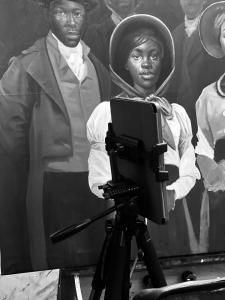
“Sometimes I wondered where this Art talent came from because I am the only artist in my family,” he says.
Perhaps the answer does not need to come from the family tree. Some talents arrive quietly, insist on being noticed and then refuse to leave.
Emmanuel’s formal artistic education eventually took him to Obafemi Awolowo University, Ile-Ife, where he studied Fine and Applied Arts, specialising in Painting. For him, choosing OAU was hardly accidental. He had encountered the institution repeatedly while reading about Nigerian art and learning about the history of what was once known as the University of Ife.
“Because of its strong reputation and contribution to the development of art in Nigeria, no other school really came to my mind when it was time to choose where to study,” he says.
OAU did more than teach him how to paint. It exposed him to people, histories, ideas and older generations of artists whose achievements made the young painter think about what might be possible.
“Seeing the works and achievements of my senior colleagues inspired me greatly and made me want to push myself further,” he says. “Their creativity, dedication, and different approaches to artistic practice showed me what was possible and encouraged me to develop my own voice.”
That last phrase “developing his own voice” is important because Emmanuel is now at the stage where technical ability alone is no longer enough. He is beginning to construct an artistic language.
His education also gave him the confidence to think about painting beyond the canvas. His practice has increasingly become a conversation about identity, society, confidence and the emotional life of ordinary people.
He graduated from OAU in 2023 as the Best Graduating Student in Fine and Applied Arts, an achievement that placed a formal marker on a journey that had begun much earlier with curiosity, practice and experimentation.
By then, his career was beginning to move from the studio into the exhibition space.
In 2023, he presented Breaking Silence, a solo virtual exhibition with Constance and Sons Gallery. The title itself now sounds almost like a description of the journey his paintings had been taking, giving visual form to thoughts and emotions that are often difficult to articulate.
He also participated in I Desire to Be Present, an online exhibition celebrating mindfulness and the beauty of the present moment. His exhibition journey has continued into 2026 with The Coalition and Plus234 ArtFair, marking another stage in his emergence within Nigeria’s contemporary art scene.
But the journey has not been confined to exhibition walls.
Emmanuel has lived and worked across different Nigerian creative environments, including Lagos, where he spent close to two years after his industrial training in 2022. His connection to Lagos became part of his professional identity during that period, even though his current base is Ibadan.
There is something fitting about Ibadan becoming home for an artist whose work requires observation and reflection.
“Being here I believe Ibadan is an amazing city for a creative to stay and evolve because the environment encourages innovations,” he says. “There is easy access to any material I want to get to explore.”
Then he adds something even more revealing: “It’s an environment that helps me as an artist to think and be more creative.”
Cities shape artists differently. Lagos can accelerate you. Ile-Ife can deepen your connection to history and academic art traditions. Ibadan, for Emmanuel, has become a place where he can slow down enough to think.
And then there is the power of technology. For a young Nigerian artist, the internet has become something much bigger than a place to post photographs of finished paintings. It is a classroom, archive, gallery, marketplace and meeting place.
“Technology has been very helpful in my artistic journey,” Emmanuel says. “It has given me access to more references, ideas, artists, and conversations that have helped me think more deeply about my work.”
His works have reached international audiences through platforms such as Artsy and Saatchi Art. His career is therefore developing in two worlds at once, the physical world of studios, galleries and collectors, and the digital world where an artist in Ibadan can place his work before audiences far beyond Nigeria.
That access is changing the possibilities available to young artists.
For Emmanuel, technology is not the destination. He sees it as another tool for research and development. “As I continue developing my art, I am especially interested in using technology to expand my research and push my concepts further.”
There is already evidence that the paintings are travelling.
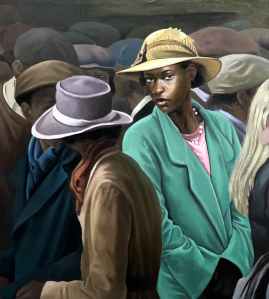
Emmanuel says his works have entered both Nigerian and international private collections. Among the collectors he identifies are Linton Vedrene, who acquired My Confidante, an Oil on Canvas from 2023, and Herb Gray, who acquired Amongst, his 2026 Oil on Canvas.
Amongst is an especially interesting marker of where Emmanuel’s practice is now. The title itself speaks of presence, connection and the individual within a larger human space with themes that have quietly occupied his work from the beginning.
At 25, Emmanuel is already moving beyond the question of how to paint well. The more interesting question for him now is what the painting should say when it is finally finished.
That may be the natural progression of an artist who began simply by practising oil painting.
Emmanuel has moved from learning how to handle oil paint to thinking more deliberately about what he wants each painting to communicate. His early works were exercises in understanding the medium, but Contentment changed something for him. The response to that painting showed him that his work could connect with people, and it encouraged him to continue exploring ideas around confidence, self-love, contentment and the mind. Today, he is paying closer attention not only to how he paints, but also to the conversations his paintings can open.
His paintings open conversations about confidence, belonging, self-love, contentment and self-esteem. At the centre of this exploration is the mind, the inner world that Emmanuel believes we must consciously nurture because our thoughts can influence the reality we create around us.
This is why his muted colours matter.
We live in an age of noise. Social media constantly tells people what they should look like, where they should be, what they should own and how successful they should appear. The pressure to perform a version of oneself for the outside world has never been greater.
Against that noise, Emmanuel paints people who seem to have stepped away from the performance for a moment.
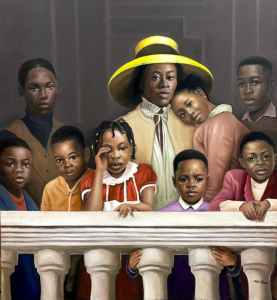
Perhaps this explains why his muted palette works so well. The paintings do not compete with the noise. They create a small room inside it. And somewhere in that room is the artist himself.
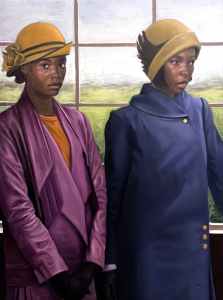
His fascination with old photographs and vintage clothing brings another layer to his work. Those images carry a sense of time and memory, and by introducing Black faces into these visual worlds, Emmanuel creates a meeting point between different cultural histories. It is his way of exploring the fusion of cultures while bringing questions of identity, memory and contemporary experience into the same frame.
For the young artist, painting has become a way of bringing these different worlds together while continuing his conversations about confidence, belonging, self-love, contentment and self-esteem. Beneath the muted colours and quiet expressions is an artist interested in the inner life of people and the importance of nurturing the mind. His paintings may appear restrained, but the ideas behind them are not.
His journey, too, has developed gradually. From the schoolboy who encountered art through an early excursion, to the young man who first practised oil painting simply to understand the medium, to the student of Fine and Applied Arts at Obafemi Awolowo University, and later the university’s Best Graduating Student in Fine and Applied Arts, each stage has added something to the artist he is becoming.
Today, Emmanuel is exhibiting, reaching collectors in Nigeria and abroad, working from Ibadan and using technology to expand his research and artistic possibilities.
He is still learning, still experimenting and still trying to understand how much more his paintings can say.
iBAND Magazine, Celebrating Visual Art from the Original.
Africa | Visual Art | Lifestyle | Culture

